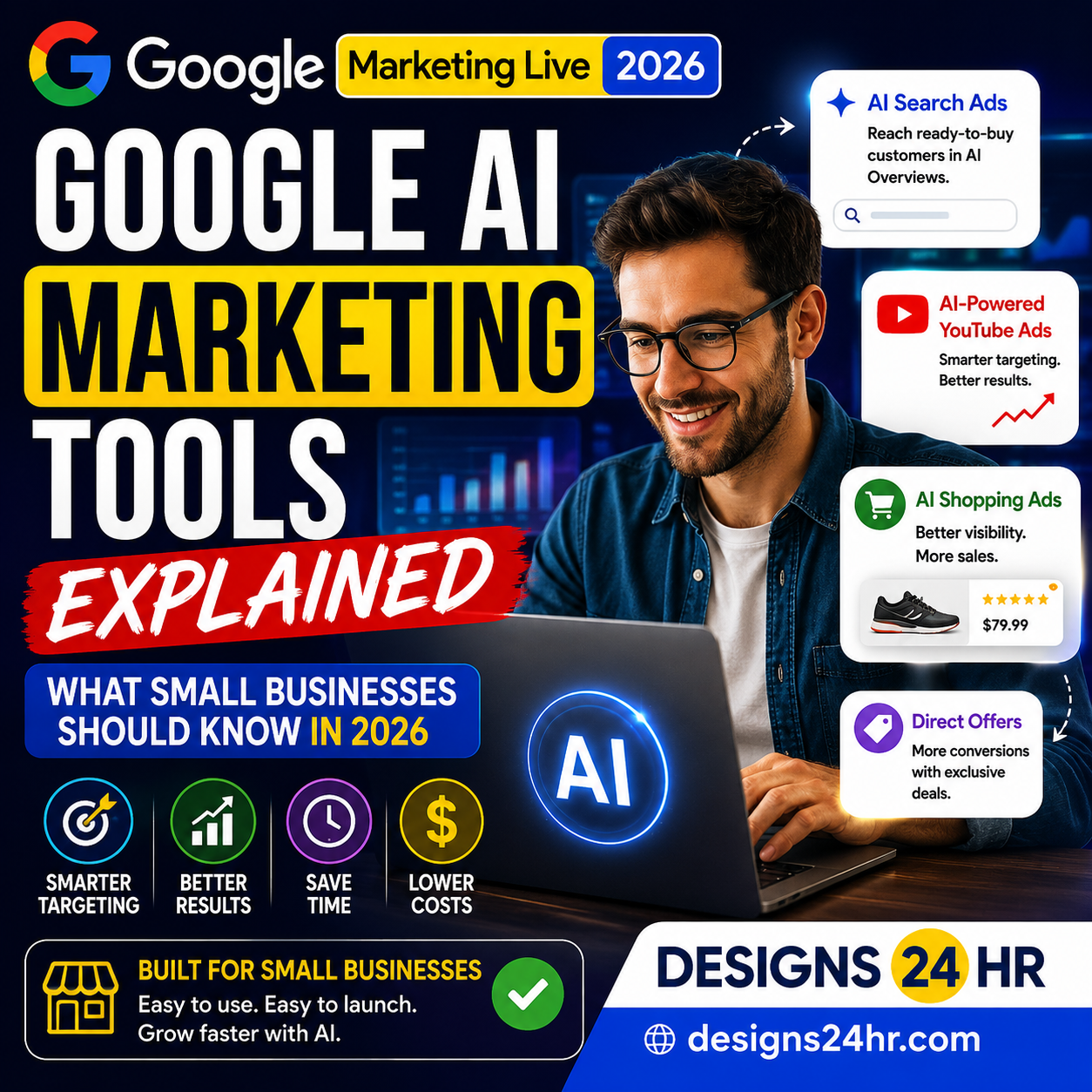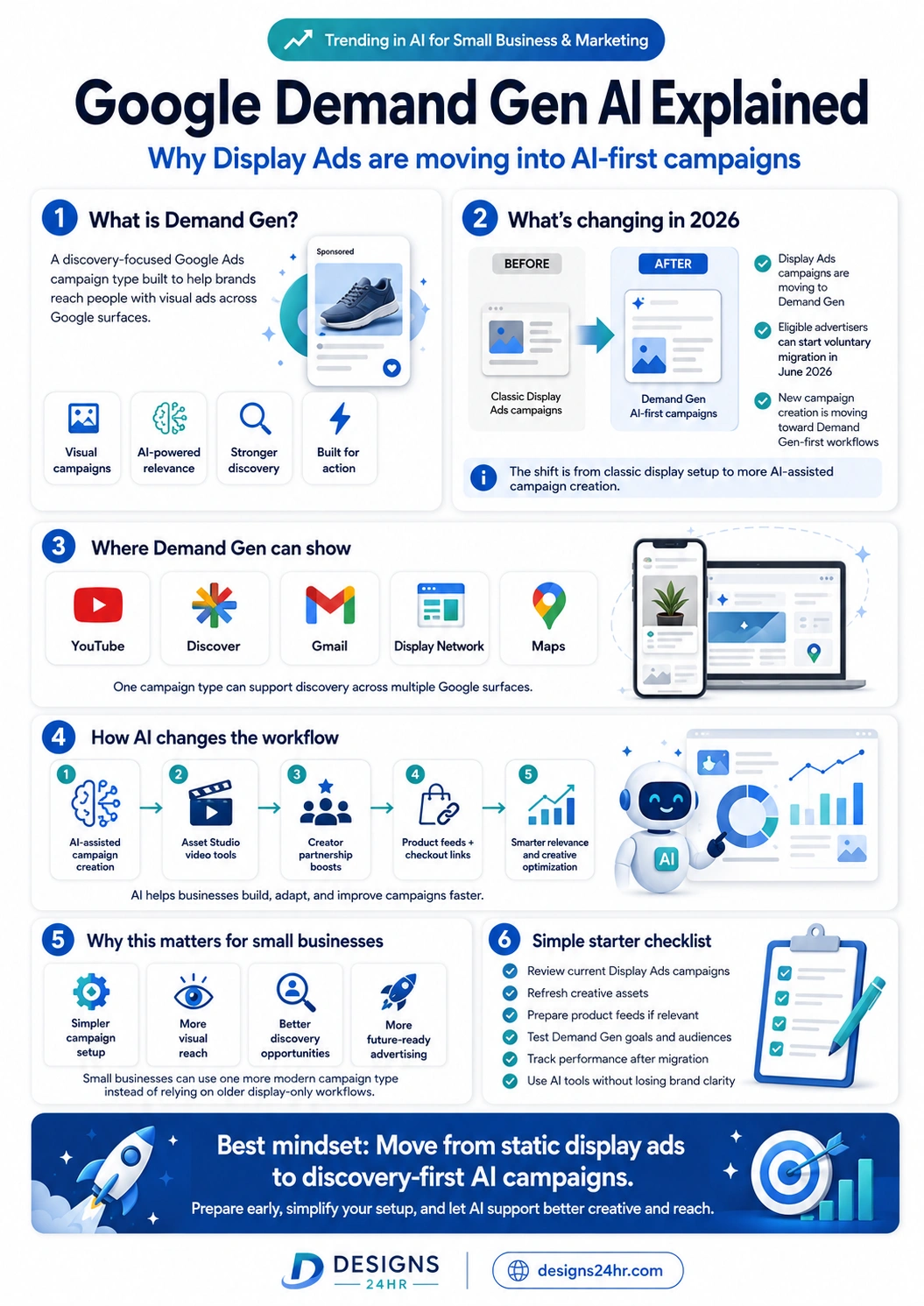
Google Demand Gen AI is becoming a major topic for advertisers because Google Display Ads are moving into Demand Gen, pushing more businesses toward AI-first campaign workflows across Google’s visual ad surfaces.
For small businesses, this change matters because it is not just a new campaign name. It signals a bigger advertising shift: from older display-only campaign setups to more visual, AI-assisted campaigns designed to create demand across YouTube, Discover, Gmail, Google Maps, and the Google Display Network.
If you run Google Ads, manage marketing for a small business, sell products online, or create campaigns for clients, this update is worth understanding now. The businesses that prepare early can refresh creative assets, review campaign goals, test Demand Gen carefully, and avoid feeling rushed when migration becomes unavoidable.
Quick answer: Google Demand Gen AI refers to Google’s AI-powered Demand Gen campaign system, which helps advertisers create demand using visual ads, audience signals, product feeds, video assets, creative previews, and AI-assisted optimization across Google’s discovery-focused surfaces.
Key takeaways:
- Focus keyword: Google Demand Gen AI.
- Main change: Google Display Ads campaigns are moving into Demand Gen as the Google Display Network.
- Important timing: Eligible advertisers can begin voluntary migration in June 2026, with a broader transition expected through 2027.
- Business impact: Small businesses should prepare creative assets, product feeds, goals, and reporting before migration.
What Is Google Demand Gen AI?
Google Demand Gen AI is Google’s campaign approach for reaching potential customers with visual, immersive, and action-focused ads across Google surfaces. Demand Gen campaigns are built to help businesses create interest before a customer is actively searching.
In simple terms, Demand Gen is for discovery. Instead of waiting for someone to type a search query, Demand Gen campaigns can show visual ads while people are watching YouTube, scrolling Discover, checking Gmail, browsing websites or apps on the Google Display Network, or engaging with other Google visual surfaces.
The AI part matters because Google uses automation and AI-powered relevance to help match creative assets, placements, audiences, and campaign goals. This does not mean advertisers should stop thinking strategically. It means the campaign workflow is becoming more AI-assisted, creative-heavy, and goal-focused.
Why Google Display Ads Are Moving to Demand Gen
Google Display Ads moving to Demand Gen is one of the clearest signs that Google wants advertisers to manage more visual demand-building campaigns through a unified campaign type.
Google says Display Ads campaigns are moving to Demand Gen as the Google Display Network. Eligible advertisers can start voluntarily moving existing campaigns with a migration tool in June 2026. Later, new campaigns will only be created within Demand Gen, and remaining eligible campaigns will be automatically migrated.
For advertisers, this means classic display-only planning may become less central over time. Demand Gen is becoming the broader home for display-style reach, visual discovery, creative testing, and AI-assisted campaign optimization.
Demand Gen Campaigns Explained for Small Businesses
Demand Gen campaigns explained simply: they are Google Ads campaigns designed to create demand before someone is ready to search, compare, or buy.
Think about a local boutique, online store, course creator, home service company, or digital product business. A search campaign usually catches people who already know what they want. A Demand Gen campaign can help introduce the brand earlier with visual ads, product feeds, videos, carousel-style creative, and audience signals.
That makes Demand Gen especially useful for businesses that need discovery, not just direct search traffic. It can support awareness, consideration, website visits, product interest, and conversions when set up with the right creative and goals.
| Old Display Mindset | Demand Gen AI Mindset |
|---|---|
| Run display ads mostly for reach and visibility. | Use visual campaigns to create demand, drive action, and support the customer journey. |
| Think mainly in banners and placements. | Think in video, image, product feeds, creator assets, and multi-surface discovery. |
| Separate display from broader AI campaign workflows. | Use AI-assisted campaign creation, optimization, and audience relevance inside Demand Gen. |
| Focus only on impressions and clicks. | Track creative quality, audience signals, conversions, product actions, and full-funnel performance. |
Where Google Demand Gen Campaigns Can Show
Google Demand Gen campaigns can reach people across some of Google’s most visual and discovery-focused surfaces. Depending on campaign setup, goals, assets, eligibility, and available controls, Demand Gen can support ads across:
- YouTube: including high-attention video and Shorts-style discovery moments.
- Discover: where people browse personalized content and may discover new brands.
- Gmail: where visual ads can appear in inbox-related ad experiences.
- Google Display Network: including websites, videos, and apps where display inventory is available.
- Google Maps: as Google expands more discovery and local-intent opportunities for advertisers.
This multi-surface reach is why the update matters for Google Ads for small business. Instead of thinking only about one ad format or one placement, businesses need to think about creative systems that can work across several customer touchpoints.
How AI Changes the Demand Gen Workflow
AI-assisted Demand Gen campaign creation changes the advertising workflow by making creative quality, goal signals, and campaign structure more important than ever.
With older display campaigns, advertisers often focused heavily on banners, placements, and targeting settings. With Demand Gen, businesses need to bring together visual storytelling, audience signals, product feeds, video assets, conversion goals, and AI-supported optimization.
1. AI can help match creative to the right moments
Demand Gen is designed around visual and immersive ad experiences. Google AI can help combine creative assets, messages, and placements so ads are more relevant to users across different surfaces.
2. Creative assets become more important
Small businesses should prepare strong images, short videos, product visuals, benefit-led headlines, and clear calls to action. AI can help optimize campaigns, but weak creative still limits performance.
3. Product feeds can support action
For ecommerce and product-based businesses, product feeds can help customers discover, explore, and buy products through more visual ad experiences.
4. Campaign goals guide the system
Demand Gen performs best when goals, conversion tracking, and measurement are clear. If the campaign is optimizing toward weak or unclear goals, AI-assisted optimization can become less useful.
What Small Businesses Should Do Before Migration
The Google Display Network migration 2026 does not mean every advertiser should panic. But it does mean businesses should prepare before the transition becomes automatic.
Here is a practical starter checklist for small businesses and marketers:
- Review current Display Ads campaigns. Identify which campaigns are active, profitable, experimental, outdated, or no longer needed.
- Check conversion tracking. Make sure important actions like purchases, leads, calls, bookings, or form submissions are tracking correctly.
- Refresh creative assets. Prepare updated images, videos, product visuals, headlines, descriptions, and calls to action.
- Organize product feeds. Ecommerce brands should make sure product titles, images, prices, availability, and landing pages are clean.
- Test Demand Gen goals carefully. Start with clear campaign goals and avoid changing too many variables at once.
- Monitor channel performance. Watch how YouTube, Discover, Gmail, Maps, and GDN placements perform after migration.
- Protect brand clarity. Use AI tools to speed up creation, but keep brand voice, offer quality, and customer trust consistent.
Best mindset: Do not treat Demand Gen as “old display ads with a new name.” Treat it as a more visual, AI-assisted campaign system that needs better creative, cleaner goals, and smarter measurement.
Google Demand Gen AI vs Performance Max
Many advertisers will ask whether Demand Gen is the same as Performance Max. It is not exactly the same.
Performance Max is designed to drive performance across Google’s full range of channels and surfaces from a single campaign type. Demand Gen is more focused on generating demand and business results across Google’s visual and discovery-focused surfaces.
| Campaign Type | Best Used For | Simple Explanation |
|---|---|---|
| Search | Capturing existing demand. | Reaches people who are already searching for something specific. |
| Performance Max | Maximizing performance across Google channels. | Uses broad automation to find conversion opportunities across Google inventory. |
| Demand Gen | Creating demand with visual discovery. | Helps businesses reach people across YouTube, Discover, Gmail, GDN, and other visual surfaces. |
Why This Matters for AI Marketing Campaigns
AI marketing campaigns are becoming less about manually controlling every tiny detail and more about feeding the system better strategy: better creative, better audience signals, better landing pages, better offers, and better measurement.
That is why Demand Gen should not be viewed only as a Google Ads update. It is part of a wider marketing trend where AI helps build, distribute, test, and optimize campaigns faster.
But AI does not remove the need for human judgment. A small business still needs to know its customer, offer, pricing, brand promise, landing page quality, and conversion path. AI can help improve reach and relevance, but it cannot fix a weak offer or confusing website.
Common Mistakes to Avoid With Google Demand Gen AI
As more advertisers move into Demand Gen, these mistakes could become expensive:
- Using old banner creative only: Demand Gen works best with stronger visual storytelling, not just recycled display banners.
- Ignoring video: YouTube and short-form video can be important discovery surfaces.
- Skipping product feed cleanup: Poor product data can weaken ecommerce ad quality.
- Testing without clear goals: AI-assisted campaigns need clean conversion signals and campaign objectives.
- Judging too quickly: Migration and AI optimization may need careful monitoring before making major decisions.
- Forgetting the landing page: Ads can drive attention, but the landing page still has to convert.
Simple Demand Gen Preparation Checklist
Use this checklist before moving Display Ads campaigns into Demand Gen:
- Audit your current Google Display Ads campaigns.
- Identify your best-performing audiences, offers, products, and landing pages.
- Prepare image, video, and product-feed assets.
- Write clear headlines and calls to action.
- Confirm conversion tracking is accurate.
- Decide which campaign goals matter most.
- Review channel controls and reporting options.
- Monitor cost, conversions, CPA, ROAS, and creative performance after migration.
- Keep testing, but avoid changing everything at once.
Google Demand Gen AI Explained in One Sentence
Google Demand Gen AI is Google’s AI-assisted visual campaign system that helps advertisers create demand across YouTube, Discover, Gmail, Maps, and the Google Display Network as Display Ads move into Demand Gen.
For small businesses, the message is clear: prepare your creative, tracking, landing pages, and product feeds now so the shift to AI-first campaigns becomes an opportunity instead of a surprise.
Sources and Further Reading
This article is based on Google’s official Demand Gen and Display Ads migration resources. Read the official updates here: Google Display Ads has a new home in Demand Gen, Google Display Network integration with Demand Gen, and About Demand Gen campaigns.
For more beginner-friendly AI and marketing explainers, visit The AI Edge by Designs24hr. You can also try the AI Prompt Generator, Title Meta Previewer, and Keyword Density Checker.
FAQs About Google Demand Gen AI
What is Google Demand Gen AI?
Google Demand Gen AI is Google’s AI-assisted campaign approach for creating demand with visual ads across Google surfaces such as YouTube, Discover, Gmail, Google Maps, and the Google Display Network.
Are Google Display Ads moving to Demand Gen?
Yes. Google says Display Ads campaigns are moving to Demand Gen as the Google Display Network. Eligible advertisers can begin voluntary migration in June 2026, with broader migration expected over time.
What are Demand Gen campaigns used for?
Demand Gen campaigns are used to create demand, reach potential customers visually, support discovery, drive engagement, and help generate actions such as site visits, leads, and sales.
Where can Google Demand Gen campaigns appear?
Demand Gen campaigns can appear across Google’s visual and discovery-focused surfaces, including YouTube, Discover, Gmail, the Google Display Network, and Google Maps where eligible.
How should small businesses prepare for Demand Gen?
Small businesses should review current Display Ads campaigns, clean up conversion tracking, refresh creative assets, prepare product feeds, test campaign goals, and monitor performance after migration.
Is Demand Gen the same as Performance Max?
No. Performance Max is designed to maximize performance across Google channels, while Demand Gen is focused on creating demand across Google’s visual and discovery-focused surfaces.
Why does Google Demand Gen AI matter for marketers?
It matters because advertising is moving toward AI-assisted creative, targeting, bidding, measurement, and multi-surface discovery. Marketers who prepare early can adapt faster and avoid relying on outdated display-only workflows.
AI is changing how businesses create attention, reach customers, and turn interest into action. Designs24hr helps you understand these updates in a simple, practical way. Share your thoughts in the comments, tell us how you are preparing for AI-first advertising, and come back to Designs24hr whenever you want to learn something new about AI and design.