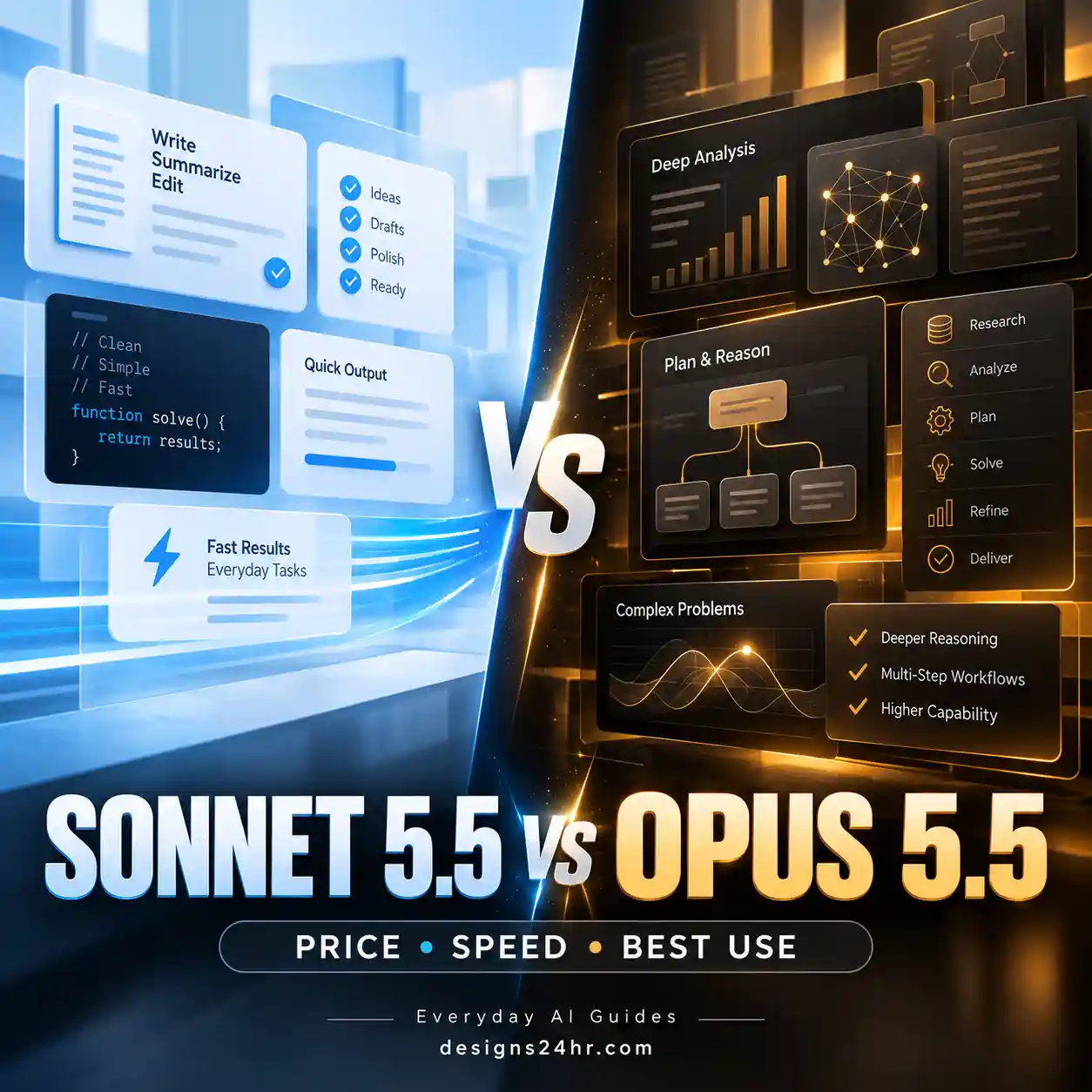
This Claude models comparison explains how Claude Haiku 5.5, Sonnet 5.5, Opus 5.5, and Fable 5.1 differ in speed, capability, and API pricing—and when you would actually choose each one for writing, coding, research, or automation.
Last fact-checked October 10, 2026. This independent educational guide is not affiliated with Anthropic. Product capabilities, model availability, and pricing can change.
Claude Models Comparison: Which Model Fits Your Task?
Looking for a direct answer? Use these four starting points before exploring the detailed Claude models comparison. They represent use-case judgments, not claims of independently measured model performance.
Claude Models Comparison: Haiku vs Sonnet vs Opus vs Fable
Claude is an AI assistant and model family developed by Anthropic. Different models trade off responsiveness, cost, and performance on demanding tasks. A higher-priced model is not automatically the best choice for every prompt: a simple extraction task and a large software refactor have different requirements.
| Model | Best starting use case | Relative latency* | Base API input / output per 1M tokens | Key trade-off |
|---|---|---|---|---|
| Haiku 5.5 | Classification, extraction, routing, high-volume routine tasks | Fastest | From $0.10 / $0.50 | Check performance on difficult reasoning; input prompt length affects pricing |
| Sonnet 5.5 | Writing, mixed business work, everyday coding support | Fast | $2 / $10 | Balanced choice, though difficult tasks may benefit from Opus |
| Opus 5.5 | Complex coding, multi-step analysis, agentic knowledge work | Moderate | $4 / $20 | Higher per-token price than Sonnet |
| Fable 5.1 | Demanding reasoning and long-horizon agentic projects | Slower | $10 / $50 | Highest listed base token cost among these four |
*Latency labels and model positioning reflect Anthropic’s published comparison, not tests performed by Designs24hr. All four models are documented with up to a 1M-token context window and 128K maximum output. Haiku’s price shown is for requests at or below its 100,000-input-token prompt threshold; longer prompts cost more. Source: Anthropic model comparison and official API pricing.
Claude Haiku 5.5: prioritize throughput
Evaluate Haiku for structured summaries, short questions, categorization, and routing that must run many times. Its low base token pricing is useful only if it consistently meets your quality threshold and if prompt-length pricing is accounted for.
Claude Sonnet 5.5: balance capability and speed
Sonnet is a sensible first comparison point for everyday writing, editing, planning, and a mix of coding tasks. Move up when the result needs repeated repairs or requires sustained complex reasoning.
Claude Opus 5.5: escalate for difficult work
Consider Opus when code changes span multiple files, research requires careful synthesis, or long workflows fail on lighter models. Anthropic’s Fable documentation recommends starting with Opus for many workloads.
Claude Fable 5.1: specialist escalation
Fable targets demanding reasoning and long-running agents. Its premium can be worth evaluating when completion quality outweighs speed and the cost of unsuccessful attempts. Do not assume every task improves simply by selecting it.
Which Claude Model Should I Use? Try This Model Selector
Choose your task and top priority. The recommendation is a rule-based starting point built from documented model positioning and practical cost trade-offs—not a live model benchmark or a personalized guarantee.
It offers a practical balance for general writing and editing. Compare its results with a lighter model if cost matters.
Recheck model availability and test with your own examples before using this recommendation.Best Claude Model for Writing, Coding, Research, and Automation
Best Claude model for writing
Start by comparing Sonnet 5.5 against Haiku 5.5 on the same outline, audience, tone, and fact-check requirements. Haiku may suffice for short transformations; Sonnet may be preferable for nuanced editing. In either case, review facts, citations, copyright concerns, and style before publication.
Best Claude model for coding
For quick explanations or simple code edits, compare Sonnet with Haiku. For interconnected changes, difficult debugging, and codebase-level reasoning, evaluate Opus. Escalate to Fable only if a difficult project fails your acceptance tests on Opus, rather than treating the most expensive option as a default.
Best Claude model for research and analysis
Sonnet can be an efficient place to begin for notes and structured comparisons. Opus may be preferable for complicated synthesis or multiple constraints. Fable is designed for especially demanding multistep research. No model should be treated as a source of verified facts without source inspection.
Best Claude model for automation
Choose based on the failure cost. Haiku fits lower-risk routing and extraction tasks when accuracy has been measured. Opus and Fable are candidates for harder, multi-step agent tasks with appropriate permissions, testing, human review, and the ability to stop harmful actions.
Claude Model Pricing Comparison and API Cost Calculator
Claude API billing is usually expressed in USD per one million input or output tokens. The simple formula for uncached standard requests is (input tokens ÷ 1,000,000 × input rate) + (output tokens ÷ 1,000,000 × output rate). Output often costs more per token than input, so an output-heavy workflow can change which model is economical.
| Model | Input per 1M tokens | Output per 1M tokens | Notes |
|---|---|---|---|
| Haiku 5.5, prompts up to 100K tokens | $0.10 | $0.50 | Base pricing for requests at/below threshold |
| Haiku 5.5, prompts over 100K tokens | $0.50 | $2.50 | Higher rate applies to that entire request’s tokens |
| Sonnet 5.5 | $2.00 | $10.00 | Standard API rates |
| Opus 5.5 | $4.00 | $20.00 | Standard API rates |
| Fable 5.1 | $10.00 | $50.00 | Standard API rates |
Prices verified against Anthropic pricing October 10, 2026. Haiku threshold is per request, not monthly accumulated tokens. The calculator below treats the entered token amounts as one request (or average requests of the same size multiplied by number of requests). It excludes caching, batch discounts, tool charges, fast mode, geography multipliers, third-party platform fees and taxes.
Estimate your Claude API costs
Based on 1,000 uncached standard requests of 3,000 input and 1,000 output tokens each.
| Model | Estimated USD |
|---|---|
| Haiku 5.5 | $0.80 |
| Sonnet 5.5 | $16.00 |
| Opus 5.5 | $32.00 |
| Fable 5.1 | $80.00 |
Illustrative estimates only. Review current API invoices and pricing before purchasing or budgeting.
Why cheaper per token does not always mean cheaper overall
Imagine that a lightweight model needs three attempts and extensive manual correction, while a more capable model completes the task once. For a real workflow, track cost per accepted output or cost per successfully completed task, not only headline token rates. Measure retries, verification effort, tool calls, latency, and error impact.
Claude Model Pricing: A Worked Cost Example
Suppose an application sends 1,000 requests, with 3,000 input tokens and 1,000 output tokens per request. Using standard uncached base rates, the example costs approximately $0.80 for Haiku 5.5, $16 for Sonnet 5.5, $32 for Opus 5.5, and $80 for Fable 5.1. These figures describe API token charges, not monthly chat subscriptions.
But the cheapest model per token is not necessarily cheapest per successful task. If a lower-cost model needs repeated retries or human rework, compare accepted outputs rather than token prices alone. For Haiku prompts longer than 100,000 tokens, the entire prompt is charged at the higher Haiku long-prompt rates listed by Anthropic.
- Estimate tokens
Use real API usage records where possible.
- Calculate cost
Include input, output, retries and applicable pricing modifiers.
- Measure task success
Compare accuracy, latency and cost per accepted result.
Source: Anthropic API pricing. Estimates are illustrative and exclude caching, tooling and other possible billing adjustments.
Claude Free vs Paid Plans: Is API Pricing the Same?
No. The per-token prices above are for API consumption, not the price of a Claude chat subscription. Consumer plans may include different model access, usage allowances, and account limits. Access can vary by plan, region, capacity, and product updates. Check the current Claude plans and pricing page before subscribing.
If you’re simply chatting, you generally don’t need to calculate API tokens. If you’re building an application that calls the Claude API, the calculator above is more relevant. Do not assume buying a consumer subscription includes the same API usage or that every model is exposed to every account.
How to Test Claude Models on the Same Task
Instead of trusting a generic ranking, use a small evaluation you can repeat. The method below works for writing, coding, customer-support drafts, or research. Designs24hr has not performed original benchmark testing for this article.
- Define success first. Write three to five measurable requirements, such as correct facts, valid code, useful structure, acceptable tone, and completion time.
- Prepare representative inputs. Select at least five tasks covering straightforward, typical, and difficult cases. Remove private data unless you have a valid basis to submit it.
- Use identical prompts. Keep the same instructions, source materials, and permitted tools. Record the model, settings, and date.
- Review blind where possible. Score outputs without seeing which model produced them. Run code tests or check source documents instead of relying on preference alone.
- Compare real costs. Include retries, latency, human revisions, API pricing, and failure risk. Repeat when models or prompts change.
Act as an impartial evaluator. I will provide the original task, acceptance criteria, and two anonymized responses (A and B). Score each response from 1 to 5 on factual accuracy, instruction following, usefulness, completeness, and safety. Explain each score using specific evidence. Do not infer which model produced the response. If a claim cannot be verified from the supplied materials, mark it unverified rather than guessing. End with a brief comparison and recommended next test.
Draft a 250-word plain-English explanation of [TOPIC] for [AUDIENCE]. Start with a direct answer, then provide a short example and two limitations. Do not invent statistics, sources, or personal experience. Flag facts requiring verification. Use concise subheadings and avoid hype. I will use the same request with multiple models to compare results.
Example model decision worksheet
| Criterion | What to measure | Your pass threshold |
|---|---|---|
| Accuracy | Fact check or executable tests | Zero critical errors |
| Instruction following | All requirements fulfilled | Set a measurable percentage |
| Response time | Seconds per successful task | Fits your workflow |
| Total cost | Tokens, retries, review labor | Within budget |
| Privacy / risk | Data and tool access safeguards | No disallowed exposure |
Common Mistakes When Choosing a Claude Model
Choosing only by price
A cheap but unreliable workflow may have a high cost per accepted output. Include review and retry costs.
Assuming the largest model always wins
Routine work often needs dependable formatting and speed, not maximum reasoning capability.
Mixing up subscription and API fees
Consumer plan pricing and programmatic API charges are separate concepts.
Ignoring model and prompt changes
Results depend on prompts, settings, tools, and model updates. Recheck important workflows regularly.
Claude Models Comparison: Frequently Asked Questions
Which Claude model does Anthropic recommend as the default?
Anthropic’s current model overview recommends starting with Opus 5.5 for most API workloads. That does not mean Opus is automatically the most economical choice for straightforward tasks; compare Sonnet and Haiku on your own quality requirements and budget.
Which Claude model should I use for everyday work?
Sonnet 5.5 is a reasonable balanced starting point for general tasks. Compare it with Haiku for simpler or higher-volume work, and with Opus for difficult multi-step tasks. Your plan may affect which models are accessible.
Is Claude Opus better than Claude Sonnet?
Opus is positioned for more demanding coding and knowledge work, while Sonnet emphasizes speed and intelligence balance. Whether Opus is worth the extra price depends on measurable improvements on your actual tasks.
What is the difference between Claude Haiku and Sonnet?
Haiku targets fast, high-volume use cases such as extraction and classification, with lower base API token rates. Sonnet offers a higher-cost balance of capability and speed for varied work. Long Haiku prompts can trigger a higher rate.
When should I choose Claude Fable instead of Opus?
Consider Fable for particularly demanding reasoning and long-horizon agentic tasks when Opus fails a controlled evaluation and the extra cost is justified. Anthropic recommends Opus as a starting point for many workloads.
Are all Claude models available on the free plan?
No blanket access claim should be assumed. Availability depends on current account entitlements, product surface, and usage rules. Check the model picker and current official plan details.
What are the current Claude model names in 2026?
The current general-purpose Claude model lineup listed in Anthropic’s official overview includes Haiku 5.5, Sonnet 5.5, Opus 5.5 and Fable 5.1. Earlier models may still be documented or available in some environments, so check the current model catalog for your account.
Is the cheapest Claude API model always the lowest-cost option?
Not necessarily. You must count output tokens, long-prompt pricing, retries, tools, reviews, and successful completions. A model with higher token rates can sometimes cost less per completed task.
How accurate is this cost calculator?
It estimates standard uncached API input and output token charges using published rates. It does not estimate variable tokenization, caching, batch processing, geographic multipliers, tool charges, subscriptions, taxes, or provider-specific fees.
Sources and Editorial Method
This guide uses model descriptions and prices supplied in Anthropic’s documentation. The task recommendations and rule-based selector are editorial guidance; they are not the results of independent benchmark tests.
- Anthropic: Current models overview and comparison
- Anthropic: Haiku 5.5 specifications and threshold
- Anthropic: Claude API pricing and modifiers
- Claude: Consumer plan information
Pricing and capabilities checked October 10, 2026. Recheck provider documentation before making purchasing or production decisions.
Keep Learning with Designs24hr
Model choice is one part of a useful AI workflow. These related guides explain prompting, browser access, and current AI tools.
Make AI tools work for your task—not the other way around
Explore beginner-friendly guides on prompts, workflow decisions, privacy, and everyday AI tools.
Explore Everyday AI Guides →