Got a Job Offer Text? Use This Checklist Before You Reply
AI job offer text scam checklist: if you received a recruiter text, remote job offer, or “reply YES” message, pause before responding. A job text can feel exciting, especially when it mentions remote work, fast hiring, flexible hours, or great pay. But unexpected job offer texts are also a common way scammers try to steal money, personal information, or access to your accounts.
This guide gives you a simple AI job offer text scam checklist to verify a recruiter, check the company, protect your personal details, and decide whether the message is safe to continue with.
What Is an AI Job Offer Text Scam?
An AI job offer text scam is a fake recruiting message that uses convincing wording, company names, remote-work promises, or automated conversation tactics to make a fake opportunity feel real. The message may arrive by text, email, social media DM, WhatsApp, Telegram, or another private chat app.
The goal is usually not to hire you. The goal is to get you to reply, click a link, share personal information, deposit a fake check, pay for equipment, complete fake “tasks,” or move into a private conversation where the scammer can pressure you more easily.
Quick rule: a real job opportunity can wait long enough for you to verify it. If the message pushes urgency, asks for money, or asks for sensitive details before a normal hiring process, pause before continuing.
Why Fake Recruiter Texts Are Harder to Spot Now
Fake job messages are getting more polished. Scammers can now write cleaner messages, copy public company language, imitate recruiter tone, and use details from job boards or social profiles to sound more believable.
The Federal Trade Commission warns that fake recruiters may claim to represent real companies, offer remote roles, mention pay without clear job details, and ask people to move forward by replying with simple words like “YES” or “INTERESTED.” The FBI also warns that scammers often move victims to private messaging apps such as WhatsApp or Telegram.
They sound professional
Some scam messages use clean grammar, real company names, and confident recruiter-style language.
They target real needs
Remote work, flexible hours, fast pay, and no-experience roles are common hooks because they feel helpful and urgent.
They move fast
The faster you reply, the less time you have to verify the company, search the role, or notice the red flags.
Common Red Flags in Job Offer Text Messages
This AI job offer text scam checklist starts with the warning signs. One red flag does not always prove a message is fake, but several together should make you pause. Use the checklist before you reply, click, send documents, or continue the conversation.
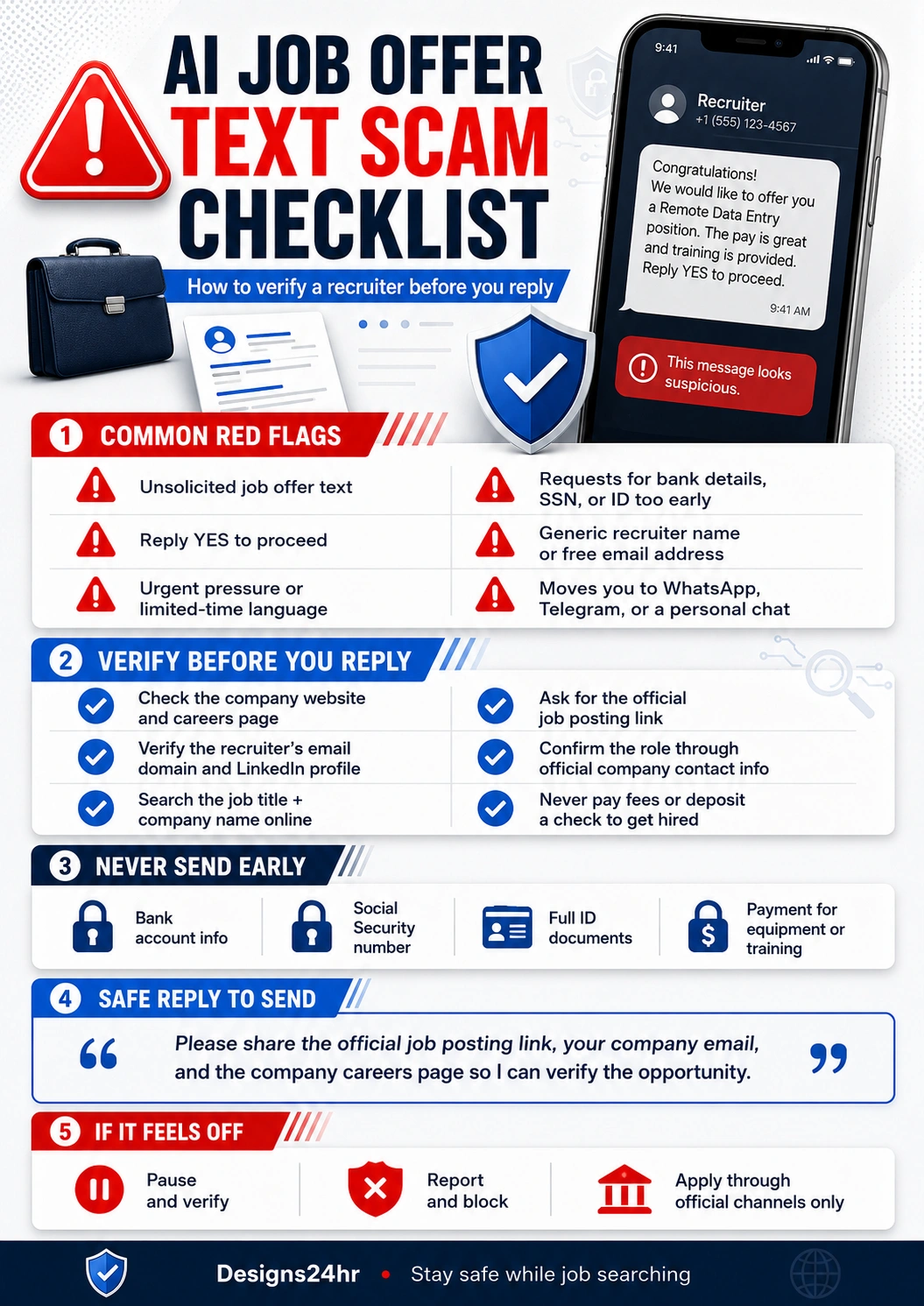
Unsolicited job offer text
You did not apply, you do not recognize the recruiter, and the message appears suddenly with a vague job offer.
“Reply YES to proceed” language
Scammers often use simple reply prompts to pull you into a longer conversation before they reveal the real request.
High pay with almost no job details
Be careful when the pay sounds great but the company, manager, responsibilities, schedule, and hiring steps are unclear.
Requests for bank details, SSN, or ID too early
Real employers may need tax or identity documents later, but not before you verify the company and receive a legitimate hiring process.
Free email address or generic recruiter name
A recruiter using a personal Gmail, Outlook, Yahoo, or unrelated email address should be verified carefully before you continue.
Moves you to WhatsApp, Telegram, or personal chat
Private chat apps are not automatically bad, but they are commonly used in scam workflows because reporting and verification are harder.
AI Job Offer Text Scam Checklist for Fake Recruiter Texts
Before you continue with any unexpected recruiter text, use this AI job offer text scam checklist to verify the opportunity from outside the message. Do not rely only on the link, phone number, profile, or instructions the sender gives you.
| What to Check | How to Verify It | Why It Matters |
|---|---|---|
| Company website | Go to the official company website yourself and look for the careers page. | Fake recruiters may send lookalike links or pretend to represent real brands. |
| Job posting | Search the job title plus the company name in Google and on the company careers page. | A real role is often listed in a public, official place. |
| Recruiter email | Check whether the email domain matches the company’s real website domain. | Personal or misspelled domains can be a warning sign. |
| Recruiter profile | Search the recruiter’s name on LinkedIn and compare their employer, role, history, and activity. | Scammers may copy names or create thin fake profiles. |
| Hiring process | Ask what the next official step is, who you will meet, and where the interview will happen. | Real hiring usually has a clear process, not only text messages and quick pressure. |
| Payment requests | Refuse requests to pay fees, buy equipment through a specific vendor, deposit checks, or send crypto. | The FTC warns that job scams often lead to fake checks, task scams, or money loss. |
Useful prompt to copy:
Act as a cautious job-search safety checker. Review this recruiter message for red flags. Tell me what looks normal, what looks suspicious, what I should verify, what information I should not share yet, and a safe short reply I can send before continuing.
Tip: remove your phone number, address, email, Social Security number, ID details, and banking information before pasting any message into an AI tool.
What Real Recruiters Usually Do Differently
A real recruiter may contact you by text, email, LinkedIn, or phone. The difference is that legitimate hiring usually becomes easier to verify as the conversation continues.
Use this AI job offer text scam checklist when the sender gives vague answers, avoids official company links, or rushes you into private chat before you can confirm the role.
More normal signs
- The recruiter gives a clear company name and role.
- The job appears on the official company careers page.
- The email domain matches the company website.
- The recruiter can explain the interview process.
- You are not asked to pay money to get hired.
- Personal documents are requested only through official, secure hiring systems later in the process.
More suspicious signs
- The message is vague but promises unusually high pay.
- You are told to reply fast or you will lose the opportunity.
- The recruiter avoids official company email.
- You are moved to WhatsApp, Telegram, or a personal chat immediately.
- You are asked to deposit a check, send crypto, pay for equipment, or buy training.
- You are asked for sensitive information before a verified interview or offer letter.
What You Should Never Send Early
Some information may be needed after a real job offer, but it should not be sent to a random text contact before you verify the employer. The FBI Internet Crime Complaint Center has warned that fake job listings can target personally identifiable information, and the American Bankers Association warns that job scams may involve requests for Social Security numbers, dates of birth, or bank account information.
Bank details
Do not send bank account numbers, routing numbers, online banking logins, payment app details, or card information to an unverified recruiter.
Identity documents
Do not send your passport, driver’s license, national ID, Social Security number, or full date of birth before verifying the employer.
Money or checks
Do not pay for equipment, training, background checks, software, onboarding, or “activation.” Do not deposit a check and send money back.
Safe Reply to Send a Recruiter Before Continuing
You do not need to accuse the sender immediately. A calm verification reply can help you slow the conversation down and check whether the opportunity is real.
Please share the official job posting link, your company email address, and the company careers page so I can verify the opportunity before continuing.
What to watch next: if the sender refuses, avoids the question, pressures you, switches platforms, or says verification is not needed, treat that as another warning sign.
What to Do If You Already Replied
If you already replied to a suspicious job offer text, do not panic. A reply alone does not always mean you are in danger, but you should stop the conversation before sharing anything sensitive.
Stop responding
Do not answer follow-up questions, click new links, download apps, or move to another messaging platform.
Do not send documents or money
Pause before sending your ID, bank details, tax information, payment app details, or any money for equipment or training.
Block and report the message
Use your phone’s report spam option, report the account on the platform, and consider reporting fraud through official channels such as the FTC or FBI IC3.
Monitor your accounts
If you shared sensitive information, watch your bank, email, credit, and identity-related accounts carefully and follow your local fraud-response steps.
Free Designs24hr Tools That Can Help You Job Search Safely
Once you verify that a job is real, you can use AI to make your application stronger. The key is to use AI for clarity, writing, and preparation without sharing sensitive information too early.
You can also use this AI job offer text scam checklist together with simple writing tools when you need a careful reply, a clearer explanation, or a safer next step.
How Do I Say This?
Use this to write a polite verification message when a recruiter text feels unclear, rushed, or suspicious.
AI Email Reply Generator
Draft a careful reply that asks for official details without oversharing your personal information.
Explain This For Me
Paste confusing recruiter language after removing personal details and get a plain-English explanation.
Decision Helper
Use this when you are unsure whether to continue, pause, verify, report, or apply through official channels only.
AI Resume Optimizer
After the role is verified, improve your resume bullets so your application is clearer and more relevant.
AI Interview Coach
Prepare for real interviews with structured practice answers and safer interview confidence.
Quick Job Offer Text Scam Checklist
This AI job offer text scam checklist can be used any time a recruiter text feels rushed, vague, too generous, or asks you to move quickly before you can verify the company.
Can I find the job on the official company careers page?
If the role is not listed anywhere official, verify through the company’s public contact information before continuing.
Does the recruiter use a real company email domain?
Be cautious with free email addresses, misspelled domains, or emails that do not match the company’s website.
Is there a normal interview process?
Real employers usually do not hire only through quick text messages with no interview, no role details, and no official documentation.
Have they asked for money, banking details, or ID too early?
If yes, stop and verify. Paying money to get paid is one of the biggest job scam warning signs.
FAQs About Job Offer Text Scams
Is a job offer text always a scam?
No. Some real recruiters may text candidates, especially after an application or prior contact. But an unexpected job offer text should be verified carefully, especially if it asks you to reply “YES,” move to a private chat app, send personal information, deposit a check, or pay for equipment.
How do I verify a recruiter before replying?
Use an AI job offer text scam checklist: check the company’s official website, find the role on the official careers page, verify the recruiter’s email domain, search the recruiter’s profile, and contact the company through official public contact information if needed.
What information should I never send early in the hiring process?
Do not send bank account details, Social Security numbers, full ID documents, payment information, online banking access, or money before verifying the employer and the hiring process.
Why do fake recruiters ask people to move to WhatsApp or Telegram?
Scammers often move people away from normal hiring channels so they can continue privately, avoid reporting systems, pressure the target, and control the conversation.
What should I do if I already replied to a fake job offer text?
Stop responding, avoid clicking links, do not send money or documents, block the number, report the message, and monitor your accounts if you shared sensitive information.
Can AI help me check a suspicious recruiter message?
Yes. AI can help you identify red flags, simplify confusing wording, and draft a safer reply. However, you should still verify the company and recruiter through official sources before continuing.
Final Takeaway
A real opportunity should become more verifiable as you ask normal questions. A fake one usually becomes more urgent, vague, private, or money-focused.
Before you reply to a recruiter text, slow down and check the company, job posting, recruiter email, hiring process, and payment requests. Use this AI job offer text scam checklist before you risk your money, identity, or personal information.
Remember: your goal is not to ignore every opportunity. Your goal is to verify the real ones before you risk your money, identity, or personal information.