Everyday AI Guides • Consumer Checklist
An AI shopping assistant can help you discover products, compare features, summarize reviews, and sometimes prepare or complete a purchase. That convenience is useful, but a confident recommendation is not proof that the product, price, seller, or checkout details are correct.
Use this AI shopping assistant checklist before you trust a product recommendation. It will help you verify the exact model, specifications, compatibility, current price, retailer, reviews, privacy settings, return terms, and final cart before your money leaves your account.
Reviewed and updated: July 24, 2026
What Is an AI Shopping Assistant?
An AI shopping assistant is software that lets you describe what you want in normal language and then helps you search, compare, narrow, or purchase products. Instead of clicking through dozens of filters, you might ask for “a lightweight carry-on under $150 with durable wheels and a useful warranty.” The assistant may ask follow-up questions, compare several products, explain trade-offs, and provide merchant links.
The important word is assistant. It can organize information and shorten your research, but it does not automatically know every product, retailer, price change, hidden fee, or personal preference. It may misunderstand your request, overlook a suitable option, combine details from different model versions, or show information that changed after it was collected.
AI shopping assistant vs. search engine
A search engine normally gives you pages or product listings that match keywords. An AI shopping assistant interprets your intent, asks questions, compares options, and explains why a product may fit. That makes it more conversational, but also introduces another layer of interpretation that you need to check.
AI shopping assistant vs. basic chatbot
A basic retail chatbot often handles order tracking, store hours, or common support questions. A shopping assistant is designed to understand a product need, search a catalog or multiple sources, recommend items, compare features, and sometimes interact with a cart or checkout.
What “agentic shopping” means
An agentic shopping assistant can move beyond giving information and take limited actions, such as monitoring a price, adding an item to a cart, preparing an order, or supporting a purchase after approval. The more authority a tool has, the more carefully you should review permissions and require human confirmation.
How Do AI Shopping Assistants Work?
Different services use different systems, but the shopper experience usually follows four stages.
1. The assistant interprets your request
It identifies details such as product type, intended use, budget, preferred brands, size, style, delivery location, required features, and deal-breakers. Vague requests produce vague recommendations, so the quality of your instructions matters.
2. It searches product information
The assistant may use retailer product feeds, public product pages, structured catalog information, reviews, merchant data, or other shopping sources. Coverage varies. A service may not have access to every retailer, every regional price, or every product variation.
3. It ranks and explains options
The system may compare price, specifications, reviews, availability, and your stated preferences. A top-ranked item is not necessarily the universally “best” product. It is the system’s interpretation of the information and constraints available at that moment.
4. It may support a shopping action
Some assistants only provide links. Others may offer price tracking, cart actions, or checkout support. OpenAI’s current shopping documentation, for example, says eligible products and merchants may offer an Instant Checkout option, while also advising users to verify that products meet their specific needs before buying.
Three Types of AI Shopping Assistants
| Type | Where You Find It | What It Usually Does | Main Check |
|---|---|---|---|
| General AI shopping assistant | A general-purpose AI or search service | Researches products across available sources and explains trade-offs | Confirm sources, exact models, and current merchant details |
| Retailer shopping assistant | A store website or app | Searches and recommends products from that retailer’s catalog | Remember that suitable products sold elsewhere may be excluded |
| Agentic shopping assistant | A shopping, retailer, or payment-enabled service | May track prices, add items, prepare an order, or support checkout | Review permissions and manually approve every transaction detail |
What AI Shopping Assistants Can and Cannot Reliably Do
AI is useful for organizing a messy shopping decision. It is less reliable as the final authority on fast-changing or merchant-controlled information.
| Shopping Task | AI Can Help With | You Still Need to Verify |
|---|---|---|
| Product discovery | Finding products that appear to match your needs | Whether important alternatives or retailers were omitted |
| Specifications | Summarizing features in plain language | The exact model, generation, dimensions, and manufacturer specifications |
| Compatibility | Interpreting stated device or use requirements | Official compatibility for your exact setup, region, or product version |
| Price comparison | Surfacing prices and offers known to the system | Final price, tax, shipping, coupon rules, membership requirements, and fees |
| Review summaries | Highlighting repeated praise and complaints | Whether reviews are authentic, current, representative, and for the exact model |
| Seller selection | Showing stores or marketplace listings | Seller identity, reputation, contact details, policies, and domain legitimacy |
| Checkout | Preparing a cart or supported transaction | Product, seller, condition, quantity, total cost, delivery, and authorization |
The safest rule
Use AI to reduce the list of possibilities. Use official product pages, trustworthy retailers, independent reviews, and your own checkout review to make the final decision.
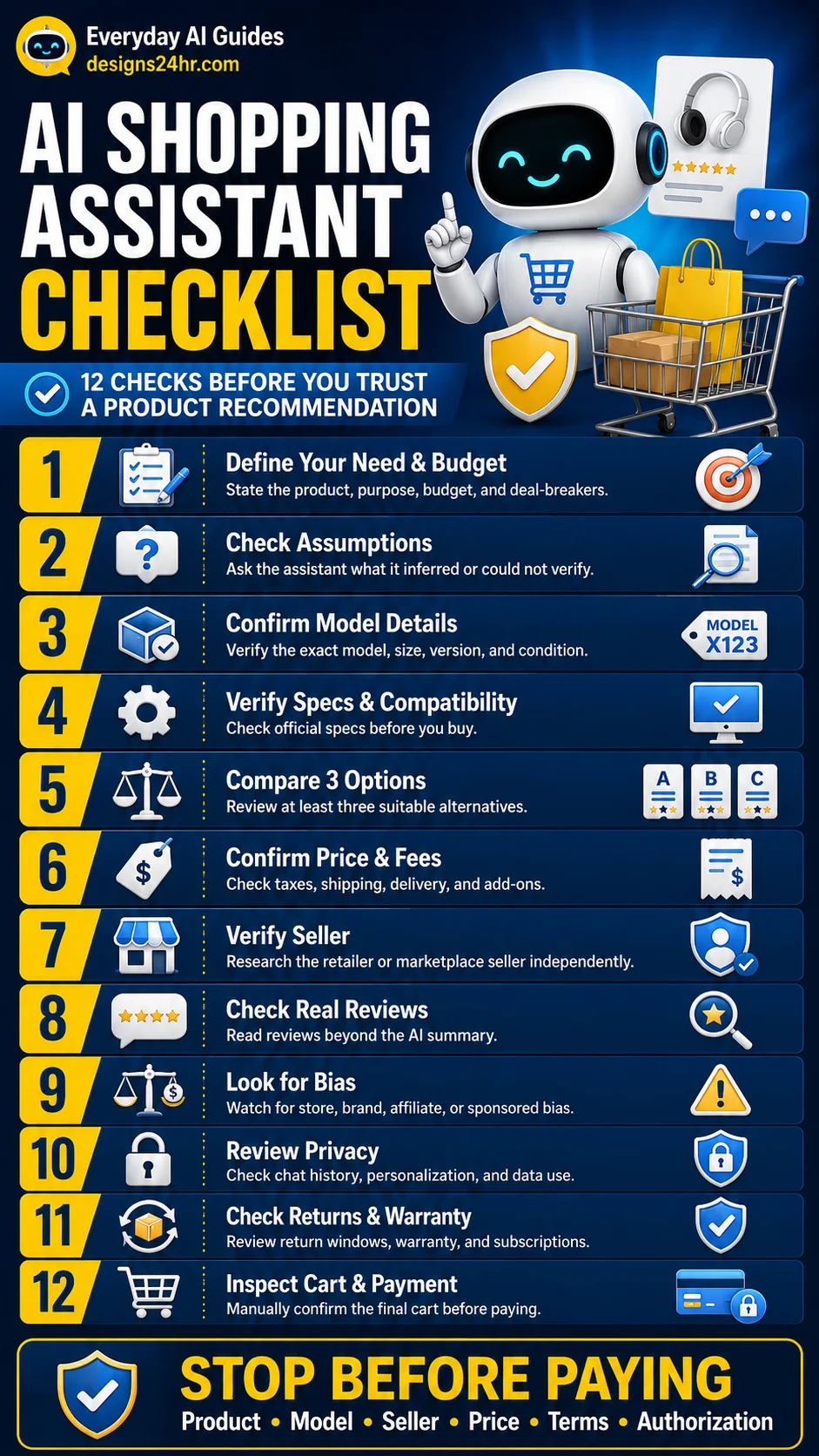
AI Shopping Assistant Checklist: 12 Checks Before You Buy
Complete these checks in order. The early steps improve the recommendation; the later steps protect you before payment.
Define Your Exact Need and Maximum Budget
Tell the assistant what the product is for, who will use it, which features are required, which features are optional, and what would make an option unacceptable. Give a maximum total budget rather than only a product price.
Include likely extras such as shipping, taxes, adapters, replacement parts, accessories, memberships, installation, or subscriptions. A $100 product that needs $60 of additional equipment is not a $100 purchase.
Ask the Assistant to State Its Assumptions
Ask what the assistant inferred about your needs and what it could not verify. This exposes misunderstandings before they influence every recommendation.
Useful questions include: “What assumptions did you make?”, “Which facts may be outdated?”, “Which requirement influenced your ranking most?”, and “What information should I confirm myself?”
Confirm the Exact Model, Version, and Condition
Similar product names can hide major differences. Record the full model number, generation, year, storage or capacity, size, color, region, included accessories, and whether the item is new, used, renewed, open-box, or refurbished.
Do not compare a current model’s specifications with an older model’s price. On marketplaces, confirm that the listing title, product description, selected variation, and cart all refer to the same item.
Verify Specifications and Compatibility
Use the manufacturer’s official documentation for features that could make the purchase unusable. Check dimensions, connector type, operating-system support, voltage, material, capacity, regional compatibility, installation needs, and required subscriptions.
When compatibility matters, ask the assistant to identify the exact source for the claim—but still open that source and confirm it yourself.
Compare at Least Three Suitable Options
A single recommendation gives you no way to judge value or trade-offs. Request at least three genuinely suitable choices: a best overall match, a lower-cost alternative, and an option that makes a different compromise.
Ask for a side-by-side table covering the same criteria for every product. If one option has missing information, mark it as unknown instead of allowing the assistant to fill the gap with a guess.
Confirm the Current Price, Stock, Shipping, and Fees
Prices and availability can change quickly. Open the retailer page and confirm the selected product variation, seller, current price, stock status, delivery date, shipping charge, taxes, coupon conditions, and any membership requirement.
OpenAI’s shopping-research guidance specifically advises checking the retailer for the final price, taxes, fees, shipping, availability, size, color, returns, and warranty because shopping information can be incomplete or out of date.
Verify the Retailer and Marketplace Seller
A product appearing in an AI result does not automatically prove that the seller is trustworthy. Check the exact domain spelling, seller name, contact information, business history, return address, marketplace rating, recent complaints, and payment methods.
The U.S. Federal Trade Commission recommends researching the marketplace and individual seller, checking several review sources, reading terms and return policies, and using safer payment methods. It also warns that an HTTPS address means a connection is encrypted—not that the site itself is legitimate.
Read Real Reviews Beyond the AI Summary
AI-generated review summaries can help identify common themes, but they may hide important differences between product versions or overrepresent the sources available to the system. Read a useful sample of positive, negative, recent, and long-term reviews.
Check whether reviews refer to the exact model and seller. Look for repeated complaints about durability, compatibility, delivery, customer service, warranty handling, or subscription charges. Do not rely on the star average alone.
Look for Store, Brand, Affiliate, or Sponsored Bias
Ask what universe of products the assistant searched. A retailer assistant may only recommend products sold by that retailer. A publisher may earn affiliate revenue. A marketplace may rank sellers using factors you cannot see.
Ask why the top product ranked first, whether sponsored placements are separate, whether affiliate links are used, and which major alternatives were excluded. Do not assume bias exists without evidence—but do not assume a recommendation is fully independent either.
Review Privacy, Memory, and Chat-History Settings
Personalization can improve recommendations, but it may involve account details, previous chats, saved preferences, browsing activity, purchase history, device information, or location. Review the service’s privacy explanation and settings before discussing sensitive needs.
Do not share passwords, full payment-card details, government identification numbers, private medical information, or information that the shopping task does not require. Check whether memory can be disabled and whether past conversations can be deleted.
Check Returns, Warranty, Subscriptions, and Ongoing Costs
Before buying, review the return window, return-shipping cost, restocking fee, product condition rules, manufacturer warranty, marketplace protection, repair process, trial period, and subscription renewal.
Also estimate ongoing costs such as filters, ink, batteries, replacement heads, storage plans, memberships, proprietary accessories, or required software. A cheaper product can cost more over its useful life.
Manually Inspect the Final Cart and Payment
Never approve a purchase based only on the assistant’s summary. Read the final cart line by line. Confirm the product, model, variation, color, size, condition, seller, quantity, unit price, total price, shipping address, delivery method, add-ons, and subscription status.
If an assistant can take shopping actions, use the minimum permissions needed. Require approval for each transaction, and remove payment access when it is no longer necessary.
A Better AI Shopping Prompt
A strong prompt gives the assistant clear constraints and asks it to expose uncertainty. Copy this template and replace the bracketed text.
Help me compare [product type] for [specific use]. My maximum total budget is [amount], including necessary accessories and delivery. My required features are [requirements], and I want to avoid [deal-breakers]. Compare at least three suitable options, give the exact model numbers, explain the trade-offs, identify any facts you could not verify, and provide the source and checking date for each price and important specification. Do not add anything to a cart or make a purchase.
Add your country, currency, delivery deadline, new-or-refurbished preference, compatibility requirements, and brands to include or exclude when relevant.
Useful follow-up prompts
- “Which recommendation is most likely to fail one of my required features?”
- “Show me the exact evidence for each compatibility claim.”
- “Which prices, stock details, or policies may have changed?”
- “What suitable products or retailers might be missing from this comparison?”
- “Separate confirmed facts from your interpretation.”
AI Shopping Assistant Red Flags
Pause before clicking or paying when you see:
- No exact model number or product variation
- A “best” recommendation without clear criteria
- Only one product or one retailer considered
- A price with no seller, checking date, or fee details
- An unfamiliar or misspelled retail domain
- A price dramatically below normal market value
- Pressure to buy immediately
- Missing contact, return, warranty, or delivery information
- An unexpected product, quantity, add-on, or subscription in the cart
- A request to pay outside a marketplace’s normal system
- A demand for gift cards, wire transfers, cryptocurrency, or another difficult-to-reverse payment method
- A request for personal information unrelated to the purchase
A warning sign does not always prove fraud, but it is a reason to stop, research the seller independently, and choose a safer option if the explanation remains unclear.
Privacy Questions to Ask Before Using an AI Shopping Assistant
Privacy practices vary by service. A statement made by one platform should never be assumed to apply to every retailer, shopping app, or AI assistant.
Privacy checklist
- Is chat history saved?
- Does the assistant use memory or previous purchases?
- Is browsing activity used for personalization?
- Is precise or approximate location collected?
- Are conversations shared with retailers or technology partners?
- Can personalization or memory be turned off?
- Can you delete old chats and saved preferences?
- Can the assistant access your cart or payment process?
- Is human approval required before a transaction?
For a platform-specific example, OpenAI states that ChatGPT shopping-research chats are not shared with retailers and that memory-based personalization can be turned off. That statement applies to that service and should not be generalized to every AI shopping assistant.
AI Shopping Assistants in 2026
AI shopping is moving from simple keyword search toward conversational product discovery and limited shopping actions. General AI services can compare products across available sources, while retailers are building assistants around their own catalogs and customer needs.
In July 2026, Retail Dive reported that Michaels launched “Ask Mike,” a retailer assistant designed to provide product recommendations and creative guidance from shoppers’ descriptions. Grocery Dive reported that Schnucks planned an agentic shopping assistant for grocery recommendations connected to lifestyle and wellness preferences. These examples show how assistants are becoming more specialized by retailer and shopping category.
Current reporting has also described a possible future virtual shopping assistant for the Apple Store app. Because reported or unreleased features can change, treat them as current context rather than a reason to assume a tool is publicly available.
The practical lesson is stable even as products change: greater personalization and greater transaction capability require stronger checks for data use, recommendation limits, product accuracy, and purchase authorization.
Stop Before Paying
- Product: exact item requested
- Model: correct version, size, and condition
- Seller: legitimate retailer or marketplace seller
- Price: correct total with fees and shipping
- Terms: acceptable delivery, returns, warranty, and subscription
- Authorization: you approved this exact transaction
Frequently Asked Questions
What is an AI shopping assistant?
An AI shopping assistant is a conversational tool that helps shoppers discover, compare, and sometimes purchase products. It can interpret needs such as budget, intended use, size, features, or preferences, then organize available product information into recommendations. Its results should still be checked against official product and retailer information.
How does an AI shopping assistant work?
It interprets your request, searches the product information available to it, ranks options, and explains why they may fit. Depending on the service, it may use retailer feeds, public product pages, structured data, reviews, account preferences, or shopping history. Some assistants can also support cart or checkout actions.
Are AI shopping assistants safe?
They can be useful when you keep control of the decision and payment. Risks include inaccurate specifications, outdated prices, incomplete product coverage, unreliable sellers, privacy concerns, and incorrect cart details. Review the assistant’s sources, permissions, and privacy settings, then verify every important purchase detail independently.
Can I trust AI product recommendations?
Trust them as suggestions, not final proof. Ask why each product was recommended, request exact model numbers and sources, and compare several alternatives. Confirm critical specifications, compatibility, price, seller, reviews, returns, warranty, and checkout details before buying.
Can AI shopping assistants compare prices?
Yes, many can surface and compare prices available from their sources. However, the displayed price may not be the lowest available or may change before checkout. Confirm the final product variation, seller, taxes, shipping, discounts, membership requirements, and total cost directly with the retailer.
Can an AI shopping assistant recommend a fake store?
An AI system can make mistakes or surface information from an unfamiliar seller, so a recommendation should not be treated as proof that a store is legitimate. Check the exact domain, seller history, contact details, independent reviews, return policy, and payment method before purchasing.
Can an AI shopping assistant buy products for me?
Some assistants can add items to a cart, prepare an order, or support checkout for eligible products and merchants. Capabilities vary. Use limited permissions and manually verify the product, seller, quantity, condition, total price, delivery, returns, subscription terms, and payment authorization before approval.
Do AI shopping assistants use my shopping history?
Some services may use previous chats, saved preferences, account information, browsing activity, or purchase history to personalize results. Others may not. Read the service’s privacy information and review memory and personalization settings instead of assuming the same rules apply everywhere.
How can I tell whether a recommendation is sponsored?
Look for labels such as “ad,” “sponsored,” or “promoted,” and read the service’s explanation of how products are selected. Ask whether affiliate links or paid placements are involved and whether sponsored results are separated from organic recommendations. A retailer-owned assistant may also be limited to that retailer’s inventory.
Should I trust AI-generated review summaries?
Use them to identify themes, then read representative reviews yourself. Check recent positive and negative reviews, long-term ownership reports, and comments about the exact model and seller. AI summaries may miss unusual but important problems or combine feedback from different product variations.
What should I verify before approving an AI-assisted purchase?
Confirm the exact product and model, specifications, compatibility, seller, condition, quantity, current price, taxes, shipping, delivery, return window, warranty, recurring charges, and final payment details. You should also confirm that you personally authorized the exact transaction shown in the cart.
What is the difference between an AI shopping assistant and a chatbot?
A basic chatbot commonly handles support questions, store hours, or order status. An AI shopping assistant is designed to interpret a shopping need, search or navigate products, compare options, explain trade-offs, and sometimes support cart or checkout actions.
Final Takeaway
An AI shopping assistant can save time by turning a broad shopping problem into a shorter, more understandable comparison. It should not replace your final judgment.
Give the assistant clear requirements, ask it to show uncertainty, compare several exact products, and independently verify the seller, price, reviews, privacy settings, return terms, and final cart. The safest purchase is one where AI helps with research and you remain in control of the decision and payment.
Sources and Further Reading
- OpenAI Help Center: Using shopping research in ChatGPT
- OpenAI Help Center: Shopping with ChatGPT Search
- Federal Trade Commission: Buying From an Online Marketplace
- Retail Dive: Michaels launches AI shopping assistant
- Grocery Dive: Schnucks turns to agentic AI shopping assistant
- MacRumors: Report on a possible Apple Store app shopping assistant