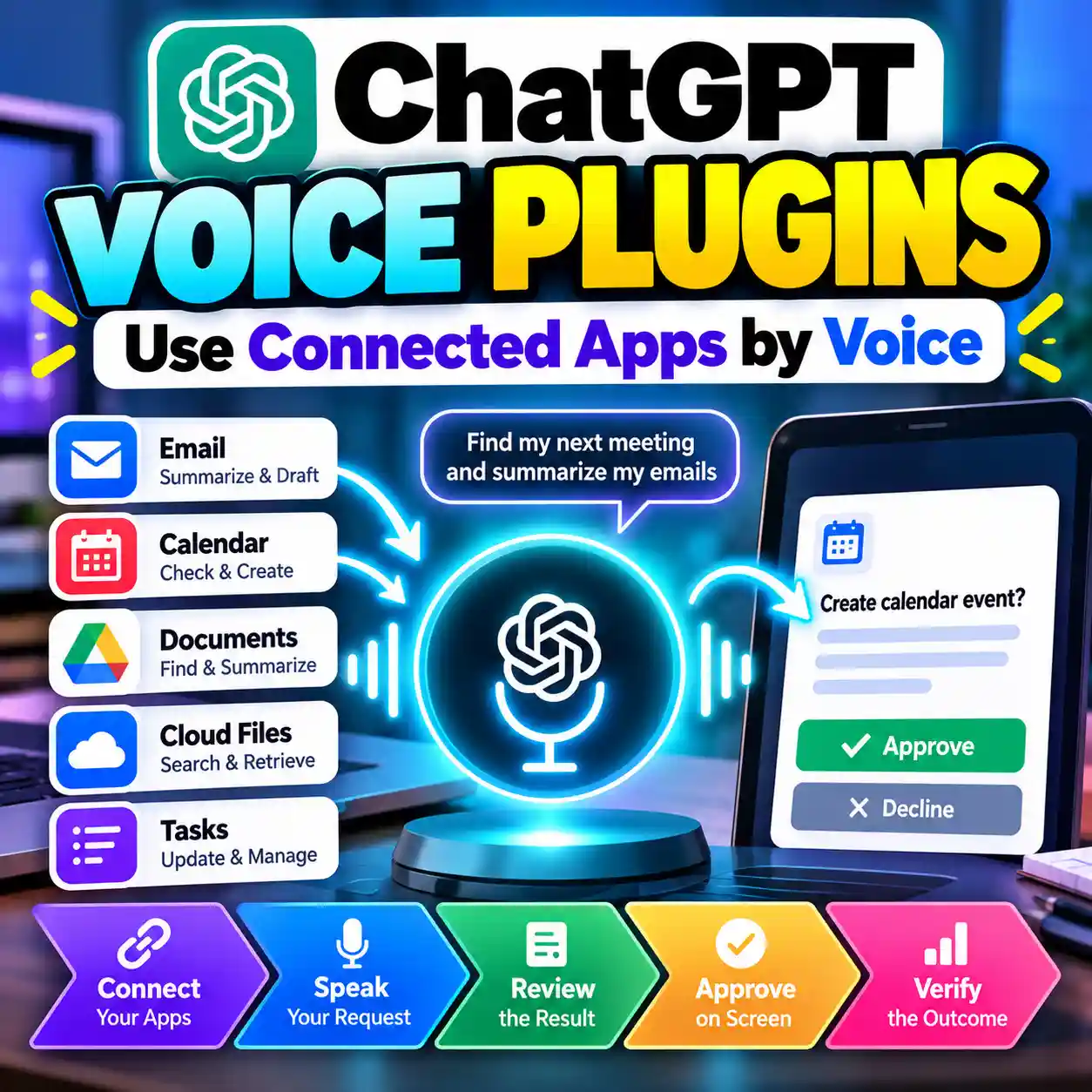
Gemini Spark in Gemini Live turns a spoken conversation into something more useful than another AI answer: Gemini Live can hand an appropriate multi-step request to Spark so the work can continue in the background.
Instead of stopping to type a detailed automation prompt, you can talk through what you need, clarify the outcome in conversation, and let Gemini decide when the request is better handled as a larger Spark task.
This guide shows you how that handoff works, what you need before you start, practical voice workflows to try, what to review before Spark takes consequential actions, and what to check if Spark is missing from your Gemini Live experience.
Open Gemini Live in the Gemini app and describe the result you want in normal spoken language. If the request is complex enough to need a multi-step agent workflow, Gemini Live can hand it to Spark rather than making you choose the tool manually. Google says Spark can work across services including Docs, Sheets, Drive and the web, and can continue long-running or scheduled work in the background.
You currently need Google AI Pro or higher for the Spark integration in Gemini Live. Subscription access does not guarantee every account sees every feature immediately, so also check account, country and rollout availability.
What Changed: Gemini Live Can Hand Bigger Jobs to Spark
Gemini Live has traditionally been strongest as a conversational interface: you talk, Gemini responds, and you continue the conversation naturally. The new Spark integration adds a second layer.
Google says Gemini Live can now recognize when a request is better suited to Spark and hand the work over automatically. You do not have to stop the conversation, open a separate automation builder or correctly guess which Gemini feature should handle the request.
Google gives an example where a user discusses their day with Gemini Live and then asks Gemini to pull event information from email, create calendar events and include driving times. Instead of forcing the user to choose Spark manually, Live hands the larger job to Spark.
That is the most important part of this update: the voice conversation can become the starting point for an agent workflow.
If you want a deeper explanation of Spark itself and how it differs from recurring Gemini actions, read our Gemini Spark vs Scheduled Actions guide. This article stays focused on the Gemini Live voice handoff.
What You Need Before Using Gemini Spark in Gemini Live
Before troubleshooting prompts, first make sure your account can actually use the pieces required for the workflow.
- A supported Gemini experience. Start from Gemini Live in the Gemini mobile experience where the new integration is available to your account.
- A Google AI Pro subscription or higher. Google’s August 26 announcement says Spark inside Gemini Live requires Google AI Pro or higher.
- An eligible account. Spark availability can differ by account type, region, age requirements and rollout.
- Keep Activity enabled where required. Google’s current Spark documentation lists Keep Activity as a requirement.
- The Connected Apps required for your task. If your workflow needs Gmail, Drive, Calendar or another service, that connection must also be available and enabled where required.
For a complete walkthrough of connections, permissions, missing integrations and data controls, use our Gemini Connected Apps guide.
How to Use Gemini Spark in Gemini Live
The best way to use this feature is not to memorize a special command such as “launch Spark.” Google specifically designed the experience so you can stay in the conversation and describe what you need.
Step 1: Open Gemini Live
Open the Gemini app with the account you want to use and start a Gemini Live conversation.
If your task will require information from another service, make sure the relevant Connected App is available before relying on it.
Step 2: Describe the finished result
Start with the outcome rather than the tool.
Instead of:
Try:
Step 3: Add context conversationally
You do not need to squeeze every detail into one sentence. Gemini Live is conversational, so add constraints as they become relevant.
Step 4: Let Gemini determine whether Spark is needed
For a simple question, Live may answer directly. For a larger multi-step request, the new integration can hand the job to Spark.
That means you should focus on describing a useful result rather than trying to force every task into Spark.
Step 5: Review the scope before consequential actions
When the workflow involves emails, calendars, files, purchases, public communication or other external actions, confirm the exact scope before approving anything important.
What Happens After You Speak the Request?
The simplest mental model is:
Google says Spark can operate across Google Docs, Sheets, Drive and the web, remember the goal as it works, and handle long-running or scheduled jobs across days or weeks.
Its broader Spark documentation also lists integrations with Google services such as Gmail, Calendar, Drive, Docs, Sheets, Slides, YouTube and Maps, although the exact actions and connections available to you can vary.
Gemini Live is where you can think out loud. Spark is where a sufficiently complex request can become an ongoing task.
Use the SCOPE → SPEAK → HAND OFF → REVIEW Method
The biggest mistake with agentic AI is giving it a large, vague mission and hoping it understands your priorities. A better approach is to make the handoff structured without making the conversation unnatural.
SCOPE: Start with the finished result
A useful scope answers four questions:
- What outcome do I want?
- What information may the task use?
- What should the task not change?
- What requires my approval?
SPEAK: Use Gemini Live for the messy thinking
This is where voice has a real advantage. You can talk through unfinished ideas, priorities, constraints and corrections without first turning them into a polished brief.
Google specifically highlights the example of speaking an unstructured “brain dump” and having Spark organize the important themes into a structured document.
HAND OFF: Let complexity decide
Not every voice command needs an AI agent. Asking for the next event on your calendar or a quick explanation may be better handled directly inside Live.
The handoff becomes useful when the goal has several steps, involves multiple sources or services, needs ongoing work, or produces something more substantial than a conversational answer.
REVIEW: Treat completion as a checkpoint
“Spark finished” should not automatically mean “everything is correct.” Check names, dates, files, destinations, permissions, recipients and any external action that matters.
For a broader permission review before connecting an AI agent to important accounts, use our AI Agent Safety Checklist.
10 Useful Gemini Live + Spark Voice Tasks to Try
These are practical examples you can adapt. They are not magic phrases, and they do not imply that every account or Connected App supports every action shown.
1. Turn a brain dump into a project plan
2. Turn research into an organized brief
3. Organize a busy week
4. Turn meeting notes into follow-up work
5. Build a content plan from spoken ideas
6. Create a study workflow
7. Organize client deliverables
8. Prepare a small-business operations list
9. Maintain a recurring information summary
10. Turn scattered information into a decision brief
Should This Stay in Gemini Live or Become a Spark Task?
The best workflow does not send everything to Spark. Match the tool to the size of the job.
| Task | Better starting point | Why |
|---|---|---|
| Ask a quick question | Gemini Live | A conversational answer may be all you need. |
| Talk through an idea | Gemini Live | Voice is useful for exploration and clarification. |
| Turn a long brain dump into organized work | Spark handoff | The result may require several processing and creation steps. |
| Work across several supported apps | Spark handoff | Cross-app work is where an agent becomes more useful. |
| Run something repeatedly | Spark | Schedules and longer-running work are part of Spark’s agent model. |
| Find and summarize Gmail messages by voice | Gemini Live | Google now supports hands-free Gmail workflows directly in Live for eligible accounts. |
If your main goal is voice-first inbox management rather than a broad multi-step agent workflow, read our dedicated Gemini Live Gmail guide.
What You Should Still Review Yourself
Background work saves time only when correcting a mistake would not cost more time than doing the task carefully in the first place.
- Recipients: confirm who will receive a message or shared file.
- Dates and times: verify deadlines, meetings, time zones and recurring schedules.
- File destinations: confirm where documents, sheets or folders will be created or changed.
- Facts: check important research against the cited source rather than assuming the summary is correct.
- Deletion: inspect exactly what will be removed before approving it.
- Purchases and bookings: verify the item, price, seller, date, destination and payment details yourself.
- Sharing and permissions: review visibility before making files or information accessible to others.
- Sensitive information: avoid putting passwords, payment credentials or unnecessary confidential information directly into agent tasks.
Google’s own Spark documentation tells users to supervise closely and notes that Gemini can make mistakes. Its current help guidance also warns against entering sign-in information, payment details or information you consider sensitive directly into a Spark task thread.
Why Isn’t Gemini Spark Showing Up in Gemini Live?
Do not assume the feature is broken just because you do not see the same controls someone else sees. Work through the likely causes in order.
1. Check your subscription
Google says Spark inside Gemini Live requires Google AI Pro or higher.
If you are an eligible U.S. college student, you may also want to review our Google AI Pro Student Offer 2026 guide to see whether the current student promotion applies to you.
2. Check the account you’re using
Google’s current Spark help page says Spark is not available when signed in with a work or school Google Account.
Make sure Gemini Live is using the personal account that actually has the required subscription.
3. Check your country
Spark availability has expanded, but Google still maintains geographic exclusions and rollout differences. A Google AI subscription being sold in your country does not automatically prove every Spark feature is available there.
4. Check Keep Activity
Google currently lists Keep Activity as a Spark requirement. It also affects the availability of many Connected Apps.
5. Check the Connected App your workflow needs
A Spark workflow that depends on another service cannot use a connection that is unavailable or disabled for your account.
Review your Gemini settings and enable only the connections required for the task.
6. Update the Gemini app
When testing a newly released Gemini Live feature, use the current version of the Gemini mobile app before spending time on deeper troubleshooting.
7. Allow for rollout timing
Google announced the Live–Spark integration on August 26, 2026. Newly announced Gemini capabilities may roll out progressively rather than appearing on every eligible account at the same moment.
Is Gemini Live + Spark Actually Worth Using?
Yes—when speaking is genuinely easier than constructing the workflow manually.
The strongest use case is not replacing every Gemini conversation with an agent. It is taking a messy, multi-step goal that is already in your head and turning the conversation into organized work without stopping to design an automation first.
For a simple question, one calculation or one small request, normal Gemini Live is usually enough. Spark becomes more valuable when the job has several steps, crosses supported services, needs ongoing work or would otherwise require you to stop the conversation and manually organize the process.
The practical rule is simple:
If talking lets you describe an entire messy objective and Spark can turn it into structured multi-step work, the handoff starts to earn its value.
Frequently Asked Questions
Can Gemini Live use Gemini Spark?
How do I start a Spark task from Gemini Live?
Do I need Google AI Pro for Gemini Spark in Gemini Live?
Can Gemini Spark keep working after I close Gemini?
What apps can Gemini Spark work with?
Why don’t I see Gemini Spark in Gemini Live?
Do I have to tell Gemini Live to use Spark?
Can Gemini Spark handle multi-step tasks?
Can I start scheduled work through Gemini Live?
Is Gemini Spark the same as Gemini Scheduled Actions?
Save the 4-Step Voice Workflow
The next time a project is stuck in your head instead of your task list, remember:
SCOPE → SPEAK → HAND OFF → REVIEW
Save this guide for your next complicated workflow, or send it to a coworker, classmate, freelancer or small-business owner who keeps using AI only for simple questions.
Keep Exploring Gemini Workflows
Official Sources
Gemini features, subscription requirements and availability can change. The current feature claims in this guide were checked against Google’s primary documentation.