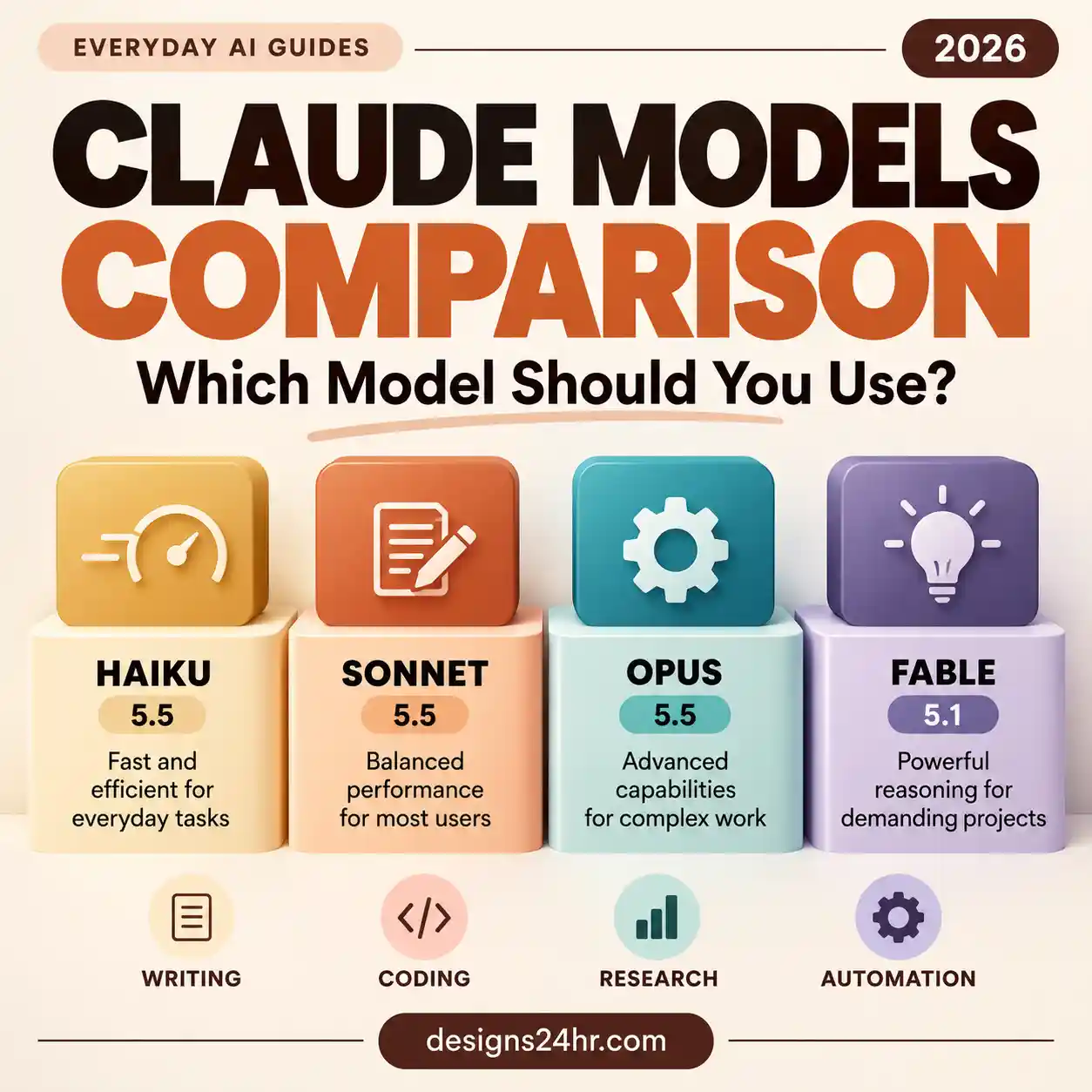
Claude Fable 5.1 is Anthropic’s newest Fable-class model for demanding coding, knowledge work, research and long-running agentic tasks. Anthropic released Fable 5.1 on September 1, 2026, with higher reported performance than Fable 5, cheaper cache reads, updated safeguards and a 1-million-token context window on supported paid Claude chats.
Claude Fable 5.1 is available now. Paid Claude users can access it according to their plan, while developers can use the API model ID claude-fable-5-1. API pricing remains $10 per million input tokens and $50 per million output tokens, while cache reads fall to $0.25 per million tokens. Anthropic estimates that this can reduce total token-billed costs by around 25% for typical Fable workloads and by up to roughly 45% for highly agentic workloads.
The important part is that “available” does not mean every Claude account gets Fable 5.1 in the same way. Pro users, Max users and organization seats can have different billing and usage behavior, so this guide separates model access, subscription limits and API pricing instead of mixing them together.
What Is Claude Fable 5.1?
Claude Fable 5.1 is Anthropic’s generally available frontier model for demanding coding and knowledge-work tasks. It succeeds Fable 5 rather than replacing lower-cost Claude models for every workload.
Anthropic positions Fable 5.1 for work that benefits from sustained reasoning, tool use, large context and long-running execution. Examples include difficult software engineering, large codebase analysis, complex research, multi-stage professional workflows and agentic tasks that may repeatedly reuse the same context.
September 1, 2026
Fable 5.1 launched as Anthropic’s newest generally available Fable model.
claude-fable-5-1
This is the model identifier Anthropic provides for Claude API developers.
$10 input / $50 output
Prices are per one million tokens before considering caching and other pricing features.
Up to 1M tokens
Anthropic currently lists Fable 5.1 with a 1-million-token context window on paid Claude plans when chatting with Claude.
What Changed in Claude Fable 5.1?
The biggest practical changes are not simply higher benchmark scores. For everyday paid users and developers, four changes matter most.
1. Anthropic reports stronger performance on difficult work
Anthropic’s launch evaluations show Fable 5.1 improving over Fable 5 across coding, knowledge work, long-running problem solving and several agentic benchmarks. Early-access companies quoted by Anthropic also reported improvements in areas such as code investigation, research, financial workflows and long multi-step tasks.
2. Cache reads are 75% cheaper
Fable 5.1 keeps the same headline input and output prices as Fable 5, but Anthropic cut the cost of reading previously cached context from $1 per million tokens to $0.25 per million tokens.
That matters most when the model repeatedly references the same large system prompt, codebase, documentation or other cached context during a long workflow.
3. Lower effort settings can be more economical
Anthropic says Fable 5.1 can reach similar or better results than Fable 5 at lower effort settings on some evaluated workloads. The practical advantage is that users may not always need the highest reasoning effort to get a strong result.
4. Safeguards are designed to intervene more precisely
Anthropic also says it reduced some false-positive safety interventions while retaining restrictions for higher-risk requests. That does not mean every Fable 5 request will now work in Fable 5.1; some categories can still be restricted.
Who Can Access Claude Fable 5.1?
Claude Fable 5.1 is available across paid Claude plans, but it is not included in every plan’s normal usage allowance. This distinction is easy to miss.
| Plan or access type | Fable 5.1 access | How usage works |
|---|---|---|
| Free | Not included | A supported paid plan is required for normal Claude access to Fable models. |
| Pro | Available | Fable usage runs through pay-as-you-go usage credits rather than the normal Pro usage allowance. |
| Max | Included | Fable can use part of the plan’s applicable weekly usage allocation before additional usage credits may be needed. |
| Team premium seat | Included | Uses applicable plan limits, subject to organization settings. |
| Team standard seat | Available | Uses pay-as-you-go usage credits. |
| Enterprise | Depends on configuration | Seat type, organization settings and billing structure can affect access. |
| Claude API | Available | Token-based API pricing applies. |
How to Use Claude Fable 5.1
For most Claude users, switching to Fable 5.1 is simpler than its billing rules.
Open Claude
Use Claude on a supported web, desktop or mobile experience and sign in with the paid account you want to use.
Open the model selector
Start a new chat or open the model picker available in your current Claude interface.
Select Fable 5.1
Choose Claude Fable 5.1 if your plan, seat and organization settings make the model available.
Check how usage will be billed
Before starting a large workflow, confirm whether your account is using an included allowance or pay-as-you-go usage credits.
Use Fable for a task that justifies it
Fable makes the most sense when the extra capability matters. A simple rewrite, short summary or everyday question may not justify a frontier-priced model.
Verify important output
A stronger model can still make errors. Review code, calculations, factual claims and consequential recommendations before relying on them.
If you work directly inside the browser, our Claude in Chrome guide explains browser actions, permissions and approval controls. The model you select and the browser permissions you grant are separate decisions.
Claude Fable 5.1 Pricing Explained
The phrase “Claude Fable 5.1 price” can refer to two different things: subscription access and token-based usage.
| Token type | Claude Fable 5.1 price | What it means |
|---|---|---|
| Fresh input | $10 / 1M tokens | New input sent to the model. |
| Output | $50 / 1M tokens | Tokens generated in the model response. |
| Cache reads | $0.25 / 1M tokens | Previously processed cached context reused by the model. |
The $10 input and $50 output rates are unchanged from Fable 5. The major pricing change is cache reads, which Anthropic says now cost 75% less.
Claude Fable 5.1 Usage Limits by Plan
Fable 5.1 does not have one universal “messages per day” number that applies to every account. Effective usage can depend on your Claude plan, seat type, context size, generated output, current usage and whether usage credits are enabled.
Max and premium organization seats
Eligible Max and premium organization seats can receive Fable usage as part of their applicable plan limits. Because Fable is more expensive to run than lower-cost models, long or context-heavy sessions can use available capacity more quickly.
Pro and standard Team seats
Fable models may be available through pay-as-you-go usage credits rather than the standard included usage allowance.
Why two users can experience different limits
A long Fable session with a huge context, tool use and substantial generated output can consume much more capacity than a short conversation. Comparing only the number of prompts between accounts can therefore be misleading.
Does Claude Fable 5.1 Have a 1M Context Window?
Yes. Anthropic currently lists Claude Fable 5.1 with a 1-million-token context window on paid Claude plans when chatting with Claude.
A larger context window lets Claude keep more source material available inside one working context. This can be useful for large documents, lengthy conversations, codebases, research material and multi-stage work.
Large source collections
Analyze substantial documents or project material without splitting everything into many tiny fragments.
Long codebase context
Keep more related files, instructions and implementation details available during difficult engineering work.
Cost and limits
A larger supported context window does not make every giant prompt efficient or inexpensive.
Irrelevant information
More context is not automatically better. Unrelated or stale information can make the task harder to reason about.
If you want Claude to retain useful preferences beyond a single conversation, that is a different feature. See our guide to viewing, editing, deleting and controlling Claude Memory.
Claude Fable 5.1 vs Fable 5
For a new Fable-class workload, Fable 5.1 is generally the more logical starting point. It keeps the same base input and output API rates, substantially reduces cache-read pricing and is the newer Fable generation.
| Feature | Fable 5 | Fable 5.1 |
|---|---|---|
| Generation | Previous Fable release | Current Fable release |
| Base input price | $10 / 1M | $10 / 1M |
| Base output price | $50 / 1M | $50 / 1M |
| Cache read price | $1 / 1M | $0.25 / 1M |
| Anthropic-reported capability | Previous frontier Fable model | Improved across multiple coding, knowledge-work and agentic evaluations |
| API model ID | claude-fable-5 |
claude-fable-5-1 |
| Best starting point for a new Fable workflow | Use when compatibility requires it | Usually start here |
When might you stay on Fable 5 temporarily?
If a production application depends on Fable 5 behavior, do not switch solely because Fable 5.1 has stronger launch benchmarks. First test representative tasks for output quality, latency, cost, tool behavior and formatting assumptions.
Claude Fable 5.1 vs Opus 5: Which Should You Choose?
Fable 5.1 is not automatically the best Claude model for every task. Opus 5 costs less for fresh input and generated output, while Fable 5.1 is positioned for especially difficult work where a higher capability ceiling may justify the additional cost.
| Factor | Fable 5.1 | Opus 5 |
|---|---|---|
| Input API price | $10 / 1M | $5 / 1M |
| Output API price | $50 / 1M | $25 / 1M |
| Cache-read price | $0.25 / 1M | $0.50 / 1M |
| Best fit | Highest-difficulty and high-value workflows | Serious professional work at lower base token cost |
Designs24hr model decision rule
Start with the least expensive model that reliably completes the task to your required standard.
- Choose Fable 5.1 when difficult reasoning, large context, long-running work or agentic reliability materially affects the outcome.
- Choose Opus 5 when you need a premium model but Fable’s higher base token rates are unnecessary.
- Choose a lower-cost Claude model when your own testing shows no meaningful quality loss.
What Is Claude Fable 5.1 Best For?
Based on Anthropic’s positioning and published evaluations, Fable 5.1 makes the most sense when the task has enough difficulty or value to justify using a frontier model.
- Complex software engineering: large migrations, difficult debugging and multi-stage implementation.
- Large-codebase investigation: following behavior across many files, services or dependencies.
- Long-running agents: workflows that plan, use tools, revisit context and continue through many steps.
- Deep research: multi-source analysis where synthesis and sustained reasoning matter.
- Professional knowledge work: difficult document analysis, planning and complex deliverables.
- Context-heavy workflows: tasks that can benefit from Fable 5.1’s lower cache-read pricing.
It is usually unnecessary to select Fable 5.1 merely to rewrite one paragraph, generate a short list or answer a routine question.
A Practical Way to Test Whether Fable Is Worth It
The most useful comparison is not “Which model sounds smarter?” It is which model completes your real task accurately enough at a cost and speed you can justify.
Use a task you actually perform regularly. Good examples include fixing a difficult coding bug, analyzing a long document, comparing several research sources or producing a complex structured deliverable.
Run the same prompt, source material and success criteria through Fable 5.1 and the alternative model. Changing the instructions makes the comparison less useful.
Complete the task below using only the information and requirements I provide.

TASK
[Describe the real task.]

SOURCE MATERIAL
[Paste or attach the relevant information.]

REQUIREMENTS
[List the non-negotiable requirements.]

SUCCESS CRITERIA
1. Correctness
2. Completeness
3. Clear reasoning
4. Useful final output
5. No invented facts
6. Follow every stated constraint

If important information is missing, identify the gap instead of guessing.

At the end, briefly list any assumptions you made.
Why Can’t I See Claude Fable 5.1?
If Claude Fable 5.1 is not showing in your account, check the most likely causes in this order.
Confirm that your plan supports Fable access
Fable models are intended for paid Claude access rather than the Free plan.
Check whether usage credits are required
Pro and some organization seats may require pay-as-you-go usage credits before Fable can be selected.
Check Team or Enterprise permissions
Organization administrators can affect model availability, billing permissions and member access.
Update Claude
If you are using a Claude app, Claude Code or another supported client, make sure it is current before troubleshooting further.
Start a fresh conversation
Open a new conversation and check the model selector again rather than relying on an older model-specific session.
Check Anthropic’s current status and documentation
If your plan and settings look correct, verify the latest official availability information before changing your subscription.
Claude Fable 5.1 API: What Developers Need to Know
Developers can identify the model using:
claude-fable-5-1
Anthropic says Fable 5.1 is available through the Claude Platform and supported cloud channels, including Amazon Web Services, Google Cloud and Microsoft Azure.
Do not migrate by changing only the model name
A production migration should include representative regression testing.
- Compare output quality on real production tasks.
- Test tool-calling behavior and expected tool sequences.
- Confirm structured-output assumptions.
- Measure latency at your chosen effort level.
- Measure input, output and caching costs.
- Test long-context behavior using your own data.
- Confirm fallback and error-handling behavior.
- Review workflows affected by model-specific safeguards.
Fable 5.1 also changes some thinking-block handling
Anthropic has introduced additional protections around preserved thinking content in the Messages API. If your integration explicitly stores, edits or manipulates thinking blocks between turns, review Anthropic’s latest API documentation before assuming behavior from an older model will transfer unchanged.
Should You Switch to Claude Fable 5.1?
If you already use Fable 5 for difficult work, Fable 5.1 is worth evaluating. The base API input and output prices remain unchanged, while cache reads are substantially cheaper and Anthropic reports stronger results across several difficult workload categories.
However, “newer” is not enough reason to move an important workflow without testing.
You already use Fable for demanding work
Especially relevant if your workflow is agentic, cache-heavy, long-running or difficult enough that Fable’s capability ceiling matters.
You depend on stable production behavior
Run your own regression tests before changing the model behind a customer-facing or business-critical workflow.
Fable is more capability than you need
Opus 5 has lower base input and output prices and may offer better value when it already meets your quality target.
Your task is routine
Do not pay frontier-model prices for work a lower-cost model completes reliably.
Frequently Asked Questions About Claude Fable 5.1
What is Claude Fable 5.1?
Claude Fable 5.1 is Anthropic’s latest generally available Fable-class model for demanding coding, knowledge work, research and long-running agentic tasks. Anthropic released it on September 1, 2026.
Is Claude Fable 5.1 available now?
Yes. Anthropic says Fable 5.1 is available across supported Anthropic platforms and major cloud providers. Access inside Claude depends on having an eligible paid plan, seat and billing configuration.
Is Claude Fable 5.1 free?
No. Fable models are not included with Claude’s Free plan. Access on paid plans can also differ depending on whether Fable usage is included or requires usage credits.
Can Claude Pro users use Fable 5.1?
Yes. Anthropic currently provides Fable access to Pro users through pay-as-you-go usage credits rather than the normal Pro usage allowance.
How much does Claude Fable 5.1 cost through the API?
Anthropic lists Fable 5.1 at $10 per million input tokens and $50 per million output tokens. Cache reads cost $0.25 per million tokens. Other pricing rules can apply to caching and deployment options.
What is the Claude Fable 5.1 API model ID?
The model ID published by Anthropic is claude-fable-5-1.
Does Claude Fable 5.1 have a 1M context window?
Yes. Anthropic currently lists a 1-million-token context window for Fable 5.1 on supported paid Claude chats.
Is Fable 5.1 better than Fable 5?
Anthropic reports higher performance for Fable 5.1 across several coding, knowledge-work and agentic evaluations. It also has substantially cheaper cache reads. For important production use, compare both models on your own representative tasks.
Is Claude Fable 5.1 better than Opus 5?
Not for every workload. Fable 5.1 is positioned for the hardest tasks, while Opus 5 has lower base API input and output prices. If Opus reliably meets your requirements, it may provide better value.
Why is Claude Fable 5.1 not showing in my model picker?
Check your paid plan, usage-credit settings, Team or Enterprise permissions, and whether your Claude app or development tool is current. Organization settings can also affect model availability.
Does Fable 5.1 work with Claude Code?
Anthropic supports Fable models in Claude Code. Keep Claude Code updated because newly released models can require a sufficiently recent client version.
Are Claude Fable 5.1 and Mythos 5.1 the same model?
Anthropic says they use the same underlying model but different safeguards and access rules. Fable 5.1 is generally available, while Mythos 5.1 is restricted to approved trusted-access use cases.
Continue Learning About Claude
Final Verdict
Claude Fable 5.1 is a meaningful Fable update, but its value depends on the work you need it to perform.
For users already running difficult coding, research or agentic workflows on Fable, Fable 5.1 deserves serious evaluation. Anthropic has kept the $10/M input and $50/M output base rates unchanged while reducing cache-read pricing to $0.25/M, which can materially improve the economics of context-heavy workflows.
For everyone else, the better question is not simply “Is Fable 5.1 more powerful?” It is “Does my task benefit enough from Fable 5.1 to justify using it instead of another Claude model?”
Use Fable 5.1 when the difficulty, duration or value of the work requires it. Use a cheaper model when it produces a result you can trust. And for production workflows, validate the new model against your own tasks before changing a stable system.
Official Sources and Editorial Note
Last reviewed: September 1, 2026. This guide prioritizes Anthropic’s first-party documentation. Benchmark and estimated cost-reduction claims attributed to Anthropic are not presented as independent Designs24hr testing.
- Anthropic — Claude Fable 5.1 and Claude Mythos 5.1 announcement
- Anthropic — Claude Fable model overview
- Anthropic Help Center — Claude Fable models on your plan
- Anthropic Help Center — Context windows on paid Claude plans
- Anthropic — Claude Opus 5
- Anthropic Help Center — Preserved thinking and Messages API behavior