Everyday AI Guides · Start Here
Wondering how to learn AI? You can start with free resources, even if you have never written code. The key is to choose what you want to do with artificial intelligence, learn a few essentials, practice on real tasks, and check your results instead of memorizing tool names.
Quick answer: To learn AI from scratch, (1) pick a goal, (2) understand the basics, (3) try an AI tool, (4) learn prompting, (5) verify its answers, (6) finish one small project, and (7) choose a learning path. Beginners who only want to use AI for work, studying, or everyday tasks do not need to learn coding first. Building AI systems is a different, more technical route.
What Does It Mean to Learn Artificial Intelligence?
Before deciding how to learn AI, distinguish using AI from building AI. Both are valuable, but the skills and prerequisites are different.
| What you want to do | What you learn first | Coding needed? |
|---|---|---|
| Use AI for everyday tasks | Clear prompts, useful context, reviewing responses, privacy | No |
| Use AI at school or work | Research checks, editing, planning, responsible workflows | No |
| Automate repeatable tasks | Process mapping, triggers, review checkpoints, simple integrations | Not always |
| Build AI-powered software | Python, data, APIs, evaluation, software basics | Usually |
| Train machine-learning models | Python, statistics, algebra, datasets, model evaluation | Yes |
Artificial intelligence is a broad field concerned with systems that perform tasks involving prediction, recognition, decision support, or content generation. Machine learning is one approach in which models learn patterns from data. Generative AI can produce text, images, code, or other content from inputs. Learning to use a generative AI assistant is a useful starting skill, but it is not the same as studying how models are trained.
If these terms feel abstract, start with Google’s Introduction to Machine Learning, which explains core ideas without requiring you to implement a model. You do not need to finish a technical course before trying your first practical task.
How to Learn AI From Scratch: Choose Your Goal First
The fastest way to become overwhelmed is to search for every AI course at once. If you are considering how to learn AI for beginners, first choose one outcome you would genuinely use.
Everyday AI user
Goal: Explain unfamiliar topics, organize plans, draft messages, and make better decisions. Start with: prompts, verification, privacy.
Student or educator
Goal: Build understanding, generate practice questions, and study independently. Start with: tutoring prompts, recall, source checking.
Employee or small-business owner
Goal: Improve repeatable work such as writing, scheduling, summarizing, or customer-message drafts. Start with: workflows and human review.
Future AI developer
Goal: Create AI-powered applications or learn machine learning. Start with: Python, basic data skills, math fundamentals.
Decision rule: If you want to use AI better, begin with the seven steps below. If you want to build AI applications, complete the introductory exercises first, then follow the programming pathway later in this guide. You can change direction once you have more experience.
How to Learn AI for Beginners: 7 Easy Steps
This is a practical way to learn AI step by step. Each stage includes an action and a visible result so you can tell the difference between watching tutorials and developing a skill. Use a free AI option that is available to you; the interface and limits may differ by provider and account.
Step 1: Choose One Real Problem to Solve
Write down a task you already do: preparing a weekly plan, improving a work email, understanding a difficult concept, or summarizing your own non-sensitive notes. Keep the first task small enough to complete in 20–30 minutes.
Exercise: Write a one-sentence goal, what a successful result looks like, and what AI must not do. Example: “Help me organize my public meeting notes into a checklist, without inventing new action items.”
I'm new to AI. My goal is [describe one everyday task]. Suggest three small ways AI could help. For each, explain what I should provide, what I must verify myself, and one thing I should avoid. Keep it beginner-friendly and do not assume I know coding.
Proof of learning: You can explain the task in your own words and identify where human judgment is needed.
Step 2: Learn the Core AI Concepts
You only need a working understanding of a few terms at first: AI, machine learning, generative AI, model, prompt, training data, and hallucination. An AI hallucination is a plausible-sounding output that is false or unsupported. It is not a reliable sign that the rest of a response is correct.
Exercise: Explain the difference between a search engine and a generative AI assistant in two sentences. Then explain why an AI-generated answer still needs verification. If you cannot explain it simply, revisit the concept rather than memorizing a definition.
Proof of learning: You understand what AI can assist with and why it can fail.
Step 3: Try One Free AI Tool
When deciding how to learn AI tools, start with one general-purpose assistant rather than opening ten services. Try asking for an explanation, a short outline, or a checklist based on non-sensitive information. Compare the first result with your original goal.
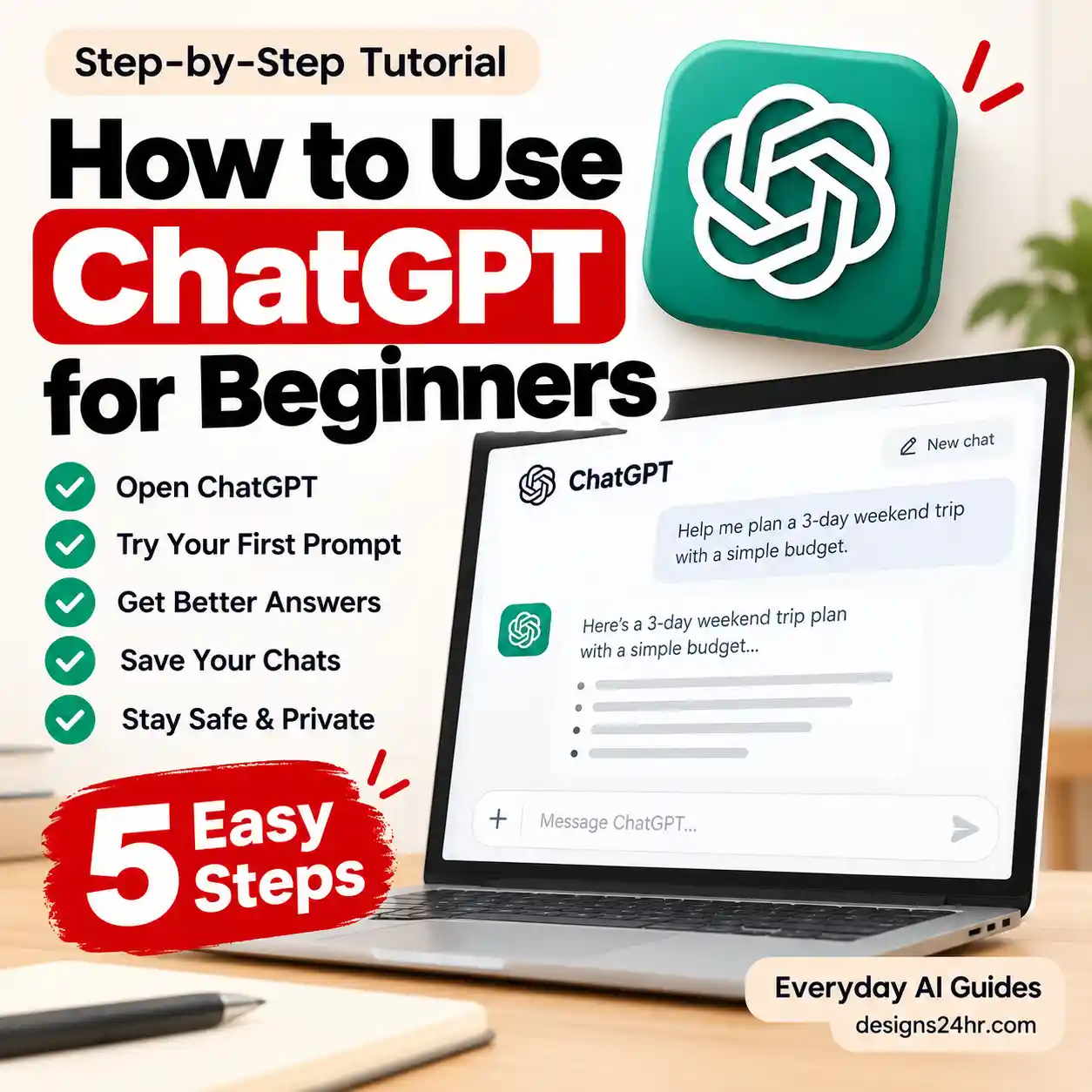
If this is your first conversation, follow our beginner’s guide to using ChatGPT to learn how to send a prompt and request a useful follow-up. The example skill—clarifying a request—also applies to many other AI assistants.
Exercise: Ask for a simple weekly plan with two constraints. Then ask the tool to revise one part of its answer. Record whether the second result is genuinely better.
Proof of learning: You can guide a tool through one revision without treating the first output as final.
Step 4: Learn AI Prompting, Not Magic Commands
If you want to learn AI skills that transfer between tools, prompting is a good early investment. Give the tool a task, relevant context, a desired format, and any limits. Avoid sharing passwords, private records, or confidential customer information as practice material.
Help me [specific task]. Context: [relevant non-sensitive details]. Audience: [who will use the result]. Format: [short checklist, table, or paragraph]. Limits: [length, budget, time, or things to avoid]. Before answering, identify any important missing information. Separate assumptions from facts.
Exercise: Run your request once with only the task, then once with context and limits. Compare the results for accuracy, usefulness, and unnecessary assumptions. For a fuller process, see our guide to using ChatGPT effectively.
Proof of learning: You can recognize why one prompt produces a more usable answer than another.
Step 5: Verify Information and Protect Your Data
Learning how to learn AI responsibly means checking outputs instead of believing them because they sound confident. Confirm important claims against primary sources, calculate numbers independently, inspect cited links, and ask whether the answer fits your circumstances.
Exercise: Ask for an explanation of a factual topic you can verify using a trusted reference. Identify two claims and check them manually. If a claim cannot be supported, mark it as uncertain. Do not test with medical, legal, financial, or otherwise high-stakes decisions.
- Does the answer address the original question?
- Are dates, figures, links, and quotations verified?
- Did the assistant invent a source or hide an assumption?
- Am I comfortable with the data I supplied?
- Can I explain the final decision without the AI?
Proof of learning: You can correct an AI error and explain why it was wrong.
Step 6: Complete One Small AI Project
Choose a project with a real deliverable. A useful example is a personal weekly task plan: provide a fictional task list, have the AI group priorities, then manually check deadlines and edit the final version. Another option is rewriting a generic email draft for clarity and tone.
Act as a planning assistant. Using this fictional task list: [paste tasks], group items by priority and propose a realistic three-day plan. Do not invent due dates. Mark missing information clearly. Present a table with task, priority, suggested day, and what I should check myself.
Exercise: Save the first response, write down three improvements, revise the result, and compare both versions. Keep a short note about what you—not the AI—decided.
Proof of learning: You have a completed, reviewed output and can describe how it was improved.
Step 7: Choose What to Learn Next
After completing the project, ask what was most useful. If you enjoyed writing prompts and checking information, develop practical workflows. If you wanted to understand or customize the underlying software, explore Python and AI programming. If you enjoyed planning repetitive work, learn AI automation with clear approval steps.
Exercise: Write three columns: “I can do,” “I need to practice,” and “I want to build next.” Choose one skill for the following week instead of starting five courses.
Proof of learning: You have evidence of progress and a realistic next task, not just a list of videos watched.
How to Learn AI for Free: Reliable Beginner Resources
If you want to learn AI for free, prioritize accessible primary-source lessons before paying for a certificate or software subscription. Course details, sign-in requirements, free tiers, and certificates can change, so check the provider’s enrollment page before starting.
| Resource | Best for | Coding? | What to know |
|---|---|---|---|
| OpenAI Academy: AI Foundations | Using AI at work and everyday tasks | No | Introductory self-paced pathway, approximately 70 minutes; uses a ChatGPT account. Check the Academy page for current badge or assessment rules. |
| Google: Introduction to Machine Learning | Core ML concepts | No implementation required | Short conceptual introduction; does not teach you to build ML models. |
| Microsoft: AI for Beginners | Exploring technical AI | Yes, for labs | Open 12-week, 24-lesson curriculum with quizzes and coding labs; beginners may need extra programming preparation. |
| Google: Machine Learning Crash Course | Learning ML more deeply | Python recommended | Interactive exercises; review the programming, algebra, and statistics prerequisites first. |
What about free AI certificates? Learning material can be free even when certificates, assessments, subscriptions, or identity verification involve different rules. Do not enroll solely because a search result says “free certificate.” Confirm the exact award, requirements, and cost on the official course page. A completed project is also useful evidence of what you can do, though it is not equivalent to a formal credential.
If your goal is simply to learn AI tools for free, you can practice several skills using the Designs24hr free tools directory. Choose a task-based utility rather than treating tool exploration as the entire learning process.
How to Learn AI Skills Without Coding
If you are wondering how to learn AI skills for free, begin with repeatable tasks rather than buying tools. For many beginners, the most useful AI skills are not programming skills. Start with tasks where you can quickly inspect the output and correct mistakes. That creates a repeatable foundation for work, study, personal planning, and small-business tasks.
- Prompting: Describe a task and request a clear output format.
- Editing: Improve AI-produced text without accepting every suggestion.
- Verification: Trace factual statements back to trustworthy evidence.
- Comparison: Evaluate alternatives using stated criteria instead of vague recommendations.
- Privacy judgment: Recognize which information should not be submitted to a service.
- Workflow design: Identify steps AI can assist with and steps requiring human approval.
To practice explanations and questions without letting AI replace your thinking, read our separate guide to studying with AI. It focuses on learning academic material, while this guide focuses on learning AI itself.
I'm learning beginner AI skills. Ask me five short questions, one at a time, about prompting, verification, privacy, and AI limitations. Do not reveal the answer until I try. After each response, explain what I got right or wrong and give me one practice task.
How to Learn AI Coding and Programming From Scratch
If your longer-term goal is to develop AI systems, learning how to learn AI involves more than using a chatbot. You will eventually need programming, data handling, evaluation, and enough mathematics to understand the models you use.
- Learn Python basics: Variables, functions, loops, collections, and reading files.
- Understand data: Tables, missing values, charts, and basic data cleaning.
- Study ML fundamentals: Training versus testing data, classification, regression, and model errors.
- Practice evaluation: Measure what a system gets right and where it fails rather than judging only by one impressive example.
- Build a small project: Use a public sample dataset and document assumptions, limitations, and results.
Microsoft’s open curriculum is a structured starting point for technical AI topics. Google’s Machine Learning Crash Course becomes more useful once you are comfortable with Python and basic math. Neither is a prerequisite for learning to use generative AI responsibly in everyday work.
Do not confuse using an AI API with training a model. An API can let an application call an existing model. Training, fine-tuning, evaluating, and deploying models are separate activities with different costs and skill requirements. Begin with the smallest path that matches your goal.
How to Learn AI Automation After the Basics
AI automation means putting tools into a repeatable process. A simple workflow might collect non-sensitive text, generate a draft, check required fields, and present it for human approval. You do not have to automate an entire business to learn the concept.
Beginner project: Map a weekly status-update process using four boxes: input, draft, verification, approval. Record which step is deterministic, which uses AI, and who accepts the final result. Try the process manually before paying for an automation platform.
- Start with low-risk, reversible tasks.
- Keep access to accounts and sensitive data limited.
- Require review before sending messages, spending money, or changing records.
- Track failures and have a manual fallback.
People searching for how to learn AI automation often jump straight to tool comparisons. A defined process and clear success checks matter more than owning an impressive stack of software.
How to Learn AI Step by Step: A Realistic Four-Week Plan
You can adapt this schedule to your time. It is a practice plan, not a promise that you will master AI in four weeks. If you only have 15 minutes a day, split the exercises across more sessions.
| Week | Focus | Practical task | Evidence of progress |
|---|---|---|---|
| 1 | Basic concepts and first prompts | Explain AI terms; request and revise a simple plan | One corrected output and a glossary in your own words |
| 2 | Prompting and verification | Compare two prompts and verify two claims | Before/after answers with source checks |
| 3 | Practical workflows | Use AI for a fictional message, task list, or study quiz | A useful deliverable plus a review checklist |
| 4 | Independent mini-project | Finish a small project and select a next learning path | Final output, limitations, and a next-step plan |
Save evidence as you go. A folder containing your original prompts, corrected responses, source links, and decisions is more informative than merely recording the number of tutorials completed.
How to Know Whether You’re Actually Learning AI
Use this original, simple 10-point self-assessment after finishing your first project. It is an editorial practice tool, not a certified exam or a scientific measure of expertise. Give yourself 0 if you cannot do the task, 1 if you need help, and 2 if you can do it independently.
| Skill | Can you demonstrate it? | Score |
|---|---|---|
| Define a task | State the goal and how to judge a successful outcome. | 0 / 1 / 2 |
| Write a useful prompt | Provide context, format, and limits. | 0 / 1 / 2 |
| Verify results | Check important claims using reliable evidence. | 0 / 1 / 2 |
| Protect information | Identify private details that should not be uploaded. | 0 / 1 / 2 |
| Finish independently | Revise and explain your final result without copying blindly. | 0 / 1 / 2 |
Interpretation: A lower score tells you which skill needs practice; a higher score means you demonstrated these introductory tasks under these conditions. Neither score certifies professional competence. Repeat the assessment with a new task in a few weeks.
To improve, pick the lowest-scoring category and repeat a different exercise. This is a more useful way to decide how to learn AI next than collecting random prompts or chasing every newly released tool.
Common Mistakes When Learning AI From Scratch
Watching without practicing
Better: Finish one task after each lesson. Keep the first draft and your correction.
Trying too many tools
Better: Use one accessible assistant until you understand prompting and verification.
Believing fluent answers
Better: Check claims, links, dates, calculations, and source quality independently.
Paying before defining a goal
Better: Start with free materials. Pay only when a feature or course solves a proven need.
Uploading private files
Better: Use fictional or non-sensitive practice examples; check provider data controls.
Assuming coding is mandatory
Better: Choose practical usage skills first unless your goal is to develop AI software.
Frequently Asked Questions About How to Learn AI
How to learn AI from scratch with no experience?
Choose one task, understand a few core concepts, try an accessible tool, practice clear prompts, verify answers, and complete a small project. Beginners who want to use AI do not need a programming background.
Can I learn AI for free?
Yes, foundational concepts and many practical exercises can be learned using free educational resources. Providers may require an account, apply usage limits, or charge separately for certain courses or certificates. Check the official terms.
How long does it take to learn AI skills?
Basic AI usage habits can be practiced over days or weeks, depending on time and prior experience. Becoming a capable developer or machine-learning practitioner usually requires a much longer, more technical learning path. There is no universal completion time.
Do I need mathematics or coding to learn AI?
Not for using everyday generative AI tools. Programming and mathematics become important when building software, training models, or studying machine learning in depth.
What should I learn first: AI tools or AI programming?
Learn tools first if your goal is productivity, writing, studying, or business workflows. Start Python and data skills if you want to build AI-powered applications or pursue a technical career. Both routes benefit from knowing how to evaluate AI errors.
How to learn AI for free with a certificate?
Check the current official course enrollment and assessment requirements. Some providers offer learning access, completion badges, or certificates under different conditions. A free lesson does not automatically mean a free credential.
Can learning AI help me make money?
AI skills may support useful services or improve work efficiency, but income is not guaranteed. Develop a demonstrable skill, understand a customer’s actual problem, and avoid claiming capabilities or results you cannot deliver.
What is the best way to learn AI online?
Combine trustworthy courses with practice on real, low-risk tasks. Use a learning goal, save corrected examples, and periodically assess whether you can work independently rather than relying only on video completion.
Your Next Step: Practice One Useful AI Skill Today
You do not need to finish a long curriculum before beginning. Set one goal, complete the first prompt exercise, check the answer, and save what you learned. Then follow the next guide that matches your needs.
Official Learning Resources and Editorial Notes
These primary sources explain the learning paths and prerequisites mentioned above. Product features, account access, and course credentials may change over time.
- OpenAI Academy — AI Foundations: introductory AI and ChatGPT learning pathway.
- Google for Developers — Introduction to Machine Learning: conceptual fundamentals.
- Microsoft — AI for Beginners: coding-oriented curriculum.
- Google — Machine Learning Crash Course prerequisites: recommended preparation for technical learners.
Editorial review: October 15, 2026. This independent guide is educational, not a guarantee of employment, certification, earnings, or expertise. Exercises and scoring rubrics are illustrative learning aids, not reported tests or scientific assessments. No paid enrollment or personal-data upload is required to follow the exercises described here.