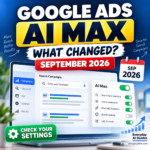
Google Ads AI Max for Search campaigns is changing how some existing Search campaign features are organized and controlled. During September 2026, Google is automatically migrating Search campaigns that use campaign-level Broad Match or standalone Automatically Created Assets into AI Max. However, active legacy Dynamic Search Ads are not part of that September automatic migration.
The important distinction: campaign-level Broad Match and standalone Automatically Created Assets are being migrated to AI Max during September 2026. Google has moved automatic Dynamic Search Ads migration to February 2027.
If you run Google Search ads, the practical question is no longer simply “What is AI Max?” It is: what changed in my campaign, which AI Max settings are active, and do those settings fit the way I want to spend my advertising budget?
Last checked: September 14, 2026. Google Ads features and migration schedules can change, so important account decisions should also be checked against the current controls shown inside your own Google Ads account.
Designs24hr is not affiliated with Google. This guide explains publicly documented Google Ads features and provides an independent workflow for reviewing them.
What Is Google Ads AI Max for Search Campaigns?
Google Ads AI Max for Search campaigns is not a separate campaign type. Google describes it as an optimization layer that can be enabled within an existing Search campaign.
AI Max groups several targeting, creative and landing-page features into one system. Depending on the settings you enable, it can expand the search terms your ads are eligible for, generate or customize ad text, select a more relevant landing page, and provide additional controls for brands and URLs.
The main AI Max features currently include:
- Search Term Matching: uses broad-match and keywordless technology to find additional relevant searches.
- Text Customization: generates additional headlines and descriptions using signals such as your existing ads, landing pages, domain and ad-group context.
- Final URL Expansion: can send a searcher to a different relevant page on your domain instead of always using the Final URL you originally entered.
- Brand controls: provide options for brand inclusions and exclusions.
- URL controls: help advertisers include or exclude pages from certain AI Max behavior.
- Expanded reporting: provides more information about AI Max search terms, generated assets and selected landing pages.
AI Max is not Performance Max. AI Max works inside Search campaigns. It retains the Search campaign structure while adding AI-powered Search features and controls.
That distinction matters for small-business advertisers because turning on more automation does not eliminate the need to understand where traffic is coming from, which landing pages people see and what a conversion is worth to the business.
What Changed With Google Ads AI Max in September 2026?
The biggest source of confusion is that several Google Ads changes have been discussed under the broader AI Max transition, but they do not all happen at the same time.
Google’s current migration guidance separates the legacy transition into different phases.
| Existing feature | Current migration timing | What happens |
|---|---|---|
| Campaign-level Broad Match | September 2026 | Eligible Search campaigns are progressively upgraded to equivalent AI Max settings. |
| Standalone Automatically Created Assets | September 2026 | The legacy feature becomes Text Customization inside AI Max. |
| Legacy Dynamic Search Ads | February 2027 | Active legacy DSA campaigns continue serving for now and are excluded from the September automatic migration. |
Do not assume every Dynamic Search Ads campaign has automatically moved to AI Max. Google’s current documentation places automatic DSA upgrades in February 2027, not September 2026.
Did Google Automatically Enable AI Max on Your Campaign?
Possibly—but the answer depends on what the Search campaign was using before the migration.
Google says campaigns using campaign-level Broad Match or Text Customization, formerly known as Automatically Created Assets, are being upgraded to AI Max beginning in September 2026.
A migrated campaign can have AI Max enabled while individual AI Max features are configured differently. That is why the top-level AI Max status is not enough for a useful account audit.
Open the individual AI Max controls and review Search Term Matching, Text Customization, Final URL Expansion, brand controls and URL controls rather than assuming the campaign’s behavior from the AI Max label alone.
What Happens to Campaign-Level Broad Match?
Google says Search campaigns using the old campaign-level Broad Match setting are automatically upgraded to AI Max beginning in September 2026.
Under AI Max, Search Term Matching combines broad-match technology with additional keywordless matching signals. Google’s developer documentation also notes that when AI Max Search Term Matching is active, campaign-level keyword match-type behavior changes and individual keyword match types may not operate in the same way until Search Term Matching is disabled at the ad-group level.
That makes search-term reporting one of the first places to look after an upgrade.
Ask:
- Are the additional searches genuinely relevant?
- Which new queries are spending meaningful budget?
- Are those queries producing qualified conversions?
- Are brand controls still appropriate?
- Would an ad-group-level restriction make sense for part of the campaign?
What Happens to Automatically Created Assets?
Google now calls Automatically Created Assets in this context Text Customization.
Text Customization is an AI Max campaign-level setting that can create additional headlines and descriptions using information such as your domain, landing page, existing ads and ad-group keywords.
This can reduce some repetitive creative work, but advertisers should still review what is generated.
- Check factual product and service claims.
- Check prices and promotional wording.
- Check important exclusions or eligibility conditions.
- Check that generated copy matches the landing page.
- Check whether brand terminology remains consistent.
Google also provides text-guideline controls within AI Max that can help advertisers restrict certain terms or messaging. Treat them as useful guardrails—not a substitute for reviewing what actually serves.
What About Dynamic Search Ads?
Dynamic Search Ads are the part of the AI Max transition most likely to produce outdated advice.
Google currently states that campaigns using Dynamic Search Ads will automatically upgrade to AI Max starting in February 2027.
That means:
- Legacy DSA campaigns may still be active during September 2026.
- The September Broad Match and Text Customization upgrades should not be interpreted as the automatic end of DSA.
- Advertisers should use Google’s latest documentation rather than older announcements when planning the DSA transition.
If another article says all Dynamic Search Ads automatically migrate in September 2026, check when it was written or last updated. Google’s current Help documentation specifies February 2027.
The 5-Minute Google Ads AI Max Settings Audit
You do not need to redesign your entire advertising strategy simply because AI Max appears in your account. Start by documenting what the Search campaign is doing now.
1. Check Whether AI Max Is Enabled
Open the relevant Search campaign and review its AI Max settings.
If AI Max is active, continue into the individual feature panels rather than stopping at the campaign-level toggle.
2. Check Search Term Matching
Search Term Matching can expand reach beyond what your original keyword configuration would have captured.
Review:
- the actual search terms receiving traffic;
- cost by query theme;
- conversion rate and conversion value where available;
- whether new search themes match genuine buyer intent;
- whether negative keywords or tighter ad-group controls are needed.
3. Check Text Customization
If Text Customization is enabled, examine the automatically generated assets that have actually served.
- Are the claims accurate?
- Is pricing language correct?
- Does the wording fit your brand?
- Does the ad accurately describe the destination page?
- Could any headline create an expectation your business cannot meet?
4. Check Final URL Expansion
Final URL Expansion can allow Google to select a different relevant page on your domain when it predicts that page better matches the searcher’s intent.
Before using it broadly, review whether your website contains pages that should never receive paid traffic.
Examples can include:
- old promotions;
- archived products;
- low-intent informational pages;
- login pages;
- thank-you pages;
- outdated service pages;
- URLs with old prices or unavailable offers.
Use URL exclusions where appropriate.
5. Review Brand Controls
Check whether your campaign should include or exclude particular brands and whether branded and non-branded demand still needs to be separated for reporting or budget reasons.
6. Review URL Controls
A useful test is:
If the answer is no for part of the website, review your URL controls before expanding landing-page automation.
7. Verify Conversion Tracking
AI Max works best when the campaign has a meaningful signal to optimize toward. More automation makes measurement quality more important, not less.
- The primary conversion represents a useful business outcome.
- Duplicate conversions are not inflating performance.
- Lead quality is reviewed when a form submission is not equal to a sale.
- Ecommerce conversion values are reasonably accurate.
- Offline or qualified-lead outcomes are incorporated when practical.
Automation can scale a good signal or a bad one. If the campaign is optimizing toward the wrong definition of success, increasing its freedom can make the wrong outcome easier to scale.
Should You Keep Google Ads AI Max Turned On?
There is no responsible universal answer.
A campaign producing profitable incremental conversions with relevant queries may justify more automation. A campaign with weak conversion tracking, poor landing pages or strict messaging constraints may need tighter controls first.
KEEP
Keep the current setup when measurement is trustworthy, expanded searches remain relevant, landing pages are suitable and the campaign is meeting the business goal.
TEST
Use a controlled AI Max experiment when the fundamentals are strong but you still need evidence that additional automation creates incremental value.
REVIEW FIRST
Tighten the setup before expanding automation when conversions are unreliable, URLs are messy, messaging is sensitive or irrelevant queries are consuming budget.
Google currently supports AI Max experiments for Search campaigns, which can provide a cleaner comparison than changing several live settings at once and guessing what caused the result.
How to Check What AI Max Is Actually Doing
A useful Google Ads AI Max audit should go beyond the settings page.
Review Search Terms
Look at the search terms receiving traffic and compare them with your actual commercial intent.
Review:
- search term;
- cost;
- conversions;
- conversion value where relevant;
- landing page;
- query theme;
- whether the traffic came from useful expansion or irrelevant matching.
The goal is not to reject every search that differs from your original keyword list. The goal is to determine whether broader matching still produces relevant and economically useful demand.
Review Landing Pages
If landing-page expansion is active, inspect which URLs are receiving paid traffic.
A relevant search sent to the wrong landing page is a different problem from an irrelevant search sent to a technically correct landing page. Separate those issues before deciding what to change.
Review Generated Assets
Evaluate generated headlines and descriptions for both performance and accuracy. A headline can attract clicks and still be unsuitable if it misrepresents the offer.
Track Paid Traffic Beyond Google Ads
Use consistent campaign parameters so you can compare paid-search traffic in analytics and downstream systems. Designs24hr’s free UTM Builder can help create campaign tracking URLs.
Google Ads reporting tells you how the advertising platform attributes results. Your analytics, ecommerce platform, CRM or sales data can help answer the larger question: did those conversions become valuable customers?
One More September 2026 Google Ads Change to Watch
AI Max is not the only Search advertising change happening in September 2026.
Google is removing the campaign-level language targeting setting from Search campaigns starting in September 2026.
Instead of requiring the advertiser to select campaign languages, Google says Search ads will automatically match using the language of the ad together with signals that help determine which languages the user understands.
Google says no action is required from advertisers for the platform change itself. However, multilingual advertisers should still understand how their ad language and landing-page language affect the traffic they receive.
What Changes?
| Before | Starting September 2026 |
|---|---|
| Search campaigns can use a campaign-level language setting. | That campaign-level language setting is removed for Search campaigns. |
| Campaign language selection is one of the signals considered for eligibility. | Google automatically evaluates the language of the ad and signals about languages the user understands. |
| Advertisers manually select target languages at campaign level. | No separate campaign-language selection is required for Search campaigns. |
Google says its Search systems can use signals including the language of the search term, user language settings and language preferences to understand which language a person can use.
An AI Max campaign is still a Search campaign. The September language-targeting change therefore matters to AI Max-enabled Search campaigns as part of the broader Search campaign system—it is not a separate AI Max feature that you need to switch on.
What Multilingual Advertisers Should Review
Google says no action is required for the migration itself. That does not mean multilingual campaign quality becomes irrelevant.
If you advertise in more than one language, review:
- the language used in each ad group;
- whether the landing page matches the language of the ad;
- whether translated landing pages are current and accurate;
- whether one ad group contains mixed-language creative unnecessarily;
- whether search terms show unexpected language patterns after the change;
- whether conversion performance differs materially by language or market.
The removal of the campaign-level language setting does not mean Google will translate your ads automatically or that every ad can serve effectively in every language. The language and relevance of your actual creative and landing page still matter.
Google’s current explanation is available in its official language-targeting documentation.
Use AI to Review Your AI Max Setup Without Sharing Sensitive Data
An AI assistant can help organize a campaign audit, identify questions to investigate and classify anonymized data. It cannot know what is happening inside your Google Ads account unless you provide that information.
Do not paste customer records, billing details, passwords, API keys, private account identifiers or information you are not authorized to share.
Prompt 1: Google Ads AI Max Settings Audit
Use this after you have manually checked your current Google Ads AI Max settings.
I am reviewing a Google Ads Search campaign after the September 2026 AI Max changes.

Here is an anonymized summary of the campaign:

Business type: [BUSINESS TYPE]
Main campaign goal: [GOAL]

AI Max: [ON/OFF]
Search Term Matching: [ON/OFF]
Text Customization: [ON/OFF]
Final URL Expansion: [ON/OFF]

Brand inclusions: [SUMMARY]
Brand exclusions: [SUMMARY]
URL inclusions: [SUMMARY]
URL exclusions: [SUMMARY]

Primary conversion goal: [GOAL]
Bidding strategy: [STRATEGY]
Main landing page type: [TYPE]

Help me audit this setup.

For each relevant setting:
1. Explain what it controls in plain English.
2. Explain what I should verify before keeping it enabled.
3. Identify possible search-quality, measurement, landing-page or messaging risks.
4. Tell me which Google Ads reports or metrics I should inspect before making a change.
5. Separate facts from assumptions.
6. Do not assume more automation is automatically better.
7. Do not invent missing campaign data.
8. Do not promise that a setting will improve conversions or ROAS.

Finish with a prioritized checklist of the five things I should inspect first.
Replace the bracketed fields with anonymized campaign information before using the prompt.
Prompt 2: Review AI Max Search Terms
This prompt is useful when you have exported a small anonymized sample of real search-term data.
I am auditing search terms from a Google Ads AI Max Search campaign.

Business:
[PRODUCT OR SERVICE]

The main customer intent I want:
[INTENT]

Primary conversion:
[CONVERSION]

Below is an anonymized sample containing:
- Search term
- Clicks
- Cost
- Conversions
- Conversion value if available
- Landing-page category

[PASTE ANONYMIZED DATA HERE]

Classify each search term as:
- Clearly relevant
- Potentially relevant
- Clearly irrelevant
- Needs more business context

For every classification:
1. Explain the reasoning.
2. Identify whether the problem appears to be query relevance, landing-page relevance or insufficient data.
3. Flag possible negative-keyword themes.
4. Identify search themes that may deserve a dedicated ad group or landing page.
5. Flag cases where the sample is too small for a reliable conclusion.

Do not recommend excluding a term only because it has zero conversions from a very small sample.

Do not invent missing data.
Remove customer data and confidential business information before pasting any campaign export into an AI tool.
Prompt 3: Review AI Max Landing Pages
This prompt is especially useful before deciding whether Final URL Expansion should have access to a large part of your website.
I am reviewing landing pages that may be used by Google Ads AI Max.

My business sells:
[PRODUCT OR SERVICE]

My main paid-search conversion is:
[CONVERSION]

Here are the TYPES of pages on my site:
[LIST PAGE TYPES — for example: service pages, product pages, blog posts, old promotions, login pages, support pages]

Help me build a Final URL Expansion audit.

Create four groups:
1. Strong paid-search landing-page candidates
2. Pages that may be useful but need manual review
3. Pages that should probably be excluded from paid-search landing-page expansion
4. Pages where you need more information before deciding

For each group, explain the reasoning.

Then give me a manual checklist I can use before adding URL exclusions.

Do not assume that every indexable website page is suitable for paid traffic.
This is a planning prompt. Verify the actual eligible URLs and exclusions inside Google Ads before changing a live campaign.
Do not send an AI tool passwords, customer lists, payment details, private account identifiers, authentication codes, API credentials or personal information simply to perform a campaign audit.
Google Ads AI Max Settings Small Businesses Should Watch Most Closely
A small business usually does not have separate teams for paid search, analytics, conversion optimization, creative and landing pages. That makes a few AI Max controls disproportionately important.
Watch whether expanded reach continues to match the real customer intent you can profitably serve.
Review generated headlines and descriptions for factual accuracy, positioning and offer consistency.
Check whether Google can route paid traffic to pages that are genuinely ready to convert visitors.
Make sure the campaign is learning from an action that represents meaningful business value.
You do not need to choose between “manual everything” and “let AI do everything.” Use automation where your measurement and controls support it, while keeping human judgment around your offer, customer value, messaging and business risk.
AI Max vs Traditional Search Campaign Management
Google Ads AI Max changes where some of the campaign work happens. It does not eliminate the advertiser’s job.
| Area | Traditional manual emphasis | AI Max emphasis |
|---|---|---|
| Search reach | Keyword lists and match types | Keywords plus broader and keywordless search matching |
| Ad text | Advertiser-created responsive Search ad assets | Advertiser assets plus optional Text Customization |
| Landing pages | Advertiser-selected Final URL | Optional Final URL Expansion plus URL controls |
| Brand control | Campaign structure, keywords and negatives | Additional brand inclusion and exclusion controls |
| Optimization | More targeting decisions are set manually | More real-time decisions can be automated from campaign signals |
| Human responsibility | Build and control more of the targeting directly | Define goals, audit expansion, protect constraints and judge business value |
10 Common Google Ads AI Max Mistakes
- Assuming AI Max is a separate campaign type. It is an optimization layer for Search campaigns.
- Assuming all AI Max features are automatically enabled together. Review each individual control.
- Assuming Dynamic Search Ads automatically migrated in September 2026. Google’s current documentation points to February 2027.
- Turning on Final URL Expansion without auditing the website. Not every website page is suitable for paid traffic.
- Ignoring generated assets. Automation still needs factual and brand review.
- Using a weak conversion goal. AI Max cannot know that your chosen conversion is commercially unimportant unless your measurement tells it so.
- Judging performance from clicks or impressions alone. Evaluate downstream outcomes.
- Changing several major settings at once. That can make it difficult to understand what caused a performance change.
- Copying another advertiser’s AI Max setup. Their economics, query mix, landing pages and customer value may be completely different.
- Assuming an AI assistant knows your account. AI can organize the information you provide, but it should not invent missing campaign facts.
What AI Max Can Do—and What It Still Cannot Decide for You
- expanding relevant search matching;
- customizing additional ad text;
- selecting eligible landing pages;
- using campaign signals at auction time;
- providing additional reporting and controls.
- which customers are actually valuable;
- which conversions matter commercially;
- whether an ad promise is appropriate;
- whether landing pages represent the offer correctly;
- whether increased automation is profitable for your business.
Where AI Max Fits in a Small-Business Marketing Workflow
AI Max is one acquisition tool, not a complete marketing strategy.
Shareable Google Ads AI Max Migration Checklist
If you only have a few minutes, work through this checklist before changing a live Search campaign.
- Confirm whether the campaign used campaign-level Broad Match or Text Customization.
- Check whether AI Max is currently enabled.
- Open the individual AI Max controls instead of relying on the top-level status.
- Review Search Term Matching.
- Review actual search terms.
- Review Text Customization and generated assets.
- Check Final URL Expansion.
- Review brand inclusions and exclusions.
- Review URL inclusions and exclusions.
- Inspect which landing pages receive paid traffic.
- Confirm the primary conversion represents real business value.
- Check multilingual campaigns after the September language-targeting change.
- Do not assume legacy DSA has already migrated.
- Use an experiment when a controlled comparison is better than guessing.
What Should You Do Next?
If your campaign has moved into Google Ads AI Max for Search campaigns, you do not need to panic or immediately turn every AI feature off.
Use this sequence:
- Record the current campaign settings. Take note of what is enabled before making changes.
- Identify what changed. Determine whether the campaign was previously using campaign-level Broad Match, Text Customization or another feature.
- Inspect Search Term Matching. Review actual searches rather than judging expansion from impressions alone.
- Review generated ad text. Check factual accuracy and whether the messaging matches your offer.
- Audit landing-page eligibility. Do this before giving Final URL Expansion broad access to your website.
- Verify conversion tracking. Make sure the optimization signal represents meaningful business value.
- Review the September 2026 language change if you advertise in multiple languages.
- Use a controlled experiment when appropriate. Avoid changing several large variables at once.
- Judge business outcomes. Compare qualified leads, sales, revenue or other valuable outcomes—not simply traffic volume.
September 2026 is an important transition month for Google Ads AI Max for Search campaigns, but it is not a reason to hand every campaign decision to automation.
Campaign-level Broad Match and Text Customization are moving into AI Max, while legacy Dynamic Search Ads are currently scheduled for automatic upgrade beginning in February 2027.
Review the individual settings, inspect the search terms and landing pages AI Max actually uses, confirm that your conversion signal represents real business value, and let measured results determine how much automation deserves to stay.
Frequently Asked Questions About Google Ads AI Max
What is Google Ads AI Max for Search campaigns?
Google Ads AI Max for Search campaigns is an optimization layer within an existing Search campaign. It adds features including Search Term Matching, Text Customization, Final URL Expansion, additional controls and expanded reporting. It is not a separate campaign type.
Did Google automatically enable AI Max in September 2026?
Google says Search campaigns using campaign-level Broad Match or Text Customization are being automatically upgraded to AI Max beginning in September 2026. Check the individual AI Max settings inside your campaign to understand the resulting configuration.
Can I turn off AI Max in Google Ads?
Yes. Google provides controls for disabling AI Max and modifying individual AI Max settings in eligible Search campaigns. Review the current configuration and performance before changing a live campaign.
Is AI Max replacing Dynamic Search Ads?
Google is transitioning Dynamic Search Ads functionality toward AI Max, but its current documentation says campaigns using DSA will automatically upgrade starting in February 2027. That is separate from the September 2026 upgrades involving campaign-level Broad Match and Text Customization.
What is Search Term Matching in AI Max?
Search Term Matching is an AI Max feature that combines broad-match and keywordless technologies with campaign signals to identify additional relevant searches beyond a traditional keyword-only setup.
What is Text Customization in Google Ads AI Max?
Text Customization is the AI Max feature previously known as Automatically Created Assets for Search campaigns. It can create additional headlines and descriptions from campaign context such as your existing ads, domain, landing page and keywords.
What is Final URL Expansion?
Final URL Expansion can allow Google Ads to choose another relevant page from your domain when it predicts that page better matches the user’s intent. Advertisers can use URL controls and exclusions to limit eligible destinations.
Does AI Max replace broad match?
Not exactly. AI Max uses broad-match technology as part of Search Term Matching but also adds keywordless matching, creative features, landing-page optimization, brand controls, URL controls and additional reporting.
Should small businesses use Google Ads AI Max?
It depends on the campaign. Small businesses should evaluate conversion tracking, search-term relevance, landing-page quality, generated messaging, customer value and cost before deciding how much AI Max automation to use. A controlled experiment may be more informative than assuming AI Max should always be on or always be off.
When are Dynamic Search Ads moving to AI Max?
Google’s current Help documentation says campaigns using Dynamic Search Ads will automatically upgrade to AI Max starting in February 2027.
What changes with Google Ads language targeting in September 2026?
Google is removing the campaign-level language targeting setting from Search campaigns starting in September 2026. Search ads will instead automatically match using the language of the ad together with signals about the languages a user understands. Google says no advertiser action is required for the platform change itself.
Official Sources Used for This Guide
Because Google Ads AI Max and its migration schedule can change, this guide prioritizes current first-party Google documentation.
- Google Ads Help — About AI Max for Search campaigns
- Google Ads Help — Set up AI Max for Search campaigns
- Google Ads Help — About Text Customization in Search campaigns
- Google Ads Help — About the Broad Match keywords campaign setting
- Google Ads Help — About targets for Dynamic Search Ads
- Google Ads Help — About language targeting
- Google Ads API — Get started with AI Max for Search campaigns
Google may change AI Max controls, terminology or migration dates after publication. For decisions affecting a live advertising budget, confirm important details against the current Google Ads interface and Google’s latest first-party documentation.