Everyday AI Guides · AI Careers & Job Search
A ChatGPT cover letter can save you an hour per application, but only if you give ChatGPT the right material and check every line before you send it. This guide gives you a seven-prompt set you can copy, a simple way to match the job description to your real experience, and a final check that keeps the letter honest and sounding like you.
Yes, ChatGPT can write a cover letter draft. For a good result, paste the job description and your resume (or a list of your real achievements), tell ChatGPT not to invent anything, and ask it to connect two or three of your strongest examples to what the employer is asking for. Then edit the draft yourself: fix the tone, cut it to one page, and confirm every claim is true.
The short ChatGPT cover letter prompt below works for most jobs. The full prompt set further down gives you more control.
Write a one-page cover letter for the job description below, using only the facts in my resume. Do not invent skills, numbers, job titles or dates. Connect my two or three most relevant experiences to the top requirements in the job post. Keep it to 3–4 short paragraphs in a warm, professional tone. After the letter, list any requirement I did not show evidence for.

JOB DESCRIPTION:
[paste the job post]

MY RESUME:
[paste your resume text]
Select the text in the box and copy it. Replace the parts in square brackets.
What a ChatGPT cover letter is good at (and where it fails)
OpenAI’s own guide to writing a cover letter with ChatGPT describes three stages: give ChatGPT detailed information (your experience, key skills and what the job description asks for, or upload both documents), polish the first draft by asking for changes in tone and length, and turn the finished letter into a reusable template. That is the right mental model. ChatGPT is a fast drafting partner, not the author of your application.
Where it helps most:
- Reading the job post. It can pull out the requirements a hiring manager is most likely to care about.
- Structure. It turns scattered notes into a clean opening, body and closing.
- Rewording. It can make a stiff paragraph warmer or a long letter shorter in seconds.
Where it fails if you let it:
- It fills gaps with guesses. Ask for “a strong cover letter” with no facts and it may add achievements, numbers or tools you never mentioned.
- It sounds generic. Phrases like “I am excited to leverage my skills” appear in thousands of letters and say nothing about you.
- It does not know the company. Unless you paste details, it cannot know why you want this job.
OpenAI’s ChatGPT Job Search Playbook recommends setting ground rules up front, such as telling ChatGPT not to invent metrics, titles, tools, timelines or scope, and asking it to flag anything that sounds generic or unverifiable. Every prompt in this guide follows that rule.
Before you open ChatGPT: build your input pack
The quality of a ChatGPT cover letter depends almost entirely on what you paste in. Spend ten minutes gathering these four things first:
| Input | What to include | What to leave out |
|---|---|---|
| Job Post | The full job description text: responsibilities, requirements, “nice to have” skills, company name and job title. | Nothing; paste the whole post if you can. |
| Your Resume | Your resume text, or a plain list of roles, dates and what you did. | Your home address, phone number, date of birth and any ID numbers. |
| Real proof | Three to five specific wins: a problem you solved, what you did, and what changed. Numbers only if you can back them up. | Confidential employer data, client names or internal figures you are not allowed to share. |
| Your reason | One or two honest sentences on why this company or role appeals to you. | Salary history or personal circumstances you would not put in the letter. |
A short writing sample (an email or post you wrote yourself) also helps ChatGPT copy your natural voice. If your resume needs work before you start, run it through our AI resume checker checklist first, because your cover letter will repeat whatever is weak there.
If you do not want your application saved in your chat history, ChatGPT’s temporary chat keeps the conversation out of your history and is not used to improve OpenAI’s models while it stays temporary. OpenAI says it may keep a copy for up to 30 days for safety purposes. Either way, remove personal identifiers you do not need.
The 4-step ChatGPT cover letter workflow
- Paste the Job Post. Ask ChatGPT to list what the employer needs most, in order of importance.
- Match Your Real Proof. Pair each top requirement with one true example from your experience, or mark it as a gap.
- Draft With a Prompt. Use the drafting prompt with your match list, so the letter is built on evidence, not adjectives.
- Fact-Check Every Line. Read the draft against your resume, remove anything you cannot prove, and rewrite at least the opening in your own words.
The seven prompts below map onto these four steps. You can run them one after another in a single chat, which keeps the context together.
The ChatGPT cover letter prompt set (7 prompts to copy)
Each ChatGPT cover letter prompt below is written to be pasted as-is. Replace anything in square brackets. They also work in other chatbots if you prefer a different assistant.
Prompt 1: Set the ground rules
I am applying for a job and want your help with a cover letter. Rules for this whole chat:
1. Use only facts I give you. Never invent skills, numbers, employers, titles, tools or dates.
2. If something is missing, ask me instead of guessing.
3. Write in plain, natural American English. Avoid clichés such as "I am thrilled", "leverage" and "dynamic team player".
4. Flag any sentence that sounds generic or that I could not prove in an interview.
Reply "Ready" and wait for my documents.
Select the text and copy it.
Prompt 2: Decode the job post
Here is the job description. List the 5 requirements the hiring manager most likely cares about, in order of importance, and quote the line from the post that shows each one. Then list any words or skills that appear more than once.

JOB DESCRIPTION:
[paste the job post]
Select the text and copy it.
Prompt 3: Match the job to your real proof
Here is my resume and a list of my achievements. For each of the 5 requirements you listed, pick the single best piece of evidence from my material. Show it as a table: Requirement | My evidence | Strength (strong / partial / missing). Do not add evidence I did not give you. If a requirement has no evidence, write "missing" and suggest a question I could answer to fill it honestly.

MY RESUME:
[paste resume]

MY ACHIEVEMENTS:
[paste 3–5 specific wins]
Select the text and copy it.
Prompt 4: Write the first draft
Using only the "strong" and "partial" rows from the table, write a cover letter for the [job title] role at [company name].
Structure:
- Paragraph 1: the role I am applying for and one specific reason I want it: [your honest reason].
- Paragraphs 2–3: my two or three best matches, each as a short story (problem, what I did, result).
- Final paragraph: restate interest, thank the reader and invite a conversation.
Keep it under 350 words and one page. Address it to [hiring manager's name, or "Dear Hiring Manager" if unknown]. Match the voice in this writing sample: [paste a short email or post you wrote].
Select the text and copy it.
Prompt 5: Polish the tone and length
Revise the letter:
- Make the tone [warmer / more formal / more confident but not arrogant].
- Cut it to about [200 / 250] words without losing the strongest example.
- Replace any phrase that could appear in anyone's cover letter with something specific to me.
Show the revised letter, then list what you changed and why.
Select the text and copy it.
Prompt 6: Run a 30-second recruiter skim
Read this cover letter as a busy recruiter who has 30 seconds. Tell me:
1. What you remember after one read.
2. Which requirement from the job post is still not addressed.
3. Any sentence that sounds AI-written, inflated or impossible to verify.
4. Any claim that is not supported by the resume I gave you.
Do not rewrite the letter yet; just list the issues.
Select the text and copy it.
Prompt 7: Turn it into a reusable template
Turn this final letter into a reusable template. Put [square brackets] around every part I must change for a new application: company, job title, hiring manager, my reason for applying and the two matched examples. Keep the parts that are true for every application, such as my core background.
Select the text and copy it.
When the next job comes along, paste the new job post with the template and repeat Prompts 2, 3 and 6. A template is a starting point; each letter still needs its own reason and its own matched examples.
Generic ChatGPT cover letter vs. a tailored one
The difference between a weak and a strong ChatGPT cover letter is usually not the writing. It is the input. These fictional examples show the pattern:
| Generic (no real input) | Tailored (built from the match table) |
|---|---|
| “I am excited to apply for this position and believe my skills make me a great fit.” | “Your post asks for someone who can keep a busy front desk calm. For three years I ran check-in at a 40-room hotel during peak season.” |
| “I have strong communication skills and a proven track record of success.” | “I rewrote our customer FAQ after noticing the same five questions every day, which cut repeat calls to the front desk.” |
| “I would welcome the opportunity to contribute to your dynamic team.” | “I would like to talk about how I could help your team handle the summer rush.” |
Examples are fictional and for illustration only. Use your own facts.
Fact-Check Every Line: the final check before you send
This is the step most people skip, and it is the one that protects you in the interview. Go through the draft with your resume open beside it:
- Every claim is true. Each skill, number, tool and job title appears in your resume or you can explain it in detail.
- The company name and job title are correct everywhere, including in the greeting and the last paragraph. This is the most common mistake when reusing a template.
- The opening is yours. Rewrite the first two sentences in your own words; that is where generic AI phrasing is most obvious.
- It answers the job post. The top two or three requirements from Prompt 2 are each addressed with an example.
- It is one page. Three or four short paragraphs is the common guidance from university career centers.
- No placeholders remain. Search for “[” to catch any square brackets left behind.
- Read it out loud. If a sentence would feel odd to say to the hiring manager in person, change it.
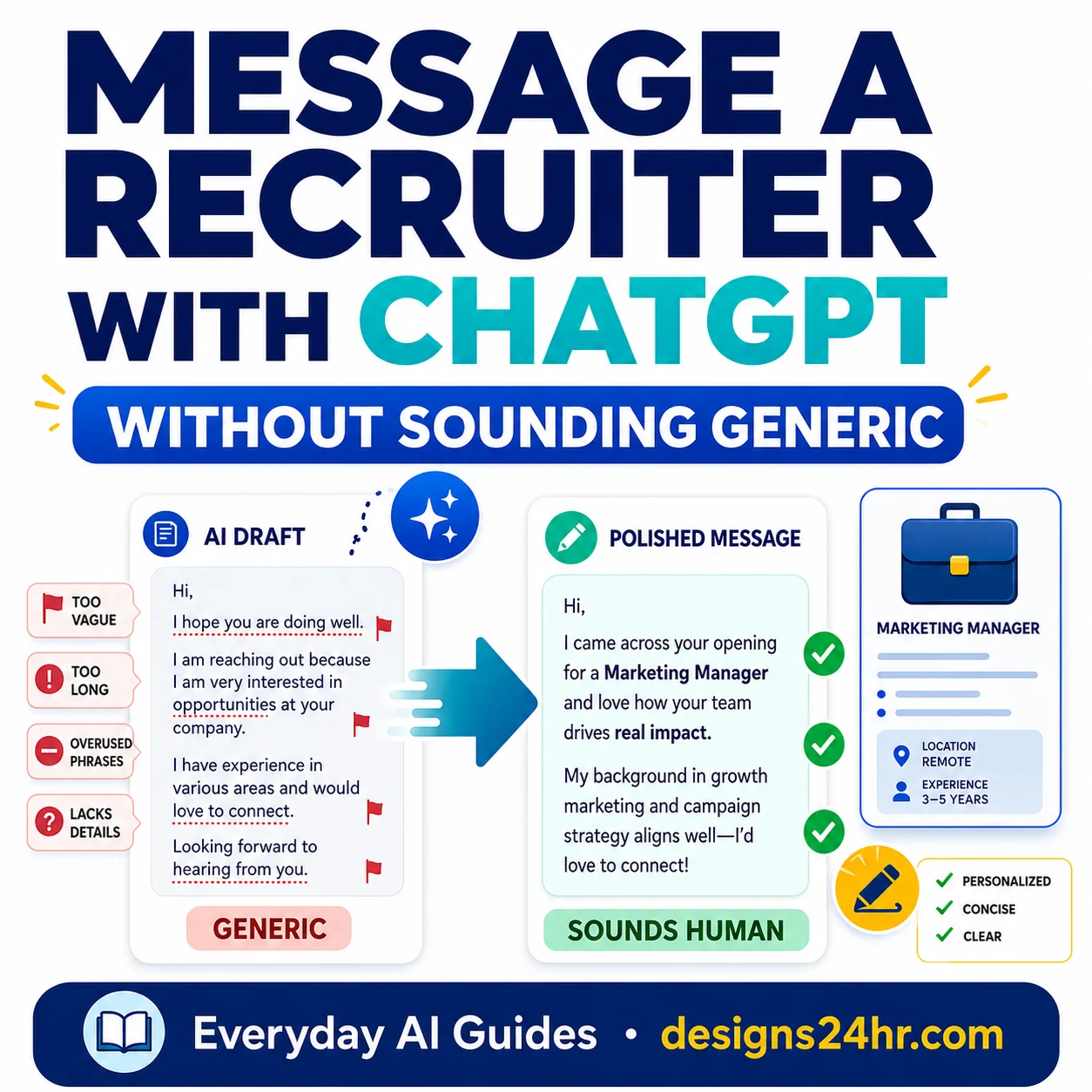
If you plan to email the hiring manager or a recruiter as well, our guide on how to message a recruiter on LinkedIn with ChatGPT uses the same “sound like a human” checks for short outreach messages.
What should a 2026 cover letter look like?
The basics have not changed much, and career centers still agree on the shape. The University of Southern California Career Center’s cover letter overview recommends a one-page letter of three to four paragraphs: an introduction naming the role and organization, one or two body paragraphs that connect your qualifications to the position, and a closing that restates your interest and thanks the reader. It also advises against copying your resume into the letter and suggests “Dear Hiring Manager” when you cannot find a name. The University of Michigan Career Center’s cover letter resources give the same three-to-four-paragraph structure and recommend tying your examples back to the job description.
What has changed is the volume of AI-written applications, so specific, verifiable examples matter more than polished phrasing. A plain letter with one real story usually beats an elegant letter with none. (This is our editorial view, not a measured statistic.)
Can employers tell if you use ChatGPT for a cover letter?
There is no reliable tool that proves a cover letter was written with ChatGPT. OpenAI’s help center says that, in its experience, AI content detectors are not reliable, and that its own test detector labeled human-written texts such as Shakespeare and the Declaration of Independence as AI-generated (OpenAI Help Center). We explain why in more detail in AI detectors explained.
That does not mean AI use is invisible. Readers notice generic phrasing, claims that do not match the resume, and letters that could be sent to any company. Whether a particular employer screens for AI writing, or what its policy is, is UNVERIFIED and varies; some applications state their own rules, so read the instructions and follow them. The safest approach is simple: use ChatGPT for structure and wording, make sure every fact is yours, and be ready to talk about anything in the letter in an interview.
Is it okay to use ChatGPT to write a cover letter?
Using ChatGPT as a drafting and editing tool is a normal way to work, and OpenAI publishes its own guidance for doing it. The line is honesty: the experience, results and motivation in the letter must be real. OpenAI Academy’s resource Helping Job Seekers with ChatGPT frames ChatGPT as a coaching tool that does a first pass while the person stays in charge, and recommends protecting privacy, verifying important facts and keeping final edits human. If an employer’s application explicitly asks you not to use AI, respect that.
Common ChatGPT cover letter mistakes and quick fixes
| Mistake | Why it hurts | Quick fix |
|---|---|---|
| Asking for a letter with no job post | The letter cannot answer what this employer wants. | Always paste the full job description (Prompt 2). |
| Accepting invented numbers | You may be asked about them in an interview. | Use the ground rules (Prompt 1) and the recruiter skim (Prompt 6). |
| Repeating the resume | Wastes the one page you have. | Tell two or three short stories instead of listing duties. |
| Wrong company name from an old template | Signals a mass application. | Search the letter for the old company name before sending. |
| Overly formal, cliché-heavy tone | Sounds like every other AI letter. | Paste a writing sample and ask ChatGPT to match it (Prompt 4). |
| Letter longer than one page | Readers skim; key points get lost. | Ask for a set word count (Prompt 5). |
After you send it: keep your job search organized
Save the final letter with the company name and date, and record where you applied. Our guide to tracking job applications with AI shows a simple system for logging applications and planning follow-ups without losing control of your data. When an interview comes, practice your answers with the free AI Interview Coach, and use the stories from your cover letter as starting points; interviewers often ask about exactly what you wrote. For more tools, see our writing and career tools.
Frequently asked questions
Can I get ChatGPT to write a cover letter?
Yes. Give it the job description and your resume or real achievements, ask it not to invent anything, and request a one-page letter of three to four paragraphs. Treat the result as a draft and edit it before sending.
What is a good prompt for writing a cover letter?
A good ChatGPT cover letter prompt includes the job description, your resume, a rule against inventing facts, a target length, a tone and a request to list any requirement you have not shown evidence for. The short prompt at the top of this page covers all of these.
Should I upload my resume to ChatGPT?
OpenAI’s cover letter guide says you can upload your resume and the job description directly. Remove details the task does not need, such as your home address and phone number, before you upload or paste anything.
How long should a ChatGPT cover letter be?
Aim for one page, which usually means three or four short paragraphs. Ask ChatGPT for a word count (for example, under 350 words) and cut further if needed.
Can I use the same ChatGPT cover letter for every job?
You can reuse a template, but each letter needs its own reason for applying and its own matched examples. Prompt 7 builds a template with brackets for exactly those parts.
Sources and editorial note
This guide is a documented process based on official and institutional sources checked on October 25, 2026. Designs24hr did not run a hiring experiment or measure response rates, and the before-and-after examples are fictional. Sources used:
- How to write a cover letter using ChatGPT (OpenAI, ChatGPT Learn)
- ChatGPT Job Search Playbook (OpenAI Forum, February 6, 2026)
- Helping Job Seekers with ChatGPT (OpenAI Academy)
- Temporary chat in ChatGPT (OpenAI Help Center)
- Do AI detectors work? (OpenAI Help Center)
- Cover Letter Overview (USC Career Center)
- Cover Letter Resources (University of Michigan Career Center)
This article was created with the help of AI, one of the many ways AI is making useful knowledge easier for everyone to create and access. It is provided for educational purposes only, to help readers understand and use AI tools better.
ChatGPT and OpenAI are trademarks of OpenAI. Product names are trademarks of their respective owners; Designs24hr is not affiliated with or endorsed by OpenAI, and no affiliation or endorsement is implied.
Get new AI guides every week
Short, practical how-tos and free tools from Designs24hr. No spam, unsubscribe anytime.