Everyday AI Guides · AI Careers & Job Search
Updated: September 2026
The Dario Amodei AI jobs warning has put a difficult question in front of students, recent graduates, and entry-level workers: if AI becomes capable of doing more office work, what should you actually do about your career?
Anthropic CEO Dario Amodei has warned that AI could disrupt a large share of entry-level white-collar work. In a May 2025 interview with Axios, he said AI could eliminate half of entry-level white-collar jobs and push unemployment much higher within one to five years. He repeated concerns about major job disruption in 2026.
That is a prediction, not an established outcome. The evidence is more complicated. By mid-2026, Anthropic’s own economics research was examining how AI is being used across tasks and occupations, while Anthropic researchers cautioned that usage data should not be treated as a complete picture of the labor market.
So the useful response is neither panic nor pretending nothing will change. It is to understand which parts of your work AI can already accelerate, strengthen the skills that complement those tools, and build evidence that you can produce useful results in an AI-assisted workplace.
Quick Answer: What Should Entry-Level Workers Do?
Don’t try to predict whether your entire profession will disappear. Break your work into tasks. Identify the repetitive digital tasks AI can increasingly assist with, learn how to use AI responsibly for those tasks, and invest more heavily in judgment, verification, communication, domain knowledge, accountability, and real-world problem solving.
The goal is not to find an imaginary “AI-proof” career. It is to become more useful as the mix of human and AI work changes.
What Is the Dario Amodei AI Jobs Warning?
Dario Amodei is the CEO and co-founder of Anthropic, the company behind Claude. His warning became widely discussed after Axios reported in May 2025 that he believed AI could wipe out half of entry-level white-collar jobs and potentially push unemployment to 10–20% within one to five years.
The warning focused particularly on knowledge-work fields such as technology, finance, law, and consulting. These areas contain many tasks that happen entirely on a computer: analyzing information, preparing documents, writing first drafts, summarizing material, processing data, researching topics, and producing routine digital outputs.
Amodei continued discussing substantial employment disruption in 2026. However, his public framing also became more nuanced. In May 2026, Fortune reported him discussing a different possibility: if AI automates much of a job, productivity and demand could expand enough that people spend more of their time on the remaining work instead of the entire occupation simply disappearing.
Is AI Actually Eliminating Entry-Level Jobs Yet?
There are reasons to take changing entry-level work seriously, but there is not enough evidence to conclude that Amodei’s most severe scenario has already happened.
Anthropic’s 2026 Economic Index research tracks how Claude is used across economic tasks. That is useful because it can show where AI is appearing in real workflows rather than relying only on hypothetical capability tests. But Anthropic explicitly notes an important limitation: its Economic Index reflects patterns in Claude usage, not the labor market as a whole.
That distinction matters. Seeing AI used frequently for a task does not prove that the corresponding job has disappeared. A worker may use AI to complete the task faster, a company may automate part of the workflow, the amount of work may expand, or responsibilities may shift toward different tasks.
In July 2026, Fortune reported that Anthropic’s head of economics, Peter McCrory, argued that AI had not produced a material increase in overall U.S. unemployment at that point. That does not prove future disruption will be small. It does show why predictions and observed labor-market outcomes should be kept separate.
Which Entry-Level White-Collar Tasks Are Most Exposed to AI?
Instead of creating a dramatic list of “jobs AI will replace,” use a task-level view. Two people with the same job title can perform very different work, and the same worker may have some tasks that AI handles well and others that still depend heavily on context, judgment, responsibility, or human interaction.
| Task characteristic | Relative AI exposure | Why |
|---|---|---|
| Routine first drafts | Higher | Generative AI can rapidly produce draft text from clear instructions. |
| Standard summaries | Higher | AI can condense supplied information quickly, although accuracy still needs checking. |
| Predictable data processing | Higher | Structured, repeatable digital workflows are easier to automate or accelerate. |
| Template-based communication | Higher | AI can generate routine messages when the required context is available. |
| Research assistance | Higher | AI can accelerate discovery and synthesis, but sources and conclusions still require verification. |
| High-stakes verification | More complementary | A person may remain responsible for checking evidence, errors, risks, and consequences. |
| Ambiguous judgment | More complementary | Real situations often contain incomplete information, competing priorities, and consequences that require context. |
| Client-specific decisions | More complementary | Understanding constraints, relationships, trust, and unstated context can matter as much as producing an answer. |
| Coordination and ownership | More complementary | Someone still needs to define goals, coordinate people, resolve conflicts, and take responsibility for outcomes. |
These labels describe relative task exposure, not guaranteed job outcomes. A highly exposed task can remain part of a valuable job, while a profession that looks relatively protected can still change significantly.
Jobs vs. Tasks: The Difference That Matters
One of the easiest mistakes in the AI-jobs debate is moving directly from “AI can do this task” to “AI will eliminate this job.”
A job is usually a bundle of tasks. Consider an entry-level marketing role. It might include drafting copy, organizing campaign data, talking with colleagues, interpreting customer feedback, checking brand requirements, updating reports, coordinating deadlines, and deciding when something needs escalation.
AI might dramatically reduce the time required for the first draft of an email. That does not automatically eliminate campaign planning, verification, coordination, decision-making, or accountability.
The reverse is also possible: if enough important tasks become automated and employers no longer need the same number of workers, hiring can decline even if some human tasks remain.
That is why a useful career plan should ask how your task mix is changing, not simply whether an online list labels your profession “safe” or “at risk.”
Use the T-A-S-K Framework to Evaluate Your Career
Use this four-part Designs24hr framework whenever you want to evaluate how AI could affect your current role or a career you are considering.
The T-A-S-K Framework
Analyze the work before making a career decision.
TTasks
List what you actually do during a normal week. Avoid relying only on your job title.
AAutomatable
Identify tasks current AI can already accelerate or partially automate, and note where human review remains necessary.
SSkills
Find the domain, judgment, communication, verification, and coordination skills that become more valuable around those tools.
KKeep Evidence
Build projects, work samples, verified results, or other evidence showing that you can use those skills in practice.
Try the T-A-S-K framework on your own role
Prompt 1 — Analyze My Job
I work as a [job title]. My main weekly tasks are: [tasks]. Analyze these tasks individually rather than judging my entire profession. Group them into: 1. Tasks AI can already accelerate 2. Tasks that still require substantial human judgment 3. Tasks where AI could complement me Then recommend five skills I should strengthen over the next 12 months. Explain your uncertainty, distinguish current capabilities from predictions, and do not claim that any job is completely AI-proof.
7 Things Entry-Level Workers Can Do Now
You do not need a perfect forecast of the labor market to make sensible preparations. These seven steps improve your ability to work alongside AI while protecting against one of the biggest risks of automation: having a skill set built mostly around tasks that become cheap and easy to generate.
Audit Your Repetitive Tasks
Write down what you do during a normal week. Highlight tasks that involve predictable inputs and predictable outputs: routine summaries, formatting, first drafts, standard research, recurring reports, basic data cleanup, or template-based communication.
These are useful places to learn AI assistance first because you can compare the AI-assisted result with your existing process.
Learn AI-Assisted Workflows, Not Just Prompt Tricks
Knowing a collection of clever prompts is less valuable than knowing how to complete a real workflow accurately. Practice giving AI useful context, checking its output, finding unsupported claims, revising weak results, and deciding when the tool should not be used.
The valuable skill is not simply generating output. It is producing a reliable result faster without giving up human review.
Strengthen Judgment-Based Skills
AI can generate many plausible answers. Workplaces still need people who can decide which information matters, identify missing context, understand consequences, prioritize competing goals, and recognize when an apparently polished answer is wrong.
Look for opportunities to practice decisions rather than only production.
Become Better at Verifying AI Output
Verification is increasingly important when AI produces drafts, summaries, calculations, research, or recommendations. Learn to trace important claims back to reliable sources, check dates, compare outputs with source material, and recognize when uncertainty should be disclosed.
An employee who can identify a confident AI mistake may be more useful than someone who simply produces AI content faster.
Build Domain Expertise
AI familiarity alone does not tell you whether a financial model makes sense, a customer request is unusual, a marketing claim is misleading, a technical requirement has been misunderstood, or a process violates company policy.
Pair AI skills with knowledge of a real field. The combination is usually more useful than becoming a generic “AI expert” with little understanding of the work itself.
Build Evidence of What You Can Do
Create work samples, projects, case studies, portfolio pieces, or documented accomplishments that show what you can actually produce. Where appropriate, explain how you used AI, what you personally contributed, what you verified, and what result you achieved.
Never invent achievements to appear more competitive. If you are updating your resume, use the AI Resume Checker Checklist to keep AI-assisted edits accurate and relevant.
Review Your Skill Mix Regularly
AI capabilities can change faster than traditional career advice. Revisit your task audit every few months. Ask what became easier, what still requires significant human input, what new responsibilities appeared, and which skills employers in your field are actually requesting.
Update based on evidence rather than every dramatic prediction you see online.
Build Your AI Career Defense Plan
A useful plan should contain three layers rather than one.
Layer 1: AI Fluency
Learn how relevant AI tools work, where they save time, where they fail, and how to verify their output.
Layer 2: Domain Value
Understand the field deeply enough to know what a good result looks like and which constraints matter.
Layer 3: Human Responsibility
Develop communication, judgment, coordination, accountability, and decision-making skills around the automated work.
Layer 4: Evidence
Show projects, outcomes, work samples, or verified achievements that demonstrate the first three layers in practice.
This approach is more useful than trying to choose a career based on a viral list of jobs that supposedly will or will not survive AI.
Prompt 2 — Build My AI Skill Plan
I am a [student/new graduate/entry-level worker] interested in [field]. Create a 30-day AI skills plan that helps me become better at using AI alongside genuine domain expertise. Prioritize: – Practical skills relevant to my field – Free or low-cost learning methods – Verification and critical thinking – Real projects rather than passive learning – Skills that complement AI instead of only duplicating tasks AI can already perform Give me one realistic action per day and finish with one portfolio project that demonstrates useful real-world skills. Do not promise that any skill or career is AI-proof.
A 30-Day AI Career Adaptation Plan
If the Dario Amodei white-collar jobs warning has made you concerned about your next career move, turn that concern into a short experiment. You do not need to reinvent your career in one month.
Week 1 — Map Your Work
List the tasks performed in your current role or target job. Mark repetitive digital tasks, judgment-heavy tasks, communication tasks, and responsibilities where mistakes have meaningful consequences.
Test a current AI tool on two low-risk tasks using non-confidential information. Compare the output with what a competent person would produce.
Week 2 — Improve One Real Workflow
Choose one task AI can genuinely accelerate. Build a repeatable process: prepare the input, instruct the tool, inspect the result, verify important facts, revise it, and document what still requires human judgment.
Measure something simple such as time saved, errors caught, revisions required, or output quality. Do not invent productivity percentages.
Week 3 — Strengthen the Human Side
Pick one complementary skill: presenting recommendations, interviewing stakeholders, interpreting data, handling exceptions, checking evidence, managing a small project, or explaining a complicated idea clearly.
Practice it in a real or realistic scenario rather than only watching tutorials.
Week 4 — Produce Evidence
Turn what you learned into one small portfolio project or documented case study. Show the problem, your process, where AI helped, what you personally verified or decided, and the finished result.
Then update your resume or professional profile only with claims you can support.
30-Day Completion Check
- I can explain which tasks in my field AI currently handles well.
- I can identify important limitations rather than trusting every output.
- I have one repeatable AI-assisted workflow.
- I strengthened at least one complementary human or domain skill.
- I created evidence of what I can actually do.
- I know what I want to learn next.
Should Students Change Their Career Plans Because of AI?
A single AI prediction is not enough reason to abandon a degree, profession, or career path.
Students should instead investigate four questions:
- What tasks make up the entry-level version of this career?
- How much are current AI tools actually being used for those tasks?
- What domain knowledge, judgment, responsibility, or human interaction remains important?
- Can I build transferable skills that remain useful if the job changes?
Also look at real job postings, internship requirements, professional associations, employer announcements, and labor-market data in your target location. A national discussion about AI can miss what is happening in a particular profession or region.
The better question is not “Which career will AI never touch?” It is “Which career gives me a useful combination of domain knowledge, adaptable skills, and opportunities to work effectively with changing technology?”
How to Use AI Without Making Your Career Profile Less Trustworthy
There is another risk for entry-level workers: using AI so aggressively in job applications that their resume, LinkedIn profile, portfolio, and interview answers stop representing their real abilities.
AI can help you organize and improve truthful information. It should not create employers, qualifications, responsibilities, project results, metrics, certifications, or experience you do not have.
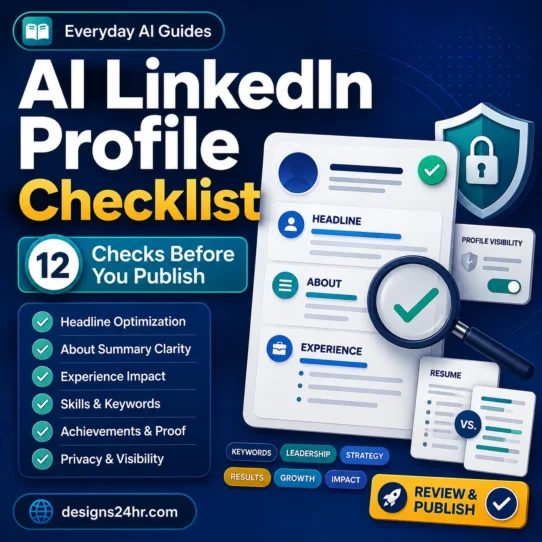
Before publishing AI-assisted profile changes, use the AI LinkedIn Profile Checklist. When you reach the interview stage, the AI Interview Practice Checklist can help you prepare from real examples without memorizing generic AI-generated answers.
Prompt 3 — Audit My Resume for AI-Era Skills
Review the following resume for evidence that I can work effectively with AI rather than simply listing AI tools. Identify: 1. Generic claims that do not prove anything 2. Places where my real domain expertise could be clearer 3. Evidence of judgment, verification, communication, ownership, or problem solving 4. Genuine AI-assisted work I have described that could be explained more clearly 5. Skills relevant to my target role that are supported by my existing experience Suggest stronger accomplishment-focused wording where the facts support it. Do not invent experience, employers, responsibilities, results, numbers, qualifications, software skills, or achievements I have not provided. Resume: [paste a privacy-safe version of your resume]
What If You Are Already Applying for Jobs?
Do not stop applying because of broad predictions about AI.
Instead, look for evidence about the specific opportunities in front of you. Read the job description carefully. Notice whether employers mention AI-assisted workflows, automation, analytical judgment, customer interaction, project ownership, or domain expertise.
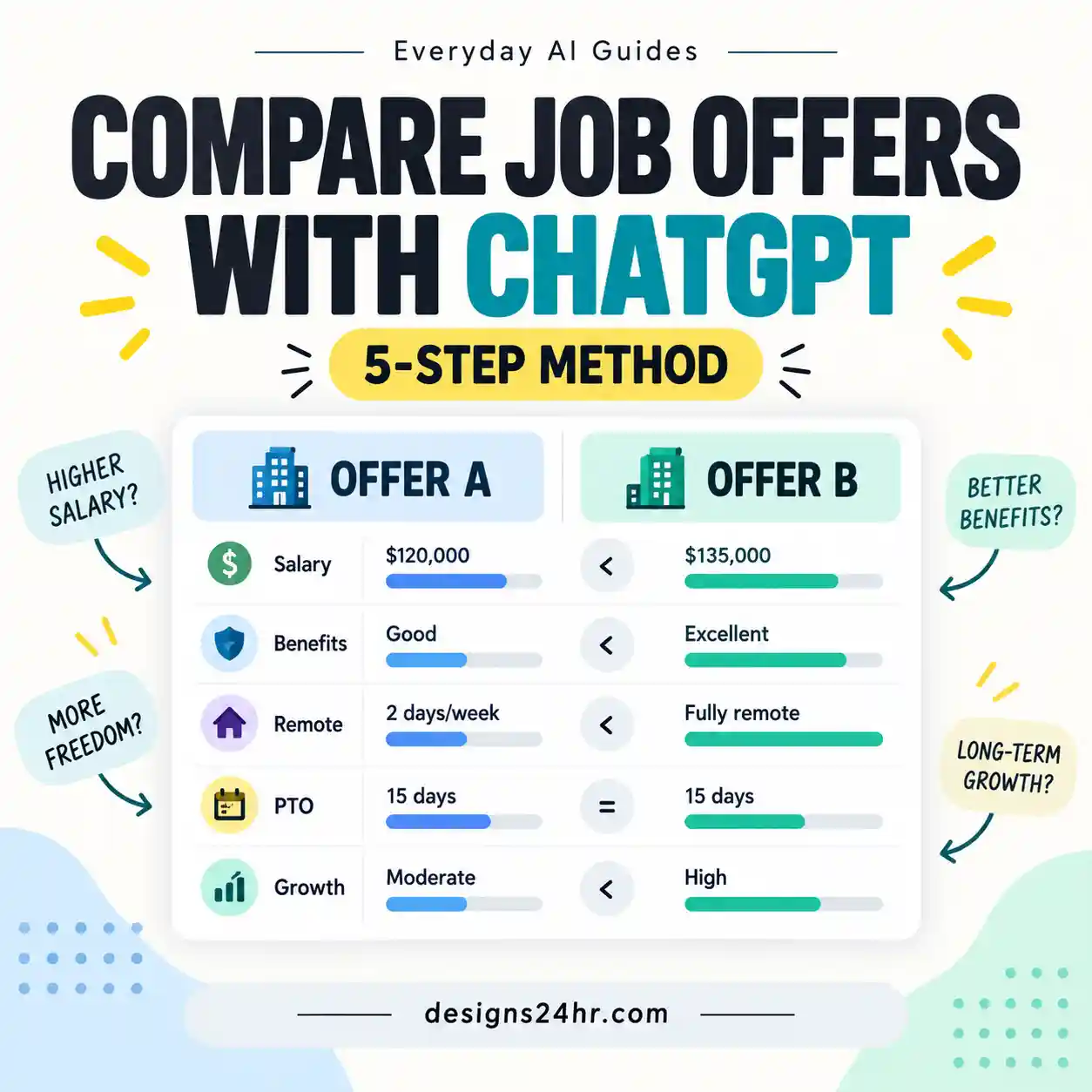
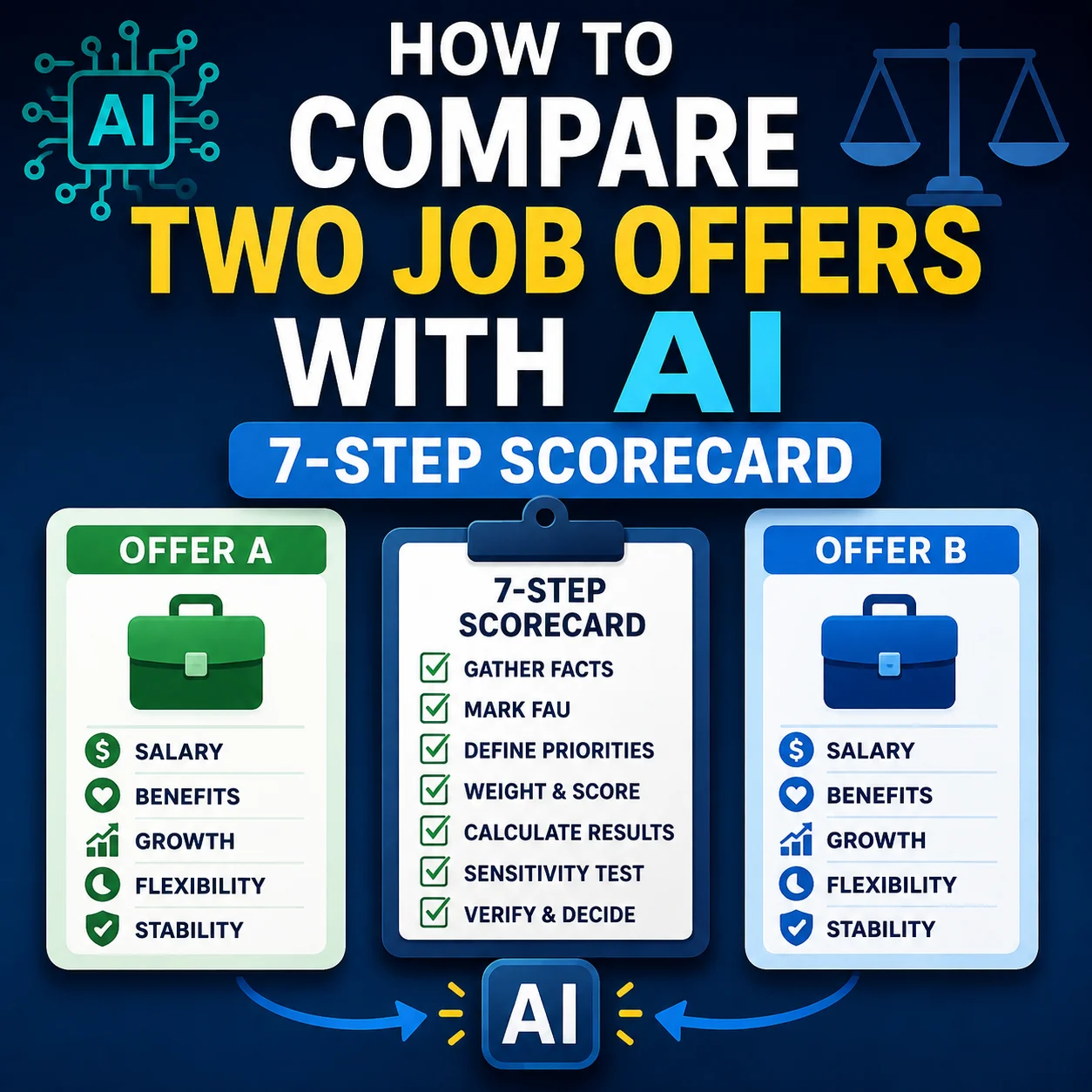
When comparing opportunities, consider whether a role gives you access to valuable skills, meaningful responsibility, mentorship, and experience with modern workflows. If you reach the offer stage, our guide to comparing job offers with ChatGPT provides a structured way to compare verified facts without asking AI to make the career decision for you.
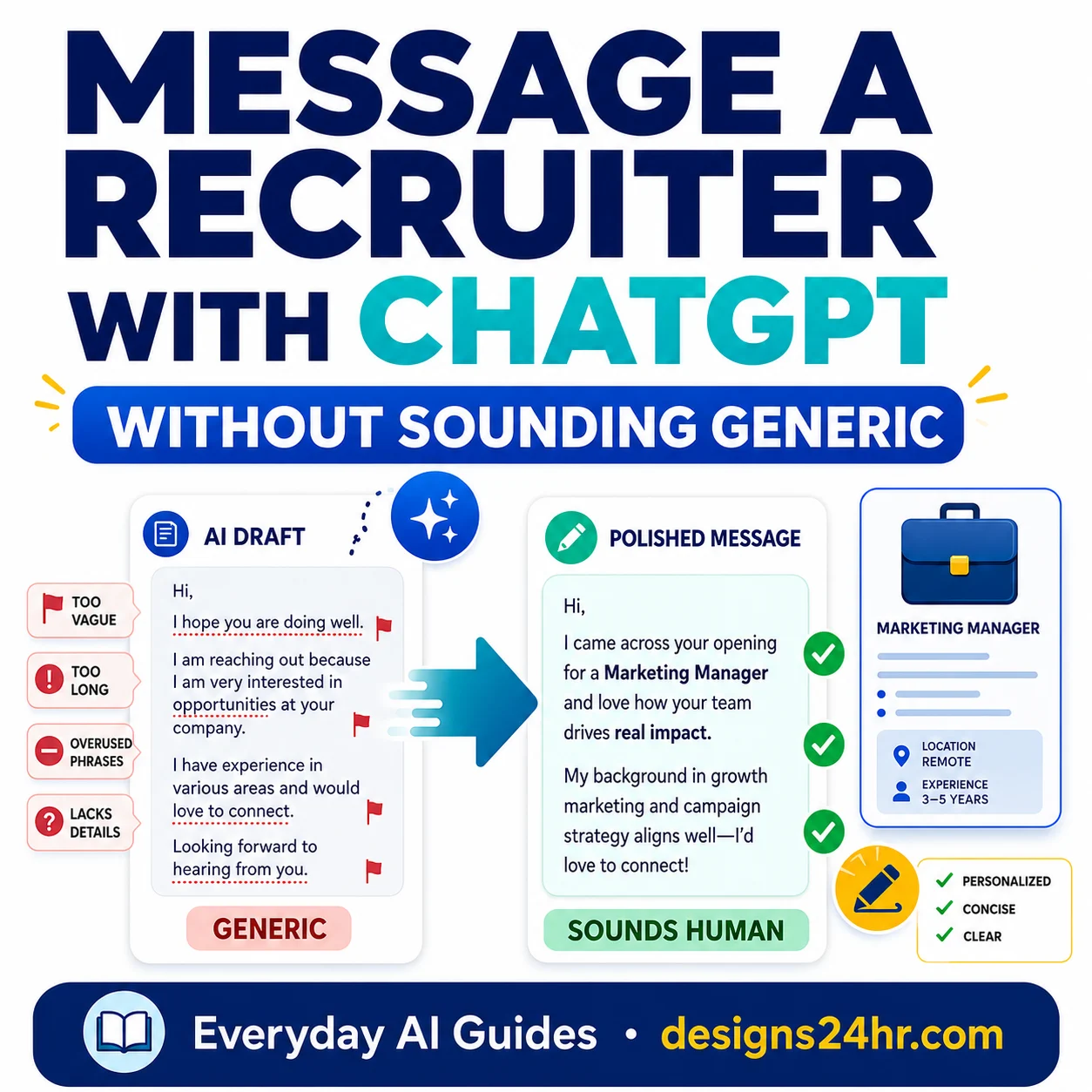
And if you need to contact someone about a role, use the recruiter messaging workflow to draft a concise message from real information rather than sending generic AI-written outreach.
What We Still Don’t Know About AI and Jobs
There are several major uncertainties that make confident long-term job predictions difficult.
Capability is not the same as adoption
An AI system may demonstrate that it can perform a task, but employers still have to integrate the technology into real workflows. Cost, reliability, privacy, security, regulation, existing software, employee training, customer expectations, and organizational resistance can affect adoption.
Automating work can change demand
If AI makes a service cheaper or dramatically increases productivity, businesses may produce more of it. That can change how much labor is needed in ways that are difficult to predict from the automation rate alone.
New tasks can appear
Technology can remove some responsibilities while creating others. Workers may spend less time producing first drafts and more time reviewing, integrating, customizing, verifying, coordinating, or handling exceptions.
Entry-level pathways could still change
Even if entire professions remain, companies may redesign junior roles. That matters because entry-level jobs traditionally provide training and experience that eventually create mid-level and senior workers.
AI usage datasets have limits
Anthropic’s Economic Index provides useful evidence about how Claude is used, but Anthropic itself notes that this is not equivalent to measuring the entire economy. Similar caution is necessary when interpreting data from any individual AI platform.
How to Read AI Job Predictions Without Panicking
When another executive, researcher, economist, or viral post predicts dramatic job changes, run the claim through this five-question check:
- Is this a prediction or observed data?
- What timeframe is being discussed?
- Does the claim concern tasks, specific occupations, or the entire labor market?
- What population and country does the evidence cover?
- What evidence would prove the prediction wrong?
A dramatic number without those details can sound much more certain than the underlying evidence actually is.
Bottom Line: Prepare for Change Without Treating a Prediction as Destiny
The Dario Amodei AI jobs warning deserves attention because AI systems are becoming capable of assisting with more knowledge-work tasks, including work traditionally assigned to junior employees.
But “AI can perform more entry-level tasks” and “half of entry-level jobs will definitely disappear” are not the same statement. The second is a forecast with substantial uncertainty.
The practical response is to prepare for a changing task mix: learn to use AI well, verify its work, strengthen your domain knowledge, practice judgment and communication, and build real evidence of what you can accomplish.
You do not need to predict the future perfectly. You need a skill set that can keep adapting as the evidence changes.
Frequently Asked Questions
What did Dario Amodei say about AI and jobs?
In a May 2025 Axios interview, Anthropic CEO Dario Amodei warned that AI could eliminate half of entry-level white-collar jobs and potentially raise unemployment sharply within one to five years. He continued warning about significant employment disruption in 2026. These statements are predictions, not established outcomes.
Will AI replace 50% of entry-level jobs?
No one currently knows that. The 50% figure is associated with Amodei’s warning about what could happen, not a measured fact about what has already happened or a guaranteed forecast. AI adoption, productivity, demand, regulation, costs, new tasks, and business decisions can all influence employment outcomes.
Which white-collar jobs are most at risk from AI?
It is more useful to evaluate tasks than label entire occupations. Repetitive digital tasks with predictable inputs and outputs may be easier to automate or accelerate. Jobs that combine those tasks with judgment, domain expertise, verification, communication, coordination, and accountability may change without disappearing entirely.
What skills should entry-level workers learn because of AI?
Useful areas include AI-assisted workflows, verification, domain expertise, critical thinking, communication, project ownership, data interpretation, and the ability to recognize when AI output is incomplete or wrong. The best combination depends on the person’s field and actual work.
Should students avoid careers that use a lot of AI?
Not based on that fact alone. Students should examine the actual tasks in a profession, current hiring requirements, local labor-market evidence, how AI is being adopted in the field, and which transferable skills the career develops. No credible analysis can guarantee that a particular career will remain unchanged by AI.
How can I tell whether AI could affect my own job?
List your weekly tasks and evaluate them individually. Identify repetitive digital work that AI can already assist with, tasks requiring substantial judgment or accountability, and skills that become more useful when routine work is accelerated. The T-A-S-K framework in this guide provides a simple way to do that.
Sources & Further Reading
This article distinguishes public predictions from observed evidence. AI capabilities and labor-market conditions can change, so check current data before making an important career decision.
- Axios — Dario Amodei’s May 2025 warning about entry-level white-collar jobs
- Anthropic — Economic Index report: Cadences, June 2026
- Anthropic — Economic Index data and limitations
- Fortune — Amodei’s evolving discussion of automation, productivity, and employment
- Fortune — Anthropic economics discussion of AI and U.S. unemployment
Editorial note: This guide provides general educational information, not individualized career, financial, or employment advice. Predictions about future AI capabilities and employment are inherently uncertain.