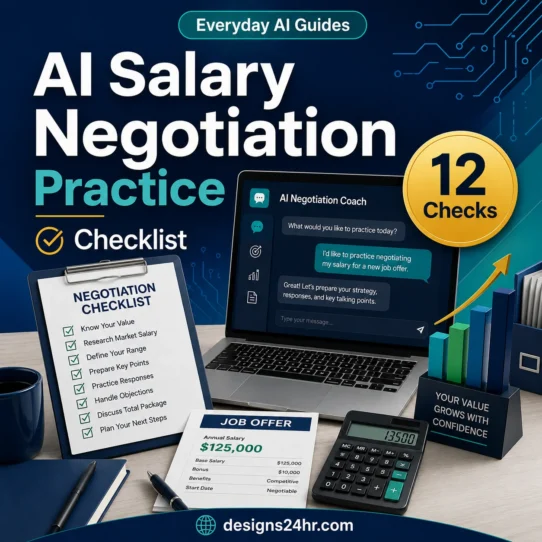
Want to compare job offers with ChatGPT? The useful way to do it is not to paste two offer letters into a chat and ask, “Which job should I take?” Instead, use ChatGPT to organize verified facts, expose missing information, compare the trade-offs that matter to you, and test whether the apparent winner changes when your priorities change.
This guide gives you a practical five-step method for comparing salary, benefits, remote flexibility, paid time off, career growth, commute, bonuses, and other factors without letting AI invent missing details or make the final career decision for you.
Quick Answer
To compare job offers with ChatGPT, first verify the facts in each offer, put both offers into the same comparison format, assign your own priorities, ask ChatGPT to identify missing information, and then stress-test the result by changing reasonable assumptions. Use AI to clarify the trade-offs — not to choose your career for you.
Can ChatGPT Help You Compare Two Job Offers?
Yes — if you give it the right job.
ChatGPT can be useful for turning two messy offers into the same structure, summarizing documented differences, creating a decision matrix, finding unanswered questions, and showing how the result changes when your priorities change.
What it cannot reliably do is know which employer has the better culture, whether a bonus will really pay out, how secure either job will be, whether a manager will support your growth, or which choice will make you happier three years from now.
Before You Paste a Job Offer Into ChatGPT
A job offer may contain far more information than an AI comparison actually needs. Before sharing any text, remove unnecessary personal or confidential information and keep only the details required for your analysis.
Keep what matters
- Base salary
- Documented bonus terms
- Signing bonus
- Equity terms provided to you
- Retirement contribution or match
- Health benefit information
- PTO and leave
- Remote or hybrid expectations
- Work location
- Start date
- Job title
Remove what AI does not need
- Home address
- Personal phone number
- Personal email address
- Signatures
- Identification numbers
- Recruiter contact information
- Internal reference numbers
- Unrelated confidential material
OpenAI currently provides account-level Data Controls that include an “Improve the model for everyone” setting. OpenAI also documents how Temporary Chat handles history, training, memory, and temporary retention. Review the current settings that apply to your account before entering information you consider sensitive.
Important: Privacy settings reduce certain uses of your conversations; they are not a reason to paste unnecessary confidential information. Share only what is needed for the task.
How to Compare Job Offers With ChatGPT in 5 Steps
Use the same process every time:
The order matters. If you start by asking ChatGPT which offer is “better,” the answer can hide missing data, unstated assumptions, or priorities that do not actually match yours.
Step 1: Verify the Information in Both Offers
Collect the offer letters, benefits summaries, recruiter answers, and other reliable source documents for both jobs. Write down only what is actually known.
For each offer, look for:
- Base salary: the guaranteed annual or hourly rate.
- Bonus: target amount, eligibility, timing, and any conditions actually disclosed.
- Signing bonus: amount and repayment conditions if stated.
- Equity: only the grant or terms that have actually been provided.
- Health coverage: premiums or employer contribution when documented.
- Retirement: match or contribution details.
- PTO: vacation, sick leave, holidays, or combined leave structure.
- Work arrangement: remote, hybrid, onsite, and required office frequency.
- Schedule: known working hours, shifts, travel, or on-call expectations.
- Role: title, responsibilities, reporting line, and documented scope.
- Growth: only specific information you were actually given.
The NOT PROVIDED Rule
If a fact is missing, ChatGPT should write NOT PROVIDED.
It should not fill an empty cell simply because a typical company might offer a certain benefit. A visible information gap is more useful than a confident-looking guess.
Never Let ChatGPT Guess These
- Company culture
- Job security
- Future raises
- Promotion probability
- Manager quality
- Actual bonus payout
- Future stock value
- Undocumented working hours
- Personal tax consequences
- Benefits not stated in your documents
Step 2: Ask ChatGPT to Normalize Both Offers
Offer letters rarely use identical language. One employer may describe compensation on the first page while another puts important benefits in separate documents. The first useful AI task is therefore normalization, not judgment.
I am comparing two job offers.

Use only the facts I provide. Do not infer, estimate, invent, or assume missing information.

Create one comparison table with the same rows for both offers.

Include these fields when available:

Base salary
Bonus
Signing bonus
Equity
Retirement contribution or match
Health benefits
Paid time off
Work location
Remote or hybrid requirements
Known working hours
Commute information I provide
Job title
Reporting structure
Start date
Travel requirements
Other documented benefits

For any field that is not explicitly provided, write:
NOT PROVIDED

After the table:

List the five biggest confirmed differences.
List every important missing fact.
Do not tell me which offer to choose yet.

OFFER A:
[Paste the relevant verified details]

OFFER B:
[Paste the relevant verified details]
Read the output against your source documents. If ChatGPT converts an unknown into a fact, correct it before continuing.
Why normalization comes before scoring
A polished score can create false confidence when the inputs are incomplete. For example, an offer with an unknown health-insurance cost should not automatically receive the same benefit value as an offer where you know your employee premium and employer contribution.
The comparison becomes stronger when uncertainty remains visible.
Step 3: Decide What Matters Most to You
Two people can look at the same offers and reasonably choose different jobs. Someone caring for family may value schedule flexibility more than another $7,000 in salary. Another person may prioritize early-career mentorship or a shorter commute.
Define your priorities before asking AI to calculate anything.
| Factor | Example importance | Question to ask yourself |
|---|---|---|
| Base compensation | 5 / 5 | How much does guaranteed pay affect my decision? |
| Remote flexibility | 5 / 5 | How important is control over where I work? |
| Career growth | 4 / 5 | How much do learning and advancement matter now? |
| Benefits | 4 / 5 | Which benefits materially affect my household? |
| PTO | 3 / 5 | How valuable is additional time off to me? |
| Commute | 3 / 5 | What time and cost am I willing to spend commuting? |
The numbers above are examples, not recommended weights. Replace them with your own priorities.
Use the verified job-offer comparison we already created.

I will give each factor an importance weight from 1 to 5, where:
1 = low importance to me
5 = extremely important to me

My weights:

Base compensation: [1-5]
Bonus or variable compensation: [1-5]
Benefits: [1-5]
PTO: [1-5]
Remote flexibility: [1-5]
Commute: [1-5]
Career growth: [1-5]
Schedule: [1-5]
Role responsibilities: [1-5]
Other: [factor and weight]

Rules:

Use only verified information.
Do not award points for anything marked NOT PROVIDED.
Separate objective facts from subjective judgments.
Explain any scoring choice that requires interpretation.
Do not invent a company culture, future promotion, job-security, bonus, equity, or workload score.
Show the scoring method clearly enough that I can challenge it.

Return:

The comparison matrix
The weighted result
The three factors having the greatest effect on the result
Any missing information that prevents a confident comparison
No final career recommendation yet
An illustrative example
Imagine these fictional offers:
| Factor | Offer A | Offer B |
|---|---|---|
| Base salary | $105,000 | $98,000 |
| Work arrangement | Hybrid, 3 office days | Fully remote |
| PTO | 15 days | 20 days |
| 401(k) match | 5% | 4% |
| Promotion timeline | NOT PROVIDED | NOT PROVIDED |
Someone prioritizing guaranteed salary might lean toward Offer A. Someone placing much greater value on remote work and time off could prefer Offer B. Neither conclusion requires pretending that one job is universally “better.”
Step 4: Stress-Test ChatGPT’s Result
This is the step most simple job-offer prompts miss.
If changing one priority from 4 to 5 suddenly reverses the result, you do not have an obvious winner. You have two close options and should investigate the unresolved factors more carefully.
Stress-test the job-offer comparison instead of simply repeating the current winner.

Run several reasonable scenarios using the verified information only.

Test:

Compensation matters more than my current weighting.
Remote flexibility matters more.
Career growth matters more.
Benefits and PTO matter more.
Commute or schedule becomes more important.
Remove any category that contains too much missing information.

For each scenario:

Show which offer is stronger.
Explain which factors caused the change.
Identify whether the result stays stable or flips.

Then classify the decision as:

STABLE:
The same offer remains stronger across most reasonable scenarios.

CLOSE:
The preferred offer changes when reasonable priorities change.

BLOCKED BY MISSING INFORMATION:
One or more unknown facts could materially change the result.

Finally, tell me the single missing fact that would be most useful to learn next.

Do not invent the missing information.
A simple way to interpret the result
| Result | What it means | What to do next |
|---|---|---|
| STABLE | The same offer remains stronger under several reasonable priority sets. | Confirm the remaining facts and consider whether the result matches your own judgment. |
| CLOSE | Small, reasonable changes can reverse the result. | Do not treat the numerical score as decisive. Focus on unresolved personal trade-offs. |
| BLOCKED | Missing information could materially change the comparison. | Ask the recruiter or employer for the missing facts before deciding where possible. |
Ask ChatGPT to find the questions you still need answered
Review our current comparison and focus only on information that is missing or unclear.

Do not invent answers.

Create a short list of questions I could ask the recruiter before accepting the offer.

For each question:

State which missing fact it would clarify.
Explain briefly why that fact could matter to the comparison.
Keep the wording neutral and professional.
Do not ask for information already provided.
Separate factual questions from questions about subjective experience.

Prioritize the questions most likely to change my decision.
This is more useful than asking AI to guess what the employer “probably” means.
Step 5: Make the Final Decision Yourself
Once you have verified the inputs, compared the offers, checked your priorities, and investigated important gaps, ask ChatGPT to summarize the decision from both sides.
Create a final decision brief using only the verified information from our job-offer comparison.

Do not make the decision for me.

Use these sections:

STRONGEST CASE FOR OFFER A
List the best evidence-based reasons someone with my priorities could choose Offer A.
STRONGEST CASE FOR OFFER B
List the best evidence-based reasons someone with my priorities could choose Offer B.
BIGGEST TRADE-OFFS
Explain what I gain and give up with each choice.
UNRESOLVED RISKS
List important areas that remain uncertain.
MISSING INFORMATION
Show any remaining NOT PROVIDED items that could matter.
WHAT COULD CHANGE THE DECISION
Identify the factors or new facts most likely to reverse the current result.
PERSONAL REFLECTION QUESTIONS
Give me five questions to answer myself before accepting either offer.

Do not invent facts, predict company performance, estimate future stock prices, assume culture, or tell me which job I must take.
How to Compare Salary and Benefits Without Inventing a Total
“Which job pays more?” can be surprisingly difficult once bonuses, health insurance, retirement contributions, equity, PTO, commute costs, and remote work enter the picture.
A useful comparison separates known numbers from estimated or unknown value.
1. Compare guaranteed cash first
Keep base salary separate from bonuses or other compensation that depends on conditions. If an employer tells you a target bonus but not the probability of receiving it, ChatGPT should not silently treat that bonus as guaranteed salary.
2. Use benefit values only when you have real inputs
Do not ask ChatGPT to invent a dollar value for health coverage merely because one plan “sounds better.” If you have employee premiums, employer contributions, deductibles, retirement matches, or other documented figures, those can be organized separately.
3. Treat equity with caution
ChatGPT can organize the equity terms you were given. It should not predict future company value, stock performance, liquidity, or what your grant will eventually be worth.
4. Keep personal costs personal
If you want to compare commute costs, childcare, parking, meals, or other consequences of the work arrangement, provide your own assumptions. Label them as personal estimates rather than employer facts.
A better question than “Which offer is worth more?”
Ask: “Which parts of each offer have a verified dollar value, which depend on my personal assumptions, and which cannot be valued reliably from the information available?”
What ChatGPT Cannot Reliably Know From Your Offer Letter
An offer document is evidence about some parts of a job. It is not evidence about everything that will determine your experience.
Usually unknowable from the offer alone
- How supportive your manager will be
- Actual day-to-day team culture
- Your future job satisfaction
- Whether colleagues will be easy to work with
- How quickly you may be promoted
- How stable the company or team will be
Easy for AI to overstate
- Likely bonus payout
- Future equity value
- Unstated working hours
- Real workload
- Future salary increases
- Undocumented perks
You can research some of these factors separately, ask better questions during the hiring process, and speak with people who have direct knowledge. But they should remain clearly separated from verified offer terms.
When the decision needs more than an AI comparison
Job offers can include legal, tax, immigration, equity, benefits, or contractual issues that depend on your individual circumstances. Use ChatGPT as an organizational tool, not a substitute for an appropriately qualified professional when professional advice is needed.
Common Mistakes When Using ChatGPT to Compare Job Offers
Asking “Which offer should I take?” as the first prompt
This encourages a conclusion before you have checked the inputs or established your priorities.
Treating missing information as neutral
An unknown benefit is not automatically good, bad, or average. Keep it marked as NOT PROVIDED.
Letting ChatGPT choose your priorities
AI can suggest factors you may want to consider, but only you know how much remote work, commute, income, schedule, growth, family needs, or time off matter in your life.
Turning every benefit into an invented dollar amount
A numerical model looks precise even when its assumptions are weak. Use actual values where possible and keep estimates visibly separate.
Ignoring a result that keeps flipping
If small changes repeatedly switch the preferred offer, the correct conclusion may simply be that the decision is close.
Uploading more personal information than necessary
More data does not automatically create a better analysis. Remove unrelated personal, confidential, and identifying information before using an online AI service.
Final Job Offer Comparison Checklist
Before accepting either offer, run through this list:
- I verified the compensation details against the actual offer documents.
- I separated guaranteed compensation from variable or uncertain compensation.
- I checked benefits instead of allowing ChatGPT to invent their value.
- Every unknown field is visibly marked NOT PROVIDED.
- I removed unnecessary personal and confidential information before using AI.
- I chose my own decision priorities and weights.
- I can explain how the comparison score was produced.
- I stress-tested the result using several reasonable priority sets.
- I identified which missing information could change the decision.
- I asked the recruiter important factual questions where appropriate.
- I separated documented facts from opinions about culture, stability, and future growth.
- I considered trade-offs that cannot be reduced to a numerical score.
- I have not treated ChatGPT’s output as professional legal, tax, financial, or employment advice.
- The final choice reflects my priorities, not the AI’s wording.
The five-step rule to remember
VERIFY → NORMALIZE → WEIGHT → STRESS-TEST → DECIDE.
If you keep those stages separate, ChatGPT becomes a much more useful thinking tool for comparing two job offers.
Frequently Asked Questions
Can ChatGPT compare two job offers?
Yes. ChatGPT can organize two offers into the same structure, compare verified facts, build a weighted decision matrix, identify missing information, and explain trade-offs. It is most useful as a decision-support tool rather than as the final decision-maker.
What information should I give ChatGPT when comparing jobs?
Provide only the information needed for the comparison, such as salary, documented bonuses, benefits, PTO, work arrangement, schedule, location, retirement contributions, job responsibilities, and other verified offer terms. Remove unnecessary identifying or confidential information.
Can ChatGPT calculate which job offer is better?
It can calculate a score using criteria and weights you define, but a higher score does not automatically mean one job is objectively better. The usefulness of the result depends on the accuracy of the inputs, your priorities, the scoring assumptions, and how much important information remains unknown.
Should I upload my entire job offer letter to ChatGPT?
You usually do not need to. Extract the relevant comparison details and remove unnecessary names, addresses, contact information, signatures, identification numbers, and unrelated confidential material. Review the current privacy and data-control options for the AI service you use.
How should I compare salary and benefits between two jobs?
Start with guaranteed compensation, then compare documented bonuses, retirement contributions, health-plan costs, PTO, and other benefits separately. Avoid converting an unknown benefit into a made-up dollar value. Personal costs such as commuting can be included when you provide your own clearly labeled assumptions.
What if ChatGPT recommends a different job when I change my priorities?
That is useful information. If reasonable changes in your priorities repeatedly reverse the result, the two offers are probably close. Instead of trusting whichever score appears last, identify the factors causing the switch and decide which ones genuinely matter most to you.
What should I do when important offer information is missing?
Mark it as NOT PROVIDED rather than guessing. Then identify whether that missing information could change the decision. If it could, consider asking the recruiter or employer for clarification before accepting the offer.
Can ChatGPT tell me which company has better culture or job security?
Not reliably from an offer letter. Culture, management quality, workload, promotion likelihood, and future stability require evidence beyond the offer itself. Keep those factors separate from documented employment terms and avoid turning uncertain assumptions into facts.
Bottom Line
The smartest way to compare job offers with ChatGPT is not to ask AI to pick your future. Give it a narrower, more useful job: organize verified facts, expose gaps, apply the priorities you choose, and show you where the decision changes.
If one offer remains stronger across several reasonable scenarios, you have useful evidence. If the result keeps flipping, you have learned something equally important: the choice is genuinely close and deserves more investigation rather than more artificial precision.
Use the AI to make the trade-offs easier to see. Keep the career decision yours.
Sources and Further Reading
This guide is for general educational and decision-support purposes. AI output can contain mistakes or inappropriate assumptions. Verify important information with the original source and seek qualified professional advice when your situation requires it.
Save this guide so you can return to the prompts when the next recruiter email arrives, or share it with someone trying to choose between two opportunities.
Get new AI guides every week
Short, practical how-tos and free tools from Designs24hr. No spam, unsubscribe anytime.