AI detectors analyze text for patterns that may be associated with AI-generated writing, but a detector score is not automatic proof of who wrote the text. Different tools can use different models, thresholds, supported languages, text requirements, and score definitions, so the same passage can produce very different results.
This guide explains how AI content detection works, what percentages and labels can actually mean, why an AI writing detector can be wrong, how false positives and false negatives happen, and what to check before treating a result as meaningful evidence.
AI Detectors: Quick Answer
AI detectors are classification tools. They estimate whether text resembles patterns the detector associates with AI-generated writing. They can be useful as a screening signal, but they do not directly observe authorship, intent, or whether a specific person used ChatGPT.
Best rule: read what the score means, check whether the text meets the tool’s requirements, review conflicting results, and compare the detector output with stronger evidence such as drafts, version history, sources, or documented AI use.
What Are AI Detectors?
AI detectors are tools designed to classify content according to whether it appears more consistent with human-written or AI-generated material. In this guide, AI detectors means text and writing detectors rather than image, audio, or video detection systems.
A typical AI text detector accepts a passage, document, or essay and returns a result such as a percentage, confidence level, label, highlighted passage, or combination of those outputs.
The important word is classification. A detector receives the text that you submit and evaluates patterns in that text. It does not watch how the document was created, see the author’s screen, inspect every revision that happened before submission, or automatically know which AI system may have been involved.
AI text detector
Estimates whether written text resembles patterns associated with generated writing.
Plagiarism checker
Looks for matching or similar wording against sources available to its comparison system.
Watermark detector
Looks for a particular signal that a compatible system may have intentionally embedded or produced.
Authorship evidence
Uses process information such as drafts, notes, revision history, citations, and documented tool use.
These methods answer different questions. Treating them as interchangeable is one of the easiest ways to misinterpret an AI detection result.
The same distinction matters outside text. Designs24hr has separate workflows for interpreting an AI image detector and an AI voice detector. Text, images, and audio require different evidence and should not be combined into one universal detection rule.
How Do AI Detectors Work?
There is no single technique used by every artificial intelligence detector. Modern detection systems may use statistical features, machine-learning classifiers, neural models, model-specific signals, ensembles, or other proprietary methods.
That is why a simple explanation such as “AI detectors only measure perplexity” is too broad. Predictability-related features have played an important role in AI-text research, but commercial detectors do not necessarily use the same architecture or the same set of signals.
Pattern-based classification
A detector can be trained to distinguish examples of human writing from examples produced by one or more language models. It then estimates how closely new text matches patterns learned during training.
Those patterns may involve combinations of linguistic, statistical, structural, and model-derived features. The detector converts the available signals into an output that the provider decides how to present.
Training data matters
An AI writing detector can only be evaluated in the context of the data, writing styles, AI models, languages, genres, and conditions it was designed or tested to handle.
A tool that performs well on long English essays from a known set of models cannot automatically be assumed to perform equally well on short answers, poetry, code, another language, heavily edited text, or output from a newer model.
Thresholds turn signals into labels
Detection is not simply a hidden switch that discovers “AI” or “human.” A classifier generates some form of score or evidence, and a threshold may be used to determine which label appears.
Changing a threshold can change the tradeoff between false positives and false negatives. A more aggressive threshold may catch more AI-generated samples but can also create more incorrect flags. A stricter threshold can reduce false accusations while allowing more generated text to pass undetected.
What Does an AI Detector Score Actually Mean?
This is one of the most important questions in AI content detection. A number such as “80% AI” looks precise, but the meaning depends on the provider.
| Displayed result | What it may mean | What it does not automatically mean |
|---|---|---|
| 80% AI | A tool-specific score, classification, confidence measure, or portion of qualifying text | There is an 80% probability that a particular person cheated |
| Likely AI | The text crossed that detector’s classification threshold | The detector has proved which model wrote it |
| Likely human | The detector did not find enough supported evidence to classify the sample as AI | The complete writing process has been verified as human-only |
| Uncertain | The available signal is insufficient, conflicting, or close to a threshold | The tool is useless or the investigation failed |
| No result | The sample may not meet the tool’s requirements | The writing has been confirmed as human |
For example, Turnitin describes its AI-writing percentage as the amount of qualifying prose text that its system identifies as likely AI-generated or likely AI-generated and subsequently altered with certain AI text tools. Turnitin also states that this percentage is separate from its similarity score.
Turnitin’s current documentation says its model can misidentify human-written, AI-generated, and AI-paraphrased text and should not be the sole basis for adverse action against a student. The service also uses an asterisk rather than surfacing a numerical percentage for results above 0% and below 20% because false positives are more likely in that range. Read Turnitin’s AI Writing Report guidance.
Use the Designs24hr SCORE Review
The SCORE Review is a practical Designs24hr framework for interpreting AI detector results without turning an automated score into a stronger claim than the evidence supports.
See What the Score Measures
Open the detector’s current documentation. Find out whether the output represents a confidence score, classification, percentage of qualifying text, section-level signal, or something else.
Check the Conditions
Confirm sample length, language, document type, supported writing format, AI-model coverage, and any other limitations published by the provider.
Obtain Another Signal
When appropriate, compare the exact same text with another suitable detector or another type of evidence. Do not average percentages from tools that define their scores differently.
Review the Writing History
Look for drafts, notes, sources, citations, document revisions, version history, assignment discussions, and disclosed AI assistance. Process evidence can answer questions that final-text classification cannot.
End With an Evidence-Limited Conclusion
State only what the combined evidence supports. “Detector evidence suggests AI involvement,” “detectors disagree,” or “inconclusive” can be more accurate than an unsupported claim of certainty.
AI Detector Evidence Matrix
Use this matrix to separate an automated score from stronger contextual evidence.
| Evidence | Strength by itself | Main limitation | Useful next step |
|---|---|---|---|
| One detector score | Limited signal | Tool-specific model, score definition, and threshold | Read the score definition and limitations |
| Two detector scores agree | Additional signal | Agreement does not establish authorship | Compare independent process evidence |
| Two detectors disagree | Inconclusive | Tools may use different models and thresholds | Check conditions and stronger evidence |
| Draft or version history | Useful contextual evidence | May be incomplete or unavailable | Review how the document developed |
| Research notes and sources | Useful process evidence | Does not alone prove every sentence’s origin | Compare notes with the submitted text |
| Documented AI conversation or export | Potentially strong when authentic and relevant | May show only part of the process | Match it to the final document and timeline |
| Provider-specific provenance or watermark signal | Potentially stronger for compatible systems | Coverage may be limited to supported systems | Read the provider’s technical documentation |
Why Do AI Detectors Give Different Results?
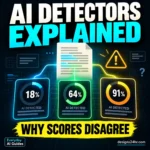
Seeing one AI text detector report 18%, another 64%, and another 91% can feel contradictory. In reality, conflicting outputs are possible because the detectors are not necessarily performing the same calculation.
Different training data
Tools may have been trained or evaluated using different combinations of human writing, AI models, languages, topics, document types, and writing styles. A pattern one classifier treats as important may carry less weight in another.
Different model coverage
Generative AI systems change quickly. A detector may perform differently on models or model versions that were not represented in its development or evaluation data.
Different thresholds
Two detectors can observe similar underlying signals and still assign different labels because the providers chose different classification thresholds.
Different text segmentation
One tool may analyze a complete passage while another may classify sentences, segments, or qualifying prose. The displayed result can therefore reflect different units of analysis.
Different score definitions
A percentage can represent different concepts from one service to another. This is why comparing percentages without reading the documentation can create false precision.
Editing and mixed authorship
Real writing workflows are not always purely “human” or purely “AI.” A person might brainstorm independently, use AI to reorganize notes, rewrite sections manually, use grammar assistance, or combine generated and original material.
A 2026 study published in Studies in Educational Evaluation evaluated five detection tools across fully human, fully AI-generated, humanized, and hybrid human-AI text. The tools performed very strongly on the clean human-versus-AI conditions in that dataset, but performance dropped substantially for hybrid and humanized text. That is an important reminder that detector performance depends on the type of text being tested. View the study.
How Accurate Are AI Detectors?
There is no responsible universal answer such as “AI detectors are 95% accurate.” Accuracy depends on the detector, dataset, writing condition, AI model, language, text length, genre, threshold, and definition of success used in the evaluation.
Some modern systems can distinguish clean human-written samples from clean machine-generated samples very effectively under particular test conditions. That does not mean the same performance automatically carries over to short passages, mixed human-AI documents, paraphrased material, new models, different languages, or every real classroom and workplace scenario.
A separate 2026 review and multi-tool audit published in AI and Ethics emphasized the distinction between classifying statistical or learned properties of text and directly establishing provenance. Its exploratory audit also found materially different classifications when the same human-authored manuscript was submitted to several commercial detectors. Read the 2026 review.
This is why the useful question is not simply:
A more useful question is:
False Positives: When Human Writing Gets Flagged as AI
A false positive happens when an AI detector incorrectly classifies human-written text as AI-generated or assigns it a misleadingly strong AI-associated signal.
False positives matter because the consequences can be much larger than the detector score itself. In education, employment, publishing, or public accusations, an incorrect classification can affect reputation, grades, opportunities, or trust.
Factors that can affect results vary by tool and may include:
- writing genre and structure;
- sample length;
- language and linguistic context;
- highly conventional or formulaic writing;
- editing or grammar assistance;
- the detector’s training data;
- the classification threshold;
- features that resemble patterns seen in generated text.
Avoid turning one older study into a universal statement that all current detectors are biased against every non-native English writer. Research findings vary across detector, dataset, language, population, and generation of the technology. The safer conclusion is that demographic and language effects need to be evaluated for the particular detector and context rather than assumed away.
False Negatives: When AI Writing Is Not Detected
A false negative occurs when AI-generated material is classified as human or is not flagged strongly enough to cross the detector’s threshold.
Possible reasons include:
- the text came from a model the detector handles poorly;
- the passage is too short or does not meet the tool’s intended format;
- the document combines human and AI writing;
- the text has undergone substantial legitimate editing;
- the detector prioritizes reducing false accusations;
- the writing falls outside the detector’s tested domain or language.
A “human” result should therefore be interpreted carefully. It normally means the detector did not find enough evidence, according to its own method and threshold, to classify the submitted sample as AI-generated. It does not certify the entire writing process.
This section explains detection limitations, not ways to defeat detectors. Intentionally manipulating text merely to evade an academic or workplace control may violate the rules that apply to the work.
Can an AI Detector Prove Someone Used ChatGPT?
No detector score alone can prove that a particular person used ChatGPT to produce a document.
A detector may classify textual patterns as being more or less consistent with machine-generated writing, but that is different from establishing the complete provenance of the document.
The same caution applies to asking ChatGPT itself whether it wrote a passage. OpenAI’s current educator guidance says ChatGPT does not have reliable knowledge of whether a submitted passage was AI-generated and can produce baseless answers when asked questions such as whether it wrote an essay. Read OpenAI’s educator guidance.
| Question | What an AI detector can potentially help with | What it cannot establish alone |
|---|---|---|
| Does this text show AI-associated patterns? | Possibly | — |
| Which exact person wrote each sentence? | — | Yes, this is beyond the detector alone |
| Was ChatGPT specifically used? | May contribute a clue in some contexts | Cannot prove this from a generic score alone |
| Did the writer violate a school or workplace policy? | Can trigger further review | Requires the relevant policy and additional evidence |
| Is the writing definitely human? | A low result may be informative | Does not certify human-only authorship |
What to Do When Two AI Detectors Disagree
Conflicting detector results are not unusual enough to justify choosing whichever number supports your preferred conclusion. Use a repeatable process instead.
- Use the exact same text version. Do not compare an original submission in one detector with an edited copy in another.
- Record the detector name and date. Models and policies can change.
- Save the exact result. Record both the percentage and the provider’s wording.
- Read each score definition. Determine whether the tools are measuring comparable outputs.
- Check minimum-length and language requirements. A technically accepted upload may still be outside a detector’s ideal conditions.
- Do not average the results. An 80% score and a 20% score do not automatically produce a meaningful “50% AI” conclusion.
- Inspect available section-level information. A mixed document may behave differently from a uniformly generated one.
- Return to process evidence. Review drafts, sources, notes, version history, documented AI use, and the applicable policy.
- Use “inconclusive” when appropriate. Conflicting evidence is itself information.
Copyable AI Detector Comparison Log
Use this log whenever you need to compare detector outputs without losing the context behind each number.
Text version:
Detector:
Date checked:
Sample size:
Language:
Document type:
Exact detector output:
Provider's score definition:
Published limitations:
Second detector:
Second detector output:
Draft/version history available:
Other supporting evidence:
Applicable policy:
Final conclusion:
Uncertainty or limitations:
AI Detectors for Essays and Schoolwork
Searches for an AI detector for essays, essay AI detector, or ChatGPT detector often come from teachers and students who want a simple yes-or-no answer. Academic decisions are exactly where an apparently precise score needs careful interpretation.
An AI detector may help an educator identify work that deserves closer review. It should not automatically replace the institution’s academic-integrity process, the assignment requirements, a conversation with the student, or other evidence of how the work developed.
Turnitin’s own documentation states that its AI-writing model can misidentify text and should not be the sole basis for adverse action. OpenAI likewise states that its detector research did not show sufficient reliability for potentially consequential judgments about students.
When a result raises a concern, relevant follow-up evidence may include:
- document version history;
- research notes;
- source annotations;
- earlier drafts;
- assignment-specific discussions;
- the student’s explanation of the reasoning and sources;
- permitted or disclosed AI assistance;
- the institution’s actual AI-use policy.
Also keep authorship detection separate from automated grading. An AI essay grader evaluates writing against a scoring method or rubric; that is not the same task as determining whether text may contain AI-generated material.
AI Detector vs. Plagiarism Checker
An AI content detector and a plagiarism checker answer different questions.
| Method | Main question | Important limitation |
|---|---|---|
| AI detector | Does this text resemble patterns associated with AI-generated writing? | Classification is not direct proof of provenance or misconduct |
| Plagiarism or similarity checker | Does this wording overlap with material in its comparison sources? | Matching text does not automatically establish plagiarism; context and citation matter |
| AI watermark or model-specific signal | Is a compatible provider-specific signal present? | Coverage depends on the system and whether the signal survives |
| Writing-process evidence | How did this document develop over time? | Evidence may be incomplete or require interpretation |
If you want to understand the distinction between generic text detection and a model-specific watermark concept, continue with the Designs24hr guide to the Claude text watermark.
When You Should Not Rely on an AI Detector Alone
The higher the consequence of a decision, the less appropriate it is to turn one automated score into a final verdict.
Use additional evidence and the appropriate human process when a result could affect:
- academic discipline or a student’s grade;
- employment or professional reputation;
- publication decisions or allegations against an author;
- contractual disputes;
- public accusations of deception or misconduct;
- other decisions where an incorrect classification could cause meaningful harm.
This does not mean every AI detector result should be ignored. It means the detector’s role should match the strength of the evidence it can actually provide.
AI Detector Result Decision Table
| Situation | Responsible interpretation |
|---|---|
| One high detector score | Strong enough to justify closer review, not automatic proof |
| Several detectors give conflicting results | Inconclusive; review score definitions and other evidence |
| One tool reports likely human | The tool found limited supported AI-associated evidence; human-only authorship is not proven |
| One tool reports likely AI | The text crossed that tool’s threshold; misconduct is not proven |
| Detector result conflicts with strong process evidence | Investigate the conflict instead of automatically privileging the detector |
| The sample does not meet tool requirements | Do not rely on the result |
| Evidence remains incomplete | Inconclusive |
AI Detection Is Not the Same as Full Verification
A detector answers a narrow classification question. Verification asks whether the broader claim is supported by trustworthy evidence.
That distinction applies across AI-generated media. For example, an image detector can estimate whether visual patterns appear synthetic, but full image verification may also require source research, provenance, metadata, reverse-image searching, dates, and context.
See the Designs24hr AI image verification checklist for an example of the difference between automated detection and a broader evidence-based verification process.
The same principle applies to factual claims produced by AI. If the issue is whether an AI answer is accurate rather than whether its wording was generated by AI, use the AI fact-checking checklist instead.
Final AI Detector Checklist
Before trusting, sharing, or acting on an AI detector result, confirm each applicable item:
- I know what this detector’s percentage or label actually represents.
- The submitted text meets the tool’s current length, language, and format requirements.
- I recorded the exact result instead of recalling it from memory.
- I recorded the detector name and date of the check.
- I did not interpret a detector percentage as a probability that a person cheated.
- I considered both false-positive and false-negative possibilities.
- I checked whether another suitable detector gives a conflicting result.
- I did not average scores that use different definitions.
- I reviewed drafts, notes, sources, version history, or other relevant process evidence where available.
- I separated AI detection from plagiarism or similarity detection.
- I checked the actual school, workplace, publisher, or organization policy that applies.
- I avoided making claims about intent or misconduct that the evidence cannot establish.
- I used “inconclusive” when the combined evidence did not support a stronger conclusion.
The One Rule Worth Sharing
An AI detector score is a signal to interpret, not a verdict to obey.
Read what the score means, check the conditions, compare other evidence, and use the narrowest conclusion the evidence supports.
Frequently Asked Questions About AI Detectors
Can AI detectors be wrong?
Yes. AI detectors can produce false positives by flagging human-written text and false negatives by missing AI-generated text. Error rates vary by detector, dataset, language, text type, model, editing, and threshold, so there is no single accuracy number that applies to every tool and situation.
What does 100% AI detected mean?
It depends on the detector. A result displayed as 100% may refer to a classification score, confidence measure, or amount of qualifying text the tool considers likely AI-generated. It does not automatically mean there is a 100% probability that a particular person used AI or committed misconduct. Read the provider’s definition.
Why does one AI detector say 90% and another say 10%?
Different detectors can use different training data, classification methods, thresholds, text segmentation, model coverage, and score definitions. Record the disagreement and check the underlying evidence instead of assuming one percentage must be correct.
Can human-written text be flagged as AI?
Yes. This is called a false positive. Even major detector providers acknowledge that human writing can be misclassified. The risk and circumstances vary by tool, so a detector flag should be reviewed rather than automatically treated as proof.
Can AI-written text pass an AI detector?
Yes. A false negative occurs when generated text is not detected or does not cross the tool’s threshold. Results may vary with the AI model, type of writing, amount of text, language, editing, mixed authorship, and the detector itself.
Are AI detectors accurate for essays?
Some detectors can perform well on particular essay datasets and test conditions, but performance is not universal. Results should be interpreted according to the exact tool, text type, language, model coverage, threshold, and consequences of the decision. For academic misconduct decisions, detector output should not be the only evidence.
Can an AI detector tell whether ChatGPT wrote something?
A generic AI detector may identify patterns it associates with generated writing, but a detector score alone cannot prove that ChatGPT specifically produced the text. OpenAI also warns that asking ChatGPT whether it wrote a passage is not a reliable authorship test.
Is an AI detector the same as a plagiarism checker?
No. An AI detector looks for patterns associated with generated text, while a plagiarism or similarity checker compares wording with sources available to its system. A document can be original yet AI-generated, or human-written while containing improperly copied material.
Does editing text change AI detector results?
It can. Substantial human editing, mixed human-AI writing, rewriting, and other changes can affect the features a detector analyzes. Recent research has found that performance can differ substantially between clean AI-generated text and hybrid or heavily modified material.
Should I use multiple AI detectors?
A second suitable detector can help reveal whether a result is stable or conflicting, but agreement between tools still does not prove authorship. Use the exact same text, document each tool’s definition and limitations, and do not average incompatible scores.
Can a detector prove academic cheating?
No detector score alone proves academic misconduct. Whether AI use violates a rule depends on the assignment and institution’s policy, and consequential decisions should consider additional evidence and appropriate human review.
Checking a different type of content? Use the AI Image Detector Checklist for suspicious images or the AI Voice Detector Checklist for synthetic or cloned audio. If the question is whether an AI-generated factual claim is trustworthy, continue with How to Fact-Check AI Answers.