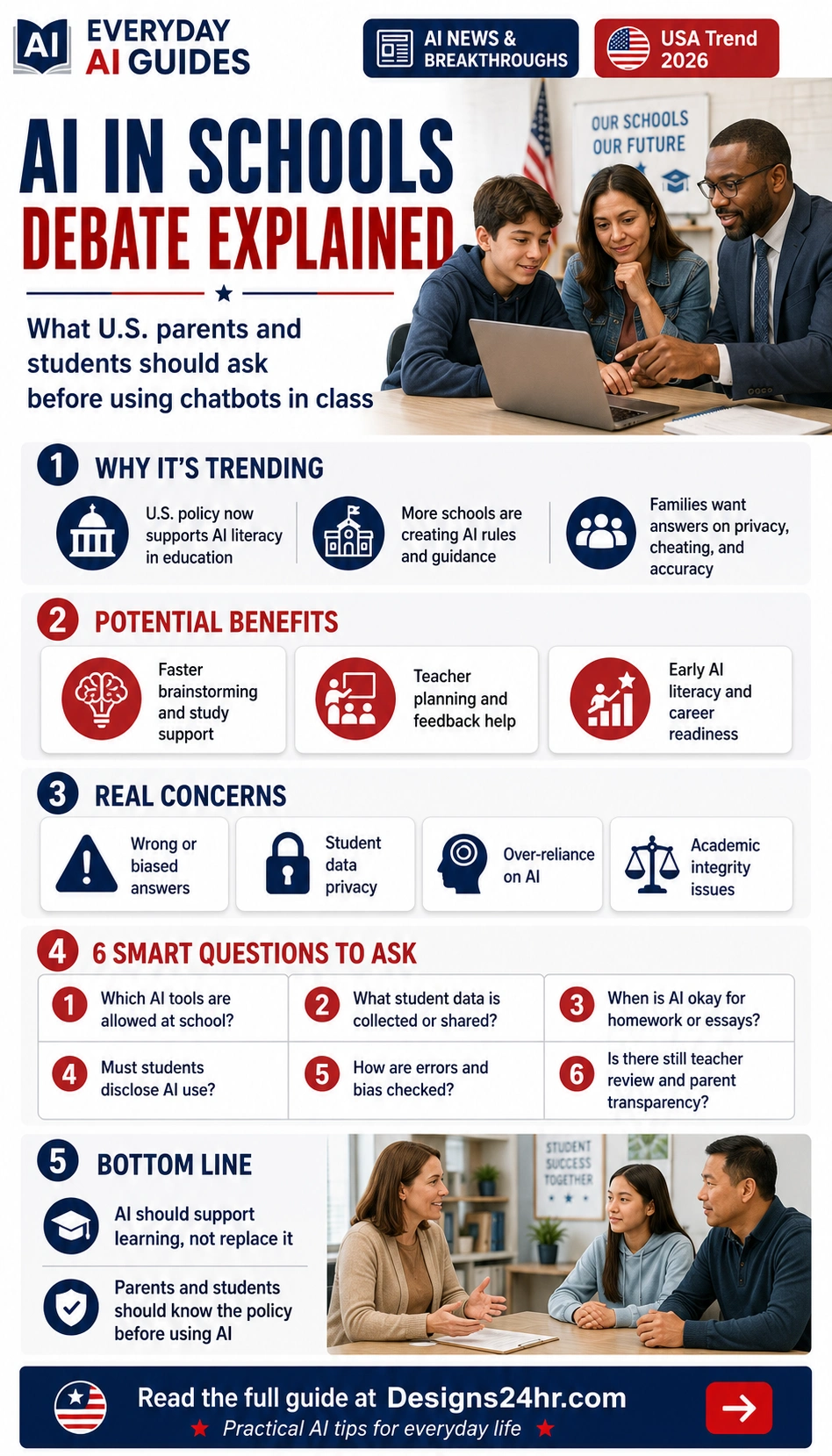
AI in Schools Debate Explained: What U.S. Parents and Students Should Ask
AI in schools is no longer just a future idea. U.S. students are already seeing chatbots, AI writing tools, AI tutors, and teacher-facing AI platforms show up in classrooms, homework, and school policy debates.
Some families see these tools as a way to improve learning and prepare students for future jobs. Others worry about privacy, cheating, over-reliance, bias, and whether children are being pushed into AI before schools have clear rules.
Parents and students should know what is allowed, what is risky, and who reviews the final work.
What This Guide Covers
- What is the AI in schools debate?
- Why AI in schools is trending in the U.S.
- Potential benefits of AI in classrooms
- Real concerns parents and educators are raising
- What students should understand before using AI
- Smart questions parents should ask schools
- Red flags before using AI in class
- The smart middle ground
- Frequently asked questions
What Is the AI in Schools Debate?
The AI in schools debate is about how students, teachers, and school districts should use artificial intelligence responsibly. It includes tools that can write drafts, explain math, summarize readings, create practice questions, help teachers plan lessons, and give students feedback.
The debate is not only about cheating. It is also about privacy, learning quality, teacher oversight, student independence, school policy, and whether AI tools are being used in ways that actually help students think.
Simple version: AI can be useful in school when it helps students practice, understand, organize, and improve. It becomes risky when it replaces thinking, collects unclear student data, gives wrong answers, or creates confusion about what work belongs to the student.
For more simple AI explainers, visit the Everyday AI Guides hub on Designs24hr.
Why AI in Schools Is Trending in the U.S.
AI in education is trending because students are already using chatbots, teachers are testing AI lesson tools, districts are writing AI policies, and national leaders are talking about AI literacy as a future workforce skill.
In the United States, AI education has become part of a larger conversation about digital skills, academic honesty, privacy, and how schools should prepare students for a world where AI tools are common in college, jobs, and everyday life.
AI literacy is becoming a priority
Schools are being pushed to help students understand AI, not just avoid it. That includes knowing what AI can do, where it fails, and how to use it responsibly.
Students are already using AI
Many students can access chatbots outside school, which makes clear classroom rules more important than pretending AI does not exist.
Parents want transparency
Families want to know which AI tools are approved, what data is collected, and whether AI is helping learning or replacing teacher guidance.
The White House has described AI literacy and appropriate AI integration in education as a national priority, while education groups and school systems are creating practical guidance for responsible AI use. The key word is appropriate. AI in school should be guided by clear rules, not rushed into classrooms without explanation.
Potential Benefits of AI in Classrooms
Used carefully, AI can help students and teachers. The strongest classroom uses are usually the ones that keep humans in control and help students build understanding instead of skipping the learning process.
Study support
AI can explain a difficult concept in simpler words, create practice questions, or help a student review material before a quiz.
Brainstorming help
Students can use AI to generate topic ideas, outline a project, or ask for examples before writing their own work.
Teacher planning support
Teachers may use AI to draft lesson ideas, adjust reading levels, create sample questions, or save time on routine planning tasks.
Feedback practice
AI can help students spot unclear sentences, check organization, or practice revising before a teacher reviews the final assignment.
Accessibility support
Some AI tools can simplify text, translate language, summarize information, or support students who need extra help understanding material.
Future readiness
Students may need AI literacy for future college, career, and everyday technology decisions, so learning safe use can be valuable.
Helpful rule: AI is usually safer when it helps a student practice, review, compare, organize, or ask better questions. It is more risky when it produces the final answer and the student cannot explain the work.
Real Concerns Parents and Educators Are Raising
The concerns around AI in schools are serious because students are still developing critical thinking, research habits, writing skills, emotional judgment, and digital responsibility. AI tools can sound confident even when they are wrong, and children may not always know how to check the answer.
Wrong or biased answers
AI tools can produce inaccurate, incomplete, outdated, or biased information. If students trust every answer, they may learn the wrong thing with confidence.
Student data privacy
Parents should know whether a tool collects names, assignments, prompts, voice, images, school email addresses, or other student data.
Academic integrity
If students copy AI-written work, hide AI use, or submit answers they do not understand, AI can turn into a cheating problem.
Over-reliance on AI
If AI solves every step, students may stop practicing the thinking, writing, researching, and problem-solving skills school is supposed to build.
That is why the best AI school policies should be specific. A vague “use AI responsibly” rule is not enough. Students need examples of what is allowed, what is not allowed, when they must disclose AI use, and how teachers will evaluate the work.
What Students Should Understand Before Using AI
Students should not be told only that AI is dangerous or amazing. They need simple rules they can actually follow. The most important rule is this: AI can help you learn, but it should not become the person doing the learning for you.
Before using AI, students should ask whether the teacher allows it for brainstorming, outlining, editing, studying, or final answers.
If a chatbot writes the answer and the student turns it in without permission or disclosure, that may be academic dishonesty.
AI can make mistakes, so students should verify dates, names, quotes, statistics, and claims with reliable sources.
A good student prompt asks for explanation, practice, examples, or feedback instead of asking for a finished answer.
Students should not paste private family details, school records, passwords, addresses, medical information, or personal photos into AI tools.
6 Smart Questions U.S. Parents Should Ask Schools
Parents do not need to be AI experts to ask smart questions. They just need clear answers from the school about tools, data, supervision, and learning value.
| Question | Why It Matters | What a Clear Answer Should Include |
|---|---|---|
| Which AI tools are allowed at school? | Students need to know whether AI is approved, blocked, optional, or teacher-specific. | A list of approved tools, grade-level rules, and examples of allowed uses. |
| What student data is collected or shared? | AI tools may collect prompts, files, accounts, or usage data. | Clear privacy details, vendor review, data retention rules, and parent-facing explanation. |
| When is AI okay for homework or essays? | Students need to know the line between support and cheating. | Assignment examples showing allowed, limited, and prohibited AI use. |
| Must students disclose AI use? | Disclosure rules prevent confusion and protect academic honesty. | A simple format for citing or explaining AI help when it is allowed. |
| How are AI errors and bias checked? | AI can be wrong, unfair, or incomplete. | Teacher review, source checking, human judgment, and no automatic grading without oversight. |
| Is there still teacher review and parent transparency? | AI should not quietly replace instruction, feedback, or adult accountability. | Clear communication about how AI supports learning and who is responsible for decisions. |
Parent tip: If a school cannot explain which AI tools are used, what data is collected, and how teachers review AI-supported work, it is reasonable to ask for more clarity before your child uses the tool.
What Teachers and Schools Should Make Clear
Schools do not need a perfect AI policy before talking to families. But they do need clear communication. The biggest problems happen when students, parents, and teachers all have different assumptions about what AI use means.
Allowed AI use
Schools should explain when students may use AI for brainstorming, practice, feedback, research support, or revision.
Not allowed AI use
Schools should explain when AI use becomes cheating, such as generating a full essay, solving graded problems, or hiding AI-written work.
Privacy review
Schools should explain whether AI tools have been reviewed for student privacy, security, age rules, and data handling.
Human oversight
Teachers should remain responsible for instruction, feedback, judgment, and grading decisions. AI should not be the final authority.
Families can also explore related AI safety topics in AI Safety, Privacy & Trust.
Red Flags Before Students Use AI in Class
AI tools can be useful, but parents should slow down if the school, app, or assignment creates confusion instead of clarity.
If students are told to use AI but are not told what is allowed or prohibited, mistakes are more likely.
If no one can explain what data the AI tool collects, stores, or shares, parents should ask more questions.
AI can assist feedback, but students still need human guidance, especially on writing, reasoning, and judgment.
If a student submits AI-assisted work but cannot explain the process, the tool may be replacing learning.
Students should know whether they must mention AI help and how to do it properly.
The Smart Middle Ground: Teach AI Literacy With Strong Boundaries
A total AI ban may be hard to enforce because students can access AI tools outside school. But unlimited AI use can also damage learning, privacy, and trust. The smart middle ground is to teach AI literacy while setting strong boundaries.
A Better Rule for Families
Do not ask only, “Is AI allowed?” Ask, “What kind of AI use helps my child learn, what kind creates risk, and who is responsible for checking the result?”
For students, that means using AI as a study partner, not a replacement brain. For parents, it means asking schools about privacy, teacher review, and academic honesty. For teachers, it means giving students clear examples instead of vague warnings.
AI is likely to become part of education in some form. The goal should be to help students become thoughtful, careful, and honest users of AI rather than passive users who trust every answer on screen.
Simple Family Checklist Before Using AI for School
Before a student uses a chatbot for homework, classwork, or study help, families can use this quick checklist.
Ask the teacher
Is AI allowed for this assignment? Is it allowed for brainstorming only, or can it be used for editing and feedback too?
Protect private information
Do not paste personal data, private school records, addresses, passwords, or sensitive family details into AI tools.
Use AI for practice
Ask for explanations, quiz questions, examples, outlines, and feedback instead of asking AI to complete the whole assignment.
Check the answer
Verify important facts with trusted sources, textbooks, teacher materials, or official websites.
Keep your own voice
The final work should sound like the student and reflect what the student understands.
Disclose when required
If the teacher asks students to mention AI use, be honest and explain how AI helped.
Bottom Line
The AI in schools debate is not about panic or hype. It is about using powerful tools carefully around children, learning, privacy, and trust.
AI can help students brainstorm, practice, review, and prepare for a future where AI tools are common. But AI should not replace student thinking, teacher judgment, parent transparency, or clear school rules.
The safest path is simple: teach AI literacy, protect student data, set clear classroom rules, require honesty, and keep humans responsible for learning decisions.
Final takeaway: Before students use chatbots in class, parents and students should know what is allowed, what data is collected, when AI use must be disclosed, how errors are checked, and whether a teacher remains in control.
Keep learning with Everyday AI Guides or browse the latest updates in AI News & Breakthroughs.
Frequently Asked Questions About AI in Schools
Is AI allowed in schools?
AI rules vary by school, teacher, district, grade level, and assignment. Some schools allow AI for brainstorming, practice, or teacher-approved support, while others restrict it for tests, essays, graded work, or unsupervised student use.
Is using AI for schoolwork cheating?
It depends on the assignment and the teacher’s rules. AI can be useful for explanations, practice questions, outlining, and study support. But copying AI-written answers, hiding AI use, or submitting work the student does not understand can become cheating.
What should parents ask before students use AI in class?
Parents should ask which AI tools are approved, what student data is collected, whether students need accounts, when AI use must be disclosed, how teachers check accuracy, and whether AI is supporting or replacing learning.
Can AI help students learn?
Yes, AI can help students review concepts, create practice questions, simplify explanations, organize ideas, and improve drafts. It works best when students still do the thinking and can explain the final work in their own words.
What are the biggest risks of AI in schools?
The biggest risks include inaccurate answers, biased outputs, student data privacy issues, academic integrity problems, over-reliance on AI, reduced critical thinking, and unclear classroom rules.
Should schools ban AI completely?
A complete ban may be difficult to enforce because AI tools are widely available outside school. A clearer approach is to teach responsible AI use, set boundaries, protect student data, explain when AI is allowed, and keep teachers involved in review and feedback.
How can students use AI without cheating?
Students can use AI without cheating by asking for explanations, examples, study questions, outlines, or feedback when the teacher allows it. They should avoid copying AI-generated work as their own and should disclose AI use when required.