An AI reasoning model is quickly becoming one of the most important ideas in artificial intelligence. For years, most people thought of AI as a chatbot: you ask a question, it gives an answer, and the conversation continues. But reasoning models are designed for something deeper. They are built to work through complex tasks, follow multi-step instructions, understand longer context, and solve problems with a more careful step-by-step approach.
That is why Microsoft’s new MAI-Thinking-1 matters. Announced around Microsoft Build 2026, MAI-Thinking-1 is Microsoft’s first in-house reasoning model, and it signals a bigger shift in how AI tools may work inside Copilot, coding platforms, business software, and everyday productivity apps.
This guide explains what an AI reasoning model is, how it is different from a normal chatbot, why Microsoft MAI-Thinking-1 is important, and what everyday users should expect as reasoning AI becomes part of work, search, coding, planning, and digital assistance.
What Is an AI Reasoning Model?
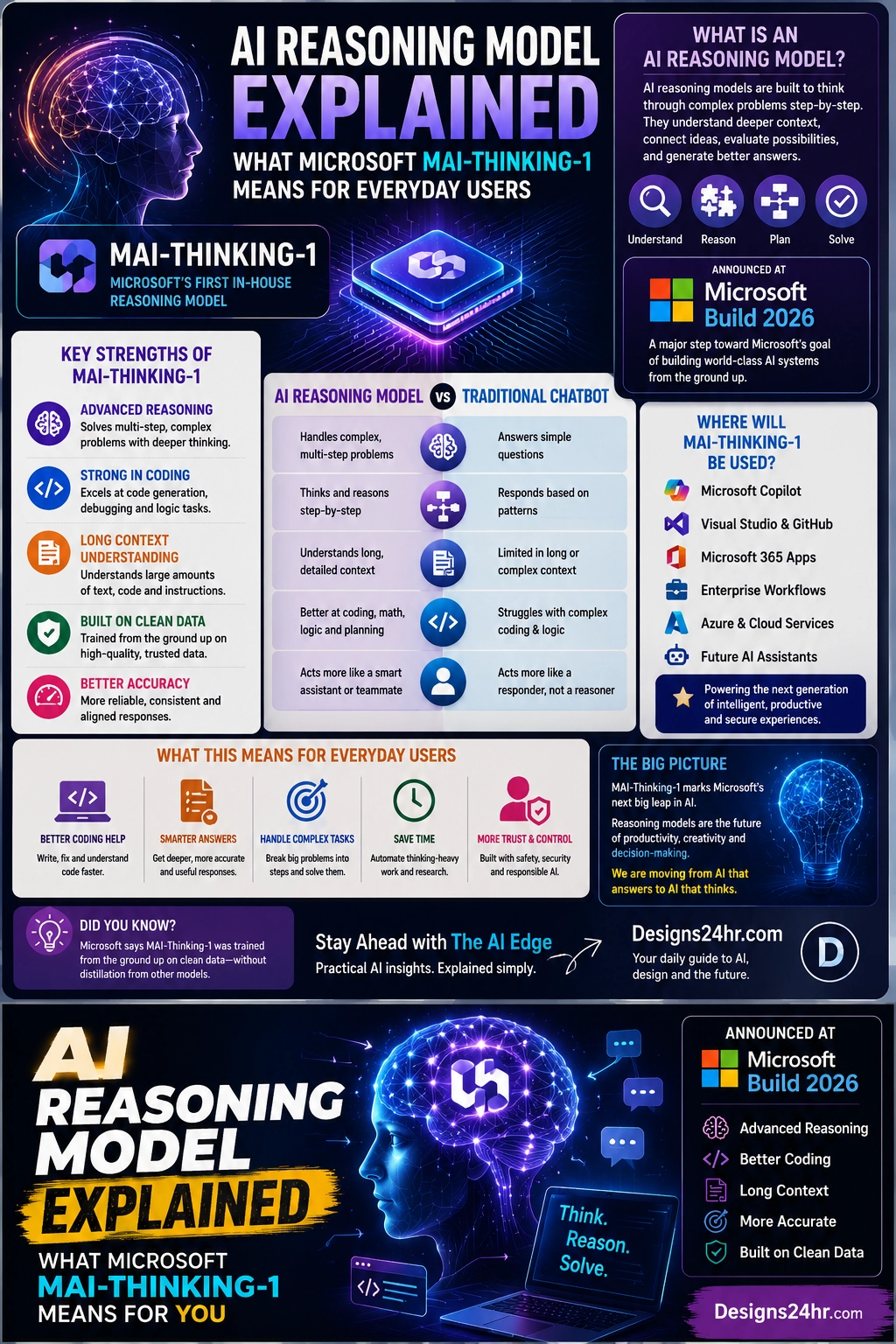
An AI reasoning model is a type of AI model designed to handle problems that need more than a quick answer. Instead of only predicting the next best response, a reasoning model is built to process information more carefully, connect ideas, break a task into smaller steps, and produce a more structured answer.
For example, a basic chatbot may answer a simple question like, “What is a good email subject line?” But an AI reasoning model can do more complex work, such as reviewing a long brief, understanding the goal, comparing multiple options, identifying weak points, and then producing a stronger recommendation.
In simple words, an AI reasoning model is made for tasks that require thinking through the problem, not just responding quickly.
AI Reasoning Model vs Chatbot: The Simple Difference
The easiest way to understand an AI reasoning model is to compare it with a traditional chatbot. A chatbot is usually best for quick replies, summaries, writing help, and simple questions. A reasoning model is better suited for deeper work where the answer depends on logic, planning, context, and multiple steps.
| Traditional AI Chatbot | AI Reasoning Model |
|---|---|
| Best for quick answers | Best for complex thinking and step-by-step tasks |
| Responds to prompts | Breaks down problems and works through them |
| May struggle with long or messy context | Designed to handle deeper context and detailed instructions |
| Useful for simple writing, ideas, and summaries | Useful for coding, planning, analysis, problem-solving, and decision support |
| Acts more like a responder | Acts more like a smart assistant or thinking partner |
This does not mean chatbots are going away. Chatbots are still useful. But reasoning models add another layer: they are better for situations where the user needs help understanding, deciding, fixing, building, or solving something.
What Is Microsoft MAI-Thinking-1?
Microsoft MAI-Thinking-1 is Microsoft’s first in-house AI reasoning model. It is part of Microsoft’s broader push to build more of its own AI systems, instead of relying only on outside models from other AI labs.
According to current reporting, MAI-Thinking-1 is designed for complex multi-step tasks, software engineering benchmarks, long-context work, and code-related reasoning. That makes it especially important for tools like Microsoft Copilot, GitHub Copilot, Visual Studio Code, Microsoft 365 apps, and future AI-powered productivity workflows.
The bigger story is not just that Microsoft launched another AI model. The bigger story is that Microsoft is moving toward a future where AI can reason more deeply inside the apps people already use for work, school, coding, business, and productivity.
Why Microsoft Building Its Own AI Reasoning Model Matters
Microsoft has been one of the biggest companies in the AI boom, especially through Copilot, Azure AI, GitHub Copilot, Microsoft 365 Copilot, and its partnership history with OpenAI. But launching an in-house AI reasoning model gives Microsoft more control over how its AI tools are built, optimized, tested, and integrated into its own products.
That matters for three main reasons.
First, Microsoft can design AI models for its own ecosystem. A reasoning model built by Microsoft can be tuned toward the needs of Microsoft products, including enterprise workflows, coding tools, productivity apps, cloud services, and business users.
Second, reasoning models can make Copilot more useful. If Copilot becomes better at understanding complex requests, working through long context, and solving multi-step problems, it could become more than a writing assistant. It could become a stronger thinking and productivity partner.
Third, Microsoft can compete more directly in frontier AI. Building its own reasoning models helps Microsoft strengthen its position in the AI race while giving developers and businesses more model choices.
Why MAI-Thinking-1 Matters for Copilot
Copilot is already becoming a major part of Microsoft’s AI strategy. Microsoft 365 Copilot is positioned as an AI tool that helps users search, chat, create, organize information, and stay in the flow of work. A stronger AI reasoning model could make that experience more capable.
For everyday users, this could mean Copilot becomes better at tasks like:
- Understanding long documents and messy notes
- Explaining complex information in simple language
- Creating better plans from incomplete instructions
- Helping with decisions that involve multiple steps
- Reviewing emails, documents, or reports for gaps
- Turning rough ideas into organized action steps
The key point is that an AI reasoning model could help Copilot move from basic assistance toward more useful problem-solving. Instead of only helping users write a paragraph or summarize a file, reasoning AI may help users understand what matters, what to do next, and why.
How AI Reasoning Models Can Help with Coding
One of the strongest use cases for an AI reasoning model is coding. Coding is not just about writing lines of code. It often requires logic, debugging, planning, testing, understanding errors, and connecting many parts of a system together.
A reasoning model can help developers and beginners by working through coding problems more carefully. For example, it may help explain why a function is failing, identify a missing condition, suggest a cleaner structure, or break a large coding task into smaller steps.
This matters because Microsoft already has a strong presence in developer tools through Visual Studio Code, GitHub, and GitHub Copilot. If MAI-Thinking-1 or related Microsoft AI models improve coding support, the impact could be felt by professional developers, students, creators, and small business owners who rely on AI to build faster.
For non-coders, this still matters. Better coding AI can lead to better apps, better automation, better websites, and faster software development. It also makes technology creation more accessible to people who have ideas but do not know how to write every line of code themselves.
What This Means for Everyday Work and Productivity
An AI reasoning model is not only for developers. The same type of reasoning can also help everyday users with normal work tasks. Many people deal with information overload every day: too many emails, too many documents, too many meetings, too many decisions, and too many small tasks that take mental energy.
Reasoning AI can help by turning scattered information into a clearer path forward. For example, a user might ask an AI assistant to review meeting notes, identify the next steps, organize tasks by priority, and draft follow-up messages. A basic chatbot may summarize the notes. A stronger reasoning model may understand what needs action, what is unclear, and what should happen next.
That is the real promise of AI reasoning models: they can help people move from information to action.
Practical Examples of AI Reasoning Models
Here are simple examples of how an AI reasoning model could help in daily life and work:
- Work planning: Turn a messy project brief into milestones, tasks, and deadlines.
- Email decisions: Review a long email thread and identify what needs a reply.
- Research: Compare multiple sources and explain the strongest conclusion.
- Coding: Debug a problem by checking logic step by step.
- Studying: Explain a difficult concept and create a practice plan.
- Business: Review customer feedback and identify the biggest improvement areas.
- Content creation: Build a structured outline from a rough idea and improve the flow.
Benefits of AI Reasoning Models
The first major benefit of an AI reasoning model is better problem-solving. When a task has multiple steps, a reasoning model can help organize the work instead of giving a shallow answer.
The second benefit is stronger accuracy in complex situations. No AI model is perfect, but reasoning models are designed to handle deeper logic and longer context better than simple response-based tools.
The third benefit is better support for work and coding. Reasoning models can help users understand problems, compare options, debug errors, and make smarter decisions.
The fourth benefit is time savings. If an AI assistant can understand the goal and work through the details, users may spend less time sorting information and more time making final decisions.
What Users Should Watch Before Trusting Reasoning AI
Even though AI reasoning models are powerful, users should not treat them as perfect. Reasoning AI can still make mistakes, misunderstand context, over-explain the wrong idea, or present a confident answer that needs checking.
There are three important things users should remember.
First, always check important answers. If the task involves money, health, legal questions, private data, business decisions, or major work, human review is still necessary.
Second, understand what data you are sharing. If you use AI inside work apps, documents, or codebases, make sure you understand privacy settings, company rules, and permission controls.
Third, use reasoning AI as support, not as the final authority. An AI reasoning model can help you think through something, but you should still make the final decision.
Why This Is Bigger Than One Microsoft Model
MAI-Thinking-1 is important, but it is also part of a larger AI trend. The whole industry is moving toward AI systems that can reason, plan, code, act, and assist inside real workflows.
This is why people are hearing more terms like AI reasoning model, AI agents, agentic AI, AI PC, and Copilot AI. These ideas are connected. The future of AI is not only about better chat answers. It is about smarter systems that can help users complete meaningful tasks.
For Microsoft, this connects with Copilot, Windows, GitHub, Visual Studio Code, Microsoft 365, Azure, and enterprise AI tools. For users, it means AI may show up in more places and become more useful for real work.
The Future of AI Reasoning Models
The future of AI reasoning models will likely focus on three things: better thinking, better tool use, and better control.
Better thinking means AI models that can handle harder problems, longer instructions, and more complicated decisions.
Better tool use means AI models that can connect with apps, files, code editors, browsers, calendars, and business systems in more practical ways.
Better control means users and businesses will need strong privacy, security, transparency, and permission settings so AI can help without creating unnecessary risk.
If Microsoft continues building models like MAI-Thinking-1 into its ecosystem, reasoning AI could become a normal part of productivity. Users may not always know which model is running in the background, but they may notice that their AI assistant becomes better at understanding complex tasks and producing useful next steps.
Final Takeaway
An AI reasoning model is one of the clearest signs that artificial intelligence is moving beyond simple chat. Instead of only answering questions, reasoning models are designed to think through problems, understand deeper context, and help with tasks that require logic, planning, coding, and decision-making.
Microsoft MAI-Thinking-1 matters because it shows Microsoft is serious about building its own reasoning AI foundation for the future of Copilot, coding tools, enterprise workflows, and everyday productivity. For everyday users, the message is simple: AI is becoming less like a basic chatbot and more like a thinking assistant.
The best way to use this new generation of AI is not to trust it blindly, but to use it wisely. Let it help you organize, reason, compare, write, code, and plan — then review the final result yourself.
At Designs24hr, we’ll continue breaking down the biggest AI updates in a simple, practical way so you can understand what matters, what is changing, and how new AI tools may affect everyday life, work, creativity, and digital productivity. Share your thoughts in the comments and return to Designs24hr whenever you want to learn something new about AI and design.
FAQs About AI Reasoning Models
What is an AI reasoning model?
An AI reasoning model is an AI system designed to work through complex tasks, follow multi-step instructions, understand deeper context, and solve problems more carefully than a basic chatbot.
How is an AI reasoning model different from a chatbot?
A chatbot usually gives quick answers inside a conversation. An AI reasoning model is designed to break down problems, connect ideas, analyze context, and produce more structured answers for complex tasks.
What is Microsoft MAI-Thinking-1?
Microsoft MAI-Thinking-1 is Microsoft’s first in-house AI reasoning model. It is designed for complex reasoning tasks, long-context understanding, and code-related work.
Why did Microsoft create its own AI reasoning model?
Microsoft building its own AI reasoning model gives the company more control over model development, product integration, enterprise use cases, and future AI tools across Copilot, GitHub, Microsoft 365, Azure, and Windows.
Can AI reasoning models help with coding?
Yes. AI reasoning models can help with coding by explaining errors, debugging logic, breaking down programming tasks, improving code structure, and helping users understand complex technical problems.
How could MAI-Thinking-1 affect Copilot?
MAI-Thinking-1 could help future Copilot experiences become better at complex instructions, planning, coding support, document understanding, and multi-step productivity tasks.
Are AI reasoning models more accurate?
AI reasoning models are designed to perform better on complex thinking tasks, but they can still make mistakes. Users should always review important answers, especially for business, legal, medical, financial, or technical decisions.
Should everyday users care about AI reasoning models?
Yes. AI reasoning models may power future AI assistants inside everyday tools like Copilot, office apps, browsers, code editors, search tools, and productivity platforms. Understanding them helps users use AI more effectively and safely.