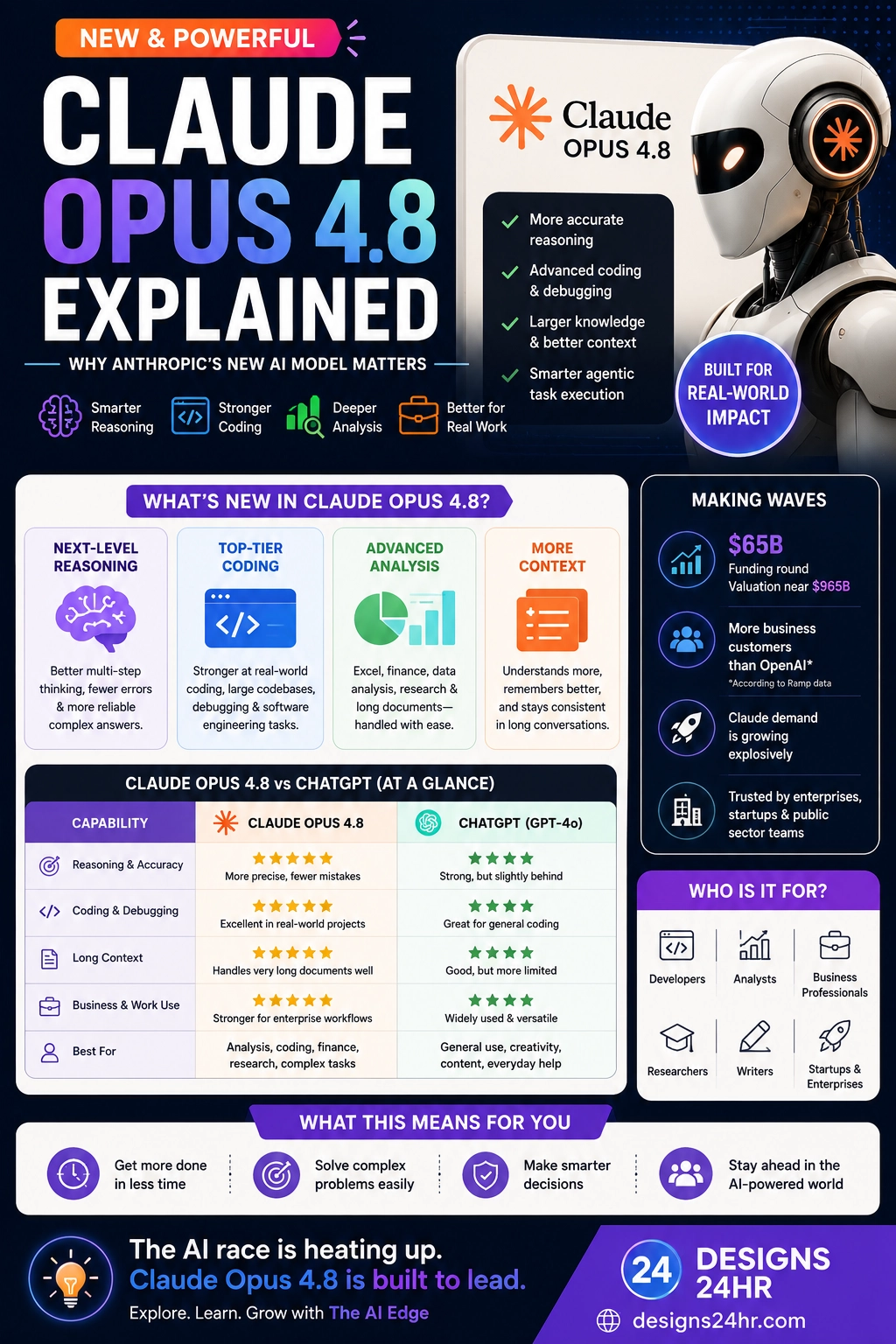
Claude Opus 4.8 is one of the biggest AI model updates to watch right now because it shows where advanced AI tools are heading: stronger reasoning, better coding support, deeper analysis, and more serious use inside real business workflows.
For everyday users, Claude Opus 4.8 may sound like another technical model name. But the bigger story is simple: AI assistants are becoming more useful for complex work, not just quick answers. That matters for developers, analysts, writers, researchers, business teams, startups, and anyone trying to use AI for serious productivity.
What Is Claude Opus 4.8?
Claude Opus 4.8 is Anthropic’s newer advanced AI model designed for high-level tasks such as reasoning, coding, analysis, writing, business workflows, and complex problem solving.
In simple terms, it is built for users who need more than a fast chatbot response. It is aimed at deeper work: understanding long instructions, finding patterns, helping with technical tasks, analyzing information, and producing more reliable outputs for professional use.
If you are new to AI tools and want better results from any model, start by improving your prompts with the AI Prompt Generator from Designs24hr.
Why Claude Opus 4.8 Matters Right Now
Claude Opus 4.8 matters because the AI race is no longer only about who can answer questions faster. The real competition is now about which AI model can help people complete serious work more accurately, safely, and consistently.
Anthropic has gained major attention from businesses, developers, and enterprise users because Claude is often seen as strong for long-form reasoning, careful writing, coding workflows, document analysis, and professional decision support.
That makes Claude Opus 4.8 important for people who want to understand which AI tools are becoming more useful for work, not just entertainment.
1. Smarter Reasoning for Complex Work
One of the biggest reasons people care about Claude Opus 4.8 is reasoning. Reasoning means the model can follow multi-step instructions, compare options, analyze trade-offs, and produce more thoughtful answers.
This is useful when a task has more than one simple answer. For example, a business owner may ask AI to compare two growth strategies. A student may ask for a careful explanation of a difficult topic. A team may ask AI to turn messy notes into a clear plan.
Stronger reasoning does not mean users should blindly trust every answer. It means the model may be better at helping structure complex thinking before the human makes the final decision.
2. Better Coding and Debugging Support
Claude Opus 4.8 is also important for coding. Developers and technical teams often need AI models that can understand code, explain errors, suggest fixes, review logic, and help with larger software tasks.
Better coding support can save time, especially when developers are debugging, reviewing old code, writing documentation, or planning how a feature should work.
For non-developers, this trend still matters. As AI coding models improve, more people may be able to build small tools, automate workflows, test app ideas, and communicate more clearly with technical teams.
3. Deeper Analysis for Business and Research
Another reason Claude Opus 4.8 is getting attention is its usefulness for analysis. AI models are becoming more valuable for reviewing long documents, summarizing research, comparing data, organizing reports, and finding important patterns.
This can help analysts, researchers, business owners, students, marketers, and teams that work with a lot of information. Instead of reading everything from scratch, users can ask AI to extract key takeaways, risks, opportunities, and next steps.
When making important choices based on analysis, use tools like the Decision Helper to compare options clearly before acting.
4. Larger Context for Long Documents and Workflows
Advanced AI models are becoming better at handling longer conversations, larger documents, and more detailed instructions. This is important because real work is rarely one short question.
A user may need AI to understand a long report, remember a project direction, analyze several sections, or help rewrite content while keeping the original purpose intact.
For businesses and professionals, larger context can make AI feel less like a basic assistant and more like a serious work partner that understands the bigger picture.
5. Claude Opus 4.8 vs ChatGPT: What Should Users Know?
Many people will naturally compare Claude Opus 4.8 with ChatGPT. The better question is not always “Which one is best?” The better question is: “Which one is better for the task I need right now?”
Claude is often discussed for careful reasoning, long-form writing, document analysis, coding support, and professional workflows. ChatGPT is widely used for general productivity, brainstorming, creative work, coding, images, voice, browsing, and everyday assistance.
For most users, the smartest approach is to test both on real tasks. Use the model that gives you clearer, more useful results for your specific workflow.
Who Is Claude Opus 4.8 Best For?
Claude Opus 4.8 is especially relevant for users who need reliable help with deeper work, not just quick responses.
- Developers: coding, debugging, code review, and technical explanation.
- Business professionals: reports, planning, strategy, and workflow support.
- Analysts: financial analysis, data explanation, and document review.
- Researchers: long-form summaries, comparisons, and structured insights.
- Writers: outlines, editing, tone improvement, and long-form drafts.
- Startups and enterprises: internal workflows, knowledge work, and productivity systems.
What This Means for Everyday AI Users
Claude Opus 4.8 shows that AI tools are becoming more specialized. Instead of using one model for everything, users may start choosing different AI tools for different types of work.
For example, one model may be better for creative brainstorming, another for coding, another for long document analysis, and another for quick daily tasks.
If your day feels scattered, use the AI Daily Task Planner to organize your work before choosing which AI tool to use.
How to Use Claude Opus 4.8 Smarter
The best results from advanced AI models come from clear instructions. A powerful model still needs a clear goal, useful context, and a specific task.
- Give context: Explain what you are trying to achieve.
- Define the role: Ask the AI to act like an editor, analyst, planner, or reviewer.
- Set the output format: Request a table, checklist, summary, outline, or step-by-step plan.
- Ask for reasoning: Request trade-offs, risks, assumptions, and next steps.
- Review carefully: Check facts, numbers, sources, and final recommendations.
Simple Claude Workflow for Serious Work
Here is a simple workflow for using Claude Opus 4.8 or any advanced AI model more effectively:
- Start with the goal: Tell the AI what outcome you want.
- Add useful context: Include the background, audience, constraints, and priorities.
- Request structure: Ask for the answer in sections, bullets, a table, or a plan.
- Review the first output: Identify what is useful, weak, missing, or unclear.
- Refine the prompt: Ask follow-up questions and improve the answer.
- Make the final decision: Use your judgment before using the output.
This turns AI into a work assistant instead of a random answer generator.
Why Anthropic’s Growth Matters
Anthropic’s rapid rise shows that the AI market is expanding beyond one dominant tool. Businesses are comparing models based on performance, safety, reliability, cost, integrations, and real workflow value.
For users, that competition is good. It pushes AI companies to improve reasoning, speed, coding, safety, and business usefulness. It also gives users more choice when deciding which AI tool fits their needs.
Smart Takeaway
Claude Opus 4.8 is not just another AI model update. It reflects a bigger shift toward AI tools that can support serious work: reasoning, coding, analysis, business planning, research, and long-form productivity.
The best way to think about Claude Opus 4.8 is simple: it is built for users who need deeper help, stronger structure, and more reliable support for complex tasks. But like every AI tool, it still works best when guided by clear prompts and reviewed by a human.
FAQ: Claude Opus 4.8
What is Claude Opus 4.8?
Claude Opus 4.8 is an advanced AI model from Anthropic designed for reasoning, coding, analysis, business workflows, writing, research, and complex knowledge work.
Is Claude Opus 4.8 better than ChatGPT?
It depends on the task. Claude Opus 4.8 may be especially useful for reasoning, long-form work, document analysis, and coding support, while ChatGPT is widely used for general productivity, creative tasks, coding, images, and everyday assistance.
Who should use Claude Opus 4.8?
Claude Opus 4.8 is useful for developers, analysts, researchers, writers, business professionals, startups, and teams that need help with complex tasks or long-form work.
Can Claude Opus 4.8 help with coding?
Yes. Claude Opus 4.8 is designed to support coding, debugging, code explanation, software planning, and technical problem solving.
Should beginners care about Claude Opus 4.8?
Yes. Even if you are not technical, Claude Opus 4.8 shows how AI assistants are becoming more useful for everyday work, research, writing, planning, and decision support.
Explore simple AI tools, visual guides, and practical resources at Designs24hr.