NVIDIA Halos for Robotics Explained: What AI Robot Safety Means for Everyday People
NVIDIA Halos for Robotics is a new safety system for physical AI, humanoid robots, and industrial robots. Here is what it means in plain English, why it matters, and why robot safety has to come before robots become normal in everyday environments.
Simple answer: what is NVIDIA Halos for Robotics?
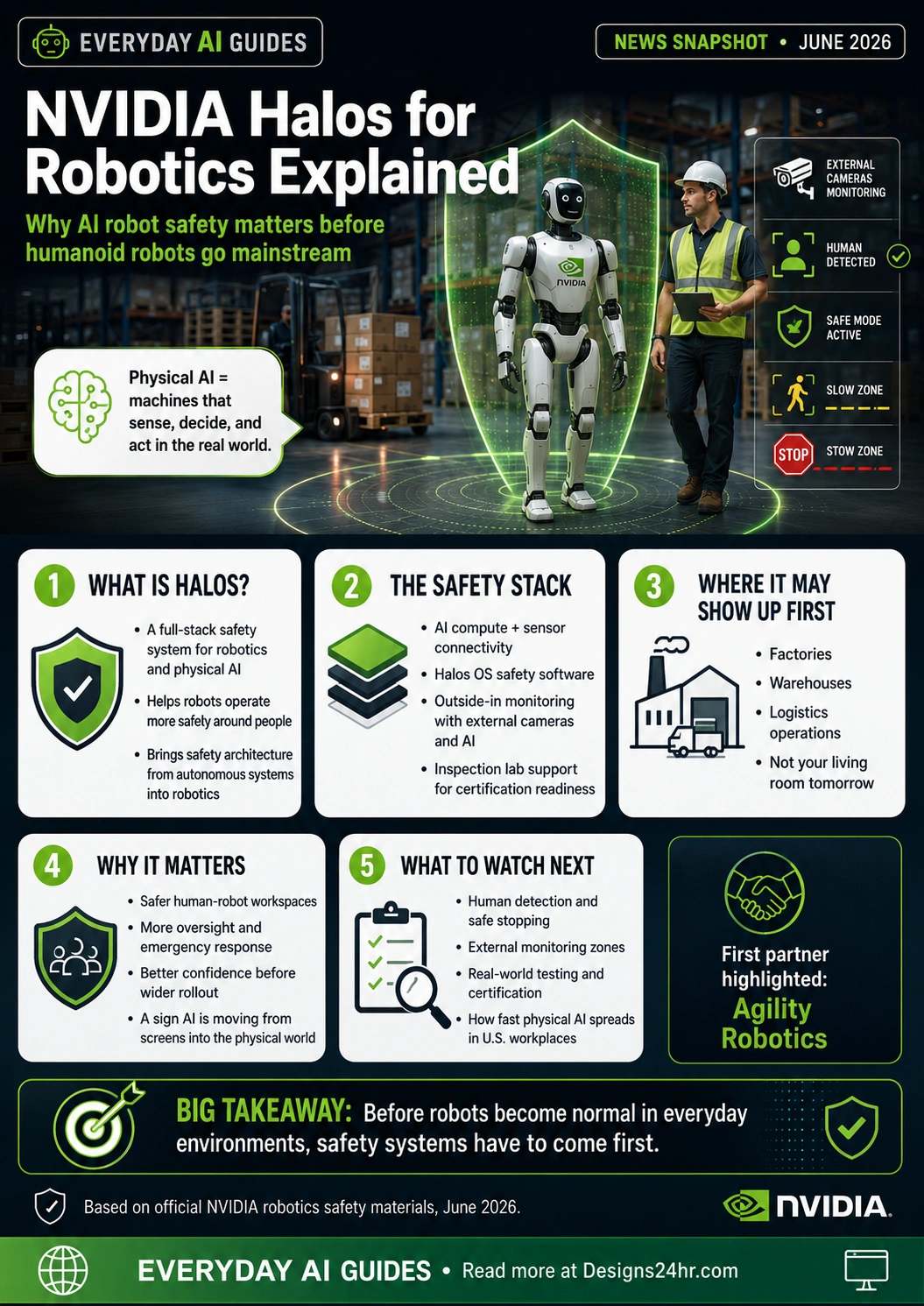
NVIDIA Halos for Robotics is a full-stack safety system for robotics and physical AI. In everyday language, that means it is designed to help connect the hardware, sensors, software, monitoring tools, and inspection process that may be needed for robots to work more safely around people.
NVIDIA announced Halos for Robotics on June 22, 2026, describing it as a safety architecture for machines that can sense, decide, and act in the real world. NVIDIA also highlighted Agility Robotics as the first humanoid robotics partner connected to the system.
This matters because AI is no longer only about chatbots or apps. The next phase of AI may involve machines that move through warehouses, factories, logistics spaces, hospitals, and eventually more human-centered environments.
What does “physical AI” mean?
Physical AI means artificial intelligence that does more than generate text, images, code, or search results. It can connect to machines, sensors, cameras, robots, vehicles, or equipment that operate in real-world spaces.
A chatbot can give a wrong answer on a screen. That can still be harmful, but the mistake usually stays digital. A robot mistake can involve motion, distance, weight, speed, tools, doors, shelves, packages, vehicles, or people nearby. That is why AI robot safety is a much bigger topic than normal app safety.
A useful way to understand it is this:
Physical AI = machines that sense, decide, and act in the real world.
That could include a warehouse robot detecting a human worker, a humanoid robot slowing down in a shared aisle, an autonomous machine stopping when a person enters a safety zone, or external cameras helping monitor a robot’s workspace.
Why NVIDIA Halos matters now
The important part of this story is not that humanoid robots are suddenly coming to every home. They are not. The important part is that major AI and robotics companies are starting to focus on the safety layer that must exist before physical AI can scale.
NVIDIA says Halos for Robotics brings safety architecture from autonomous systems into robotics. Its official materials describe a stack that includes AI compute, sensor connectivity, Halos OS software, outside-in monitoring, and inspection lab support for certification readiness.
For everyday readers, the big takeaway is simple: before robots can become more common in workplaces and public environments, companies need better ways to test, monitor, slow, stop, validate, and certify those systems.
The safety stack explained in plain English
A “full-stack” safety system can sound technical, but the idea is easier to understand when you break it into layers.
AI compute
The robot needs computing power to process what it sees, hears, senses, and decides. This layer helps run the AI models and robot software.
Sensors and cameras
Robots need information from the world around them. Cameras, sensors, and external monitoring systems can help detect people, obstacles, zones, and movement.
Safety software
Safety software helps decide when a robot should continue, slow down, stop, or follow a safer behavior around humans and equipment.
Outside-in monitoring
Instead of relying only on the robot’s own sensors, external cameras and AI systems can also watch the workspace from the outside.
Testing and inspection
Robotics teams need evidence that a system is working safely. Inspection support can help companies prepare for certification and deployment reviews.
Human oversight
Even with advanced AI, people still need clear rules, monitoring, emergency procedures, maintenance, and accountability.
Inside-out safety vs. outside-in safety
Robot safety can involve two different ways of watching the environment.
Inside-out safety
This is what the robot sees and understands from its own built-in sensors, cameras, software, and internal systems.
Outside-in safety
This uses external cameras, monitoring zones, and AI agents around the workspace to help supervise robot behavior from the outside.
In a busy warehouse, outside-in safety could help detect a person entering a shared area, monitor multiple robots, or trigger safer behavior when a zone becomes crowded or risky.
Where AI robots may show up first
The first real-world use cases are more likely to be controlled work environments, not ordinary living rooms. That matters because workplaces can have rules, training, marked zones, supervision, maintenance schedules, and safety procedures.
Factories
Humanoid and industrial robots may help with repetitive, physically demanding, or structured tasks where workflows can be mapped and monitored.
Warehouses
Robots may assist with movement, sorting, carrying, scanning, or support tasks in logistics spaces where safety zones can be designed.
Logistics operations
Distribution centers and supply chain environments may test physical AI earlier because they already use automation and robotics systems.
This does not mean your home will have a humanoid robot tomorrow. The safer and more realistic reading is that robot safety systems are being built for industrial and workplace adoption first.
What this means for U.S. workers and families
For U.S. readers, the practical question is not “Will robots replace everyone?” The better question is: how will companies prove that robots can work safely around people?
If humanoid robots and physical AI systems become more common, workers may need to understand new safety zones, robot behavior signals, reporting processes, training requirements, and emergency stop procedures. Families may also hear more about robotics in healthcare, logistics, retail, delivery, and manufacturing.
The trust issue is huge. People are more likely to accept robots in shared spaces if they can see clear safety rules, visible monitoring, reliable stopping behavior, human oversight, and honest communication about what robots can and cannot do.
AI robot safety checklist: what to look for
When you hear about a new humanoid robot, warehouse robot, or physical AI system, use this simple checklist before believing the hype.
- ✓Human detection: Can the robot reliably detect people nearby?
- ✓Safe stopping: Can it slow down or stop when a person enters a risk zone?
- ✓External monitoring: Are cameras or outside-in systems supervising the workspace?
- ✓Clear zones: Are there visible areas where robots can move, slow, or stop?
- ✓Testing evidence: Has the system been tested in realistic conditions, not only in a demo video?
- ✓Human oversight: Is there a trained person responsible for monitoring and response?
- ✓Limitations disclosed: Does the company clearly explain where the robot should not be used?
What NVIDIA Halos does not mean
It is important not to overhype the announcement. NVIDIA Halos for Robotics does not mean robots are suddenly safe in every environment. It does not mean humanoid robots are ready for every home, school, hospital, or workplace. It also does not remove the need for regulation, testing, training, and human responsibility.
Instead, it is a sign that the AI industry is preparing for a future where safety systems must be part of the robotics stack from the beginning, not added after problems happen.
Why robot safety is different from chatbot safety
Most people first experienced AI through chatbots, image generators, writing tools, or search assistants. Those tools can create mistakes, hallucinations, bias, privacy risks, and bad advice. But physical AI adds another layer because the AI can affect the physical world.
Chatbot risk
A chatbot might give inaccurate information, make up a source, misunderstand a question, or provide advice that needs verification.
Robot risk
A robot might move near a person, carry an object, enter a shared space, misread a scene, or fail to stop quickly enough.
That is why safety systems for physical AI need stronger testing, clearer rules, better monitoring, and more careful deployment than many software-only AI tools.
The big takeaway
Before robots become normal in everyday environments, safety systems have to come first.
NVIDIA Halos for Robotics is important because it shows the AI industry moving from “what can robots do?” toward “how can robots operate safely around people?” That shift matters for workers, families, companies, and anyone trying to understand the next stage of AI.
What to watch next
Here are the next signs to watch as physical AI develops:
- More humanoid robot pilots in factories, warehouses, and logistics operations.
- More public discussion around robot safety standards and certification.
- Better outside-in monitoring systems using cameras and AI agents.
- Clearer rules for how robots should behave around human workers.
- More focus on emergency response, safe stopping, and human detection.
- More debate about jobs, training, workplace trust, and accountability.
Related guides on Designs24hr
For more simple AI explainers, visit the Everyday AI Guides hub. You can also explore our AI safety and privacy guides, beginner-friendly AI guides, smart living with AI, and AI news and breakthroughs.
FAQs about NVIDIA Halos for Robotics
What is NVIDIA Halos for Robotics?
NVIDIA Halos for Robotics is a safety system for robotics and physical AI. It is designed to connect AI compute, sensors, safety software, monitoring, and inspection support so robots can operate more safely around people.
What does physical AI mean?
Physical AI means AI systems that can sense, decide, and act in the real world. Unlike a chatbot, physical AI may control robots, machines, vehicles, or other systems that move through physical environments.
Does NVIDIA Halos mean humanoid robots are coming to homes soon?
Not necessarily. The first likely use cases are controlled environments such as factories, warehouses, and logistics operations. These spaces are easier to monitor, test, and manage than everyday homes.
Why does AI robot safety matter?
AI robot safety matters because robots can move, carry objects, work near humans, and make real-world decisions. That creates higher safety expectations than software-only AI tools.
Who is the first partner highlighted for NVIDIA Halos for Robotics?
NVIDIA highlighted Agility Robotics as the first humanoid robotics partner for Halos for Robotics.
Will AI robots replace human workers?
Some robots may automate repetitive or physically demanding tasks, but the real impact depends on the industry, job type, safety rules, training, and how companies choose to deploy robotics. The most realistic near-term focus is human-robot collaboration in controlled workplaces.
Sources and further reading
This beginner-friendly guide is based on public information from official and trusted sources. For deeper reading, review NVIDIA’s official Halos for Robotics announcement, NVIDIA Robotics Safety, NVIDIA’s full-stack functional safety explanation, NVIDIA’s humanoid robots overview, and the NIST AI Risk Management Framework.
This article is an educational explainer for everyday readers. It is not a robotics certification, workplace safety standard, engineering review, or legal recommendation.
Final thought
The next chapter of AI may not only happen on laptops and phones. It may happen in the physical spaces where people work, move, shop, build, ship, and receive care. NVIDIA Halos for Robotics is worth watching because it puts the spotlight on a question everyone should care about: can AI systems become useful in the real world while staying understandable, monitored, tested, and safe around people?