OpenAI Daybreak Explained: How AI Could Help Fix Security Bugs Before Hackers Exploit Them
OpenAI Daybreak explained in simple terms: this new cybersecurity initiative focuses on helping trusted defenders move from finding software vulnerabilities to validating, testing, and patching them faster.
Simple answer: what is OpenAI Daybreak?
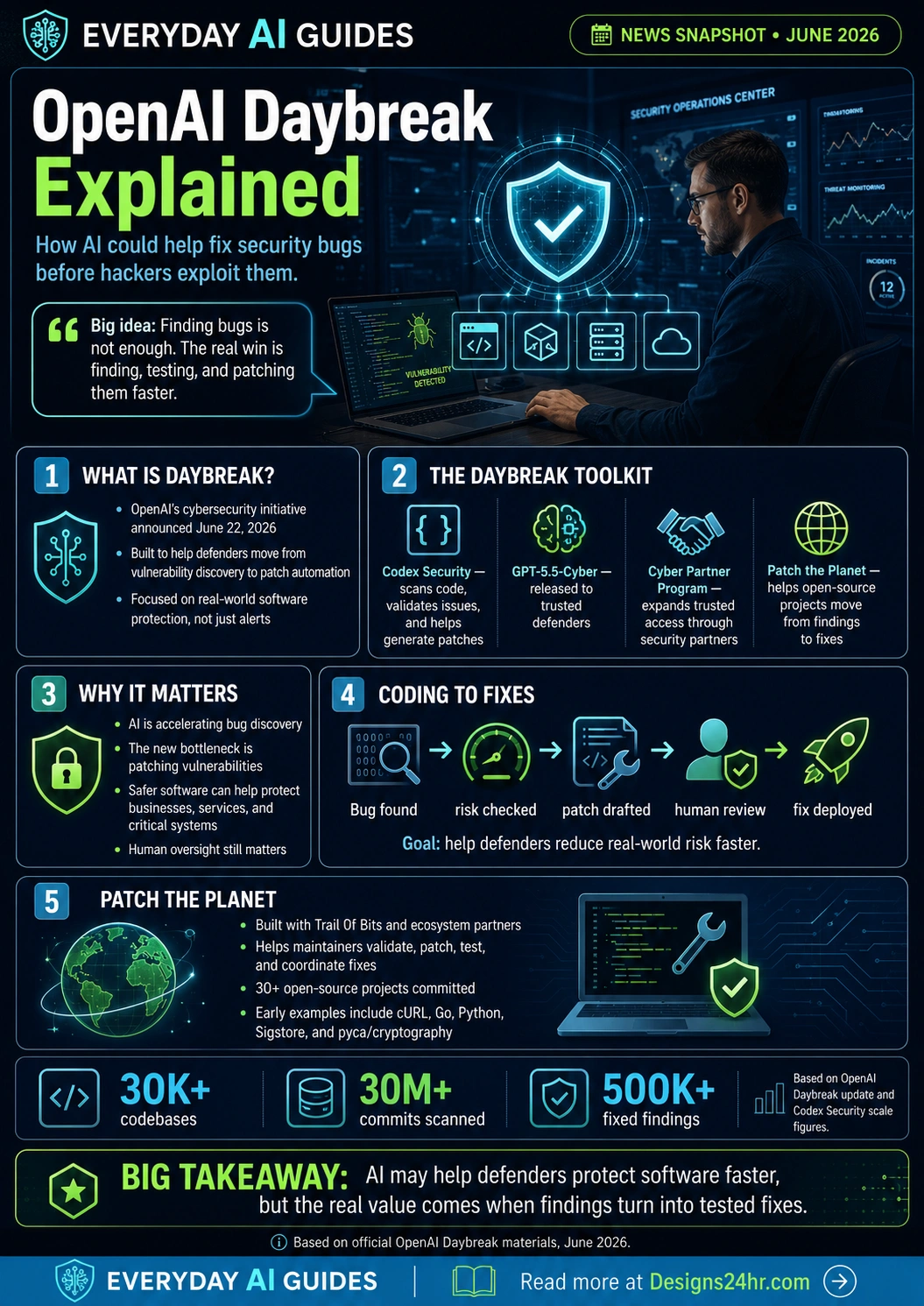
OpenAI Daybreak is a cybersecurity initiative built to help defenders find, validate, prioritize, patch, test, and deploy software security fixes faster. Instead of focusing only on discovering vulnerabilities, Daybreak is designed around the bigger safety goal: turning findings into real fixes.
OpenAI announced Daybreak on June 22, 2026, describing it as a set of tools, partnerships, and GPT-5.5-Cyber capabilities that move past vulnerability discovery and toward end-to-end patch automation.
For everyday readers, the important idea is simple: AI may not only create cybersecurity risks. It may also help trusted defenders protect the apps, websites, services, businesses, schools, hospitals, and public systems people rely on every day.
Why security bugs matter to everyday people
A security bug is a weakness in software that could expose data, break a service, allow unauthorized access, or create risk for users and organizations. These bugs can affect websites, mobile apps, operating systems, online stores, school portals, hospital systems, banking tools, business dashboards, and open-source software used behind the scenes.
Most people never see the code. But they do feel the effects when software is not patched quickly enough. A delayed fix can mean more risk for personal information, customer accounts, business systems, public services, and critical infrastructure.
That is why OpenAI Daybreak matters: it focuses on the gap between finding a vulnerability and actually fixing it.
The big idea: finding bugs is not enough
In cybersecurity, discovering a vulnerability is only the beginning. A report does not protect anyone by itself. The real protection comes when a team confirms the issue, understands the risk, creates a patch, tests the fix, reviews the change, coordinates disclosure if needed, and deploys the update safely.
OpenAI’s Daybreak announcement emphasizes that AI is accelerating vulnerability discovery, but the new bottleneck is patching. In other words, defenders may soon find more issues than they can fix manually at the same pace.
The real win is not simply “AI found a bug.” The real win is “the bug was reviewed, tested, fixed, and deployed before attackers could exploit it.”
What is inside the OpenAI Daybreak toolkit?
OpenAI Daybreak brings together several defensive cybersecurity pieces. You do not need to be a developer to understand the basic role of each one.
Codex Security
Codex Security is designed to scan code, validate potential issues, provide evidence, and help generate codebase-specific patches for human review.
GPT-5.5-Cyber
GPT-5.5-Cyber is OpenAI’s cyber-focused model release for trusted defenders, intended for defensive security work with controlled access.
Cyber Partner Program
The Daybreak Cyber Partner Program is meant to expand trusted access through security partners, products, and services.
Patch the Planet
Patch the Planet is a Daybreak initiative focused on helping open-source projects move from findings to fixes with expert review and coordination.
Human review
OpenAI’s materials make clear that humans remain involved in deciding which findings to investigate, which changes to apply, and what to share.
Security workflows
The goal is to fit AI assistance into existing developer and security workflows instead of creating another pile of disconnected alerts.
From coding bugs to real fixes: the Daybreak flow
The easiest way to understand OpenAI Daybreak is to think of it as a defensive software security pipeline.
A possible vulnerability is discovered in code or reported through a security workflow.
The issue is validated, prioritized, and reviewed to understand whether it is real and reachable.
A targeted fix is generated or refined for the specific codebase and situation.
Security teams and developers review the issue, the patch, the evidence, and the tradeoffs.
The tested patch is merged, released, and monitored so real-world risk goes down.
That flow is the key reason this topic matters. AI security tools become more valuable when they help defenders reduce real risk, not just produce longer lists of problems.
What is Codex Security?
Codex Security is part of OpenAI’s defensive cybersecurity direction. In simple terms, it is designed to help security teams and developers review code for vulnerabilities, understand the context, generate reports, and draft patches for human review.
OpenAI says Codex Security can help with deep scans, recent-change reviews, severity reports, validation evidence, remediation guidance, attack-path tracing, threat modeling, and codebase-specific patch generation.
That does not mean developers should blindly accept every AI-generated fix. Security patches still need review, testing, deployment checks, and accountability. The best use case is AI helping expert defenders move faster while humans stay in control.
What is GPT-5.5-Cyber?
GPT-5.5-Cyber is OpenAI’s cyber-focused model release connected to Daybreak. OpenAI describes it as being made available through limited release to trusted defenders.
That access model matters. Powerful cybersecurity models can be useful for defense, but the same general category of capability can create risk if used irresponsibly. For everyday readers, the important point is that OpenAI is presenting GPT-5.5-Cyber as a defensive tool for approved security work, not as a general public hacking tool.
What is Patch the Planet?
Patch the Planet is a Daybreak initiative built with Trail of Bits and ecosystem partners to support open-source maintainers. Open-source software is important because it often sits inside the apps, tools, libraries, websites, and services people use every day.
OpenAI says Patch the Planet pairs AI-assisted security research with expert human review to help identify vulnerabilities and help patch them. The initiative is designed to reduce burden on maintainers by supporting validation, patch development, testing, and coordinated disclosure.
OpenAI also reported that more than 30 open-source projects committed to participate, with early examples including cURL, Go, Python, Sigstore, and pyca/cryptography.
OpenAI-reported Daybreak scale figures
OpenAI reported several scale figures in its Daybreak update. These numbers are useful for understanding the size of the effort, but they should be read as OpenAI-reported figures, not independent proof that every organization is now secure.
These figures come from OpenAI’s Daybreak and Codex Security update. They show scale, not a guarantee that all security problems can be fixed automatically.
Why human oversight still matters
AI can help with speed, pattern recognition, code review, report generation, and patch drafting. But cybersecurity is not only about speed. It is also about judgment.
A real security fix may affect performance, compatibility, user experience, business logic, legal disclosure, customer communication, and future maintenance. A patch that looks correct in one part of the code could break something else if it is not tested carefully.
That is why the strongest version of AI cybersecurity is not “AI replaces security teams.” It is AI helps trusted defenders work faster while humans review, approve, test, and deploy fixes responsibly.
What this means for small businesses and website owners
If you run a website, online store, blog, agency site, school site, local business site, or customer portal, the Daybreak story should make one thing clear: patching matters.
Many security problems do not happen because a business owner did something dramatic. They happen because software, plugins, themes, servers, apps, or integrations become outdated and known vulnerabilities stay open for too long.
For small businesses
AI-assisted security tools may eventually help service providers, developers, and managed security teams find and fix issues faster for clients.
For website owners
The practical lesson is to keep software updated, remove unused plugins, use strong logins, maintain backups, and take security alerts seriously.
What everyday users should do next
You do not need to be a cybersecurity expert to benefit from the lesson behind OpenAI Daybreak. The everyday version is simple: safer software depends on fast updates, responsible teams, and verified fixes.
- ✓Turn on automatic updates for your phone, browser, computer, and important apps when possible.
- ✓Update websites and plugins if you manage a WordPress site, store, portfolio, or business page.
- ✓Use multi-factor authentication on email, banking, hosting, business, and admin accounts.
- ✓Keep backups so a website or business system can recover if something goes wrong.
- ✓Do not ignore security notices from your hosting provider, software vendor, bank, workplace, or school.
- ✓Be careful with unknown links and attachments, especially when a message pressures you to act quickly.
What OpenAI Daybreak does not mean
OpenAI Daybreak does not mean AI can fix every security bug automatically. It does not mean human experts are no longer needed. It does not mean all hacking risk disappears. It also does not mean everyday users should try to perform security testing on systems they do not own or have permission to test.
The safer interpretation is this: AI may help approved defenders move faster from vulnerability discovery to reviewed, tested, and deployed patches.
Why this is a bigger AI safety story
Many AI safety conversations focus on scams, deepfakes, hallucinations, privacy settings, or harmful content. Those are important. But Daybreak points to another side of AI safety: using AI to help protect the software layer that modern life depends on.
If AI can help defenders find real vulnerabilities, validate them, produce better evidence, draft safer patches, and reduce the burden on maintainers, it could become an important part of cyber defense. The key condition is responsible access, strong human oversight, testing, and clear governance.
Related guides on Designs24hr
For more simple explainers like this, visit our Everyday AI Guides hub. You can also explore AI safety and privacy guides, AI for small business, AI for work and productivity, and free AI tools from Designs24hr.
FAQs about OpenAI Daybreak
What is OpenAI Daybreak?
OpenAI Daybreak is a cybersecurity initiative focused on helping trusted defenders move from finding software vulnerabilities to validating, prioritizing, patching, testing, and deploying fixes faster.
What is Codex Security?
Codex Security is part of OpenAI’s defensive security workflow. It is designed to scan code, validate possible vulnerabilities, provide evidence, and help generate codebase-specific patches for human review.
What is GPT-5.5-Cyber?
GPT-5.5-Cyber is OpenAI’s cyber-focused model release for trusted defenders. It is intended for defensive security work with controlled access, not general public hacking use.
What is Patch the Planet?
Patch the Planet is an OpenAI Daybreak initiative built with Trail of Bits and ecosystem partners to help open-source software maintainers validate vulnerabilities, develop patches, test fixes, and coordinate disclosure.
Why does AI cybersecurity matter for everyday people?
Everyday people depend on apps, websites, banks, schools, hospitals, businesses, and public services that run on software. If AI helps defenders patch vulnerabilities faster, it may reduce real-world security risk.
Does OpenAI Daybreak mean AI can fix all security bugs automatically?
No. OpenAI Daybreak does not mean AI can safely fix every bug by itself. Human review, testing, governance, responsible access, and careful deployment still matter.
Should everyday users use AI to test websites for security bugs?
Everyday users should not test systems they do not own or have permission to test. The safer takeaway is to keep personal devices, apps, websites, plugins, and accounts updated and protected.
Sources and further reading
This beginner-friendly guide is based on public information from official and trusted sources. For deeper reading, review the OpenAI Daybreak announcement, the Patch the Planet initiative, the NIST Cybersecurity Framework, and CISA cybersecurity guidance.
This article is an educational explainer for everyday readers. It is not legal, security, engineering, compliance, or incident-response advice.
Final takeaway
OpenAI Daybreak explained in one sentence: AI may help defenders protect software faster, but the real value comes when findings turn into reviewed, tested, and deployed fixes. For everyday people, small businesses, and website owners, the lesson is clear: security is not just about finding problems. It is about fixing them before they become real-world harm.