AI Model Reviews Explained: Why the U.S. Government Wants to Test Advanced AI Before Release
The U.S. government wants more visibility into powerful AI systems before they reach the public. Here is what AI model reviews mean, why frontier AI testing matters, and why everyday users should care.
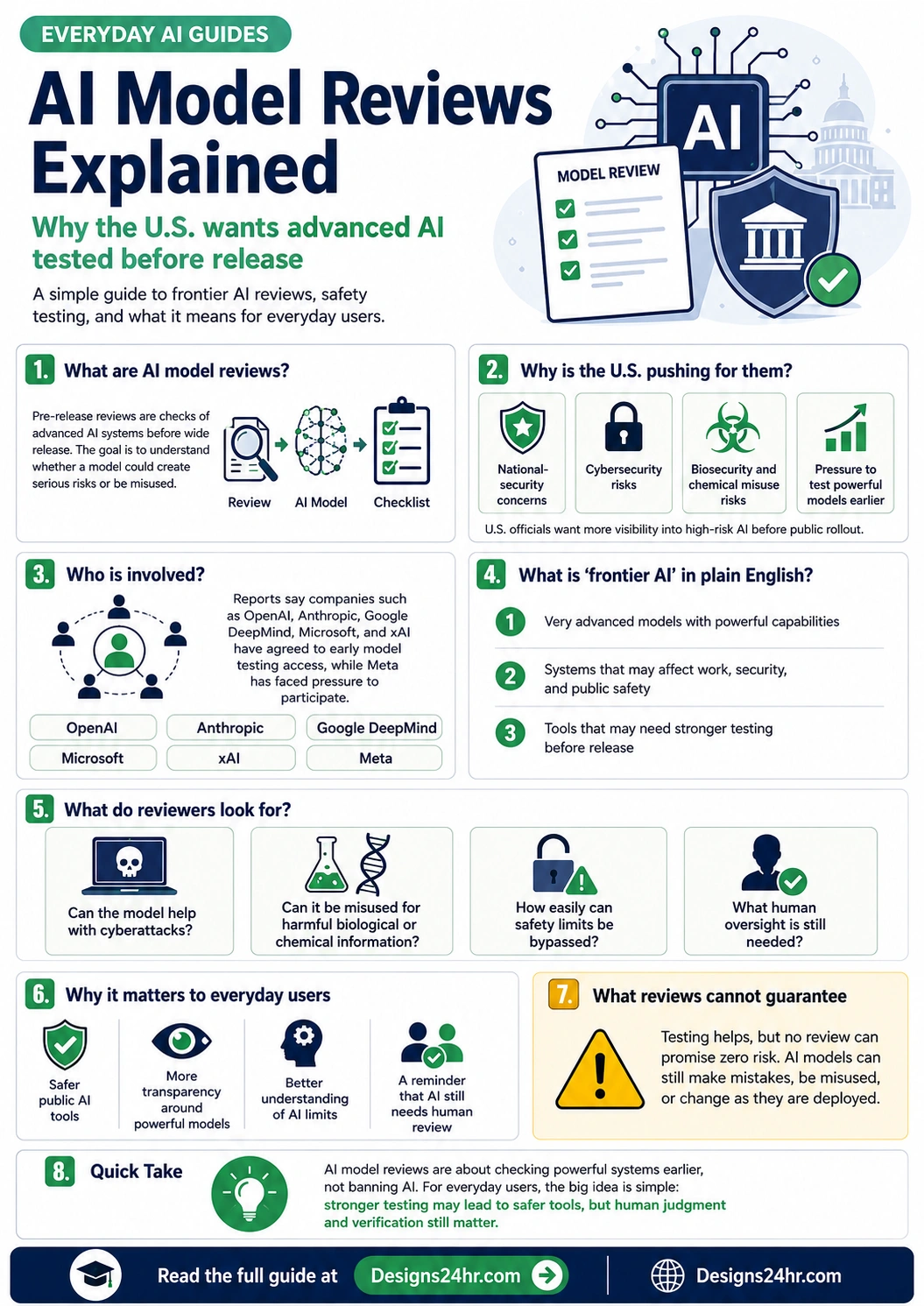
AI model reviews are safety and risk checks for powerful AI systems. The goal is to understand what a model can do, how it might fail, and whether it could be misused before it is widely released.
Artificial intelligence is moving fast. Every few months, new AI models promise better reasoning, stronger coding help, deeper research, more realistic media creation, or more useful workplace automation. But as AI systems become more capable, governments and safety researchers are asking a harder question: should the most advanced models be tested before they are widely released?
That is the idea behind AI model reviews. In simple terms, a model review is a structured check of an advanced AI system’s abilities, weaknesses, and possible risks. Reviewers may look at whether the model can help with cyberattacks, produce dangerous technical instructions, bypass safeguards, spread misleading information, or behave unpredictably in high-impact settings.
This became a major U.S. AI news topic after Reuters reported that the U.S. government was pressing Meta to submit AI models for voluntary review, while other major AI developers had already agreed to provide early access for national-security evaluations. For everyday users, the story is not just about one company. It is about how powerful AI tools may be tested before they affect workplaces, schools, families, businesses, and public information.
What Are AI Model Reviews?
AI model reviews are evaluations of advanced AI systems before, during, or around release. The goal is to understand what a model can do, where it may fail, and whether it could create serious risks if misused.
Think of it like a safety inspection, but for software intelligence. A powerful AI model is not just a normal app. It can generate text, code, plans, images, research summaries, and step-by-step instructions. That flexibility makes AI useful, but it also makes testing more complicated.
The simple version
An AI model review asks: What can this model do, what could go wrong, and what safeguards should exist before more people use it?
Why Is the U.S. Government Pushing for AI Reviews?
The U.S. government is paying closer attention to advanced AI because powerful models may affect national security, cybersecurity, public safety, scientific research, critical infrastructure, and economic competition. The concern is not that every AI tool is dangerous. The concern is that the most capable models may create risks that are hard to detect after release.
Reuters reported that U.S. officials are trying to identify threats such as cyberattack risks and military misuse before powerful AI tools are widely deployed. That is why early access matters. If reviewers can test advanced systems before broad release, they may be able to spot serious vulnerabilities earlier.
Cybersecurity
Reviewers may test whether a model can help find, write, or improve harmful cyber techniques.
Biosecurity
Advanced AI may be tested for whether it can help with dangerous biological or chemical information.
National security
Governments may evaluate whether frontier models could affect military, intelligence, or public safety concerns.
What Does “Frontier AI” Mean?
Frontier AI usually means advanced AI systems near the leading edge of current capabilities. These are models that may be more powerful than ordinary consumer tools and may be able to perform complex reasoning, coding, research, planning, or multi-step tasks.
For everyday users, the phrase can sound technical, but the basic meaning is simple: frontier AI is the newest, strongest, most capable class of AI systems. Because these models may affect more areas of life and work, they may need stronger testing than smaller or more limited tools.
| Term | Plain-English Meaning | Why It Matters |
|---|---|---|
| AI model | The system behind an AI tool that generates answers, code, images, plans, or analysis. | The model’s behavior affects how safe, useful, and reliable the tool feels. |
| Frontier AI | A highly advanced AI system near the current edge of capability. | More powerful systems may create larger benefits and larger risks. |
| Model review | A structured test of a model’s capabilities, risks, vulnerabilities, and safeguards. | Testing can reveal problems before public release. |
| Voluntary agreement | A company chooses to share models or cooperate with evaluation efforts. | It can support safety work, but it is not the same as a permanent law. |
Which AI Companies Are Part of the Current Story?
Reuters reported that OpenAI and Anthropic had already been working with the U.S. government to test unreleased AI models, while Google DeepMind, Microsoft, and xAI agreed in May to provide early access to new models for national-security evaluations. The same report said Meta was being pressed to join a voluntary review agreement.
The important point for readers is not to treat this as a simple “good company versus bad company” story. AI safety reviews are part of a bigger industry shift. Governments want earlier visibility, companies want to protect innovation and competitive information, and users want powerful tools that are safer and more trustworthy.
What this means in practice
Model review agreements may give government evaluators early access to advanced systems so they can test for dangerous capabilities, vulnerabilities, or misuse risks before those tools become widely available.
What Do AI Reviewers Look For?
AI model reviews can vary depending on the model, the evaluator, and the risk area. But advanced AI testing may focus on whether a model can support dangerous activity, bypass safeguards, produce unreliable information, or make risky tasks easier for people who should not have that help.
Can the model help someone create, improve, or explain harmful cyber techniques?
Can the model provide dangerous technical help related to biological or chemical misuse?
Can users easily trick the model into ignoring safety rules or producing restricted content?
Does the model sound certain even when its answer is incomplete, wrong, or unsafe?
Can the model take multi-step actions in ways that need more human control?
Where does a person still need to review, approve, verify, or stop the AI’s output?
Why NIST and CAISI Matter
The National Institute of Standards and Technology, known as NIST, plays a major role in U.S. AI measurement, standards, and risk-management work. NIST’s artificial intelligence work includes AI testing, evaluation, validation, verification, benchmarks, standards, and trustworthy AI guidance.
NIST’s Center for AI Standards and Innovation, or CAISI, is designed to support testing and collaborative research around commercial AI systems. CAISI says it works on voluntary agreements with private-sector AI developers and leads unclassified evaluations of AI capabilities that may pose national-security risks.
This matters because advanced AI testing is not only about opinions. It requires methods, benchmarks, evaluations, risk frameworks, and technical expertise. The more powerful the AI system, the more important it becomes to measure what it can actually do.
Plain-English takeaway
NIST and CAISI help create a more structured way to test AI systems. That does not mean every risk disappears, but it can help companies and government agencies talk about AI safety with clearer standards.
How AI Model Reviews Could Affect Everyday Users
Most people will never personally test a frontier AI model before release. But the results of model reviews can still affect everyday AI users. Better testing may influence which features are released, how safeguards are designed, how companies explain model limits, and how AI tools handle sensitive requests.
Safer public tools
Testing may help companies identify serious problems before tools reach millions of people.
More transparency
Model reviews may encourage clearer explanations of what an AI system can and cannot do.
Better user habits
AI safety news reminds users to verify important answers and avoid blind trust.
If you want a related plain-English explainer, read OpenAI Daybreak Explained, which covers how AI could help find and fix security bugs before attackers exploit them.
What AI Model Reviews Cannot Guarantee
AI reviews are important, but they are not magic. No test can prove that a complex AI system will always be safe in every real-world situation. Models can still make mistakes, users can find new ways to misuse tools, and capabilities can change as systems are updated.
Important limits
- A review cannot guarantee zero risk.
- A model may behave differently after updates or deployment changes.
- Bad actors may find new misuse methods after release.
- Testing may miss rare or unexpected behaviors.
- Human review is still needed for important AI-generated answers.
This is why users should still verify important AI outputs. If an AI answer affects money, health, legal decisions, security, school, work, or family safety, do not treat it as automatically correct. Use trusted sources, compare information, and apply human judgment.
For everyday fact-checking practice, try the AI Hallucination Checker to learn how to review AI answers before trusting them.
AI Model Reviews Are Not the Same as Banning AI
A common misunderstanding is that AI testing means the government wants to stop AI progress. In reality, model reviews are usually framed around risk management, not a total ban on AI development.
The goal is to make powerful AI easier to evaluate before it creates public harm. This can support responsible innovation by helping developers identify risks earlier, improve safeguards, and give users more reliable tools.
| Misunderstanding | Better Explanation |
|---|---|
| “AI reviews mean AI will be banned.” | Reviews are about testing powerful systems and understanding risks, not automatically banning all AI tools. |
| “If a model is reviewed, it must be perfectly safe.” | Testing can reduce risk, but it cannot promise perfect safety in every situation. |
| “Only experts should care.” | Everyday users should care because model safety affects public tools, workplace AI, education, online information, and privacy. |
| “All AI risks are the same.” | Different models create different risks depending on capability, access, use case, safeguards, and deployment. |
A Simple Checklist for Reading AI Safety Headlines
When you see a headline about AI model reviews, AI safety testing, or frontier AI, use this quick checklist:
- Who is involved? Is it a company, government agency, research lab, regulator, or evaluator?
- What is being tested? Is the review about cybersecurity, biosecurity, misinformation, model behavior, or something else?
- Is the agreement voluntary or required? Voluntary cooperation is different from a legal mandate.
- What does the source actually say? Read past the headline and check the original report or government page.
- What does it mean for users? Look for practical effects on safety, transparency, access, and human review.
For more simple AI explainers, visit the Everyday AI Guides hub.
How Everyday Users Should Respond
You do not need to become an AI policy expert to use AI more safely. The best response is to build practical habits. Model reviews may improve safety at the system level, while your own review habits improve safety at the personal level.
Use AI as help, not authority
AI can summarize, draft, explain, and brainstorm, but it should not replace judgment on serious decisions.
Verify important answers
Check trusted sources before relying on AI for safety, money, legal, health, work, or school decisions.
Watch for overconfidence
AI can sound certain even when it is wrong. Ask for sources, limitations, and alternative explanations.
Protect private information
Do not paste sensitive personal, customer, school, business, or security information into tools without understanding the privacy settings and policy.
Keep learning as tools change
AI systems are updated often. A safe habit today may need adjustment when new features, agents, or integrations appear.
If a policy page, AI article, or technical announcement feels confusing, use Explain This For Me to turn complex language into a simpler explanation.
Final Takeaway
AI model reviews are about testing powerful systems earlier, not stopping everyday people from using helpful AI. As advanced AI becomes more capable, governments and researchers want to understand serious risks before those systems are widely released.
For everyday users, the lesson is simple: stronger testing may lead to safer tools, but human review still matters. AI can help you learn, write, plan, code, search, and create, but you should still verify important answers and understand the limits of the tool in front of you.
You can read more from Reuters, explore NIST’s artificial intelligence work, and learn about the NIST AI Risk Management Framework for more context.
Frequently Asked Questions
What are AI model reviews?
AI model reviews are safety and risk checks of advanced AI systems before, during, or around release. The goal is to understand what a model can do, how it may fail, and whether it could be misused in serious ways.
Why does the U.S. government want to review advanced AI models?
The U.S. government wants more visibility into powerful AI systems because advanced models may create national security, cybersecurity, biosecurity, misinformation, or public safety concerns if they are misused or released without enough testing.
What does frontier AI mean?
Frontier AI usually means highly advanced AI systems near the leading edge of current capabilities. These models may be powerful enough to affect work, security, research, public information, and other high-impact areas.
Which AI companies are part of the current review discussion?
Reuters reported that OpenAI and Anthropic had already been working with the U.S. government to test unreleased AI models, while Google DeepMind, Microsoft, and xAI agreed to provide early access to new models for national-security evaluations. Reuters also reported that Meta was being pressed to submit models for voluntary review.
Can AI model reviews guarantee safe AI?
No. AI model reviews can reduce risk and improve understanding, but they cannot guarantee zero risk. AI systems can still make mistakes, be misused, change after deployment, or behave differently in real-world conditions.
Why should everyday users care about AI model reviews?
Everyday users should care because stronger model testing may lead to safer public AI tools, better transparency, and clearer limits. However, users should still verify important AI answers and avoid blindly trusting AI-generated content.
Are AI model reviews the same as AI regulation?
Not always. Some reviews may happen through voluntary agreements, while regulation usually involves formal legal requirements. Both can be part of a broader AI safety and governance conversation.
Keep Learning AI Without the Confusion
Explore more simple, USA-focused AI explainers from Everyday AI Guides and use free Designs24hr tools to understand fast-moving AI news more clearly.
Visit Everyday AI Guides AI News & Breakthroughs AI Safety, Privacy & Trust Try Explain This For Me