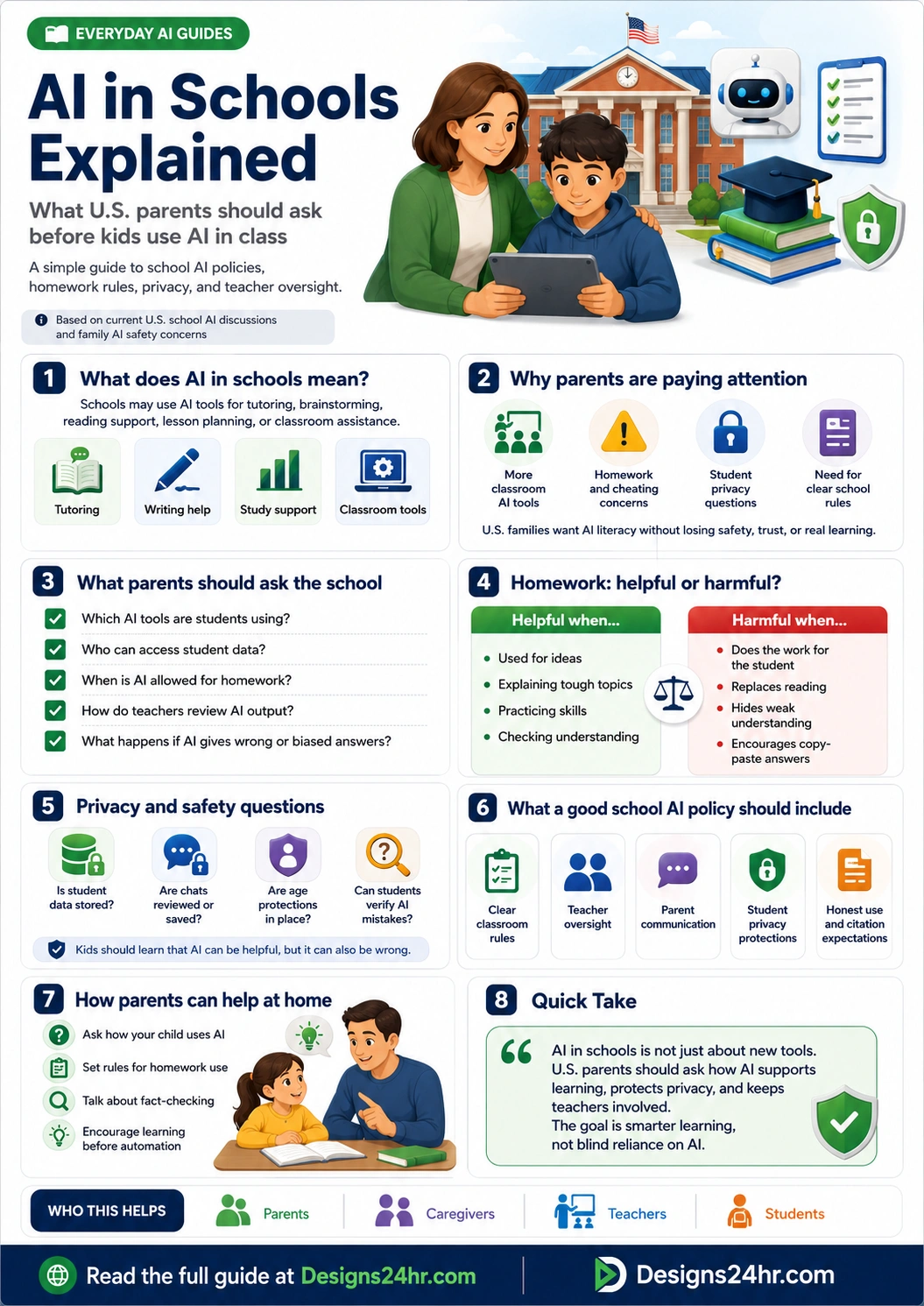
AI in Schools Explained: What U.S. Parents Should Ask Before Kids Use AI in Class
AI tools are moving into classrooms, homework, tutoring, and school policy discussions. Here is a practical parent checklist for safety, privacy, teacher oversight, and real learning.
AI in schools can support tutoring, brainstorming, study help, and teacher planning, but parents should ask clear questions about student privacy, homework rules, teacher review, accuracy, bias, and how AI use supports real learning.
Artificial intelligence is no longer just a workplace tool or a tech headline. It is entering classrooms, homework routines, tutoring platforms, school devices, and teacher planning tools. For many U.S. parents, the question is not whether children will encounter AI. The question is whether schools are using it with clear rules, strong privacy protections, and enough adult oversight.
That is why AI in schools has become such an important family topic. Some schools are experimenting with AI tutors, writing support, reading help, lesson planning, grading assistance, and classroom chatbots. Some parents welcome AI literacy because students will need to understand the technology. Other parents worry that AI could weaken thinking skills, create privacy risks, encourage cheating, or place too much power in the hands of education technology companies.
This guide is designed to help parents ask smarter questions. It is not anti-AI, and it is not blind hype. The goal is simple: help families understand what to ask before kids use AI in class, so AI supports learning instead of replacing it.
What Does AI in Schools Mean?
AI in schools can mean many different things. A student might use AI to brainstorm essay ideas, explain a math concept, summarize a reading passage, practice vocabulary, generate study questions, or get feedback on a project. A teacher might use AI to create lesson plans, organize classroom materials, draft rubrics, or adapt explanations for different learning levels.
Because AI has so many possible uses, parents should not assume every school AI tool is the same. One tool might be a basic writing helper. Another might store student chat history. Another might be built into a school-issued device. Another might be used by teachers behind the scenes without students directly interacting with it.
The simple version
AI in schools means students, teachers, or school systems are using AI tools to support learning, planning, feedback, tutoring, writing, reading, research, or classroom administration. The safety questions depend on which tool is used, who controls it, and what data it collects.
Why Parents Are Paying Attention Now
Parents are paying attention because AI is moving faster than many school policies. Students may already be using AI at home, on phones, through school accounts, or inside classroom platforms before families fully understand the rules.
Common Sense Media’s 2026 research found that AI has moved quickly into kids’ lives, and kids are using it for more than homework. The report also noted that guardrails are thin and that many children have not had a parent conversation about AI safety.
At the same time, U.S. education leaders are promoting AI literacy and appropriate AI integration in education. That means schools may feel pressure to teach students about AI while families are still asking basic questions about privacy, accuracy, and development.
AI literacy
Students may need to understand AI because it will affect future work, college, research, and daily life.
Privacy concerns
Parents need to know whether student chats, assignments, names, grades, or personal details are collected or stored.
Learning impact
AI can explain difficult topics, but it can also become a shortcut if students let it do the thinking for them.
What Parents Should Ask the School First
The best way to respond is not panic. It is asking clear, practical questions. Parents do not need to understand every technical detail of every AI model, but they should understand how AI is being used with their child.
Ask for the names of the platforms, apps, browser tools, learning tools, or chatbots being used in class or assigned for homework.
Ask whether the district, principal, teacher, technology team, or outside vendor selected the tool.
Ask whether names, emails, assignments, chat logs, grades, location, voice, images, or device data are collected.
Ask whether student prompts and AI responses are stored, monitored, used for training, or accessible to teachers or vendors.
Ask which assignments allow AI, which assignments ban AI, and how students should cite or disclose AI help.
Ask whether teachers check AI-generated feedback, explanations, grades, summaries, or recommendations before students rely on them.
Helpful or Harmful? How AI Can Affect Learning
AI can be useful when it helps a student understand a difficult idea, practice a skill, ask better questions, or organize thoughts. But it can become harmful when it replaces reading, thinking, writing, problem-solving, or teacher guidance.
| AI Use | Helpful When | Harmful When |
|---|---|---|
| Homework help | AI explains a concept, gives practice questions, or helps a student check understanding. | AI gives the final answer and the student copies it without learning. |
| Writing support | AI helps brainstorm ideas, organize an outline, or improve clarity after the student writes. | AI writes the essay, paragraph, or assignment for the student. |
| Reading support | AI explains difficult words or summarizes after the student has read the material. | AI replaces the reading and the student never engages with the original text. |
| Study practice | AI creates quizzes, flashcards, examples, or practice problems. | AI becomes a shortcut that hides weak understanding before a test. |
| Project feedback | AI gives suggestions that a teacher or student reviews critically. | AI feedback is treated as automatically correct or better than teacher guidance. |
Privacy Questions Parents Should Ask
Student privacy is one of the biggest concerns with AI in classrooms. Children may type personal thoughts, homework answers, names, classroom details, learning struggles, or family information into AI tools without realizing how that information may be stored or used.
Before a child uses a school AI tool, parents should ask how the school protects student data and whether the tool has age-appropriate protections.
Data storage
Ask whether student prompts, answers, uploads, or chat histories are stored and for how long.
Data access
Ask who can see student activity: teachers, administrators, vendors, support teams, or other third parties.
Age protections
Ask whether the tool is designed for your child’s age group and whether parents can review policies.
Ask these privacy questions
- Does the AI tool collect student names, emails, assignments, or chat history?
- Can student data be used to improve or train the AI system?
- Does the vendor sell, share, or analyze student data for non-school purposes?
- Can parents request deletion or review of student data?
- Are students allowed to upload images, voice, documents, or personal information?
- What happens if a child types sensitive family or personal information into the tool?
Accuracy, Bias, and AI Mistakes
AI can sound confident even when it is wrong. It can explain a topic in a way that seems smooth but includes missing context, misleading claims, outdated information, or biased assumptions. For students, that matters because a wrong explanation can shape how they understand a topic.
Parents should ask whether schools teach students that AI is not always accurate. Students need to know how to verify answers with textbooks, class notes, teacher feedback, credible websites, and their own reasoning.
What kids should learn about AI answers
- AI can be helpful, but it can also be wrong.
- AI should not replace class materials or teacher instructions.
- AI may give biased, incomplete, or overconfident answers.
- Students should ask “How do I know this is true?”
- Important answers should be checked with trusted sources.
For practice, students and parents can use the AI Hallucination Checker to learn how to review AI answers before trusting them.
What a Good School AI Policy Should Include
A strong school AI policy should be easy for parents, teachers, and students to understand. It should not be hidden in vague technology language. Families should know when AI is allowed, when it is not allowed, and how the school protects students.
Students should know when AI is allowed for brainstorming, tutoring, writing support, research, or homework.
AI should support teachers, not remove teachers from decisions about learning, feedback, or student progress.
The policy should explain what data is collected, who sees it, and how long it is stored.
Students should know how to disclose AI help and when using AI becomes cheating.
AI tools should match the student’s age, grade level, maturity, and learning needs.
Parents should be told which AI tools are being used and how to ask questions or opt out when appropriate.
A Parent Email You Can Send to the School
Parents do not need to sound confrontational. A clear, polite message can start the conversation.
Example message:
Hello, I’m trying to better understand how AI tools are being used in my child’s classroom. Could you please share which AI tools students are allowed or expected to use, what student data is collected, how teachers review AI-generated content, and what rules students should follow for homework and citations? I support useful technology, but I want to make sure AI is being used safely and in a way that supports real learning. Thank you.
You can also use How Do I Say This? to rewrite a parent message in a calm, respectful tone.
How Parents Can Talk to Kids About AI
The most important AI safety conversation may happen at home. Kids need practical guidance, not fear. Parents can explain that AI can be useful, but it is not a person, not a teacher, not always correct, and not a replacement for learning.
Ask how your child is already using AI
Start with curiosity. Ask whether they use AI for homework, writing, studying, games, chatting, brainstorming, or entertainment.
Set homework boundaries
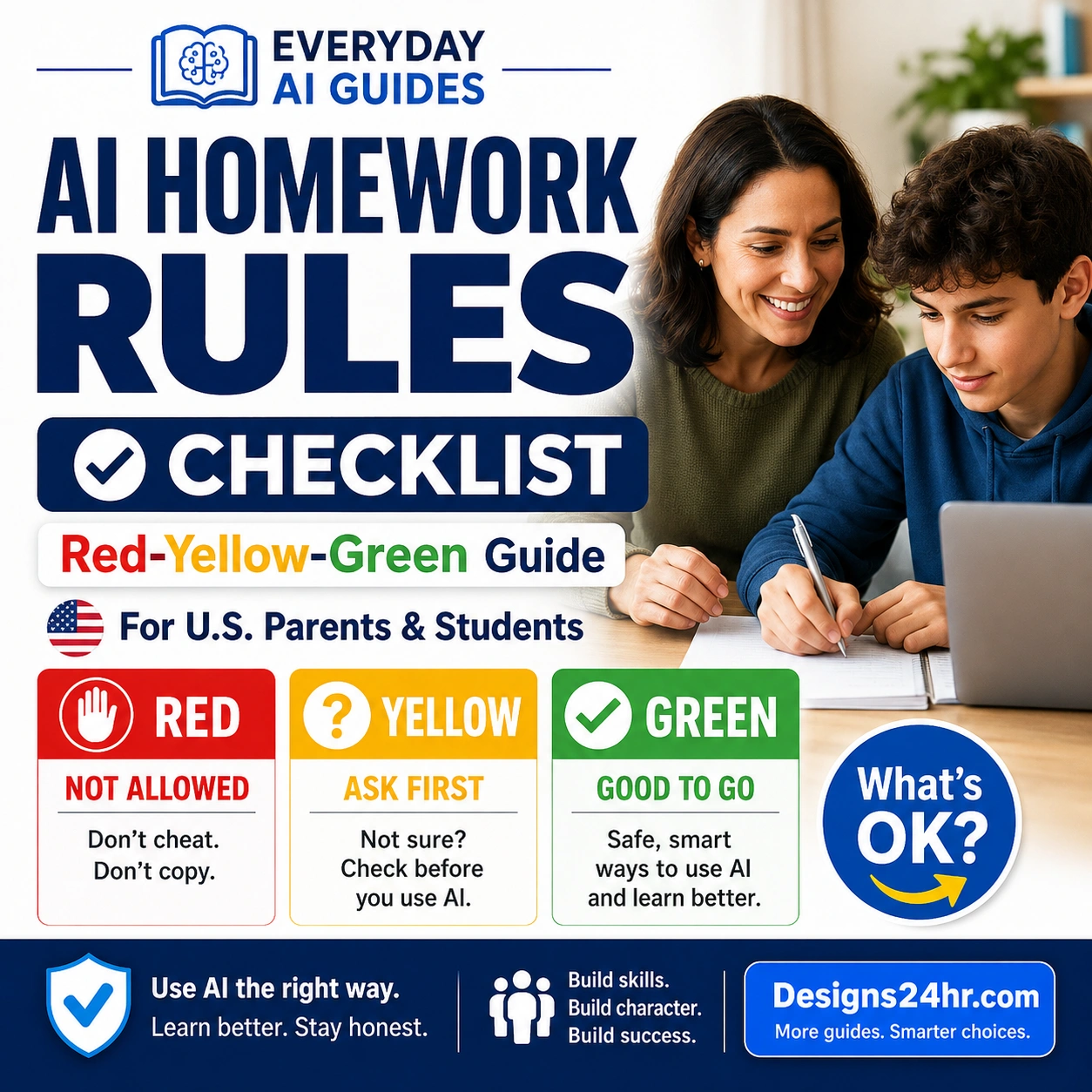
Decide what is allowed. For example, AI may explain a concept or create practice questions, but it should not write the final assignment.
Teach fact-checking
Show your child how to compare AI answers with class notes, textbooks, teacher instructions, and trusted websites.
Talk about private information
Remind kids not to type private family details, passwords, addresses, school IDs, photos, or sensitive personal information into AI tools.
Keep teachers involved
If a child is confused, AI can help explain, but the teacher should remain the trusted guide for class expectations and grading.
Safe AI Prompts for Learning, Not Cheating
AI prompts matter. A cheating prompt asks AI to do the work. A learning prompt asks AI to help the student understand the work.
| Instead of This | Try This | Why It Is Better |
|---|---|---|
| Write my essay for me. | Help me create an outline after I explain my topic and main points. | The student still does the thinking and writing. |
| Give me the answer to this math problem. | Explain the steps for solving this type of problem, then give me a similar practice problem. | The student learns the method instead of copying. |
| Summarize the book so I do not have to read it. | After I read this chapter, ask me questions to check whether I understood it. | AI supports reading instead of replacing it. |
| Make my project look smarter. | Review my draft and ask me three questions that would make my project stronger. | AI becomes a feedback tool, not a hidden author. |
Parents can use the AI Prompt Generator to create safer learning prompts that encourage explanation, practice, and critical thinking.
When Parents Should Push for More Information
If a school is using AI tools without clear communication, parents should ask for more details. A school does not need a perfect AI policy on day one, but families deserve basic transparency when children’s learning and data are involved.
Ask for more clarity if:
- Your child is required to use an AI tool and you do not know what it collects.
- The school cannot explain whether AI chats are saved or reviewed.
- Teachers are using AI-generated feedback without student or parent awareness.
- Students are confused about when AI use is allowed or considered cheating.
- The tool asks students for personal information that does not seem necessary.
- The school has no parent-facing AI policy or FAQ.
AI in Schools Is Not Just a Technology Decision
AI in education is not only about apps and devices. It is about how children learn, how teachers teach, how schools protect data, how families understand technology, and how students build judgment in a world where AI will be everywhere.
The best school AI approach is balanced. Students should learn what AI is and how to use it responsibly. Teachers should remain central to learning. Parents should be informed. Schools should protect privacy. Kids should understand that learning matters more than quick answers.
Best family mindset
Do not teach kids to fear AI. Teach them to question it, verify it, use it honestly, protect their privacy, and rely on their own thinking first.
Final Takeaway
AI in schools is not just about new tools. It is about trust, privacy, learning, and teacher oversight. U.S. parents should ask what AI tools are being used, what data is collected, when AI is allowed for homework, how teachers review AI output, and how schools prevent shortcuts from replacing real learning.
AI can help students learn when it explains, practices, supports, and encourages better questions. It can hurt learning when it replaces reading, writing, problem-solving, or teacher guidance. The goal is not to ban every AI tool or accept every new platform. The goal is smarter learning with clear rules.
You can read more about current parent concerns in The Guardian’s report on AI in U.S. classrooms, review the White House AI education initiative, and explore Common Sense Media’s 2026 report on teens, tweens, and AI.
Frequently Asked Questions
What does AI in schools mean?
AI in schools usually means students or teachers are using AI tools for tutoring, brainstorming, reading support, writing help, lesson planning, study support, classroom assistance, or feedback.
Should parents be worried about AI in class?
Parents should be aware, not panicked. AI can help with learning support, but parents should ask about privacy, teacher oversight, homework rules, accuracy, bias, and whether students are learning or simply copying answers.
What should parents ask before kids use AI at school?
Parents should ask which AI tools are being used, what student data is collected, whether chats are saved, how teachers review AI output, when AI is allowed for homework, and what happens when AI gives wrong or biased answers.
Can AI help students learn?
Yes, AI can help explain difficult topics, generate practice questions, support brainstorming, and provide study help. It becomes a problem when it replaces reading, thinking, writing, problem-solving, or teacher guidance.
Can AI be wrong?
Yes. AI can give incorrect, incomplete, biased, or misleading answers. Students should be taught to verify AI output with trusted sources, class materials, teachers, and their own reasoning.
What should a good school AI policy include?
A good school AI policy should include clear classroom rules, teacher oversight, student privacy protections, age-appropriate use, honest-use expectations, citation rules, parent communication, and consequences for misuse.
How can parents talk to kids about AI?
Parents can ask how their child uses AI, set homework boundaries, explain that AI can be helpful but wrong, encourage fact-checking, and remind kids that learning matters more than quick answers.
Help Kids Use AI Smarter
Keep learning with Everyday AI Guides and use free Designs24hr tools to simplify school AI policies, check AI answers, and write better parent-teacher messages.
Visit Everyday AI Guides AI for Parents & Families AI for Students & Learning AI Safety, Privacy & Trust Try Explain This For Me