AI Homework Rules Checklist: A Red-Yellow-Green Guide for U.S. Parents and Students
AI homework rules do not have to be confusing. This simple red-yellow-green checklist helps families understand when AI homework help is useful, when students should ask first, and when using AI can cross the line into cheating.
Quick answer: Using AI for homework is not automatically cheating. It depends on what the student asks AI to do, what the teacher allows, and whether the final work still shows the student’s own thinking. A good rule is simple: AI can support learning, but it should not replace learning.
Why AI Homework Rules Matter Now
Students are already using tools like ChatGPT, Gemini, Copilot, and school-approved AI apps to brainstorm ideas, understand hard topics, summarize notes, and check writing. That means parents and teachers need clear AI homework rules that are easy to explain before a problem happens.
According to Pew Research Center, 54% of U.S. teens say they have used chatbots for help with schoolwork. College Board also reported that 84% of high school students used generative AI for schoolwork in 2025, and 69% reported using ChatGPT for assignments or homework.
of U.S. teens say they have used chatbots for help with schoolwork.
of high school students reported using GenAI for schoolwork in 2025.
of high school students reported using ChatGPT for assignments or homework.
The goal is not to scare students away from AI. The goal is to help them use AI honestly, build stronger study habits, and avoid turning in work they did not actually do.
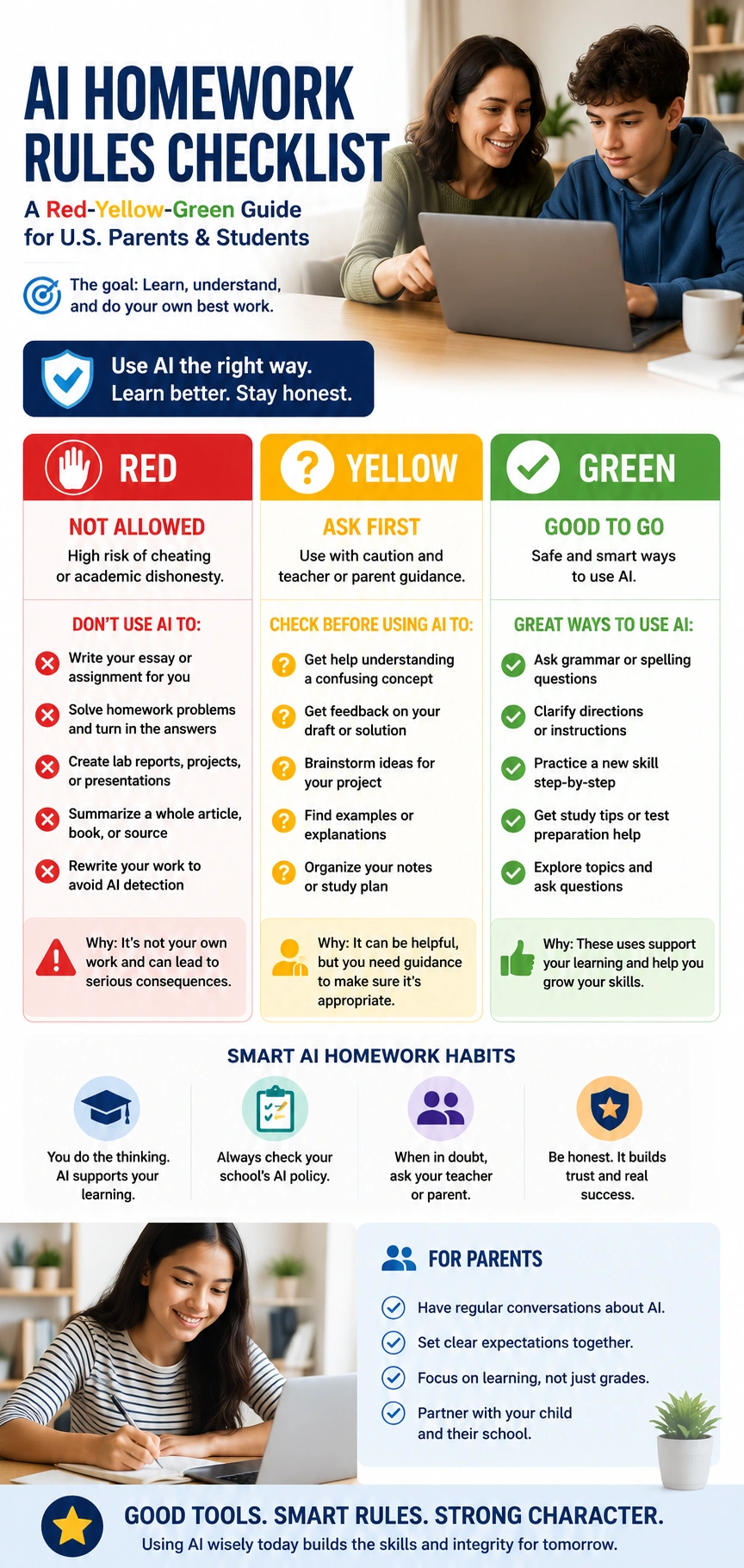
The Red-Yellow-Green AI Homework Checklist
Use this AI homework checklist before a student opens an AI tool. Green means the use is usually safe for learning. Yellow means the student should ask a parent or teacher first. Red means the student should avoid it because it may break trust, school rules, or academic honesty expectations.
Not Allowed
High risk of cheating or academic dishonesty.
- Submitting AI-written answers as your own work
- Copying and pasting AI work into an assignment
- Using AI during tests, quizzes, or closed-book work
- Hiding that AI helped when the teacher requires disclosure
- Using fake citations, made-up facts, or invented sources
- Asking AI to rewrite work just to avoid AI detection
Ask First
Helpful only when there is permission and a clear purpose.
- Using AI to outline a first draft
- Getting help with a sample math problem
- Brainstorming ideas for a project
- Translating instructions or reading support
- Getting feedback on a draft or solution
- Finding examples or explanations to compare
Usually OK
Safe and smart ways to use AI for learning support.
- Explaining a hard concept in simpler words
- Creating practice quiz questions
- Checking grammar after you write your own draft
- Summarizing your own study notes
- Clarifying directions or assignment instructions
- Making a study plan or practice schedule
What Counts as Good AI Homework Help?
Good AI homework help keeps the student in control. The student still reads, thinks, solves, writes, checks, and explains the final answer. AI can act like a study assistant, but it should not become the person doing the work.
Good AI Use Sounds Like This
- Explain this science idea like I am in 8th grade.
- Give me three practice questions about this topic.
- Check my paragraph for grammar mistakes only.
- Help me make a study plan for my history test.
- Show me how to approach this type of problem without giving me the final answer.
Risky AI Use Sounds Like This
- Write my essay for me.
- Give me the answers to this worksheet.
- Make this sound like I wrote it so my teacher cannot tell.
- Create citations for sources I did not read.
- Do my project and make it look original.
AI Homework Rules for Parents
Parents do not need to become AI experts. They just need a few clear family expectations. The best AI rules for parents are simple enough for a student to remember and specific enough to prevent confusion.
Simple Family AI Homework Rules
- Student thinking comes first: AI can help explain, but it should not replace the student’s work.
- Ask before using AI on graded assignments: If the assignment will be turned in, check the teacher’s rules first.
- Disclose when AI helped: If AI helped with outlining, editing, or brainstorming, be honest when disclosure is required.
- Verify facts every time: AI can make mistakes, so students should check dates, names, sources, and answers.
- No copy-paste homework: Copying AI answers is not learning and may break school rules.
A helpful parent question is: “What part did AI help with, and what part did you do yourself?” This keeps the conversation focused on learning instead of blame.
AI Homework Rules for Students
Students can use AI responsibly when they treat it like a tutor, not a shortcut. Before using AI for schoolwork, students should know what the teacher allows, what the assignment is testing, and whether they can explain the final answer in their own words.
| Before You Use AI | Ask Yourself | Best Choice |
|---|---|---|
| The assignment is graded | Did my teacher say AI is allowed? | Ask first before using AI. |
| You feel stuck | Do I need an explanation or just the answer? | Ask AI for steps, hints, or examples, not the final answer. |
| You wrote a draft | Do I want feedback without changing my voice? | Ask for grammar, clarity, or structure suggestions. |
| You found a fact from AI | Can I verify this with a trusted source? | Check the fact before using it. |
| You are ready to submit | Can I explain this work myself? | If not, study more before submitting. |
What to Ask Your School or Teacher About AI
Every school may handle AI homework differently. Some teachers allow AI for brainstorming. Some allow it only for grammar checks. Some do not allow it at all on certain assignments. When rules are unclear, families should ask direct questions.
Question 1
Can students use AI for brainstorming, outlines, or study help on this assignment?
Question 2
Does the teacher require students to disclose when AI was used?
Question 3
Which AI uses are not allowed for tests, essays, projects, or worksheets?
These questions help students avoid accidental rule-breaking and help parents support the teacher’s expectations at home.
Quick Family AI Homework Agreement
Use this simple agreement as a starting point. Families can copy it, adjust it, and talk through it before the next homework session.
Student Promise
- I will not submit AI-written work as my own.
- I will ask first when I am unsure if AI is allowed.
- I will use AI to understand, practice, and improve.
- I will check facts before trusting AI answers.
- I will be honest if AI helped with my work.
Parent Promise
- I will ask calm questions before assuming cheating.
- I will help check school and teacher rules.
- I will focus on learning, not just grades.
- I will help my child use AI safely and honestly.
- I will update our family rules when school rules change.
Smart AI Homework Habits
The best AI homework rules are habits students can repeat. These habits help students learn better, stay honest, and avoid becoming dependent on AI for every assignment.
1. Try First
Spend a few minutes thinking, reading, or solving before asking AI. This keeps the student’s brain active.
2. Ask for Help, Not Answers
Use prompts like “explain,” “give me a hint,” or “make practice questions” instead of “do this for me.”
3. Check Everything
AI can sound confident and still be wrong. Check facts, formulas, citations, and teacher instructions.
4. Keep Your Voice
AI should not make every student sound the same. The final writing should still sound like the student.
5. Follow the Assignment
If the teacher wants original thinking, handwritten work, a process explanation, or no AI, follow that rule.
6. Be Honest
Honesty builds trust. If AI helped, explain how it helped when the teacher or school asks.
How This Connects to Everyday AI Learning
AI homework rules are part of a bigger skill: learning how to use AI wisely in daily life. Parents can explore more simple guides in Everyday AI Guides, especially topics for AI for Parents & Families and AI for Students & Learning.
For younger learners, families may also want to read about safe AI study habits, kid-friendly AI use, teen AI supervision, and privacy checks before adding new AI tools into homework routines.
FAQ About AI Homework Rules
Is using AI for homework cheating?
Not always. Using AI for homework depends on the assignment, the teacher’s rules, and how the student uses it. AI can support learning, but submitting AI-written answers as your own work can be cheating.
What are good ways to use AI for homework?
Good uses include explaining hard concepts, creating practice questions, checking grammar after the student writes, summarizing the student’s own notes, and helping organize a study plan.
What should students avoid when using AI for schoolwork?
Students should avoid copying AI answers, letting AI write full assignments, using AI during tests or quizzes, inventing citations, or hiding that AI helped when disclosure is required.
Should students tell teachers when AI helped?
Students should follow the teacher’s disclosure rules. If the teacher asks students to explain whether AI helped with brainstorming, outlining, editing, or research, students should be honest.
What should parents ask before their child uses AI for homework?
Parents can ask what tool the student wants to use, what part of the assignment AI will help with, whether the teacher allows it, and how the student will check the answer.
Can AI help students learn better?
Yes, AI can help students learn when it explains ideas, creates practice questions, helps organize notes, or gives feedback. It becomes a problem when it replaces the student’s own thinking.