Meta AI Teen Supervision Explained: What U.S. Parents Should Know About AI Chats
Meta AI teen supervision is becoming an important topic for U.S. parents as teens use AI chatbots for school, entertainment, advice, creativity, and everyday questions.
AI is no longer something teens only hear about in school or tech news. Many U.S. teens now use chatbots to search for information, get help with homework, summarize content, create images, brainstorm ideas, and sometimes ask personal questions.
That is why Meta AI teen supervision matters. Meta is adding more teen account protections and parent-facing tools around AI experiences, while families are trying to understand how much oversight is helpful, what should be blocked, and how to keep teen AI use safe without turning every conversation into surveillance.
This guide explains what Meta AI teen supervision means, why U.S. parents should care, what controls may help, what AI chat risks families should discuss, and what parents can do now to create safer AI habits at home.
What Is Meta AI Teen Supervision?
Meta AI teen supervision refers to tools, settings, and safety features designed to help parents manage how teens interact with AI across Meta experiences such as Instagram, Facebook, and Messenger.
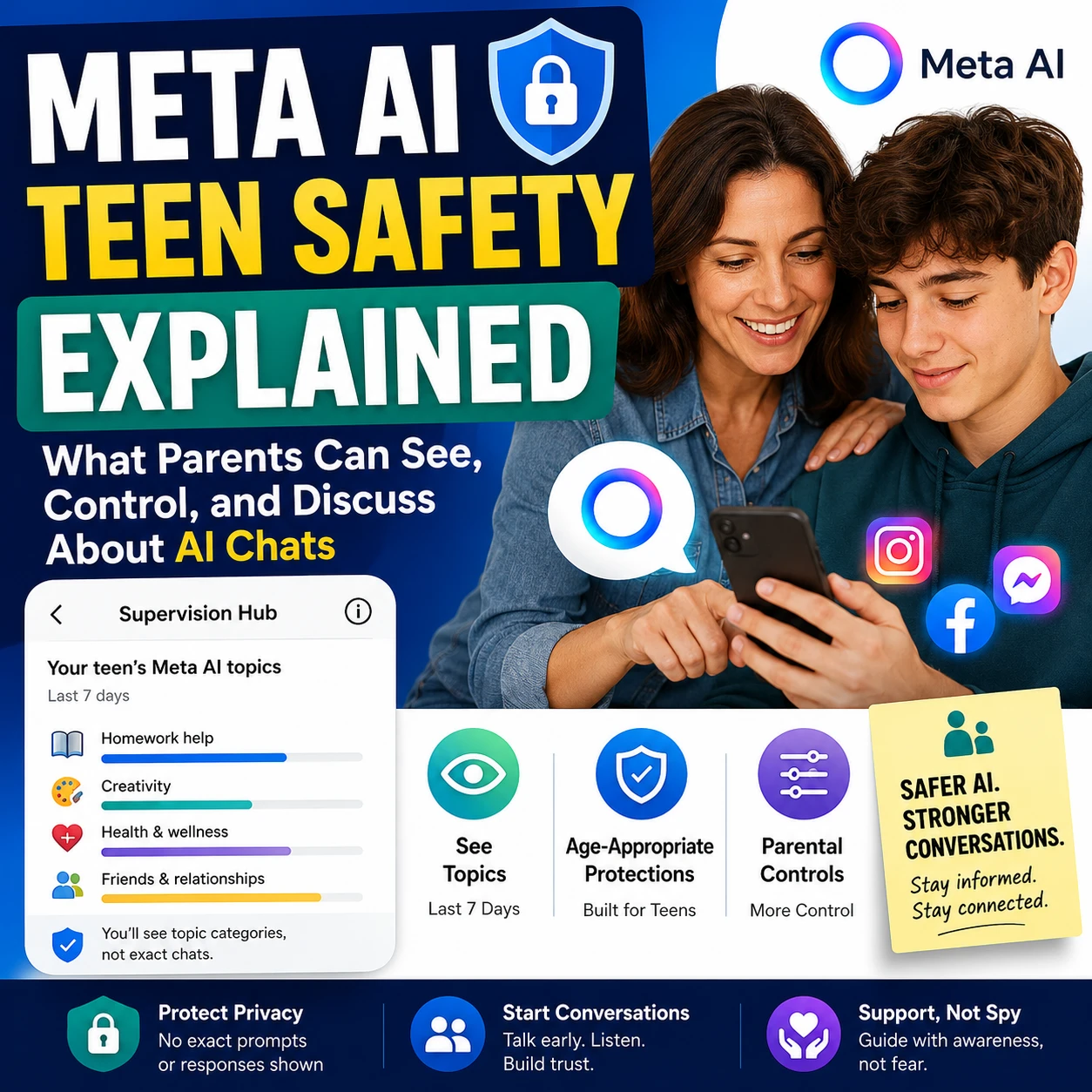
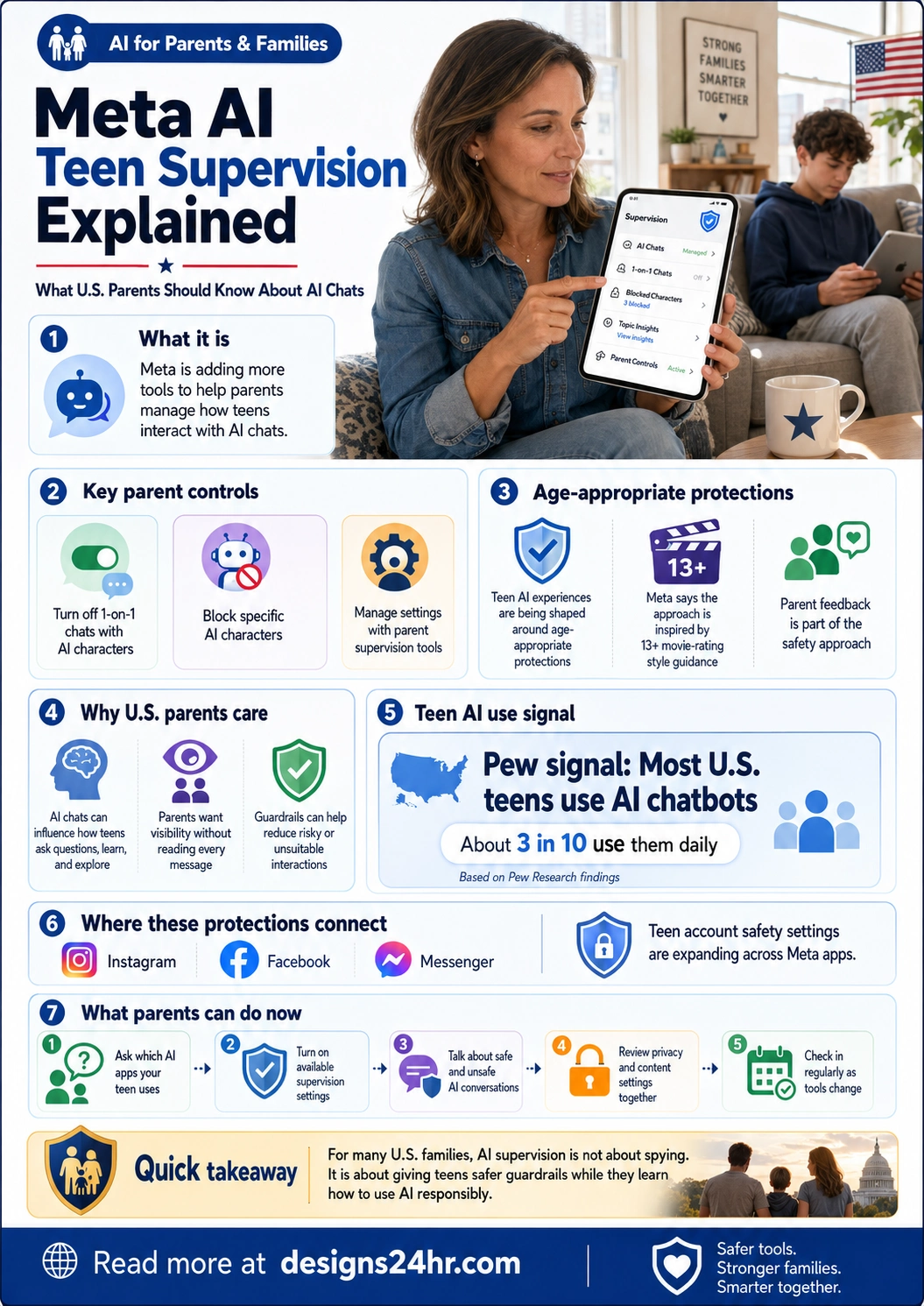
Meta has said it is adding more ways for parents to manage teen AI interactions, including the ability to turn off one-on-one chats with AI characters, block specific AI characters, and view topic-level insights into what teens discuss with AI. The goal is not for parents to read every message. The goal is to provide more visibility and safer guardrails around teen AI use.
This is important because AI chats can feel more personal than regular search. A teen might ask an AI chatbot for homework help one minute, then ask about friendships, stress, identity, health, or emotions the next. That makes parental guidance more important.
Why U.S. Parents Should Care About AI Chats
Pew Research Center has reported that a majority of U.S. teens use AI chatbots, and many use them for schoolwork, search, entertainment, summaries, images, and other tasks. Pew’s research also highlights that AI chatbots introduce a new layer to modern parenting.
For parents, the concern is not only whether teens use AI. The bigger question is how they use it, how often they use it, what they believe from it, and whether they know when to ask a trusted adult instead of relying on a chatbot.
AI Can Influence Teen Thinking
Chatbots can shape how teens learn, ask questions, solve problems, and understand information, especially when answers sound confident.
Parents Need Visibility
Parents do not need to read every message, but they do need enough awareness to guide safe, healthy, age-appropriate AI use.
Guardrails Can Reduce Risk
Controls for AI characters, teen settings, and topic insights may help reduce unsuitable interactions while keeping useful AI access.
Conversations Still Matter
No setting replaces honest family conversations about privacy, misinformation, emotional support, school rules, and digital boundaries.
Key Parent Controls to Understand
The strongest value of Meta AI teen supervision is that it may give parents a more practical way to guide AI use without needing to constantly monitor every interaction. The exact availability of features can vary by app, country, account type, and rollout timing, but these are the core ideas parents should understand.
| Parent Control | What It Means | Why It Helps Families |
|---|---|---|
| Turn off one-on-one AI character chats | Parents may be able to limit private conversations with AI characters. | Helps reduce the risk of teens becoming too attached to roleplay-style AI conversations. |
| Block specific AI characters | Parents may be able to block certain AI characters they do not want their teen using. | Gives parents more control when a specific character or experience feels unsuitable. |
| Topic-level insights | Parents may be able to see general topics teens discuss with AI, without reading full chat logs. | Creates a middle ground between no visibility and reading every private message. |
| Teen account protections | Meta Teen Account settings can help limit age-inappropriate experiences by default. | Supports safer default settings across teen social and messaging experiences. |
| Family Center supervision | Meta Family Center provides parent tools and insights for teen accounts. | Gives parents one place to review available supervision options and talk through settings with teens. |
What Topic Insights Mean for Parents
One of the most important ideas in Meta AI teen supervision is topic-level insight. Instead of showing parents every message, topic insights can give a general sense of what a teen is discussing with AI. For example, a parent might see that a teen is asking about school, entertainment, hobbies, planning, or other broad categories.
This can help parents start better conversations. Instead of accusing a teen or demanding full access, a parent can ask, “I noticed AI has been part of your homework routine. How are you using it?” or “What kind of AI chats feel helpful to you?”
Age-Appropriate Protections Across Meta Apps
Meta says its teen protections are being shaped around age-appropriate content expectations and parent feedback. Meta has also expanded its 13+ content settings for Teen Accounts across Instagram, Facebook, and Messenger, with the goal of helping teens see more age-appropriate content by default.
For parents, this matters because AI is not separate from the rest of a teen’s online life. A teen may discover content on Instagram, message friends on Messenger, and interact with AI in the same digital ecosystem. Stronger teen settings across apps can help create a more consistent safety layer.
Still, parents should remember that settings are only one part of safety. Teens also need digital judgment, media literacy, emotional awareness, and clear family rules.
Benefits of Meta AI Teen Supervision
Meta AI teen supervision may help U.S. parents create a healthier balance between teen independence and parent guidance. Teens can still use AI for learning and creativity, while parents get more tools to reduce risk.
- More visibility: Parents can better understand whether AI is part of their teen’s daily digital life.
- Safer boundaries: Blocking or limiting certain AI character chats may reduce unsuitable or overly personal interactions.
- Better family conversations: Topic insights can help parents ask smarter questions instead of guessing.
- Age-aware defaults: Teen account settings can help keep experiences closer to what is appropriate for younger users.
- Less overwhelm: Parents get a clearer place to start instead of trying to manually monitor every app and chatbot.
Risks Parents Should Still Discuss
Even with supervision tools, AI chats can create risks. AI can sound confident while being wrong. It can give generic advice that does not understand a teen’s real situation. It may blur the line between tool, friend, tutor, and emotional support.
That is why U.S. parents should talk about AI in practical terms. Teens do not need fear-based lectures. They need clear examples of what AI can help with and what it should not replace.
Misinformation
AI can give incorrect or outdated answers. Teens should learn to verify important information with trusted sources.
Privacy
Teens should avoid sharing private details, passwords, addresses, school information, personal photos, or sensitive family details.
Emotional Dependence
AI should not replace trusted adults, friends, counselors, teachers, or professional help for serious concerns.
School Rules
Using AI for homework can be helpful or dishonest depending on the assignment, teacher rules, and how the tool is used.
What Parents Can Do Right Now
Parents do not need to wait for every new feature to roll out before talking about AI. The most important step is to create a family AI plan that feels realistic, not overwhelming.
- Ask which AI apps your teen uses. Start with curiosity. Ask about ChatGPT, Meta AI, school tools, search assistants, image generators, and character chatbots.
- Review available supervision settings. Check Meta Family Center, Teen Account settings, privacy settings, and any AI-specific controls available for your teen’s account.
- Talk about safe and unsafe AI conversations. Explain what is okay to ask AI and what should go to a parent, teacher, counselor, doctor, or trusted adult.
- Set privacy rules together. Agree on what personal information should never be shared with AI chats.
- Discuss school honesty. Ask teachers or review school rules about when AI help is allowed and when it crosses the line.
- Check in regularly. AI tools change fast. A quick weekly or monthly conversation can work better than one big lecture.
Conversation Starters for U.S. Parents
The best use of Meta AI teen supervision is not only turning settings on or off. It is using those settings to open better family conversations.
- “What do you usually ask AI to help you with?”
- “Have you ever received an AI answer that seemed wrong or weird?”
- “What kinds of questions should go to a real person instead of a chatbot?”
- “Do you know what personal information not to share with AI?”
- “How does your school allow or limit AI for assignments?”
- “Are there any AI characters or chatbots that make you uncomfortable?”
How to Balance Privacy and Supervision
One of the hardest parts of teen AI safety is balance. Parents want to protect their teens, but teens also need trust, independence, and room to learn. Reading every message can damage trust. Ignoring AI completely can create risk.
A better approach is guided independence. Parents can use supervision tools, set boundaries, and talk regularly while giving teens enough privacy to develop judgment. Topic insights and general safety settings may help families find that middle ground.
When Parents Should Step In Immediately
Most AI use is routine, but some situations need quick adult attention. If a teen is using AI for serious emotional distress, self-harm questions, risky health advice, secret relationships with AI characters, bullying, threats, or unsafe behavior, parents should step in and involve appropriate trusted adults or professionals.
AI can be useful for general learning, but it is not a replacement for emergency help, medical advice, mental health care, school support, or family communication.
Useful Designs24hr Tools for Families
Families can use AI more safely when they understand what tools are doing and how to make better decisions. On Designs24hr, parents can use Explain This For Me to simplify confusing AI or safety terms, Decision Helper to compare family choices, and Is This Worth It? to think through tools, subscriptions, or apps before using them.
You can also explore more simple guides on The AI Edge to understand how AI is changing family life, education, privacy, safety, and everyday decision-making.
Final Takeaway
Meta AI teen supervision is important because AI chats are becoming part of everyday teen life. For U.S. parents, the goal is not to ban every tool or monitor every message. The goal is to help teens use AI safely, responsibly, and with enough guidance to avoid common risks.
Parent controls, blocked AI characters, topic insights, teen account settings, and age-appropriate protections can all help. But the most powerful safety tool is still an ongoing conversation between parents and teens.
The best approach is simple: set guardrails, keep communication open, review settings together, and teach teens when AI is helpful — and when a real human should be involved.
Want More Simple AI Guides for Families?
Explore more beginner-friendly AI safety guides on The AI Edge and use free Designs24hr tools to make smarter, safer decisions with AI.
FAQs About Meta AI Teen Supervision
What is Meta AI teen supervision?
Meta AI teen supervision refers to parent-facing tools and protections that help families manage how teens interact with AI chats and AI characters. These can include supervision settings, AI character controls, topic-level insights, and teen account safety settings where available.
Can parents turn off Meta AI chats for teens?
Meta has said it is adding tools that can help parents manage teen AI interactions, including controls for one-on-one chats with AI characters and specific AI character blocking. Availability may depend on the app, region, account type, and rollout timing.
Can parents read every AI chat message?
Meta has described topic-level insights as a way for parents to understand general AI conversation topics without reading every full chat message. This can support safety while still giving teens some privacy.
Why are AI chats a concern for teens?
AI chats can give wrong information, feel emotionally persuasive, answer sensitive questions, and blur the line between tool and companion. Teens need guidance on privacy, fact-checking, school rules, and when to talk to a trusted adult instead.
What should U.S. parents do first?
Start by asking which AI tools your teen uses, review available supervision and privacy settings, set family rules for safe AI use, and talk regularly about schoolwork, privacy, misinformation, emotional support, and age-appropriate content.