AI Voice Cloning Scams: How U.S. Families Can Create a Safe Word Before It Happens
AI voice cloning scams can make a fake emergency call sound like someone you love. The safest response is not to trust the voice alone. Smart families create a simple safe word, slow down, and verify the emergency before sending money or sharing information.
AI voice cloning scams are becoming one of the most personal and frightening types of phone scams. A scammer may call pretending to be your child, grandchild, parent, spouse, friend, coworker, or even a trusted authority figure. The voice may sound familiar. The story may feel urgent. The caller may say there has been an accident, arrest, kidnapping, medical emergency, travel problem, or money crisis.
That emotional pressure is the scam. The goal is to make you react before you verify. For U.S. families, the best protection is a simple family verification plan created before a stressful call happens.
- How AI voice cloning scams work
- Why fake emergency calls can sound convincing
- Red flags parents, grandparents, and families should watch for
- How to create a family safe word
- What to do during a suspicious emergency call
What Are AI Voice Cloning Scams?
AI voice cloning scams use artificial intelligence to imitate someone’s voice. Scammers may use a short audio clip from social media, videos, voicemail, livestreams, public posts, or other online sources. They can then create a fake voice message or phone call that sounds like the person is speaking.
The FTC has warned that scammers can use AI to clone a loved one’s voice from a short audio clip and combine it with a fake family emergency story. The FBI’s Internet Crime Complaint Center has also warned that criminals use generative AI audio to impersonate relatives in crisis situations and pressure victims for immediate money.
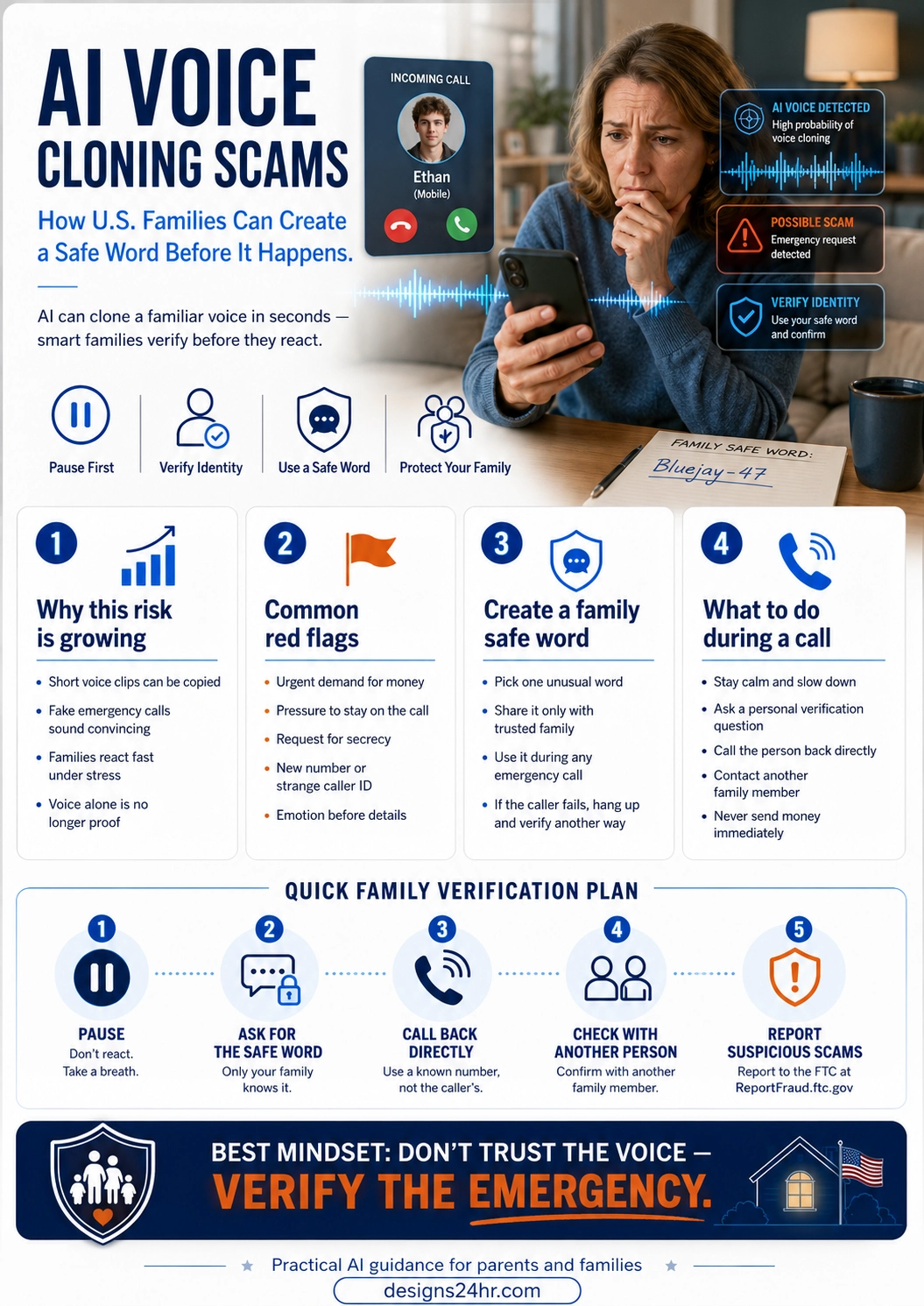
Why This Risk Is Growing
AI voice cloning scams are growing because the technology is becoming easier to access and harder for everyday people to detect. A scammer does not need a long recording. A short voice sample, a believable emergency story, and a fast payment demand may be enough to create panic.
Recent research on synthetic voices in vishing scenarios found that people struggled to reliably tell AI-generated voices from real human voices. That is why families should not depend on their ears alone. Verification habits are stronger than guessing whether a voice sounds real.
Short voice clips can be copied
Public videos, social media posts, voice notes, and online clips may give scammers enough audio to create a convincing imitation.
Emergency stories trigger panic
Scammers often claim there has been an accident, arrest, kidnapping, hospital visit, travel emergency, or urgent family crisis.
Caller ID can be misleading
A call may appear local or familiar, but caller ID can be spoofed. Do not rely on the number alone.
Fast payment requests are common
Scammers may ask for wire transfers, payment apps, gift cards, crypto, or immediate cash to make the situation feel urgent.
Common Red Flags of AI Voice Scam Calls
AI voice cloning scams often follow the same emotional pattern: fear first, facts later. Watch for these warning signs.
| Red flag | Why it matters | What to do |
|---|---|---|
| Urgent demand for money | Scammers want you to pay before you can think clearly. | Pause, hang up, and verify directly through a known number. |
| Request for secrecy | A real emergency should not require you to hide the situation from trusted family. | Contact another family member or trusted person immediately. |
| Caller will not answer personal questions | Scammers may only know basic public details. | Ask your family safe word or a question only the real person would know. |
| Payment by gift card, crypto, wire, or payment app | These methods can be harder to recover after a scam. | Do not send money until the emergency is independently verified. |
| Caller pressures you to stay on the phone | Scammers do this to stop you from checking with others. | End the call and call back using a number you already trust. |
The Best Protection: Create a Family Safe Word
A family safe word is a private word or phrase that trusted family members can use to verify identity during a stressful or unusual call. It should be easy for your family to remember, but hard for a stranger to guess from social media.
The safe word works because scammers may be able to copy a voice, but they should not know your private verification word. If someone calls claiming to be in danger, your family can ask for the safe word before taking action.
How to Create a Strong Family Safe Word
A good safe word should be private, unusual, memorable, and shared only with trusted people.
Family Safe Word Setup
-
Choose one unusual word or phrase.
Avoid birthdays, pet names, school names, street names, favorite teams, or anything visible online. -
Keep it short and memorable.
Use something your family can remember during stress, such as a random phrase or two-word code. -
Share it privately.
Tell only trusted family members. Do not text it in group chats where many people can access it. -
Practice when to use it.
Explain that any emergency money request, strange call, or suspicious message should require verification. -
Change it if it leaks.
If you think the word was shared too widely, choose a new one and update trusted family members.
What to Do During a Suspicious Emergency Call
When a call feels scary, the most important step is to slow down. Scammers want speed. Families need verification.
Quick Family Verification Plan
-
Pause first.
Take a breath. Do not send money or share information while you are scared. -
Ask for the safe word.
If the person claims to be a family member, ask for the private family safe word. -
Call back directly.
Hang up and call the person using a number already saved in your phone, not the number that called you. -
Check with another person.
Contact a spouse, parent, sibling, friend, school, workplace, or trusted contact to confirm the situation. -
Report suspicious scams.
If it appears to be fraud, report it to the FTC at ReportFraud.ftc.gov and consider reporting cyber-enabled crime to IC3.gov.
Who Should Use a Family Safe Word?
Every family can benefit from a safe word, but it is especially helpful for households with children, teens, college students, older adults, caregivers, travelers, and grandparents.
- Parents: Use a safe word for calls claiming your child is hurt, arrested, stranded, or in danger.
- Grandparents: Use it to verify grandchild emergency calls before sending money.
- College students: Share a safe word with parents before travel, late nights, or campus emergencies.
- Older adults: Keep the safe word simple and practice what to do if a scam call happens.
- Caregivers: Create a verification plan for medical, family, or emergency calls.
- Families with public social media: Be extra careful if voice clips of children or relatives are posted online.
Safe Word Examples and Rules
Do not use the examples below as your real safe word. Use them only to understand what a strong safe word should feel like.
| Better safe word style | Weak safe word style |
|---|---|
| Two random words that are easy to remember | A pet name visible on social media |
| A private family phrase not posted online | A birthday, school, street, or sports team |
| A word changed if too many people learn it | A word reused for years without review |
| Something only trusted family members know | Something a scammer could guess from public posts |
What Parents Should Teach Kids and Teens
Children and teens should know that a scam call can sound emotional, urgent, and realistic. They should also know that they will never be in trouble for hanging up and verifying.
“If anyone calls saying I am hurt, arrested, kidnapped, stranded, or need money fast, ask for our safe word. If they cannot answer, hang up and call me directly.”
Also remind kids and teens to be careful about public voice clips. Short videos, livestreams, public posts, and voice messages can all expose audio that scammers may try to misuse.
What Grandparents Should Know
Grandparent scams are especially dangerous because scammers often use fear, love, and urgency together. A fake caller may say, “Grandma, I’m in trouble,” “Please don’t tell Mom and Dad,” or “I need money right now.”
A family safe word gives grandparents a simple rule to follow under pressure. They do not have to decide whether the voice sounds real. They only need to verify the word, call back directly, and check with another family member.
What Not to Do During an AI Voice Scam
During a suspicious emergency call, avoid actions that make it easier for the scammer to control the situation.
- Do not send money immediately.
- Do not buy gift cards for someone on the phone.
- Do not transfer money by wire, crypto, or payment app without verification.
- Do not share Social Security numbers, banking details, passwords, or codes.
- Do not stay on the line if the caller refuses verification.
- Do not let the caller stop you from contacting other family members.
- Do not trust the caller ID alone.
How to Reduce Voice Cloning Risk Online
You cannot control every voice clip already online, but you can reduce future exposure.
Review public videos
Check whether children, teens, or family members have public videos with clear voice audio.
Limit public voice posts
Avoid posting long, clear voice clips publicly if they are not necessary.
Use private sharing
Share family videos privately with trusted people instead of posting everything publicly.
Teach verification first
The best defense is not silence online. It is making sure your family verifies emergency calls.
What to Do If You Already Sent Money
If you think you sent money because of an AI voice cloning scam, act quickly.
- Contact your bank, card provider, payment app, or wire transfer company immediately.
- Ask whether the transaction can be stopped, reversed, disputed, or reported as fraud.
- Save call logs, screenshots, receipts, phone numbers, payment details, and messages.
- Report the scam to the FTC at ReportFraud.ftc.gov.
- Report internet-enabled fraud to the FBI’s IC3 at IC3.gov.
- Warn family members so the scammer cannot target someone else with the same story.
Best AI Voice Scam Safety Prompts
You can use AI to prepare your family safety plan, but do not paste private information or real safe words into a public or shared tool. Use general placeholders instead.
| Goal | Prompt to try |
|---|---|
| Create a family plan | “Create a simple family verification plan for emergency phone calls. Include a safe word, callback rule, and money-transfer rule.” |
| Teach grandparents | “Write a simple explanation for grandparents about AI voice cloning scams and why they should ask for a family safe word.” |
| Teach teens | “Create a short family safety script for teens explaining what to do if someone calls their parents pretending to be them.” |
| Make a checklist | “Make a one-page checklist for suspicious emergency calls: pause, ask safe word, call back directly, verify with another person, report.” |
| Prepare a family meeting | “Give me a 10-minute family meeting agenda to discuss AI voice scam protection without scaring kids.” |
AI Voice Cloning Scams vs. Regular Phone Scams
Regular phone scams often rely on fake stories, pressure, and payment demands. AI voice cloning scams add one more layer: a voice that sounds like someone you know. That makes them more emotional and harder to ignore.
| Regular phone scam | AI voice cloning scam |
|---|---|
| Caller pretends to be a stranger, company, agency, or authority figure. | Caller may sound like a loved one, coworker, boss, or friend. |
| Victim is pressured by fear or urgency. | Victim is pressured by fear, urgency, and emotional familiarity. |
| Verification means checking the company or agency directly. | Verification means asking the safe word and calling the real person back directly. |
| Caller may demand payment or personal information. | Caller may use a familiar voice to make the same demand feel more believable. |
Internal Resources From Designs24hr
For more family-friendly AI safety guidance, explore The AI Edge. You may also find AI Shopping Scams: How to Verify AI Recommendations Before You Buy and ChatGPT Memory Settings: How to Control What AI Remembers About You helpful for building safer AI habits at home.
Helpful External Resources
These trusted resources can help U.S. families understand AI voice cloning scams, robocall rules, and fraud reporting.
- FTC: Scammers use AI to enhance family emergency schemes
- FTC: Fighting back against harmful voice cloning
- FBI IC3: Criminals use generative AI to facilitate financial fraud
- FCC: AI-generated voices in robocalls are illegal
- FCC: Voice phishing and caller ID spoofing guidance
- FTC: ReportFraud.ftc.gov
- FBI IC3: Report internet crime
FAQ: AI Voice Cloning Scams
What are AI voice cloning scams?
AI voice cloning scams use artificial intelligence to imitate a real person’s voice and create a fake emergency call, message, or request for money or personal information.
“`How can families protect themselves from AI voice scams?
Families can protect themselves by creating a private safe word, pausing before reacting, calling the person back directly using a known number, checking with another trusted person, and refusing urgent payment demands until the situation is verified.
What is a family safe word?
A family safe word is a private word or phrase that trusted family members use to verify identity during suspicious or stressful emergency calls. If the caller cannot provide it, the family should stop and verify another way.
Can AI really clone a family member’s voice?
Yes. Scammers may use AI-generated audio to imitate a loved one’s voice, especially if voice clips are available online. That is why voice alone should not be treated as proof of identity.
What should I do if I receive a fake emergency call?
Stay calm, do not send money, ask for the family safe word, hang up, call the person directly using a known number, check with another trusted contact, and report suspicious fraud to the FTC or FBI IC3.
Should grandparents use a safe word?
Yes. Grandparents are often targeted by fake emergency scams, so a simple family safe word can help them verify a call before sending money or sharing personal details.
“`Final Takeaway
AI voice cloning scams are scary because they attack trust. But your family does not have to guess whether a voice is real. Create a safe word, teach everyone to pause, call back directly, verify with another person, and never send money fast under pressure.
Best mindset: do not trust the voice — verify the emergency. For more practical AI safety guides, visit The AI Edge by Designs24hr.