AI Shopping Scams: How U.S. Consumers Can Verify AI Recommendations Before Buying
AI shopping tools can help you compare products faster, find deals, and organize buying decisions. But AI shopping scams are becoming a real concern because fake stores, suspicious links, copied product pages, and unrealistic offers can still appear around online shopping recommendations. Smart buyers use AI for research — not blind trust.
AI shopping recommendations are becoming part of everyday online buying. A shopper can ask an AI assistant to compare headphones, find a birthday gift, choose a laptop, suggest home products, or summarize reviews in seconds. That convenience is useful, but it also creates a new safety habit every U.S. consumer should learn: verify before you buy.
The risk is not only that AI could make a mistake. The bigger risk is that a fake website, cloned brand page, suspicious seller, or too-good-to-be-true deal may look trustworthy at first glance. If an AI tool surfaces or summarizes information from the open web, shoppers still need to check the store, the URL, the reviews, the return policy, and the payment method before entering card details.
- Why AI shopping scams are becoming a concern
- How fake stores can appear around AI shopping recommendations
- Common red flags to watch before buying
- A 5-step verification checklist for safer shopping
- How to use AI shopping assistants without trusting them blindly
What Are AI Shopping Scams?
AI shopping scams happen when a shopper relies on an AI-generated recommendation, product summary, deal suggestion, or search-style answer that points them toward a risky seller, fake store, suspicious product page, or misleading offer. Sometimes the AI tool is not trying to scam anyone. It may simply surface information from the web without fully proving that the store is safe.
This matters because scammers can create fake storefronts that copy real branding, product photos, logos, reviews, and discount language. A fake website can look professional, offer a familiar product, show a convincing price, and still be designed to steal money or payment information.
Why This Risk Is Growing
AI shopping scams are becoming more relevant because shopping behavior is changing. Consumers are using AI tools to compare products, summarize options, generate gift ideas, and shorten the research process. At the same time, search engines and shopping platforms are adding more AI-powered features that can answer questions directly and guide users through product discovery.
That creates a convenience gap. The faster a shopper gets an answer, the easier it becomes to skip the boring but important checks: looking at the domain name, checking whether the seller is real, reading refund policies, comparing reviews, and confirming secure payment options.
More AI shopping help
Consumers can now ask AI tools to compare products, find deals, summarize reviews, and suggest stores. That can save time, but it can also make people trust a recommendation too quickly.
More fake store tactics
Scammers can build convincing pages with copied images, familiar logos, fake reviews, and urgent discounts that look real enough to fool busy shoppers.
More trust shortcuts
If an AI answer sounds confident, a shopper may assume the recommendation has already been checked. That assumption can be risky.
More pressure to buy fast
Scam stores often use countdowns, limited-stock warnings, extreme discounts, and “today only” urgency to push people into paying before verifying.
Common Red Flags of AI Shopping Scams
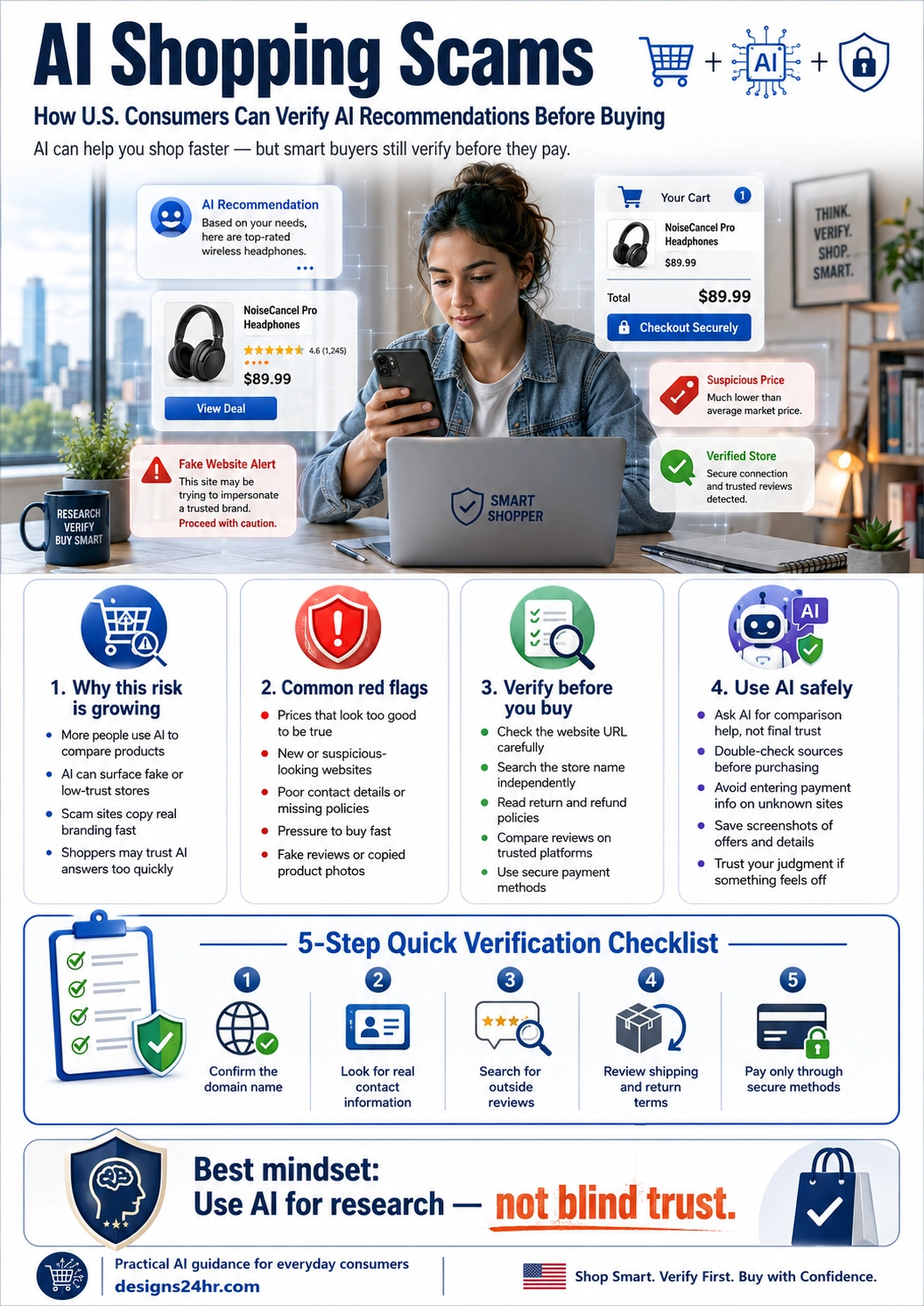
The safest way to use AI shopping recommendations is to pause before checkout and look for warning signs. One red flag does not always prove a scam, but multiple red flags should make you stop.
| Red flag | Why it matters | What to do |
|---|---|---|
| Price looks too good to be true | Fake stores often use unusually low prices to attract fast purchases. | Compare the same product across trusted retailers before buying. |
| Website URL looks strange | Scam sites may use misspellings, extra words, odd domains, or lookalike brand names. | Search the brand name independently instead of clicking only the AI-suggested link. |
| No real contact information | Missing address, phone number, support email, or company details can signal a low-trust seller. | Look for clear customer support, business details, and policy pages. |
| Copied product photos or generic reviews | Scam stores may copy images and fake review text from real websites. | Search outside reviews and compare images on trusted platforms. |
| Only risky payment options | Scammers may push bank transfers, gift cards, crypto, or payment methods that are harder to recover. | Use secure payment methods with buyer protection when possible. |
How to Verify AI Shopping Recommendations Before Buying
You do not need to stop using AI for shopping. You just need a verification habit. Before you buy from a store you do not already know, use this five-step checklist.
5-Step Quick Verification Checklist
-
Confirm the domain name.
Look carefully at the URL. Watch for misspellings, extra hyphens, strange endings, or brand names with added words that imitate the real company. -
Look for real contact information.
Check whether the website shows a real business name, support email, phone number, address, and clear customer service process. -
Search for outside reviews.
Do not rely only on reviews shown on the store’s own website. Search the store name plus words like “reviews,” “scam,” “complaints,” or “BBB.” -
Review shipping and return terms.
Read the return policy, refund timeline, shipping cost, delivery estimate, and cancellation rules before entering payment details. -
Pay only through secure methods.
Use trusted payment methods when possible. Avoid unusual payment requests, direct transfers, gift cards, crypto, or checkout pages that feel suspicious.
How to Use AI Safely While Shopping
AI can still be useful for shopping research. The key is to ask better questions and keep the final trust decision in your hands.
Use AI for comparison, not final trust
Ask AI to compare product features, explain differences, create a buying checklist, summarize pros and cons, or generate questions you should ask before purchasing. But do not treat a single AI answer as proof that a seller is legitimate.
Ask AI to help you verify
Instead of asking only, “Where should I buy this?” ask verification-focused questions:
- “What red flags should I check before buying from this website?”
- “What is the official website for this brand?”
- “What information should a trustworthy online store clearly show?”
- “Help me create a checklist to compare this seller with trusted retailers.”
- “What questions should I answer before entering payment details?”
Open the official site yourself
If the product is from a known brand, search for the official website manually. Avoid relying only on a link from an AI answer, ad, social post, unknown email, or unfamiliar shopping page.
Save evidence before paying
If you decide to buy, save screenshots of the product page, price, seller name, return policy, shipping promise, and checkout confirmation. This can help if you need to dispute a charge or report a problem later.
Safe AI Shopping Prompts You Can Use
These prompts can help you use AI as a research assistant while keeping your own judgment in control.
| Goal | Prompt to try |
|---|---|
| Compare products safely | “Compare these three products based on features, warranty, reviews, and value. Do not recommend a seller unless there is clear evidence it is trustworthy.” |
| Check a store | “What signs should I look for to decide whether this online store is legitimate before buying?” |
| Spot fake discounts | “This product is listed much cheaper than other stores. What could explain the price, and what red flags should I check?” |
| Review return terms | “Summarize this return policy and tell me what details are missing or unclear.” |
| Make a safer decision | “Create a quick verification checklist before I buy from a website I have never used before.” |
What to Avoid When Using AI Shopping Tools
AI shopping recommendations can save time, but careless use can increase risk. Avoid these common mistakes:
- Do not enter payment details on an unfamiliar site just because AI mentioned it.
- Do not assume a product card or summary means the store has been verified.
- Do not ignore strange URLs, missing policies, or weak contact information.
- Do not trust extreme discounts without checking other retailers.
- Do not use payment methods that offer little or no buyer protection.
- Do not share unnecessary personal information with unknown stores.
What to Do If You Think You Found an AI Shopping Scam
If a store looks suspicious, do not continue to checkout. Close the page, search the company independently, and look for outside reviews. If you already paid and think you were scammed, act quickly.
- Contact your bank or card provider and ask about disputing the charge.
- Save screenshots, receipts, emails, tracking numbers, and website details.
- Report the scam to the FTC at ReportFraud.ftc.gov.
- Report the website or scam details to BBB Scam Tracker.
- If the scam came through an AI tool, use that tool’s reporting option when available.
AI Shopping Scams vs. Normal Online Shopping Scams
AI shopping scams are not completely separate from normal online shopping scams. They are the next version of the same problem. Fake websites, copied product photos, false reviews, and suspicious prices have existed for years. The new part is that AI can make the shopping journey feel faster and more authoritative, which may cause shoppers to skip verification.
| Traditional shopping scam | AI shopping scam risk |
|---|---|
| You find a fake store through an ad, email, or search result. | You find a fake or low-trust store after asking AI for shopping help. |
| The site uses copied branding and unrealistic discounts. | The AI summary may make the store feel more legitimate than it is. |
| You trust reviews shown on the seller’s own page. | You trust an AI-generated summary without checking outside reviews. |
| You rush because of a limited-time offer. | You rush because AI shortened the research process and gave you a quick answer. |
Who Should Be Extra Careful?
Every shopper should verify before buying, but some groups may be more likely to rely on AI shopping recommendations because they are saving time, comparing many options, or buying unfamiliar products.
- Parents: When buying toys, school items, tech, clothing, or gifts from unfamiliar stores.
- Students: When comparing laptops, headphones, study tools, dorm products, or budget deals.
- Small business owners: When buying equipment, software, supplies, or marketing tools.
- Holiday shoppers: When searching for fast deals, hard-to-find items, or last-minute gifts.
- Older adults: When using AI tools, email links, social ads, or unfamiliar checkout pages.
- Deal hunters: When a discount looks much lower than trusted retailers.
Internal Resources From Designs24hr
For more simple and practical AI guidance, explore The AI Edge. You can also visit Designs24hr for easy tools and resources designed to help everyday users work smarter and stay safer online.
Helpful External Resources
These trusted resources can help U.S. consumers shop more safely, report scams, and understand online shopping protections.
- FTC: Online Shopping
- FTC: Scams Consumer Advice
- FTC: Report Fraud
- BBB Scam Tracker
- BBB: Online Shopping Scams
- Google: A New Era for AI Search
FAQ: AI Shopping Scams
What are AI shopping scams?
AI shopping scams are online shopping risks where a consumer may trust an AI-generated product recommendation, store suggestion, deal summary, or shopping answer that leads to a fake website, suspicious seller, copied product page, or unsafe checkout.
Are AI shopping recommendations safe?
AI shopping recommendations can be useful for research, but they should not be trusted blindly. Always verify the website, seller, reviews, return policy, and payment method before buying from an unfamiliar store.
How can I verify an AI product recommendation?
Check the domain name carefully, search the store independently, look for real contact information, read return and refund policies, compare reviews on trusted platforms, and use secure payment methods.
What is the biggest red flag of an AI shopping scam?
One of the biggest red flags is a price that looks much lower than trusted retailers, especially when combined with a strange URL, missing contact details, poor policies, fake reviews, or pressure to buy quickly.
Should I click links from AI shopping answers?
Be careful with any shopping link from an AI answer. For known brands, it is safer to search for the official website yourself and confirm the correct domain before entering payment details.
What should I do if I paid a fake online store?
Contact your bank or card provider quickly, save screenshots and receipts, report the scam to the FTC at ReportFraud.ftc.gov, and consider filing a report with BBB Scam Tracker.
Final Takeaway
AI can make shopping research faster, but it should not replace verification. Before you buy from an unfamiliar website, confirm the domain, check contact details, search outside reviews, read return terms, and use secure payment methods.
The safest mindset is simple: use AI for research — not blind trust. For more practical AI safety guides, visit The AI Edge by Designs24hr.