Restricted AI Models Explained: Why Some Advanced AI Tools Roll Out Slowly
Some powerful AI models do not appear in public apps on day one. Instead, they may launch first with trusted partners, security teams, developers, government-reviewed participants, or vetted organizations.
If you saw headlines about GPT-5.6, Claude Mythos 5, limited previews, trusted partners, Project Glasswing, or restricted AI access, the simple question is: why would an AI company release a model to some people first instead of everyone at once?
Quick Answer: What Is a Restricted AI Model?
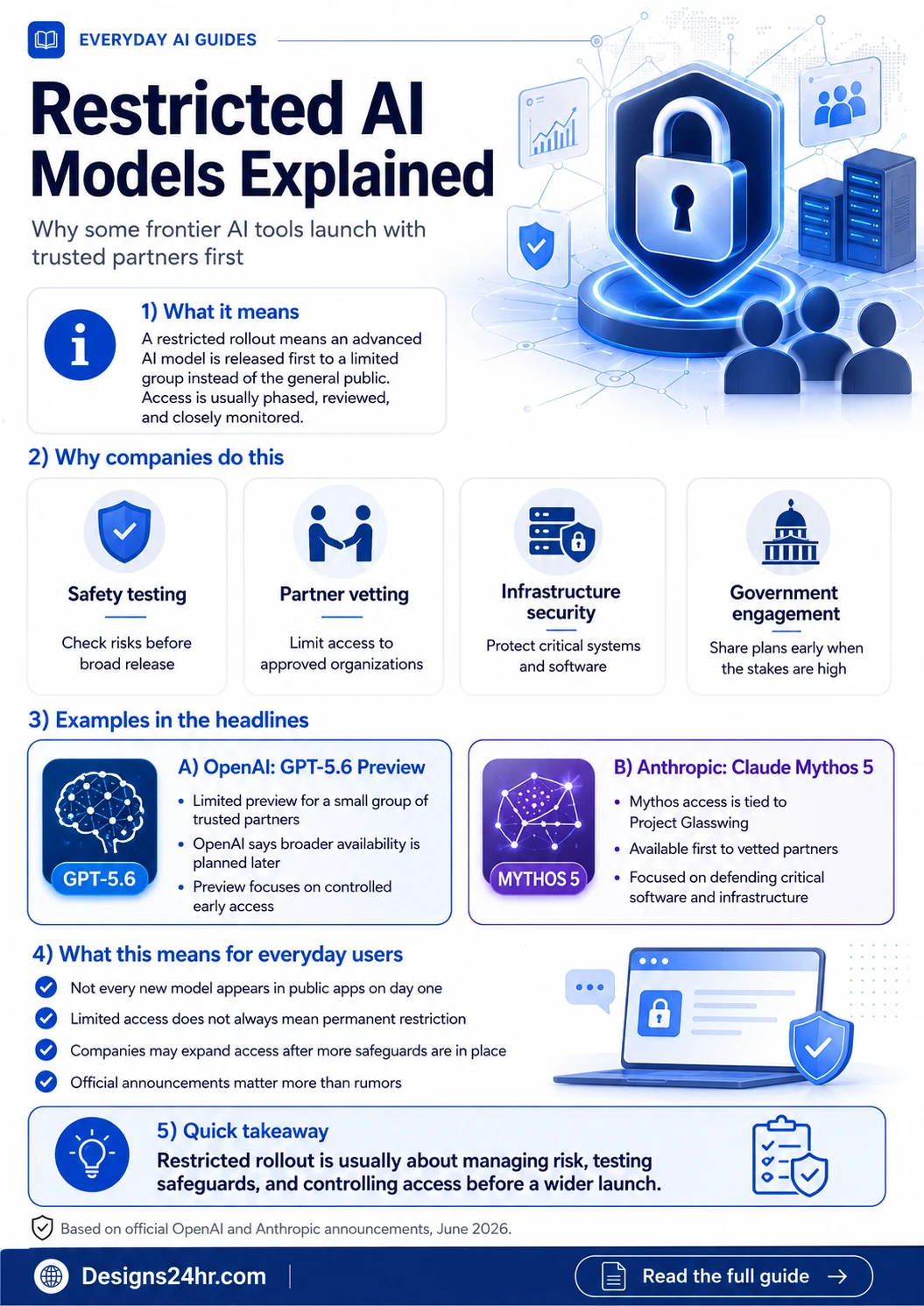
A restricted AI model is an advanced AI system that is not immediately available to the general public. Access may be limited to a smaller group first so the company can test safeguards, watch for misuse, work with trusted partners, collect feedback, and decide whether the model is ready for wider use.
Restricted access does not always mean the model is permanently blocked. It usually means the rollout is phased. The model may start with approved organizations, developers, security teams, or enterprise partners before it reaches public apps like ChatGPT, Claude, an API, or business tools.
Why Are Some AI Models Released to Trusted Partners First?
As AI models become more capable, companies have more to check before a broad release. A model that can reason better, write stronger code, use tools more effectively, analyze large files, or help with cybersecurity can be useful. It can also create higher risks if it is misused or misunderstood.
That is why a trusted partner rollout can make sense. Instead of releasing a powerful model to everyone at the same time, the company can learn how the model behaves in controlled environments first.
Safety Testing
Companies can check whether safeguards work before the model reaches a much larger audience.
Partner Vetting
Access can be limited to organizations that meet security, compliance, or use-case requirements.
Security Review
Models with strong coding or cyber capabilities may need extra controls around critical systems.
Early Feedback
Trusted testers can report issues, edge cases, and real-world performance before wider release.
GPT-5.6 Preview: What OpenAI Says About Limited Access
OpenAI’s GPT-5.6 preview is a useful example of how restricted AI model access can work. OpenAI says GPT-5.6 starts with a limited preview for a small group of trusted partners, with broader availability planned later. OpenAI also says the preview includes GPT-5.6 Sol, Terra, and Luna through the API and Codex, while ChatGPT is not included during the preview period.
For everyday users, that means you may hear about a new model before you can actually use it in ChatGPT. That can feel confusing, but it is common in phased technology launches. A company may announce the model, share safety details, work with approved partners, and then expand access later if the rollout goes well.
Simple GPT-5.6 takeaway
GPT-5.6 preview does not mean every ChatGPT user gets the model immediately. It means OpenAI is starting with a smaller preview group and official availability details should be checked through OpenAI’s own updates.
Claude Mythos 5: Why Project Glasswing Matters
Anthropic’s Claude Mythos 5 is another example of restricted model access. Anthropic connects Mythos-class model access with Project Glasswing, an initiative focused on helping vetted partners defend critical software and infrastructure.
The important detail is that Mythos access is not being framed as a normal consumer chatbot launch. It is tied to cybersecurity, infrastructure defense, vetted partners, and safeguards. That makes the rollout different from a typical public AI assistant update.
If you are an everyday user, you do not need to know every technical detail of Project Glasswing. The practical point is simple: some AI models are powerful enough that companies may release them first to organizations that can help test or apply the model in controlled, high-value safety contexts.
Does Restricted Access Mean the Public Will Never Get It?
No. Restricted access does not automatically mean permanent restriction. Sometimes a model starts with trusted testers and later becomes available to more people. Sometimes the preview remains limited because the company decides the model is too specialized, too risky, or not ready for public use. Sometimes a later version becomes public after stronger safeguards are built.
The safest way to think about restricted AI models is this: limited access is a rollout stage, not always a final decision.
| What You Hear | What It Usually Means | What You Should Do |
|---|---|---|
| “Trusted partner preview” | A limited group can test the model before broader availability. | Check the company’s official blog or help center before assuming public access. |
| “Vetted partners only” | Access may depend on security, use case, organization type, or approval. | Do not trust random screenshots claiming anyone can access it. |
| “Government engagement” | The company may be sharing plans, risks, or capabilities with government stakeholders. | Look for official company statements instead of viral summaries. |
| “System card released” | The company may be publishing safety, capability, and risk information. | Read the summary first, then check details if the model affects your work. |
Why Governments and Companies Care About Frontier AI Safety
Frontier AI models are not just better writing assistants. Some advanced models may become stronger at coding, planning, cybersecurity analysis, scientific reasoning, data analysis, and multi-step work. Those abilities can help researchers, companies, developers, security teams, and everyday users. They can also raise harder questions about misuse, privacy, accuracy, and control.
This is why AI safety is becoming part of product rollout. A company may need to ask:
- Can the model help users safely without enabling harmful instructions?
- Can the model handle cybersecurity-related tasks without creating new risks?
- Can the company detect misuse during early access?
- Are the right privacy and permission controls in place?
- Can the model explain uncertainty instead of sounding too confident?
- Can the company support users if the model makes mistakes?
These questions matter even more as AI tools become closer to AI agents that can use tools, take steps, and work across apps. The more an AI system can do, the more important safety, permissions, and human control become.
What This Means for Everyday ChatGPT and Claude Users
If you use ChatGPT, Claude, Gemini, Copilot, or other AI tools for everyday tasks, restricted AI model rollouts are worth understanding, but they are not a reason to panic. Most users simply need better expectations.
Here is what it means in normal language:
- Not every new AI model appears in public apps on launch day.
- A company may announce a model before most users can access it.
- Limited access may be used for safety testing, partner feedback, or controlled deployment.
- Some models may be aimed at enterprise, developer, cybersecurity, or infrastructure use instead of casual chat.
- Public availability can change later, so official updates matter.
This is similar to other technology rollouts. A new feature might start with enterprise customers, developers, beta testers, researchers, or selected partners before it reaches a normal app. The difference is that with advanced AI, the safety and misuse questions can be bigger.
How Restricted AI Models Connect to AI Browsers and AI Agents
Restricted AI access also matters because AI is moving beyond simple chat windows. AI tools are becoming more connected to browsers, files, apps, code, calendars, websites, and workplace systems. That is useful, but it also means access control becomes more important.
For example, an AI assistant that only answers a basic question is one kind of risk. An AI agent that can browse websites, use tools, summarize private files, or help complete online tasks is a different kind of risk. If you want a deeper beginner explanation, read AI Browsers Explained and ChatGPT Superapp Explained.
The big pattern is clear: as AI becomes more capable, companies may become more careful about who gets access first, what the model can do, and which safeguards are required before wider rollout.
How to Avoid Rumors About “Secret” AI Models
Whenever a powerful AI model is limited, rumors spread fast. You may see posts claiming that a model is hidden, banned, leaked, dangerous, or already available through a secret link. Some claims may be partly true. Many will be exaggerated or wrong.
Before you trust a model-access claim, use this simple verification habit:
30-Second Restricted AI Model Check
- Check the official company page. Look for the AI company’s blog, help center, release notes, or system card.
- Check the date. AI availability changes quickly, so old posts can become misleading.
- Check the product. A model may be available in the API but not in ChatGPT, Claude, or a public app.
- Check the access group. Look for phrases like trusted partners, vetted partners, preview, enterprise, developer access, or research access.
- Check the source quality. Avoid trusting screenshots, viral posts, or anonymous claims without official confirmation.
- Check the risk level. If the claim affects your work, business, school, privacy, or money, verify it before acting.
For a broader safety habit, use the AI Hallucination Checker before trusting AI-generated claims, especially when an answer includes dates, model names, pricing, access rules, policies, or technical promises.
Simple Checklist Before Trusting a New AI Model Headline
Use this checklist whenever you see a headline about a new AI model, limited preview, government request, trusted partner launch, or restricted AI access.
| Question | Why It Matters |
|---|---|
| Who announced it? | Official company pages are more reliable than viral summaries. |
| Which product gets access? | API access, developer access, enterprise access, and public app access are not the same. |
| Is it a preview or general release? | A preview may be limited, temporary, or invite-only. |
| Who are the trusted partners? | Access may be limited to vetted organizations, security teams, or infrastructure partners. |
| What safeguards are mentioned? | Safety testing, monitoring, policy restrictions, and system cards can explain the slower rollout. |
| What should everyday users do now? | Wait for official access details, avoid rumors, and do not pay for fake access links. |
Important safety note
Be careful with anyone selling “early access” to a restricted AI model through unofficial links, private groups, downloads, browser extensions, or account-sharing offers. If the company has not officially announced public access, treat those offers as risky until proven otherwise.
What Businesses, Students, and Creators Should Know
Restricted AI model rollouts can affect different users in different ways. You do not need to be a policy expert, but you should understand how access rules may affect your workflow.
For small businesses
If a new model is only available to trusted partners, do not build a customer workflow around it until you know when broader access is available, what the pricing will be, and which product actually supports it.
For students
If you see classmates talking about a new model, check whether it is available in the public app you use. Do not rely on model rumors for school projects, citations, or deadlines.
For creators
A restricted model can become a trending content topic, but avoid claiming you tested it unless you actually have access. Explain what the official source says and what is still unknown.
For developers
Check whether preview access is available through API, Codex, enterprise programs, cloud partners, or another channel. Product access can vary by model, region, account type, and approval.
Helpful Designs24hr Tools for Understanding AI Announcements
AI model announcements can be filled with technical terms, safety wording, product names, access rules, and confusing release details. These free Designs24hr tools can help you slow down and understand what a company actually said.
Explain This For Me
Paste a confusing AI announcement, model description, or help-center paragraph and turn it into simpler everyday language.
Plain Language Translator
Use this when AI policy, system cards, or product updates feel too technical and you want the main point without the jargon.
Decision Helper
Use this when you are deciding whether to wait for a new model, use a current AI tool, change workflows, or pay for a different product.
Final Takeaway
Restricted AI models are not automatically a mystery or a scandal. In many cases, restricted rollout is a practical way to manage risk, test safeguards, review real-world use, and control access before a wider launch.
For everyday users, the best response is simple: follow official updates, understand the difference between preview access and public access, avoid fake access claims, and verify AI headlines before you share or act on them.
As AI models become more powerful, slower rollouts may become more common. That does not mean you are being left behind. It means the companies building frontier AI are under more pressure to prove that powerful systems can be released carefully, not just quickly.
Sources and Further Reading
FAQs About Restricted AI Models
What is a restricted AI model?
A restricted AI model is an advanced AI system that is released first to a limited group instead of the general public. Access may be limited for safety testing, partner review, security monitoring, or controlled feedback.
Why do AI companies use trusted partner rollouts?
AI companies may use trusted partner rollouts to test safeguards, reduce misuse risks, work with approved organizations, and learn how a powerful model performs before wider release.
Is GPT-5.6 available to everyone?
At the preview stage, GPT-5.6 access is limited. OpenAI says broader availability is planned, but everyday users should check official OpenAI updates for product access, timing, and availability details.
What is Claude Mythos 5?
Claude Mythos 5 is an Anthropic model connected to Project Glasswing. Anthropic describes Mythos access as tied to vetted partners and work focused on defending critical software and infrastructure.
Does restricted access mean an AI model is unsafe?
Not always. Restricted access can mean the model is powerful enough that the company wants more testing, safeguards, partner review, or monitoring before broader access.
Will restricted AI models become public later?
Some restricted models may become more widely available later, while others may stay limited or be replaced by safer future versions. The answer depends on the company, model capabilities, safeguards, and product plan.
Should everyday users worry about restricted AI models?
Most everyday users do not need to panic. The practical habit is to follow official updates, avoid fake access offers, protect personal data, and understand that advanced AI tools may roll out slowly.
How can I tell if an AI model rumor is real?
Check the company’s official blog, help center, release notes, system card, developer documentation, or verified newsroom update. Avoid trusting screenshots, viral posts, or claims that do not name a real source.
Keep Learning AI in Plain English
Everyday AI Guides from Designs24hr explains fast-moving AI tools, safety updates, productivity ideas, and technology shifts in simple language so you can understand what matters without getting lost in hype.