ChatGPT superapp is becoming one of the biggest AI trend phrases because it points to a simple idea: AI assistants may be moving beyond chat boxes and becoming everything apps for writing, coding, research, planning, creation, and action.
A Reuters report, citing the Financial Times, says OpenAI is preparing a major ChatGPT overhaul that could turn ChatGPT into a more multifunctional “superapp” with coding tools, AI agents, and third-party integrations. That does not mean “ChatGPT Superapp” is an official product name. It means the direction of AI apps may be changing fast.
This ChatGPT superapp explained guide breaks down what a ChatGPT superapp could mean, why AI assistants are becoming everything apps, how Codex and AI agents fit into the story, what users may gain, and what people should watch before putting more of their work into one AI hub.
Simple takeaway: A ChatGPT superapp would mean ChatGPT is no longer just a place to ask questions. It could become a central AI workspace where users write, code, research, create images, plan tasks, connect apps, and automate parts of everyday work.
What Is a ChatGPT Superapp?
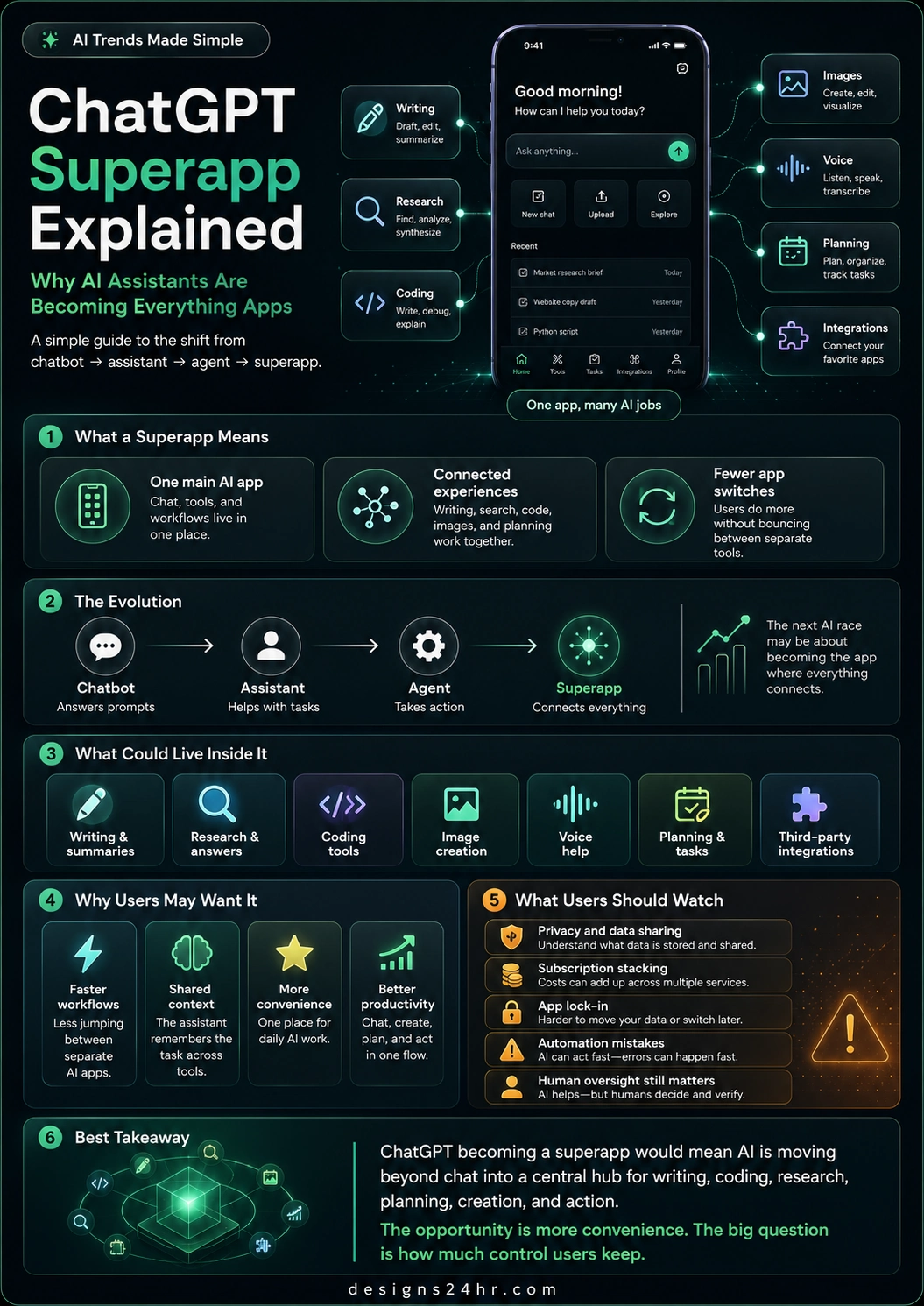
A ChatGPT superapp means one AI assistant becoming the main place where many different AI jobs happen. Instead of opening separate apps for writing, coding, image creation, research, planning, voice, automation, and integrations, users could do more from one connected AI interface.
The easiest way to understand it is this: ChatGPT started as a chatbot. Over time, it became more useful for search, voice, images, files, productivity, coding, and business workflows. A superapp direction would connect more of those abilities inside one experience.
That is why the phrase AI everything app matters. The next race in AI may not only be about which model is smartest. It may also be about which assistant becomes the place where users actually get things done every day.
Why AI Assistants Are Becoming Everything Apps
AI tools are becoming more capable, but users are also becoming more overwhelmed. One person may use one AI app for writing, another for coding, another for image generation, another for web research, another for planning, and another for automation.
That creates a new problem: too many AI tools, too many subscriptions, too many tabs, and too much context switching. A superapp solves that by trying to bring the most important AI jobs into one place.
For normal users, the appeal is convenience. For businesses, the appeal is productivity. For AI companies, the advantage is stickiness: if one assistant becomes the center of a user’s work, the user may rely on it more often and for more tasks.
Important note: “Superapp” is currently a reported strategy and trend angle, not an official ChatGPT product label. The confirmed direction is that ChatGPT and OpenAI tools are expanding across chat, voice, web search, images, mobile, Codex, coding agents, and productivity workflows.
ChatGPT Superapp Explained: From Chatbot to Assistant to Agent to Superapp
To understand what is a ChatGPT superapp, it helps to look at how AI assistants are evolving.
| Stage | What It Does | Simple Meaning |
|---|---|---|
| Chatbot | Answers prompts, explains ideas, drafts text, and responds in conversation. | AI that answers. |
| Assistant | Helps with everyday tasks like writing, research, planning, summaries, and ideas. | AI that helps. |
| Agent | Can work through tasks, use tools, follow steps, and complete more active workflows. | AI that acts. |
| Superapp | Connects many AI jobs, tools, integrations, and workflows in one central hub. | AI that becomes the workspace. |
This is the big shift: AI assistants are moving from one-time answers toward connected work. A user may start with a question, turn it into a plan, create files, build code, generate images, research sources, connect apps, and complete a task without leaving the main AI experience.
How ChatGPT Could Become an AI Everything App
A true AI assistant superapp would combine several jobs that people currently spread across separate tools.
For example, a creator could use one AI app to brainstorm a blog idea, research the topic, write the outline, create the thumbnail prompt, generate social captions, organize a publishing checklist, and track follow-up tasks.
A small business owner could use it to write emails, summarize customer feedback, analyze product ideas, draft website copy, plan content, create images, and prepare basic automation workflows.
A developer could use it to plan features, ask technical questions, review code, create tests, fix bugs, and manage coding tasks through Codex-style agent workflows.
Where Codex Fits Into the ChatGPT Superapp Story
ChatGPT Codex integration is one of the clearest signs of where AI assistants may be heading. OpenAI describes Codex as an AI assistant for coding, research, and productivity. OpenAI’s Codex app is positioned as a command center for agents, helping users manage multiple agents, parallel workflows, and long-running software development tasks.
This matters because coding agents are not just chatbots that write code snippets. They can read, edit, run code, work in parallel, and support real development workflows. That makes them closer to active AI workers than simple answer tools.
If ChatGPT becomes more connected with Codex, users may experience a stronger bridge between conversation, planning, code, research, and execution. That is exactly the kind of connection people expect from a superapp.
What Could Live Inside a ChatGPT Superapp?
The strongest version of a ChatGPT superapp would not be one feature. It would be a collection of useful AI jobs working together.
- Writing and summaries: Draft, rewrite, summarize, simplify, and polish content.
- Research and answers: Search, compare, explain, and synthesize information.
- Coding tools: Build, debug, review, document, and improve software projects.
- Image creation: Generate, edit, visualize, and support creative workflows.
- Voice help: Talk to the assistant, ask questions hands-free, and use voice for quick work.
- Planning and tasks: Turn ideas into plans, checklists, schedules, and workflows.
- Third-party integrations: Connect outside apps and services so AI can help across more of daily life.
- AI agents: Let specialized assistants complete longer tasks with human direction and review.
This is why ChatGPT productivity tools could become more important for everyday users. The more tasks ChatGPT can connect, the less people need to jump between separate AI tools.
Why Users May Want a ChatGPT Superapp
The biggest reason users may want a ChatGPT superapp is not hype. It is friction. People want fewer tools, faster workflows, and better context.
Here are the practical benefits:
- Faster workflows: Users can move from idea to draft to research to output without starting over in multiple apps.
- Shared context: The assistant can better understand the project if the work stays in one place.
- More convenience: One AI app can become the starting point for many daily tasks.
- Better productivity: Writing, coding, research, planning, and creation can happen in one flow.
- Less app switching: Users do not need to constantly copy and paste between tools.
- More powerful agents: AI agents can help with bigger, multi-step projects when connected to the right tools.
Productivity takeaway: The promise of a ChatGPT superapp is simple: less bouncing between tools, more connected context, and more work completed from one AI workspace.
Why OpenAI ChatGPT Overhaul Reports Matter
The reported OpenAI ChatGPT overhaul matters because it reflects a larger industry pattern. AI companies are not just launching smarter models. They are trying to build daily platforms where users spend more time and complete more tasks.
That is a major change from the early AI chatbot era. At first, people visited AI tools to ask questions or draft text. Now, AI assistants are becoming places where users create, organize, code, search, plan, and take action.
This may also explain why coding agents are becoming so important. Coding is one of the clearest areas where AI can move from suggestion to execution. If users trust AI to help build software, they may also start trusting AI to handle more advanced work in other categories.
ChatGPT AI Agents: The Real Shift Behind the Superapp Idea
ChatGPT AI agents are important because agents can move beyond answering. An agent can take a task, follow steps, use tools, and work through a process while the user supervises.
For example, a chatbot can explain how to fix a bug. A coding agent can inspect the code, make changes, run tests, and show the result for review. That difference changes what people expect from AI.
The future of ChatGPT may be less about typing better prompts and more about directing the right AI agent for the right job. That could make ChatGPT feel more like a command center than a chat window.
What Users Should Watch Before Using AI Everything Apps
A superapp sounds convenient, but users should also be careful. The more one app does, the more power it has over your workflow, data, subscriptions, and habits.
Here are the biggest things users should watch:
- Privacy and data sharing: Understand what data is stored, shared, connected, or used across tools.
- Subscription stacking: One AI hub may connect paid services, premium features, and usage limits.
- App lock-in: The more work you keep in one platform, the harder it may be to switch later.
- Automation mistakes: AI agents can move fast, but fast errors can create real problems.
- Human oversight: AI can help, but users still need to decide, verify, and approve important work.
- Work boundaries: Users should separate personal, business, private, and sensitive tasks carefully.
The best AI everything app is not the one that removes all human control. It is the one that helps users move faster while keeping review, choice, and accountability clear.
Could a ChatGPT Superapp Replace Other Tools?
A ChatGPT superapp may reduce the need for some separate tools, but it probably will not replace everything for everyone. Specialized tools still matter, especially for advanced design, enterprise systems, developer environments, accounting, legal workflows, healthcare, and high-security work.
The more realistic outcome is that ChatGPT becomes the starting layer. Users may begin tasks inside ChatGPT, use it to organize thinking, connect to outside apps, and then move into specialized tools when needed.
That is still powerful. If ChatGPT becomes the front door to many workflows, it does not need to replace every app. It only needs to become the place where many tasks begin.
Who Benefits Most From an AI Assistant Superapp?
An AI assistant superapp could help almost anyone, but the biggest benefits may go to people who already use AI for several different tasks.
- Creators could plan content, write scripts, create visuals, and organize publishing tasks.
- Students could study, summarize notes, practice concepts, and organize projects.
- Small business owners could write copy, research competitors, plan offers, and build workflows.
- Developers could use Codex-style tools for coding, debugging, documentation, and testing.
- Marketers could research topics, draft campaigns, create briefs, and organize content calendars.
- Busy professionals could summarize meetings, plan tasks, prepare documents, and reduce admin work.
The key is not whether every user needs every feature. The key is whether one AI workspace can remember enough context to make each next task easier.
Future of ChatGPT: What This Trend Could Mean
The future of ChatGPT may be less about one chat box and more about an AI operating layer for everyday work. That means ChatGPT could become a place where people ask, create, search, code, plan, connect, and automate.
If this direction continues, users may choose AI tools based on three things: how smart the model is, how well the app fits their daily workflow, and how much control they keep over their data and decisions.
That last part matters. The more useful AI becomes, the more important user control becomes.
ChatGPT Superapp Explained in One Sentence
ChatGPT superapp means ChatGPT could evolve from a chatbot into a central AI hub where writing, coding, research, image creation, planning, integrations, and AI agents work together in one connected experience.
FAQ: ChatGPT Superapp
What is a ChatGPT superapp?
A ChatGPT superapp means ChatGPT could become a central AI hub for many tasks, including writing, coding, research, image creation, planning, integrations, and AI agents. It is a reported strategy and trend idea, not an official product name.
Is ChatGPT officially becoming a superapp?
Reuters, citing the Financial Times, reported that OpenAI is preparing a major ChatGPT overhaul toward a more multifunctional superapp-style experience. OpenAI has also officially expanded ChatGPT and Codex capabilities across chat, mobile, coding agents, voice, web, and productivity workflows.
Why are AI assistants becoming everything apps?
AI assistants are becoming everything apps because users want fewer tools, less app switching, shared context, and more connected workflows. One AI hub can help users move from idea to action faster.
How does Codex fit into the ChatGPT superapp idea?
Codex fits into the ChatGPT superapp idea because it shows how AI can move beyond answers into active work. OpenAI describes Codex as an AI assistant for coding, research, and productivity, with apps and workflows built for agentic coding and long-running tasks.
What could users do in a ChatGPT superapp?
Users could write, summarize, research, code, generate images, plan tasks, use voice, connect apps, manage projects, and direct AI agents from one central AI workspace.
What are the risks of an AI everything app?
The main risks include privacy concerns, data sharing, subscription stacking, app lock-in, automation mistakes, and over-reliance on AI without human oversight.
Will a ChatGPT superapp replace other apps?
It may reduce the need for some separate AI tools, but it probably will not replace every specialized app. More likely, ChatGPT could become the starting point for many tasks while users still use specialist tools when needed.
Why does the ChatGPT superapp trend matter?
It matters because the AI race is moving beyond model intelligence alone. The next major competition may be about which AI assistant becomes the daily workspace where people create, organize, code, research, and take action.
Sources and Further Reading
- Reuters: OpenAI plans ChatGPT “superapp” overhaul, citing Financial Times
- OpenAI / ChatGPT: ChatGPT overview
- OpenAI / ChatGPT: Download ChatGPT for mobile
- OpenAI / ChatGPT: Codex official page
- OpenAI: Introducing the Codex app
- The AI Edge by Designs24hr
- Best Free AI Tools for Productivity in 2026
- How to Use AI at Work
- 10 Daily AI Habits That Can Supercharge Your Productivity
- Microsoft Scout AI Agent Explained
Final Thought
ChatGPT becoming a superapp would mean AI is moving beyond chat into a central hub for writing, coding, research, planning, creation, and action.
The opportunity is more convenience. The big question is how much control users keep.
At Designs24hr, we make fast-moving AI topics easier to understand through clear visual guides, practical explainers, and beginner-friendly breakdowns. Share your thoughts in the comments, and come back to Designs24hr whenever you want to learn something new about AI, productivity, design, and the future of smart technology.