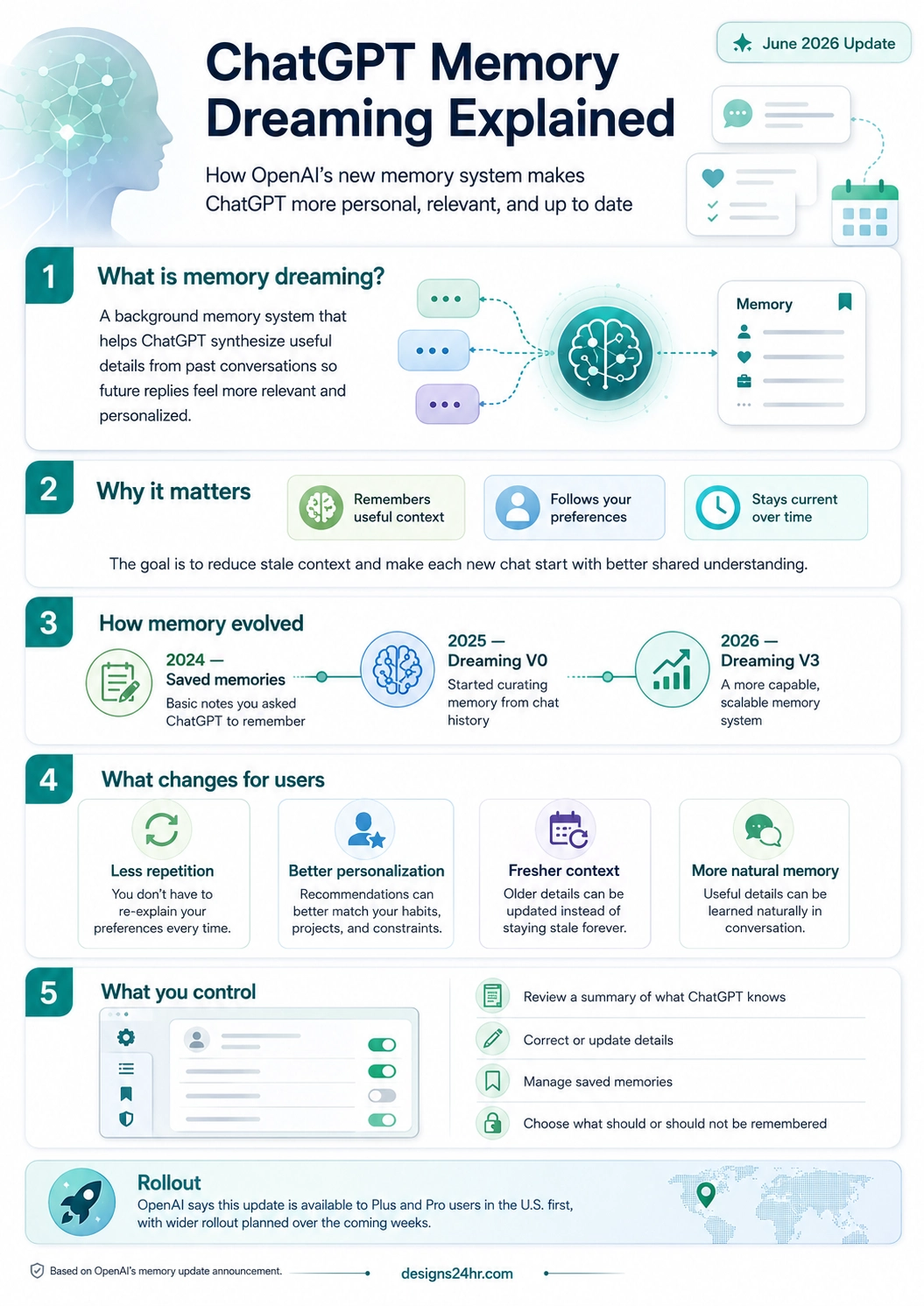
ChatGPT memory dreaming explained in simple terms means this: OpenAI is improving how ChatGPT remembers useful context from past conversations, so future replies can feel more personal, more relevant, and more up to date.
The OpenAI memory update is important because it moves ChatGPT closer to becoming a true personal AI assistant. Instead of starting every new chat from zero, ChatGPT can better understand your preferences, projects, habits, and constraints over time.
For everyday users, that can mean less repetition, better recommendations, more natural answers, and a smarter experience when using ChatGPT for work, learning, planning, writing, research, business, or daily productivity.
Quick answer: ChatGPT memory dreaming is OpenAI’s background memory synthesis system. It helps ChatGPT identify useful context from past conversations, reduce stale memory, follow user preferences, and give more personalized answers over time.
Key takeaways:
- Focus keyword: ChatGPT memory dreaming explained.
- Main benefit: ChatGPT can remember useful context instead of making users repeat everything.
- Big change: Memory is becoming more natural, fresher, and easier to review.
- User control: You can manage, update, and guide what ChatGPT remembers.
What Is ChatGPT Memory Dreaming?
ChatGPT memory dreaming is a newer memory system designed to help ChatGPT synthesize useful details from past conversations. The goal is not to remember every random message. The goal is to carry forward the context that makes future answers more helpful.
OpenAI describes memory as the part of ChatGPT that helps it learn your preferences, projects, and constraints. That way, future conversations can begin with shared understanding instead of forcing you to explain the same background again.
In plain English, ChatGPT memory dreaming helps ChatGPT become less like a one-time chatbot and more like a personalized AI assistant that can understand your ongoing needs.
Why the OpenAI Memory Update Matters
The biggest reason this update matters is simple: people do not use AI in isolated moments anymore. Many users now use ChatGPT for ongoing work, school, business, content creation, coding, planning, design, research, and daily problem solving.
Without better memory, every new chat can feel disconnected. With improved memory, ChatGPT can better understand what you are working on, how you like answers structured, what your goals are, and which details are still relevant.
That is why the ChatGPT memory update 2026 is not just a small feature change. It is part of a bigger shift toward AI tools that understand context over time.
How ChatGPT Memory Works Now
To understand how ChatGPT memory works, it helps to think of memory in three stages: saved memories, early dreaming, and the newer dreaming-based memory architecture.
| Memory Stage | How It Works | What It Means for Users |
|---|---|---|
| 2024: Saved memories | ChatGPT could save details users directly asked it to remember. | Helpful, but limited because users often had to clearly say what should be remembered. |
| 2025: Dreaming V0 | ChatGPT started using a background process to curate memory from chat history. | Memory became more natural and less dependent on direct “remember this” instructions. |
| 2026: Dreaming V3 | OpenAI introduced a more capable and scalable memory architecture built on dreaming. | Memory is designed to become fresher, more relevant, and easier for users to review. |
What ChatGPT Memory Dreaming Can Improve
1. Less repetition in every chat
One of the clearest benefits of ChatGPT memory dreaming is that you should not need to repeat the same preferences every time. If ChatGPT already understands your preferred tone, format, project rules, or learning level, it can respond faster and more accurately.
2. Better personalization
A ChatGPT personalized AI assistant can give answers that fit your actual situation. For example, it may better understand your writing style, your business goals, your study needs, your design preferences, or your daily routines.
3. Fresher context over time
Old memory can become incorrect. A strong memory system needs to understand when context changes. OpenAI says the new memory system is designed to improve freshness, continuity, and relevance, which helps reduce the problem of stale memory.
4. More natural memory
Instead of only remembering information when you give a direct command, memory dreaming can help ChatGPT learn useful details more naturally from conversation. That makes the assistant feel more aware without requiring constant manual setup.
Saved Memories vs. Memory Dreaming
Saved memories and memory dreaming are connected, but they are not exactly the same thing.
| Feature | Saved Memories | Memory Dreaming |
|---|---|---|
| Best for | Specific facts or preferences you ask ChatGPT to remember. | Broader context that can be synthesized from chat history. |
| How it feels | Like manually saved notes. | Like a smarter organizer that keeps useful context fresh. |
| Main benefit | Direct control over specific remembered details. | More natural personalization across ongoing conversations. |
What Users Can Control in ChatGPT Memory
ChatGPT memory controls are important because personalization only works well when users can manage it. OpenAI says users can review a summary of what ChatGPT knows, correct or update details, manage saved memories, and provide instructions about what should or should not be remembered.
That means memory is not something users should ignore. It is more like a personal settings area for your AI assistant. The cleaner your memory is, the better ChatGPT can understand your current goals.
Best practice: Keep stable preferences in memory, such as your writing style, project rules, brand voice, learning level, or recurring workflows. Remove temporary, outdated, or incorrect information so ChatGPT does not keep using stale context.
Real-Life Examples of ChatGPT Memory Dreaming
Here are practical examples of how ChatGPT remembers preferences and makes everyday AI use more helpful:
- Work: ChatGPT can remember your preferred writing tone, formatting style, and project goals.
- School: It can adjust explanations based on your learning level and subject needs.
- Business: It can keep track of your audience, brand voice, product strategy, and recurring tasks.
- Planning: It can remember your travel preferences, schedule style, budget limits, or daily routines.
- Creative work: It can understand your preferred design direction, content style, or idea-generation process.
Why Stale Memory Is a Big Deal
ChatGPT stale memory happens when old information stays in context even after it is no longer accurate. For example, a project may end, your schedule may change, your business direction may shift, or a saved preference may no longer match how you work.
This is why OpenAI’s focus on freshness matters. A useful AI memory system should not only remember. It should also stay current, update old assumptions, and give users a clear way to correct details.
How to Use ChatGPT Memory More Effectively
- Tell ChatGPT your stable preferences. These can include tone, format, learning style, project rules, or brand voice.
- Ask ChatGPT to remember important workflows. Memory works best for repeated tasks you do often.
- Update memory when your situation changes. Correct old details before they affect future answers.
- Review memory summaries when available. This helps you see what ChatGPT understands about you.
- Remove temporary context. Not every short-term task needs to become long-term memory.
Is ChatGPT Memory Dreaming Safe?
ChatGPT memory can be very useful, but users should still be thoughtful about what they allow any AI system to remember. A good rule is to keep memory focused on helpful preferences and recurring work context, not sensitive information you do not want reused later.
The safest way to use memory is to review it regularly, correct anything inaccurate, and remove details that no longer matter. Personalization is most helpful when it is accurate, current, and controlled by the user.
ChatGPT Memory Dreaming Explained in One Sentence
ChatGPT memory dreaming explained simply: it is OpenAI’s improved memory system that helps ChatGPT remember useful context, stay current, follow your preferences, and give more personal answers across future conversations.
The main takeaway is clear: ChatGPT is becoming less like a blank chatbot and more like a personal AI assistant that can understand your work, preferences, and ongoing goals over time.
Sources and Further Reading
This article is based on OpenAI’s official announcement about ChatGPT memory dreaming and the latest OpenAI memory update. Read the official source here: OpenAI: Dreaming — Better memory for a more helpful ChatGPT.
For more beginner-friendly AI explainers, visit The AI Edge by Designs24hr.
FAQs About ChatGPT Memory Dreaming
What is ChatGPT memory dreaming?
ChatGPT memory dreaming is OpenAI’s background memory synthesis system. It helps ChatGPT use useful context from past conversations so future responses can feel more relevant, current, and personalized.
How does ChatGPT memory work?
ChatGPT memory works by saving or synthesizing useful context, such as preferences, projects, and constraints, so future chats can start with better shared understanding instead of starting from zero.
Is ChatGPT memory dreaming different from saved memories?
Yes. Saved memories are specific details ChatGPT stores, often because you asked it to remember them. Memory dreaming is a broader background process that helps synthesize useful context from chat history.
Can I control what ChatGPT remembers?
Yes. OpenAI says users can review memory summaries, update details, manage saved memories, and guide what ChatGPT should or should not remember.
Why does ChatGPT memory matter?
ChatGPT memory matters because it can reduce repetition, improve personalization, keep context fresher, and help ChatGPT better understand ongoing projects and user preferences.
What is stale memory in ChatGPT?
Stale memory means old or outdated information that may no longer be accurate. The newer OpenAI memory system is designed to help improve freshness and relevance over time.
Who gets the new ChatGPT memory update first?
OpenAI said the update is available first to Plus and Pro users in the United States, with a wider rollout planned over the coming weeks.
AI is moving fast, but understanding it should not feel overwhelming. Designs24hr helps you keep up with the tools, updates, and trends that can make everyday life smarter. Share your thoughts in the comments, tell us how you use ChatGPT memory, and come back to Designs24hr whenever you want to learn something new about AI and design.