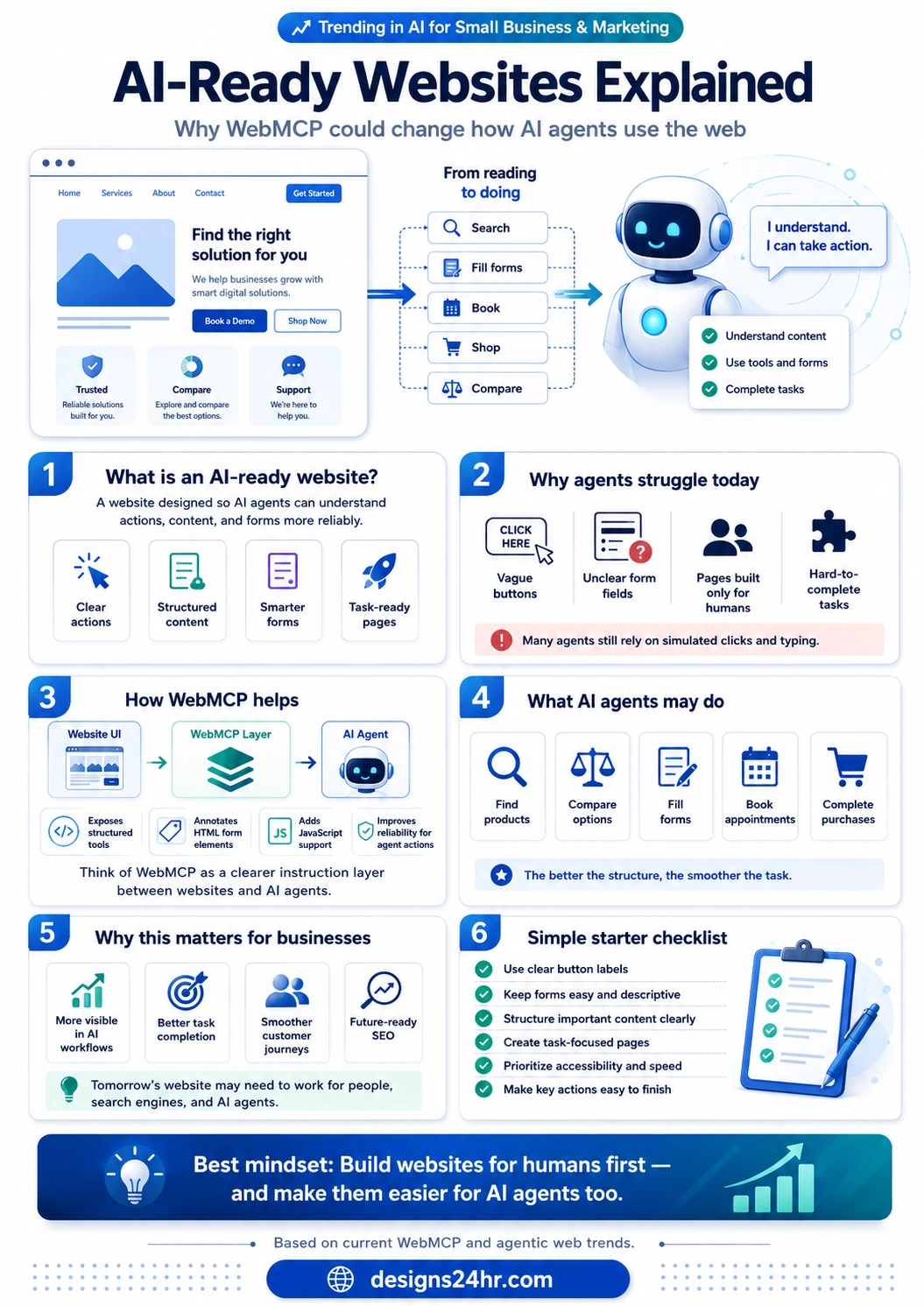
AI-ready websites may become one of the next big shifts in SEO, web design, and small business marketing. For years, websites were built mainly for people and search engines. Now, a new layer is emerging: websites may also need to work clearly for AI agents that can read, compare, fill forms, book, shop, and complete tasks for users.
This is where WebMCP explained becomes important. Google’s Chrome developer documentation describes WebMCP as a proposed web standard that helps websites expose structured tools for AI agents. In simple words, it could help AI agents understand how to use a website more reliably instead of guessing through clicks and typing.
For small businesses, creators, service providers, ecommerce stores, and website owners, this matters because the future of online visibility may not only be about ranking on Google. It may also be about whether AI agents can understand your website, use your forms, complete key actions, and recommend your business inside AI-driven workflows.
Quick answer: AI-ready websites are websites built with clear structure, readable content, simple forms, obvious actions, and task-focused pages so both humans and AI agents can understand and use them more easily.
Key takeaways:
- Focus keyword: AI-ready websites.
- Main trend: AI agents are starting to interact with websites, not just summarize them.
- Why WebMCP matters: It may help websites expose structured actions and forms for AI agents.
- Business impact: Clearer websites may be easier for people, search engines, and AI agents to use.
What Are AI-Ready Websites?
AI-ready websites are websites designed so AI systems can understand their content, actions, forms, products, services, and user journeys more reliably.
A normal website may look beautiful to a human visitor, but an AI agent might struggle to understand which button books an appointment, which form field asks for an email address, which product is best for a user, or which page completes a task.
An AI-ready website is different. It uses clearer content, stronger page structure, descriptive buttons, accessible forms, useful metadata, fast performance, and task-focused layouts. The goal is not to design only for machines. The best goal is to build websites for humans first, then make them easier for AI agents too.
Why AI Agents and Websites Are Becoming Connected
AI agents and websites are becoming connected because AI is moving from answering questions to helping users complete tasks. A user may soon ask an AI assistant to compare products, find a local service, book an appointment, complete a form, or purchase an item.
That means websites may need to be understandable not only as content pages, but also as action systems. If an AI agent cannot tell what a form does, what a button means, or how a checkout flow works, the task may fail or become unreliable.
This is the heart of the agentic web explained simply: the web is becoming a place where AI agents may help users take action, not just read information.
WebMCP Explained in Simple Terms
WebMCP explained in plain English: it is a proposed web standard that could help websites expose structured tools and actions for AI agents.
According to Chrome for Developers, WebMCP provides JavaScript and annotates HTML form elements so agents know how to interact with page features. Chrome’s documentation also describes this as a way to improve the performance and reliability of agent actions on websites.
Think of WebMCP like a clearer instruction layer between your website and AI agents. Instead of an agent trying to guess how to click through a page like a human, the website can provide more structured signals about what actions are available and how those actions should work.
Why AI Agents Struggle With Normal Websites
Many websites were designed only for human eyes. That creates problems for AI agents because visual layout does not always explain function clearly.
| Website Problem | Why It Confuses AI Agents | Better AI-Ready Approach |
|---|---|---|
| Vague buttons | Buttons like “Click here” or “Learn more” may not clearly explain the action. | Use descriptive labels like “Book a consultation,” “Compare pricing,” or “Download guide.” |
| Unclear form fields | AI agents may not know what information belongs in each field. | Use clear labels, helpful instructions, validation messages, and simple form structure. |
| Pages built only for humans | Visual design may look good but lack structured meaning. | Use semantic headings, organized sections, schema markup, and accessible HTML. |
| Hard-to-complete tasks | Complicated flows can make actions unreliable. | Create task-focused pages with fewer distractions and clearer next steps. |
How WebMCP Could Help AI-Ready Websites
WebMCP may help make AI agents using websites more reliable by giving agents clearer ways to understand available actions.
For example, a website might expose structured tools for searching products, filling forms, comparing options, booking appointments, or completing a purchase. This could reduce the need for an AI agent to rely only on simulated clicks and typed inputs.
That does not mean every website owner needs to become a developer overnight. But it does mean the direction is clear: websites with cleaner structure, clearer actions, and better task flows may be better prepared for the agentic web.
What AI Agents May Do on Websites
As AI agents become more capable, they may help users complete common website tasks more directly. These tasks could include:
- Finding products based on a user’s budget, preferences, or use case.
- Comparing options across services, plans, features, or prices.
- Filling forms with user-approved information.
- Booking appointments with local businesses, clinics, consultants, or service providers.
- Completing purchases when the user clearly approves the action.
- Summarizing choices so the user can make a faster decision.
The better your website structure is, the smoother these tasks may become for both humans and AI agents.
Why AI Website Visibility Matters for Businesses
AI website visibility is not only about whether your website appears in a search result. It may also become about whether AI assistants can understand your business, trust your content, and complete useful actions on your website.
For small businesses and marketers, this creates a new kind of opportunity. A clear, fast, structured, helpful website may have a better chance of being useful inside AI-powered search, AI summaries, agent workflows, and recommendation experiences.
This does not replace traditional SEO. It expands it. The future of SEO with AI agents may combine classic search optimization, answer-engine optimization, technical structure, accessibility, and task completion.
AI Search Optimization vs. Traditional SEO
AI search optimization does not mean abandoning keywords, helpful content, page speed, or backlinks. Those still matter. But AI-driven discovery also rewards clarity, structure, trust, and usefulness.
| Traditional SEO Focus | AI-Ready Website Focus |
|---|---|
| Ranking pages for keywords. | Helping AI systems understand the page, purpose, and next action. |
| Optimizing titles, headings, and content. | Structuring content so it can be summarized, cited, and used accurately. |
| Improving clicks from search results. | Improving visibility inside AI answers and agent workflows. |
| Making pages useful for users. | Making pages useful for users, search engines, and AI agents. |
How to Make a Website Ready for AI Agents
Here is how to make website ready for AI agents without overcomplicating the process.
1. Use clear button labels
Replace vague labels like “Click here” with action-specific labels. Use buttons like “Book a demo,” “Get pricing,” “Compare plans,” “Download checklist,” or “Start free tool.” Clear labels help humans and AI systems understand the next step.
2. Structure important content clearly
Use helpful headings, short paragraphs, clean sections, FAQ blocks, tables, and summaries. AI systems understand pages better when the content has a logical structure.
3. Make forms simple and descriptive
Every form field should have a clear label. Avoid confusing steps, hidden requirements, or unclear error messages. Forms are one of the biggest areas where AI agents may struggle if the structure is weak.
4. Create task-focused pages
A task-focused page has one clear purpose. For example, a booking page should make booking easy. A pricing page should make comparing plans easy. A product page should make buying or learning more easy.
5. Add schema where it makes sense
Schema markup can help search engines and AI systems understand your content type, business details, FAQs, articles, products, services, and reviews. Use schema honestly and accurately.
6. Improve accessibility and speed
Accessible, fast websites are easier for people and machines to use. Clean HTML, readable text, descriptive links, alt text, mobile responsiveness, and good page speed all support a stronger AI-ready foundation.
WebMCP for Website Owners: What to Know Now
WebMCP for website owners is still an emerging idea, not something most small businesses need to implement immediately. But it signals where the web is heading.
The main lesson is simple: websites should become easier to understand and easier to act on. That means your website should not hide important actions behind confusing design, unclear text, or complicated forms.
Even before WebMCP becomes widely adopted, these improvements can still help conversion, SEO, accessibility, and user experience.
Simple AI-Ready Website Checklist
Use this checklist as a starting point for making your website more AI-ready:
- Use clear page titles and headings.
- Write simple, specific button labels.
- Make forms short, labeled, and easy to complete.
- Add FAQ sections for common customer questions.
- Use schema markup where appropriate.
- Keep important content easy to find without too many clicks.
- Make service, product, pricing, and contact pages task-focused.
- Improve mobile layout, accessibility, and page speed.
- Use descriptive internal links instead of vague “read more” links.
- Make your main customer actions easy to complete.
Best mindset: Build websites for humans first, then make them easier for AI agents too. A confusing website hurts people, search engines, and future AI workflows.
What This Means for Small Business and Marketing
For small businesses, AI-ready websites could become a serious marketing advantage. If AI assistants become a common way people find services, compare options, and complete tasks, websites that are easier for AI agents to understand may be better positioned.
This is especially important for businesses that depend on forms, bookings, quotes, product comparisons, subscriptions, downloads, lead generation, or online purchases.
The businesses that prepare early do not need to chase every new AI trend. They need to make their websites clearer, faster, more useful, and more action-ready.
AI-Ready Websites Explained in One Sentence
AI-ready websites are websites built with clear structure, helpful content, simple actions, and task-focused pages so people, search engines, and AI agents can understand and use them more effectively.
The future of the web may not be only about getting visitors to click. It may also be about helping AI agents complete useful tasks for those visitors.
Sources and Further Reading
This article is based on Google Chrome’s official WebMCP documentation and Chrome’s Google I/O 2026 updates about the agentic web. Read the official resources here: Chrome for Developers: WebMCP and Chrome at Google I/O 2026.
For more beginner-friendly AI explainers, visit The AI Edge by Designs24hr. You can also try the AI Prompt Generator, Explain This For Me, and Plain Language Translator.
FAQs About AI-Ready Websites
What are AI-ready websites?
AI-ready websites are websites designed with clear structure, readable content, simple forms, descriptive actions, and task-focused pages so both humans and AI agents can understand and use them more reliably.
What is WebMCP?
WebMCP is a proposed web standard described by Chrome for Developers. It is designed to help websites expose structured tools and annotate page features so AI agents can interact with websites more reliably.
Why do AI agents struggle with normal websites?
AI agents can struggle when websites use vague buttons, unclear forms, confusing layouts, hidden steps, or pages designed only for human visual browsing.
How can I make my website ready for AI agents?
Start by using clear button labels, structured content, easy forms, schema markup, task-focused pages, mobile-friendly design, accessibility best practices, and fast page speed.
Is AI-ready website optimization the same as SEO?
No. AI-ready website optimization includes SEO, but it also focuses on helping AI systems understand actions, forms, page structure, and task completion.
Why do AI-ready websites matter for small businesses?
AI-ready websites matter because customers may increasingly use AI assistants to find, compare, book, buy, and complete tasks online. Clear websites may be easier for these AI workflows to understand.
Do small businesses need WebMCP right now?
Most small businesses do not need to implement WebMCP immediately, but they should pay attention to the trend and start improving website clarity, structure, accessibility, and task completion now.
AI is changing how people search, compare, and take action online. Designs24hr helps you understand these changes in a simple, practical way. Share your thoughts in the comments, tell us how you are preparing your website for AI-driven discovery, and come back to Designs24hr whenever you want to learn something new about AI and design.