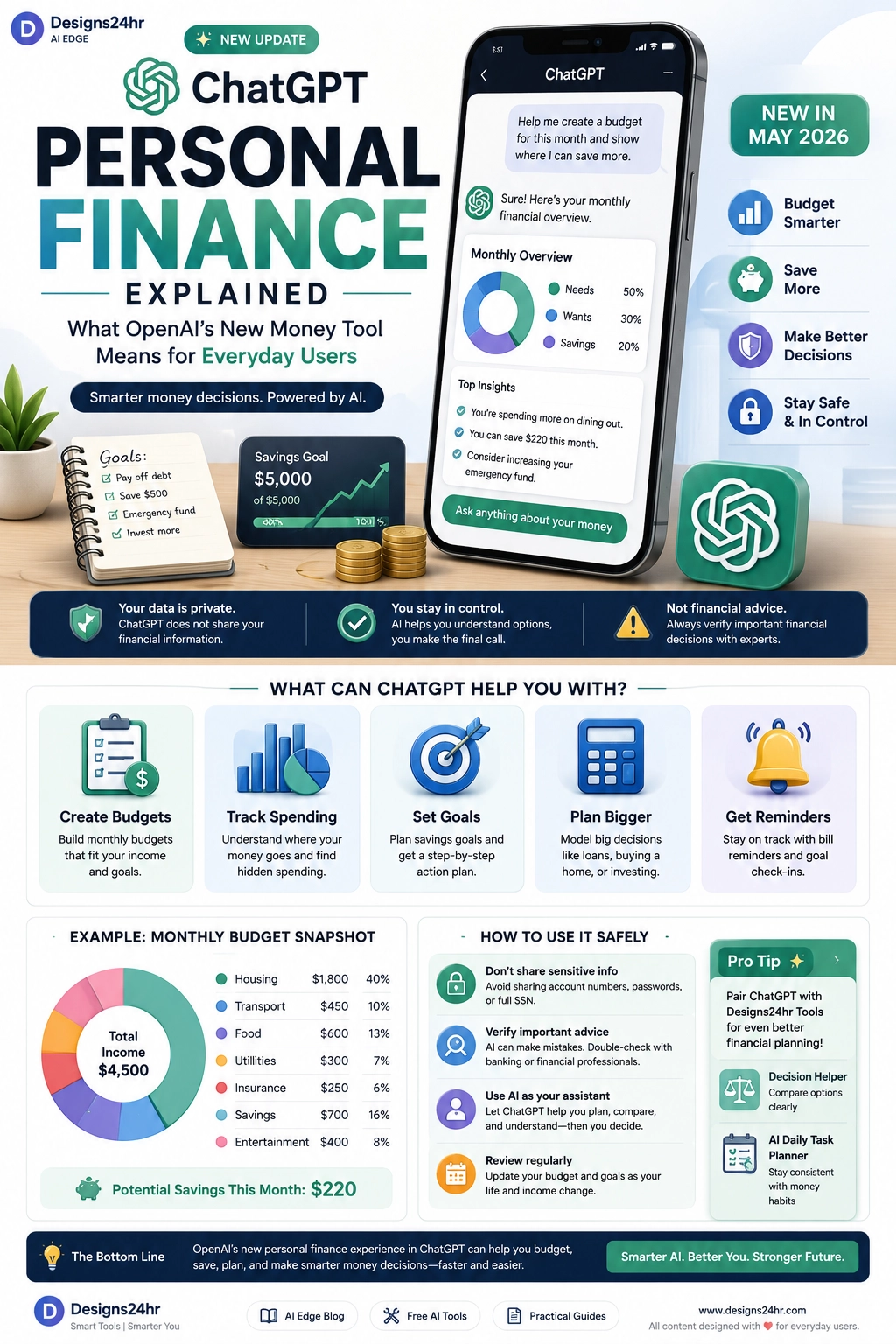
ChatGPT is moving into personal finance, and that could change how everyday users think about budgeting, spending, saving, and money decisions. OpenAI’s new personal finance experience is designed to help users connect financial accounts, see where their money is going, and ask questions based on their own financial context.
For everyday users, this sounds exciting — but it also needs to be handled carefully. AI can help organize information, explain patterns, and suggest questions to consider. It should not replace your judgment, your bank, a certified financial planner, or a qualified professional when the decision is important.
What Is ChatGPT Personal Finance?
ChatGPT personal finance is OpenAI’s new finance-focused experience inside ChatGPT. It allows eligible users to connect financial accounts, view a financial dashboard, and ask ChatGPT questions based on their money situation.
The goal is to make personal finance easier to understand. Instead of manually reviewing multiple bank accounts, credit cards, subscriptions, savings goals, and spending categories, users may be able to ask questions in plain English and get clearer financial summaries.
If you are trying to organize your daily money tasks before using any advanced finance tool, the AI Daily Task Planner from Designs24hr can help turn your next steps into a simple action plan.
Why This Matters for Everyday Users
Money decisions are part of everyday life. People want to know where their money goes, how much they can save, whether they are spending too much, and what they should plan for next.
AI can make that process easier by turning financial data into simpler explanations. Instead of staring at transactions or spreadsheets, a user may ask: “Where did I spend the most this month?” or “How can I save more without changing my rent or car payment?”
That is the real promise: not replacing financial professionals, but helping normal people understand their money faster.
1. Budgeting: See Where Your Money Goes
One of the most useful ways AI can help with money is budgeting. ChatGPT personal finance may help users understand income, bills, subscriptions, spending categories, and savings goals in a more conversational way.
For example, instead of manually sorting expenses, users could ask ChatGPT to summarize spending by category or identify where costs increased compared with last month.
This can be especially useful for people who struggle to keep a monthly budget updated or feel overwhelmed by banking apps.
2. Spending Insights: Find Hidden Patterns
Small spending habits can be hard to notice. Coffee runs, subscriptions, delivery fees, impulse purchases, and app payments can quietly add up.
AI can help spot patterns by grouping spending and explaining what changed. A user might ask, “What are my biggest non-essential expenses?” or “Which subscriptions should I review this month?”
This kind of insight can help people make better choices without feeling like they have to become finance experts.
3. Savings Goals: Make Progress Easier to Track
Saving money becomes easier when the goal is clear. ChatGPT personal finance may help users track goals such as building an emergency fund, saving for a trip, paying down debt, preparing for a big purchase, or planning a monthly savings target.
Instead of asking, “Can I save more?” a better question is: “Based on my current spending, what realistic amount could I save this month without missing important bills?”
AI can help break that question into smaller choices, but the user still needs to decide what is realistic and safe.
4. Bigger Money Decisions: Compare Options More Clearly
Money decisions often involve trade-offs. Should you pay extra toward debt or build emergency savings first? Should you cut one subscription or reduce dining out? Should you buy now or wait?
ChatGPT can help organize those choices by comparing pros, cons, risks, and next steps. It can make a decision easier to understand, but it should not make the final decision for you.
When you are comparing money choices, the Decision Helper can help you think through options more clearly before you act.
5. Financial Reminders and Check-Ins
Many people do not need complicated financial advice. They need reminders, structure, and regular check-ins.
AI could help users remember upcoming bills, review spending, check savings progress, plan for irregular expenses, or prepare for the next pay period.
This can make personal finance feel less like a once-a-month panic session and more like a simple routine.
What ChatGPT Can Help You Ask About Money
The best use of ChatGPT personal finance may be asking better questions about your money. Good questions can lead to better awareness and smarter decisions.
- Budgeting: “Where did most of my money go this month?”
- Saving: “What are three realistic ways I could save more?”
- Subscriptions: “Which recurring charges should I review?”
- Debt: “Help me compare debt payoff options.”
- Planning: “What should I prepare for before a big purchase?”
- Habits: “What spending pattern should I pay attention to?”
Privacy and Safety: What Users Should Understand
Personal finance data is sensitive. Before connecting accounts or sharing financial details with any AI tool, users should understand what data is being connected, what permissions are being granted, how memories work, and how to delete information if needed.
OpenAI says ChatGPT can save key financial context as financial memories to make future finance conversations more relevant, and users can view or delete those financial memories from the Finances page.
A smart rule is simple: do not share more financial information than you need to, and always know how to disconnect accounts or delete saved information.
What You Should Not Trust AI to Do Alone
AI can be helpful, but money decisions can have real consequences. ChatGPT should not be treated as a guaranteed financial advisor, tax professional, lawyer, accountant, or investment manager.
- Do not rely on AI alone for investment decisions.
- Do not use AI as a replacement for tax or legal advice.
- Do not assume every number or recommendation is correct.
- Do not share account numbers, passwords, or private credentials.
- Do not make major financial changes without verifying the details.
Use AI to understand options, organize information, and prepare better questions. Then verify important decisions with trusted sources or qualified professionals.
How to Use ChatGPT Personal Finance Safely
The safest way to use AI for money is to keep the human in control. Let AI summarize, explain, and organize — but you make the final decision.
- Start with a clear goal: Budgeting, saving, debt review, spending insight, or planning.
- Share only what is needed: Avoid unnecessary private details.
- Ask for explanation, not commands: Request options, trade-offs, and questions to consider.
- Review the answer: Check numbers, assumptions, and missing context.
- Verify important decisions: Use banks, official documents, or financial professionals when needed.
- Update regularly: Money changes, so budgets and goals should be reviewed often.
Beginner-Friendly Money Prompts to Try
Here are simple prompts users can adapt when using AI for budgeting and financial organization:
- “Help me create a monthly budget based on income, bills, needs, wants, and savings.”
- “Summarize where I may be overspending and suggest realistic changes.”
- “Help me compare saving more versus paying extra toward debt.”
- “Create a checklist for reviewing subscriptions and recurring charges.”
- “Help me plan a savings goal for the next three months.”
- “Explain this financial topic in simple terms, but tell me what I should verify.”
For stronger AI prompts, use the AI Prompt Generator to turn a rough money question into a clearer prompt.
Who Can Benefit Most?
ChatGPT personal finance could be useful for many types of everyday users, especially people who want more clarity around money without building complex spreadsheets.
- Students: understand spending, subscriptions, and basic budgeting.
- Working adults: track monthly expenses and plan savings goals.
- Families: organize bills, household categories, and bigger purchases.
- Freelancers: separate income, expenses, taxes, and irregular cash flow.
- Small business owners: understand basic cash flow questions and spending categories.
- Beginners: learn financial concepts in plain language.
Smart Takeaway
ChatGPT personal finance could help everyday users budget smarter, track spending, set savings goals, compare options, and understand money decisions more clearly.
But the most important rule is this: AI can help you understand your money, but it should not control your money. Use it as an assistant, verify important details, protect your private data, and keep final decisions in human hands.
FAQ: ChatGPT Personal Finance
What is ChatGPT personal finance?
ChatGPT personal finance is OpenAI’s finance-focused experience that lets eligible users connect financial accounts, view a dashboard, and ask questions based on their financial context.
Can ChatGPT help me create a budget?
Yes. ChatGPT can help organize income, bills, spending categories, savings goals, and budget questions. You should still review the numbers and make final decisions yourself.
Is ChatGPT safe for financial advice?
ChatGPT can help explain and organize financial information, but it should not replace a qualified financial advisor, tax professional, accountant, lawyer, or official financial source.
Can ChatGPT connect to bank accounts?
OpenAI’s new personal finance experience allows eligible U.S. Pro users to securely connect financial accounts through supported integrations. Users should review permissions and know how to disconnect accounts.
What should I avoid sharing with AI finance tools?
Avoid sharing passwords, full account numbers, Social Security numbers, private credentials, or unnecessary sensitive details. Only share what is needed and review privacy controls carefully.