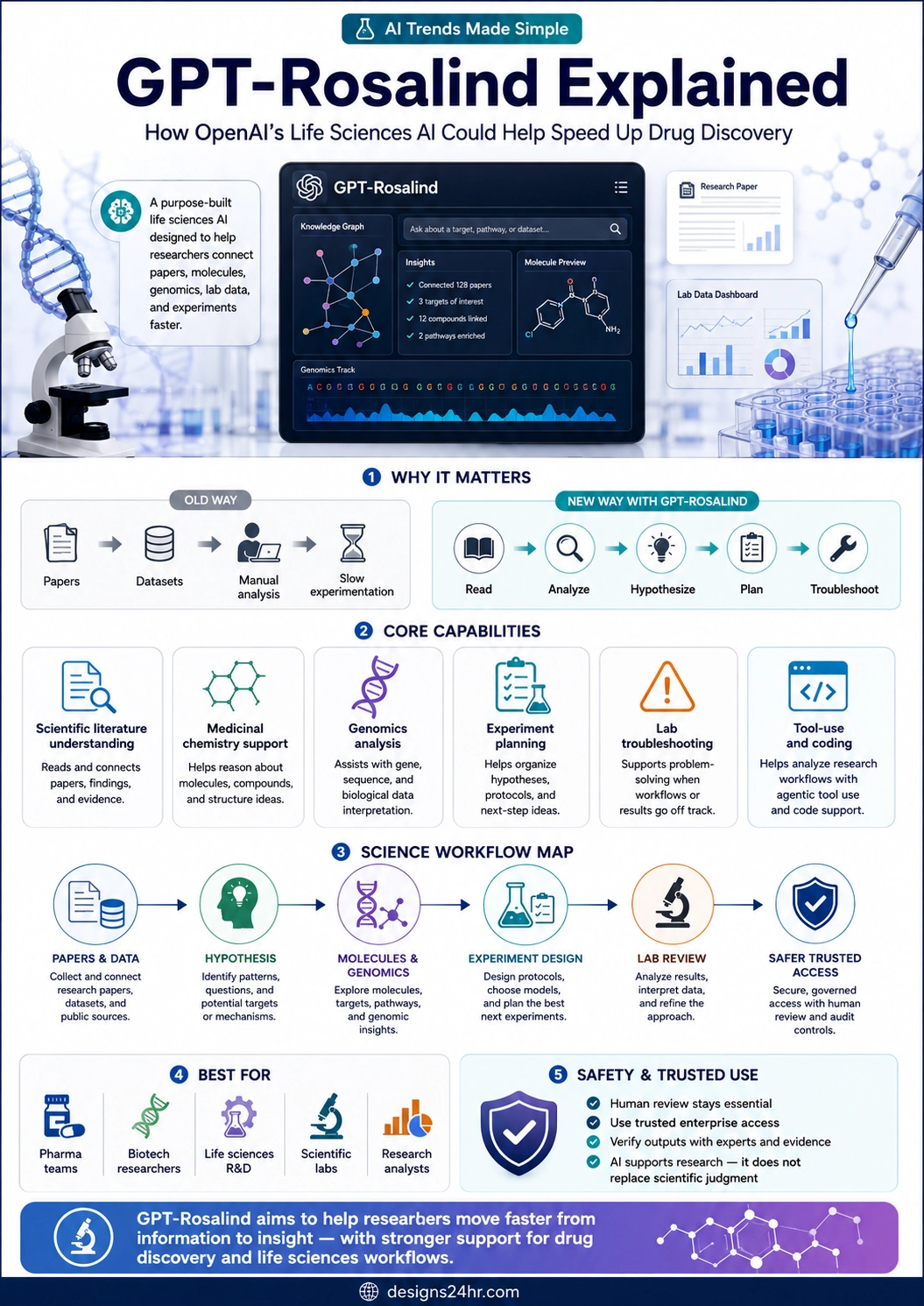
GPT-Rosalind is OpenAI’s purpose-built life sciences AI model series designed to support scientific research, drug discovery, genomics analysis, medicinal chemistry, lab troubleshooting, and complex research workflows.
Drug discovery is slow because science does not move through one clean document. Researchers often need to connect papers, molecules, genes, pathways, lab protocols, datasets, experiment results, and expert judgment before they can form the next useful hypothesis.
GPT-Rosalind matters because it points toward a future where AI can help scientists move faster through that messy research process — not by replacing scientists, but by helping them organize evidence, analyze complex data, plan experiments, and troubleshoot scientific workflows with more support.
This guide from Designs24hr explains GPT-Rosalind in plain English: what it is, how OpenAI’s life sciences AI could help drug discovery, what researchers may use it for, why trusted access matters, and why human scientific review is still essential.
What Is GPT-Rosalind?
GPT-Rosalind is OpenAI’s life sciences AI model series built for scientific research at enterprise scale. OpenAI describes GPT-Rosalind as a purpose-built model to accelerate scientific research and drug discovery, with stronger reasoning across biology, chemistry, protein engineering, genomics, and translational medicine.
The newer GPT-Rosalind update adds stronger capabilities for biological reasoning, medicinal chemistry, genomics analysis, wet lab troubleshooting, agentic coding, tool use, and experimental workflows. That means the model is designed to help with more than simple Q&A. It is built to support real research workflows where scientists need to connect evidence, run analyses, and evaluate next steps.
OpenAI says GPT-Rosalind is available in research preview to eligible organizations through a trusted-access deployment structure. That means it is not positioned as a casual consumer tool for medical advice. It is intended for qualified organizations doing legitimate scientific research with governance, safety oversight, and controlled access.
Simple example: A research team could use GPT-Rosalind to review scientific literature, connect evidence from genomics data, analyze possible molecular targets, suggest experiment ideas, and help troubleshoot where a lab workflow may be going off track — with scientists reviewing the work at every step.
Why GPT-Rosalind Matters for Drug Discovery
Drug discovery is one of the hardest areas for AI because biology is complex, data is fragmented, and experiments must eventually work in the real world. A promising idea in a paper or dataset still needs lab testing, validation, safety review, and clinical development before it can become a treatment.
GPT-Rosalind is important because it targets the early research bottleneck: connecting scattered scientific information and turning it into clearer hypotheses, experiment plans, and analysis workflows.
Instead of asking researchers to manually jump between papers, databases, code, lab notes, sequence files, structure viewers, and analysis tools, GPT-Rosalind is designed to help bring more of that work into one assisted workflow.
What Can GPT-Rosalind Help Researchers Do?
GPT-Rosalind is designed for life sciences research workflows, not general consumer health advice. Its strongest use cases include evidence synthesis, genomics analysis, medicinal chemistry support, experiment planning, lab troubleshooting, and tool-assisted scientific workflows.
1. Understand scientific literature
Researchers often need to read and compare large amounts of scientific evidence. GPT-Rosalind can help summarize research papers, connect findings, identify evidence gaps, and make it easier to see how different studies relate to a target, pathway, disease area, or molecule.
2. Support medicinal chemistry reasoning
Medicinal chemistry involves thinking about molecules, structures, compounds, interactions, properties, and possible optimization paths. GPT-Rosalind is designed to provide stronger intelligence in core drug-discovery domains, including medicinal chemistry.
3. Assist with genomics analysis
Genomics data can be difficult to interpret because it involves genes, variants, pathways, sequences, and biological context. GPT-Rosalind can support workflows that connect genomic signals with scientific evidence and potential biological meaning.
4. Help plan experiments
AI can help researchers organize hypotheses, protocols, next-step questions, and possible validation paths. GPT-Rosalind is not a replacement for lab expertise, but it can help researchers think through experimental workflows more efficiently.
5. Troubleshoot lab workflows
OpenAI highlights wet lab troubleshooting as one of the areas where the updated GPT-Rosalind shows progress. This means the model is being evaluated on its ability to reason about problems that appear in real lab protocols and suggest ways to investigate or optimize the workflow.
6. Use tools and coding workflows
The updated GPT-Rosalind combines stronger life sciences intelligence with agentic coding and tool-use capabilities. That matters because scientific research often requires scripts, data pipelines, analysis notebooks, file viewers, and repeatable workflows.
| Research Need | How GPT-Rosalind Could Help | Why Human Review Still Matters |
|---|---|---|
| Scientific papers | Summarizes evidence, connects findings, and highlights research gaps. | Experts must verify sources, methods, and conclusions. |
| Genomics analysis | Helps interpret gene, sequence, variant, and pathway context. | Biological interpretation can be complex and context-dependent. |
| Medicinal chemistry | Supports reasoning about molecules, compounds, and optimization ideas. | Chemistry ideas require validation, safety review, and expert judgment. |
| Experiment planning | Helps organize hypotheses, protocols, and next-step options. | Scientists must decide what is realistic, safe, and scientifically sound. |
| Lab troubleshooting | Suggests possible causes and workflow checks when results go off track. | Lab conditions, materials, and real-world variables need human expertise. |
How GPT-Rosalind Fits Into a Drug Discovery Workflow
Drug discovery usually starts long before a medicine reaches patients. Researchers need to identify a biological problem, understand disease mechanisms, study targets, test molecules, validate evidence, run experiments, and make decisions under uncertainty.
GPT-Rosalind could support that process by helping researchers move through the early workflow more efficiently.
- Gather evidence. Researchers collect papers, datasets, molecular information, genetic signals, and experimental records.
- Analyze patterns. GPT-Rosalind can help connect information across biology, chemistry, genomics, and lab workflows.
- Generate hypotheses. The model can help suggest possible mechanisms, target ideas, or experiment questions for expert review.
- Plan experiments. Scientists can use AI support to organize protocols, variables, and next-step testing strategies.
- Review results. Researchers analyze outputs, troubleshoot issues, and decide what should be tested next.
- Keep humans in control. Scientific experts validate the reasoning, evidence, and safety of every important decision.
This workflow is why GPT-Rosalind is best understood as a scientific support system, not a magic discovery button. It can help researchers move faster through information and analysis, but it cannot skip the need for evidence, experiments, validation, and review.
What Are LifeSciBench and LabWorkBench?
OpenAI introduced LifeSciBench as an expert-judged benchmark designed to evaluate scientifically valuable life sciences work across several workflow areas. These include evidence handling, analysis, design and optimization, scientific reasoning, validation and operations, and translation and communication.
OpenAI also describes LabWorkBench, an evaluation focused on whether GPT-Rosalind can help scientists reason about real wet lab work, such as linking perturbations to experimental outcomes and supporting troubleshooting or optimization.
These evaluations matter because life sciences AI cannot be judged only by whether it sounds scientific. It needs to be tested against workflows that resemble what researchers actually do.
Why this matters: A life sciences AI model must be useful in real research contexts, not just impressive in general conversation. Benchmarks like LifeSciBench and LabWorkBench are designed to measure whether the model helps with evidence, reasoning, validation, and workflow execution.
GPT-Rosalind and Scientific Tools
OpenAI says it built Life Sciences Research and Life Sciences NGS Analysis plugins to extend GPT-Rosalind with a practical execution layer for repeatable scientific workflows. These tools are designed to help researchers connect sourced evidence retrieval, biological interpretation, and bioinformatics execution in one workspace.
The updated system also includes interactive viewers for biologically native file types, including sequence, alignment, and structure viewers. This allows researchers to stay closer to the evidence while asking follow-up questions in context.
That tool layer is important because scientific work is not only about generating text. Researchers need to inspect data, preserve artifacts, track provenance, run analyses, and review outputs carefully.
Who Is GPT-Rosalind For?
GPT-Rosalind is not built for casual medical advice or self-diagnosis. It is designed for eligible organizations and scientific teams working on legitimate life sciences research with strong governance and safety oversight.
It may be useful for:
- Pharmaceutical research teams
- Biotech researchers
- Life sciences R&D groups
- Genomics and bioinformatics teams
- Medicinal chemistry teams
- Scientific research analysts
- Enterprise research organizations with trusted-access approval
For everyday readers, the main takeaway is not “use GPT-Rosalind yourself.” The main takeaway is that AI is becoming more specialized for serious scientific research.
Why Trusted Access Matters
Life sciences AI is powerful because it can reason about biology, molecules, experiments, and scientific workflows. That power also creates safety responsibilities.
OpenAI says GPT-Rosalind is available through a trusted-access deployment structure for organizations conducting legitimate scientific research with clear public benefit, strong governance, safety oversight, controlled access, and enterprise-grade security.
This matters because advanced biological capabilities should not be released without safeguards. Scientific AI can help accelerate discovery, but it must be used with careful controls, expert supervision, and appropriate review.
Important: GPT-Rosalind is not a medical advice tool for patients. It should not be used to diagnose, treat, prescribe, or make personal health decisions. It is designed for controlled scientific research workflows where qualified experts review the outputs.
What GPT-Rosalind Does Not Replace
GPT-Rosalind may help researchers work faster, but it does not replace scientific judgment, peer review, lab validation, clinical trials, regulatory review, ethics oversight, or real-world safety testing.
AI can suggest a hypothesis, but it cannot prove it without evidence. AI can help analyze data, but experts must check assumptions and methods. AI can help troubleshoot experiments, but lab scientists still need to understand the physical reality of samples, equipment, protocols, and conditions.
The safest way to understand GPT-Rosalind is as an accelerator for expert work, not a substitute for expert responsibility.
GPT-Rosalind and the Future of AI in Medicine Research
GPT-Rosalind is part of a larger movement toward specialized AI models for complex professional fields. Instead of one general AI assistant trying to answer everything, the future may include more domain-focused models built for specific workflows like science, security, law, design, engineering, and medicine research.
In life sciences, that shift could be especially important because discovery depends on connecting huge amounts of information across different scales. A disease pathway, a molecular target, a gene variant, a chemical structure, and a lab result may all matter at the same time.
If AI can help researchers connect those pieces faster, scientific teams may be able to explore more possibilities, test better hypotheses, and reduce wasted time in early research.
Simple way to think about it: GPT-Rosalind is like a research co-pilot for qualified scientists. It can help read, connect, analyze, plan, and troubleshoot — but the scientist still decides what is true, what is safe, and what deserves real-world testing.
Why This Topic Matters Beyond Pharma
Even if most people will never use GPT-Rosalind directly, the trend matters because it shows where AI is going. AI is moving from general chat into specialized systems that support high-value work in science, healthcare research, engineering, education, and business.
For the public, that could eventually mean faster research, better scientific tools, improved workflows for researchers, and possibly shorter paths from promising ideas to tested treatments. But it also means society needs serious conversations about safety, oversight, transparency, and responsible deployment.
The most important message is balance: AI can help speed up science, but science still needs humans, evidence, experiments, ethics, and trust.
Keep learning with Designs24hr: For more simple AI trend explainers, visit The AI Edge. You can also use the Keyword Density Checker to review SEO content before publishing, or try the Title Meta Preview Tool to improve your search snippet.
Frequently Asked Questions About GPT-Rosalind
What is GPT-Rosalind?
GPT-Rosalind is OpenAI’s purpose-built life sciences AI model series designed to support scientific research, drug discovery, genomics analysis, medicinal chemistry, experimental workflows, and lab troubleshooting.
Is GPT-Rosalind for patients?
No. GPT-Rosalind is not a consumer medical advice tool. It is intended for eligible organizations and qualified scientific research teams working under trusted-access controls and expert review.
How could GPT-Rosalind help drug discovery?
GPT-Rosalind could help researchers connect scientific papers, datasets, molecules, genes, pathways, lab protocols, and experiment results so they can form stronger hypotheses and plan next research steps more efficiently.
Can GPT-Rosalind discover medicines by itself?
No. GPT-Rosalind can support research workflows, but drug discovery still requires expert scientists, lab validation, safety testing, clinical trials, regulatory review, and strong evidence.
What areas of science does GPT-Rosalind support?
OpenAI describes GPT-Rosalind as supporting biology, drug discovery, translational medicine, medicinal chemistry, genomics, quantitative biology, wet lab troubleshooting, and broader life sciences workflows.
What is LifeSciBench?
LifeSciBench is OpenAI’s expert-judged benchmark for evaluating life sciences research tasks across evidence handling, analysis, design, scientific reasoning, validation, operations, translation, and communication.
What is LabWorkBench?
LabWorkBench is an OpenAI evaluation designed to test GPT-Rosalind’s ability to help scientists reason about real wet lab protocols, experimental outcomes, troubleshooting, and optimization.
Why does trusted access matter for GPT-Rosalind?
Trusted access matters because advanced life sciences AI can be powerful. OpenAI says GPT-Rosalind access is designed for eligible organizations with legitimate scientific research goals, governance, safety oversight, and controlled enterprise security.
The Bottom Line
GPT-Rosalind shows how AI is moving into serious scientific workflows. Instead of only answering general questions, OpenAI’s life sciences AI is designed to help researchers connect evidence, analyze genomics, reason about molecules, plan experiments, troubleshoot lab work, and move faster through drug discovery research.
That could make scientific research more efficient, but it does not remove the need for human experts. The best use of GPT-Rosalind is not blind automation. It is expert-assisted acceleration: AI helps organize and reason, while scientists verify, test, validate, and decide.
At Designs24hr, we believe the future of AI should be powerful, practical, and responsible. GPT-Rosalind is a strong example of how AI can support real discovery when it is guided by evidence, safety, and human judgment. Share your thoughts in the comments, and come back to Designs24hr whenever you want to learn something new about AI and design.
Sources: This article is based on OpenAI’s official pages Introducing GPT-Rosalind for life sciences research, Introducing new capabilities to GPT-Rosalind, OpenAI’s life sciences solutions page, and Reuters coverage of OpenAI launching GPT-Rosalind for life sciences research.