RAISE US AI Workforce Initiative Explained for U.S. Workers
RAISE US AI workforce initiative is a new national effort focused on helping U.S. workers prepare for AI job changes, retraining, career guidance, and practical workforce skills. Instead of treating AI as something only tech workers need to understand, this initiative points to a bigger shift: everyday American workers may need clearer training paths, better career support, and safer ways to use AI at work.
Quick Answer: What Is the RAISE US AI Workforce Initiative?
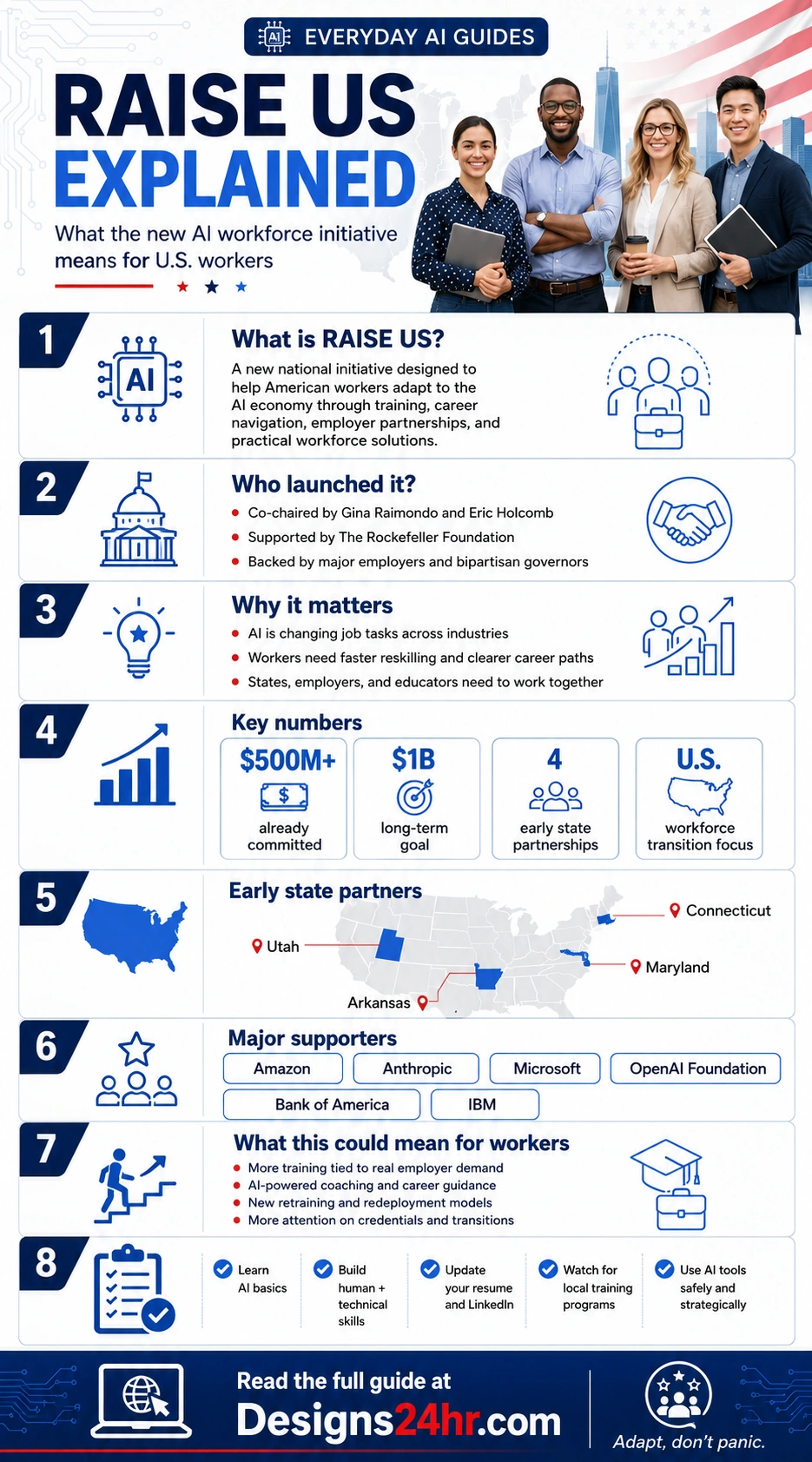
RAISE US AI workforce initiative is designed to help American workers adapt to an AI-driven economy. Instead of focusing only on one training course or one company program, RAISE US brings together employers, governors, educators, philanthropies, and AI companies to test practical ways workers can retrain, move into better roles, and use AI more confidently.
The big idea is simple: AI may change many job tasks, but workers should not be left alone to figure everything out. They need clearer training paths, better career support, and programs that connect real employer demand with practical AI-era skills.
In This Guide
What Is RAISE US?
RAISE US is a worker-focused AI initiative launched to help the United States respond to the way artificial intelligence is changing jobs. The official launch announcement says the effort is meant to help American workers exposed to technological disruption navigate transitions, find good jobs, and prosper.
That matters because many workers are not asking a theoretical question anymore. They are asking practical questions like:
- Will AI change my current job?
- What skills should I learn first?
- Can AI help me move into a better role?
- Which training programs are actually useful?
- How do I stay employable without going back to school for years?
The RAISE US AI workforce initiative is trying to answer those questions at a workforce-system level by connecting states, employers, training providers, and technology partners.
Why RAISE US Is Getting Attention Now
AI has moved from a future trend into a daily workplace issue. Many companies are testing AI tools for writing, customer support, research, coding, data analysis, hiring workflows, training, marketing, and administrative tasks. That does not mean every worker will be replaced, but it does mean many jobs may require new habits and new expectations.
Boston Consulting Group has estimated that 50% to 55% of U.S. jobs could be reshaped by AI over the next two to three years. PwC’s 2026 Global AI Jobs Barometer also points to a changing labor market where judgment, leadership, and other human skills become more important alongside AI skills.
The important takeaway is this: AI workforce preparation is not only about learning to prompt a chatbot. It is about learning how to work with AI while protecting accuracy, judgment, communication, trust, and real-world value.
Key Numbers to Know
Who Is Behind RAISE US?
RAISE US is co-chaired by Gina Raimondo, former U.S. Commerce Secretary, and Eric Holcomb, former governor of Indiana. The Rockefeller Foundation is supporting the initiative, and reporting around the launch lists major supporters and partners from technology, banking, business, education, labor, philanthropy, and state government.
Reported major supporters include Amazon, Anthropic, Microsoft, the OpenAI Foundation, Bank of America, IBM, and others. The early state partnerships include Arkansas, Connecticut, Maryland, and Utah.
The reason the RAISE US AI workforce initiative is getting attention is because it connects workforce training, AI career tools, employers, state leaders, and practical job transition support in one national effort.
This mix is important because AI job disruption cannot be solved by workers alone. Employers decide what skills they hire for. States can test workforce programs. Educators can help build training paths. AI companies can help make tools and training more useful. RAISE US is trying to connect those pieces.
What RAISE US Could Mean for U.S. Workers
RAISE US is still new, so workers should not treat it like an instant national job guarantee. But it could become important if it helps states and employers build better AI-era training models.
1. More training tied to real employer demand
Many workers do not need vague “learn AI” advice. They need training that connects to actual jobs, actual hiring needs, and actual promotion paths. RAISE US could help test training models that are closer to what employers need.
2. More AI-powered career guidance
One reported focus area is AI-powered career coaching and navigation. That could include tools that help workers compare career paths, identify transferable skills, find local programs, or understand which roles match their experience.
3. New retraining and redeployment models
If AI changes part of a job, the best outcome is often not immediate unemployment. It may be retraining, redeployment, or redesigning the role so a worker can move into higher-value tasks. RAISE US appears focused on testing those kinds of models.
4. More attention on short-term credentials
Traditional degrees can be valuable, but many working adults need faster options. Short-term credentials, apprenticeships, employer-backed programs, and practical certificates may become more important as AI changes job requirements.
What This Does Not Mean
RAISE US does not mean every AI-related job risk is solved. It also does not mean every worker should immediately quit, panic, or chase every new AI course online.
The better approach is calmer and more practical: understand how AI is changing your role, build skills that make you more useful, use AI tools carefully, and watch for credible training opportunities connected to real employers.
What Skills Matter Most in the AI Economy?
The workers most likely to benefit from AI will usually be the ones who combine practical AI use with strong human judgment. AI can draft, summarize, organize, analyze, and suggest. But people still need to decide what is accurate, ethical, useful, and appropriate.
Here are the skill areas worth building first:
- AI basics: Understand what AI tools can and cannot do.
- Prompting: Learn how to give clear instructions, context, examples, and constraints.
- Output review: Check AI answers for accuracy, bias, missing context, and overconfidence.
- Workflow thinking: Break work into repeatable steps where AI can help without replacing your judgment.
- Communication: Explain decisions clearly to managers, customers, coworkers, and clients.
- Adaptability: Keep learning as tools, job descriptions, and employer expectations change.
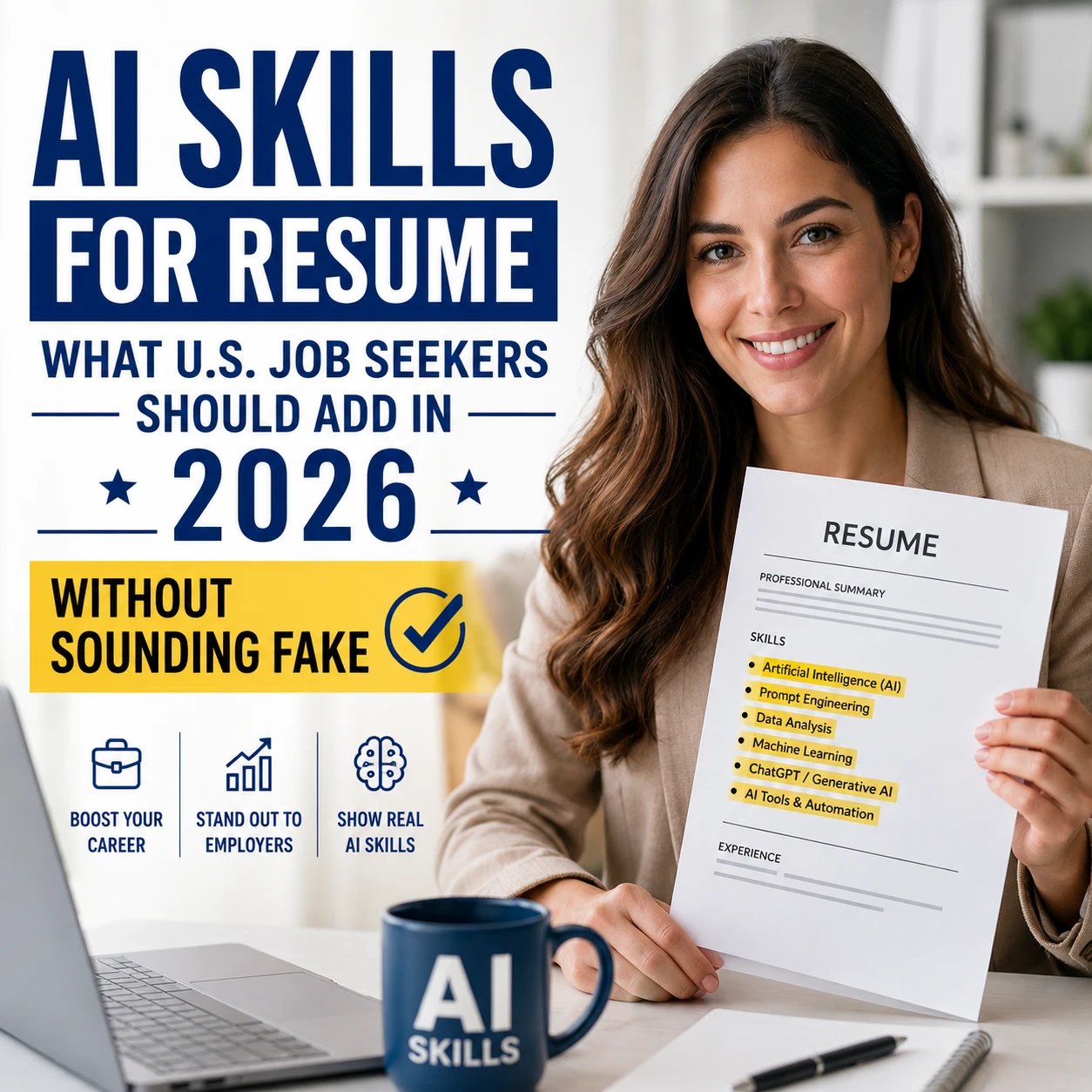
- Career storytelling: Update your resume, LinkedIn, and interview answers so employers can see your value in an AI-era workplace.
If you are new to AI learning, you can also review OpenAI Academy courses explained to understand beginner-friendly AI training options.
How U.S. Workers Can Prepare Now
You do not need to master every AI tool overnight. A smarter plan is to build a simple weekly routine that improves your skills without overwhelming you.
Start with your current job tasks
Write down the tasks you do every week. Mark which tasks are repetitive, writing-heavy, research-heavy, data-heavy, or communication-heavy. Those are often the first places AI can change how work gets done.
Learn one useful AI workflow
Pick one workflow, such as summarizing meeting notes, drafting emails, researching companies, organizing tasks, rewriting resume bullets, or preparing interview answers. Practice until you can use AI without copying blindly.
Update your resume for AI-era work
Add examples that show problem solving, communication, tools, data, process improvement, customer impact, or workflow improvement. Do not exaggerate AI experience. Show how you learn and apply tools responsibly.
Watch for credible local programs
Because RAISE US is starting with state partnerships, workers should watch official state workforce sites, local community colleges, employer training announcements, and apprenticeship programs for practical opportunities.
Build human skills AI cannot replace easily
Focus on judgment, trust, empathy, leadership, negotiation, creativity, ethical decision-making, and customer understanding. These skills become more valuable when basic digital tasks become easier to automate.
Important Safety Note for Workers
Do not paste private employer data, customer information, medical details, financial records, passwords, confidential documents, or sensitive personal information into AI tools unless your company has clearly approved that tool and use case.
AI can help you learn, write, organize, and prepare, but you should always review the output before using it for a job application, workplace message, client document, or important career decision.
Helpful Designs24hr Tools to Use Next
If RAISE US is a sign that AI workforce skills are becoming more important, the best thing you can do today is start improving your career materials and practical AI habits.
Use the AI Resume Optimizer to improve structure, clarity, and keyword alignment for AI-era roles.
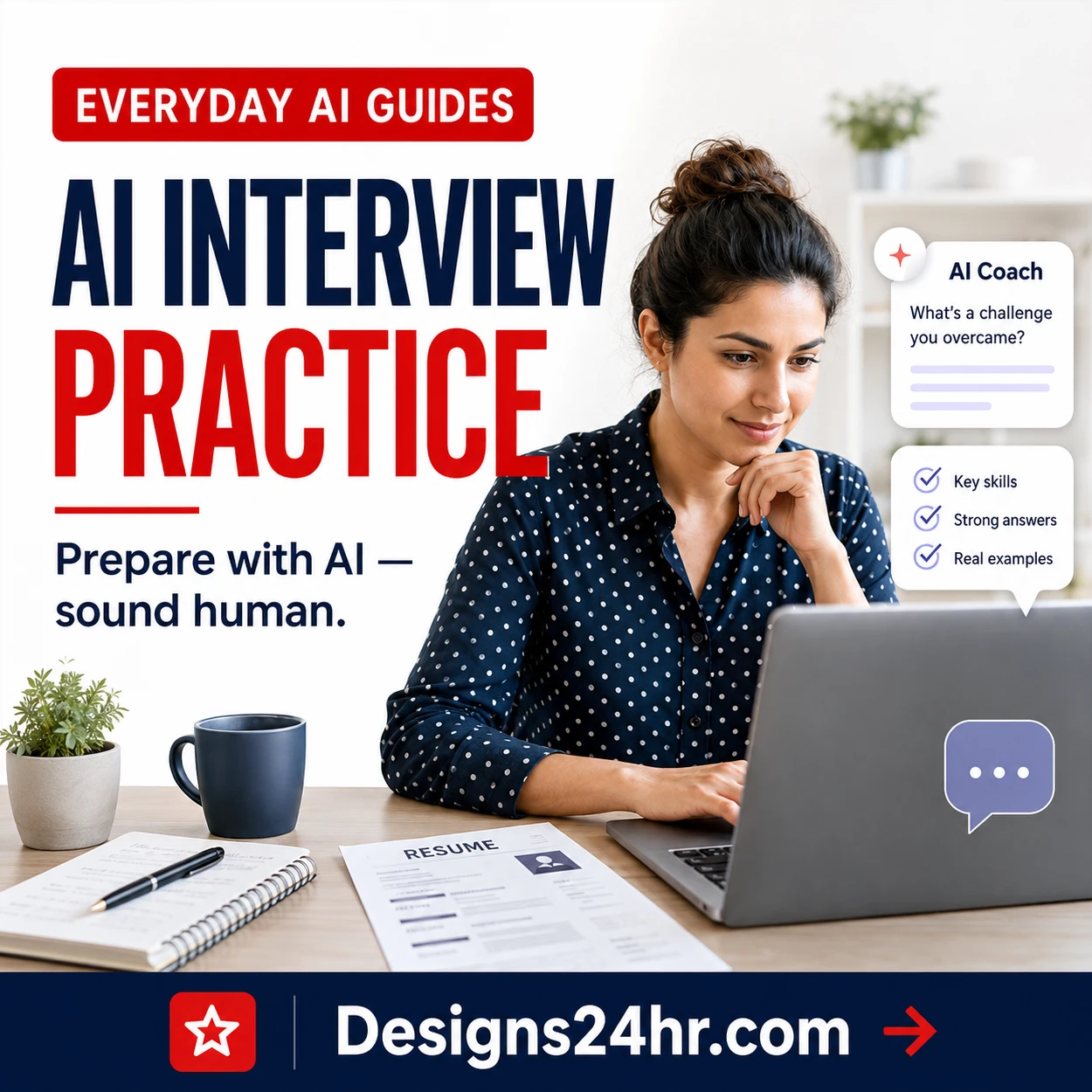
Use the AI Interview Coach to practice stronger answers before your next interview.
Use the AI Prompt Generator to create clearer prompts for learning, job search, and daily work.
You may also want to read ChatGPT Job Search Explained if you want to use ChatGPT for resumes, job research, and interview preparation. For a broader career view, read Will AI Take My Job in 2026?. Students can also review AI skills for college students to prepare earlier.
Bottom Line
RAISE US is important because it shows that AI workforce change is becoming a national issue, not just a tech-industry conversation. The initiative may help create better training, coaching, state-level pilots, employer partnerships, and career transition models for American workers.
For workers, the main message of the RAISE US AI workforce initiative is simple: do not panic, but do not ignore AI either. Start learning the basics, update your career materials, and build skills that make you more useful in an AI-supported workplace.
The most useful message for workers is preparation. Learn the basics, update your career materials, use AI tools safely, build human judgment, and pay attention to credible training programs connected to real jobs.
Sources and Further Reading
This guide is based on official announcements, current news coverage, and workforce research available at the time of publication.
FAQs About the RAISE US AI Workforce Initiative
What is RAISE US?
RAISE US is a new national AI workforce initiative focused on helping American workers adapt to job changes caused by artificial intelligence. It brings together employers, state leaders, educators, philanthropies, and AI companies to test training and career transition models.
Who started RAISE US?
RAISE US is co-chaired by Gina Raimondo, former U.S. Commerce Secretary, and Eric Holcomb, former governor of Indiana. The Rockefeller Foundation is supporting the initiative, and major employers and technology companies are involved.
Is RAISE US only for tech workers?
No. The initiative is focused on American workers more broadly, especially workers whose jobs may be affected by AI. That can include office workers, customer support teams, administrative workers, students, job seekers, career changers, and employees in many non-tech industries.
Will RAISE US stop AI from replacing jobs?
RAISE US cannot guarantee that AI will not replace or reduce some roles. Its purpose is to help workers, employers, and states prepare better through training, career guidance, retraining models, and workforce programs.
Which states are involved in RAISE US first?
Early state partnerships reported around the launch include Arkansas, Connecticut, Maryland, and Utah.
What skills should workers learn because of AI?
Workers should start with AI basics, clear prompting, output review, workflow thinking, communication, adaptability, and career storytelling. The goal is to combine AI tool use with human judgment and real workplace value.
How can I prepare for AI job changes now?
Start by identifying which parts of your job are repetitive or AI-assisted, learn one useful AI workflow, update your resume, practice interview answers, and watch for credible local training programs connected to real employer demand.
Can AI help me update my resume?
Yes. AI can help you rewrite resume bullets, compare your resume to a job description, organize your experience, and improve clarity. You should always review the final resume yourself and avoid adding skills or experience you do not truly have.
Is AI workforce training worth it in 2026?
For many workers, yes. AI is changing how job tasks are performed, and practical AI training can help workers stay more adaptable. The best training is specific, hands-on, responsible, and connected to real career goals.
Adapt, Don’t Panic
AI may change how many jobs work, but preparation beats panic. Keep learning, use AI carefully, protect your judgment, and build skills that make you more useful in the workplace.
Explore more simple AI guides and free tools at Designs24hr.com.