Will AI Take My Job in 2026? What U.S. Workers Should Actually Do Next
If you are asking, “will AI take my job in 2026?” you are not alone. Across the United States, workers are trying to understand whether artificial intelligence is a real career threat, a productivity tool, or both. The honest answer is simple: AI is more likely to change parts of your job before it replaces your entire job.
If you searched for will AI take my job in 2026, you are probably looking for a clear answer without hype or panic. The truth is that AI is already changing how U.S. workers write emails, summarize meetings, analyze reports, create content, answer customer questions, organize schedules, review documents, and complete repetitive office tasks.
That does not mean every American worker should panic. It means U.S. workers need to understand which parts of their job are most exposed to AI and which human skills still create real value. For many people, the biggest risk is not that AI instantly replaces them. The bigger risk is that someone who knows how to use AI becomes faster, more productive, and easier to promote.
This guide breaks down what AI job risk actually means in 2026, which tasks are most likely to change, which human skills still matter, and what U.S. workers can do right now to stay useful, confident, and competitive.
The reason so many Americans are asking will AI take my job in 2026 is because AI tools are moving from experimental apps into everyday workplace systems. The workers who understand this shift early can use AI to protect their value instead of waiting for their role to change around them.
Why U.S. Workers Are Worried About AI Jobs in 2026
AI job anxiety is not just a social media trend. A recent Reuters/Ipsos poll found that 53% of Americans worry AI could put them or someone in their household out of work. That fear is understandable because AI is no longer limited to tech companies. It is now showing up in offices, schools, customer service teams, marketing departments, legal work, finance, healthcare administration, sales, and small businesses.
At the same time, many workers are still not using AI regularly. Pew Research Center reported that 21% of U.S. workers said at least some of their work was done with AI in a September 2025 survey, while 65% said they do not use AI much or at all in their job. That gap creates both risk and opportunity.
In simple terms, the U.S. workforce is split into three groups: people already using AI, people watching from the sidelines, and people who are worried but unsure where to start. The workers who move from worry to practical skill-building will usually be in the strongest position.
Will AI Take My Job in 2026? The Honest Answer for U.S. Workers
The better question is not only will AI take my job in 2026. A better question is: which parts of my job can AI do faster, and which parts still need me?
Most jobs are made of many smaller tasks. Some tasks are repetitive, rules-based, and easy for AI to assist with. Others require judgment, trust, physical presence, emotional intelligence, leadership, taste, accountability, or real-world experience. AI is strongest when the work is digital, repetitive, text-heavy, data-heavy, or pattern-based. It is weaker when the work requires human relationships, hands-on execution, high-stakes responsibility, or original decision-making in messy real-life situations.
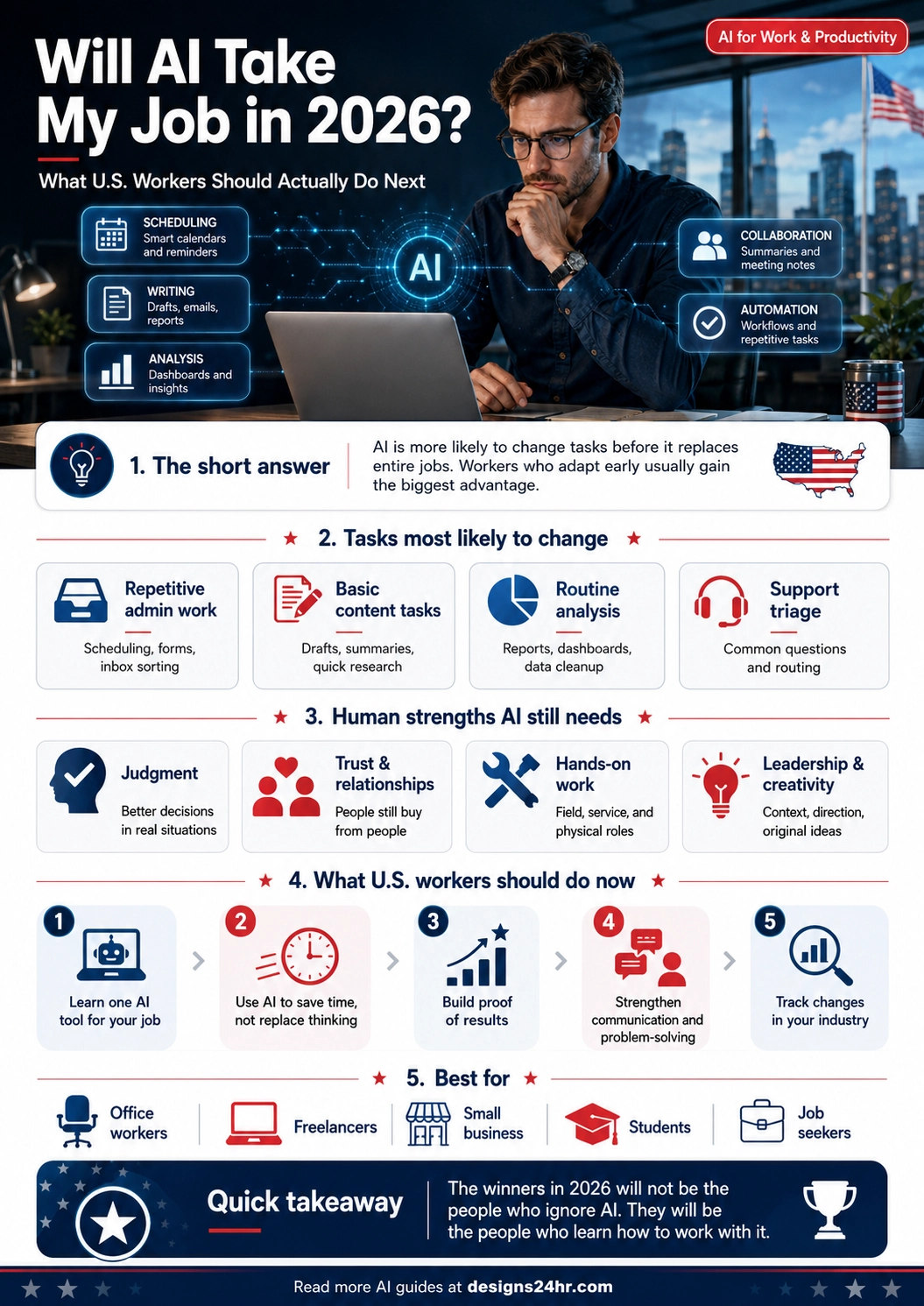
Tasks Most Likely to Change Because of AI
When U.S. workers ask will AI take my job in 2026, they usually picture a full job disappearing. In reality, the first change is usually smaller: AI starts handling pieces of the job faster than people can do manually.
AI is already good at helping with routine digital work. That does not automatically mean every worker doing these tasks will lose their job, but it does mean the value of the job may shift. Workers who only perform repetitive tasks may feel more pressure. Workers who use AI to complete those tasks faster and then add human judgment may become more valuable.
Repetitive Admin Work
Scheduling, inbox sorting, form filling, basic documentation, meeting reminders, and routine follow-ups can often be supported by AI tools.
Basic Writing Tasks
Draft emails, summaries, outlines, product descriptions, simple reports, and first-draft content are becoming easier to generate with AI.
Routine Analysis
AI can help summarize spreadsheets, clean data, explain dashboards, find patterns, and turn raw information into simpler insights.
Support Triage
Common customer questions, ticket routing, basic troubleshooting, and FAQ-style responses are increasingly handled or assisted by AI systems.
Jobs AI May Change, But Not Fully Replace
Many U.S. jobs will not disappear overnight. Instead, the work may become more AI-assisted. A customer support representative may use AI to answer faster. A marketing assistant may use AI to draft content ideas. A financial analyst may use AI to summarize data. A paralegal may use AI to review documents more efficiently. A teacher may use AI to prepare lesson materials while still managing the classroom and supporting students.
The U.S. Bureau of Labor Statistics has also noted that AI may support demand in some computer-related occupations because businesses need people to develop, maintain, and manage AI-enabled systems. In its discussion of AI impacts in employment projections, the BLS explained that software developers can use AI for coding-related tasks, while demand may also continue for workers who build business solutions and maintain complex data infrastructure.
| Work Area | How AI May Change It | How Workers Can Stay Valuable |
|---|---|---|
| Office Administration | AI can help with scheduling, emails, forms, reminders, and basic documentation. | Become the person who manages workflows, checks accuracy, and keeps teams organized. |
| Marketing | AI can create drafts, headlines, campaign ideas, and content outlines. | Focus on strategy, brand voice, customer insight, editing, and conversion quality. |
| Customer Support | AI can answer common questions and route tickets. | Handle complex issues, difficult conversations, refunds, retention, and trust-building. |
| Finance & Analytics | AI can summarize reports, explain trends, and automate routine analysis. | Improve business judgment, risk awareness, decision support, and communication. |
| Legal & Compliance | AI can assist with document review, research, summaries, and contract comparison. | Strengthen interpretation, accountability, client communication, and final review judgment. |
Human Skills AI Still Struggles to Replace
A smart answer to will AI take my job in 2026 must include what AI still cannot do well. AI can generate, summarize, classify, and automate, but it still depends on human direction, human review, and human accountability.
That is why the safest career strategy is not simply “learn AI.” It is “learn AI plus human skills that make your work harder to replace.”
- Judgment: Knowing what matters, what is risky, what is missing, and what decision should be made.
- Communication: Explaining ideas clearly to customers, managers, teams, and clients.
- Trust: Building relationships with people who need confidence, empathy, and accountability.
- Problem-solving: Handling messy situations where there is no perfect template or simple answer.
- Creativity: Creating original ideas, campaigns, strategies, offers, and experiences that connect with real people.
- Hands-on work: Physical services, field work, repair, caregiving, skilled trades, and in-person support still need human presence.
What U.S. Workers Should Do Right Now
The workers who benefit from AI in 2026 will not always be the most technical. They will often be the people who learn how to use AI in a practical, job-specific way. You do not need to become a machine learning engineer. You need to understand where AI fits into your daily work and how it can help you produce better results.
If your main concern is will AI take my job in 2026, the smartest response is to turn that concern into a simple action plan.
- Learn one AI tool for your actual job. Do not try every tool at once. Pick one tool that helps with writing, planning, analysis, research, email, design, or customer support.
- Use AI to save time, not replace thinking. Let AI draft, summarize, organize, or brainstorm. You should still review, edit, check facts, and make the final decision.
- Build proof of results. Track how AI helps you save time, improve output, reduce errors, respond faster, or support more customers.
- Improve communication and problem-solving. These skills become more valuable when basic task execution becomes easier to automate.
- Study your industry, not just AI headlines. AI will affect healthcare, retail, marketing, finance, education, legal work, and local services differently.
How to Check Your Own Risk If You Are Asking “Will AI Take My Job in 2026?”
If you want a simple way to understand your personal risk, look at your weekly tasks. Do not start with your job title. Start with what you actually do every day.
You can also use the U.S. Department of Labor-backed O*NET OnLine database to explore occupations, tasks, skills, work activities, and requirements across the U.S. economy. It is a useful resource for job seekers, students, workforce planning, and anyone trying to understand how their role may evolve.
Best AI Skills for U.S. Workers in 2026
Workers searching will AI take my job in 2026 do not need to learn everything about artificial intelligence. For most U.S. workers, the best AI skills are practical workplace skills. These are the skills that help you use AI to get better results without depending on it blindly.
- Prompting: Giving AI clear instructions, context, examples, and output formats.
- Editing: Improving AI drafts so they sound accurate, useful, and human.
- Fact-checking: Verifying claims, numbers, sources, policies, and important details before using AI output.
- Workflow design: Knowing where AI fits inside your process so it saves time without creating mistakes.
- Data understanding: Reading basic reports, spreadsheets, trends, and dashboards with AI assistance.
- AI safety habits: Avoiding sensitive uploads, checking permissions, and understanding privacy risks.
What Not to Do If You Are Worried About AI
Fear can push workers into two bad choices: ignoring AI completely or blindly trusting it. Neither is a smart strategy. Ignoring AI makes it harder to compete with people who are learning it. Blindly trusting AI can lead to mistakes, privacy problems, weak work, or false information.
The better path is controlled adoption. Use AI as a helper, not a replacement for your brain. Let it speed up routine work, but keep human judgment in charge.
Useful AI Tools to Start With
U.S. workers asking will AI take my job in 2026 should start with everyday work tasks, not complicated technical systems. You can use Designs24hr tools like the Resume Optimizer to improve your job search materials, the Interview Coach to practice answers, the AI Email Reply Generator to respond faster, and the Daily Task Planner to organize your day.
The goal is not to become dependent on AI. The goal is to become the kind of worker who understands how to use AI responsibly, efficiently, and strategically.
Final Takeaway: Facts, Not Fear
So, will AI take my job in 2026? For most U.S. workers, the answer is not a simple yes or no. AI will change tasks, reshape expectations, and create pressure in many roles. Some jobs will shrink. Some jobs will grow. Many jobs will become more AI-assisted.
For U.S. workers, the best answer to will AI take my job in 2026 is to look at your tasks, not just your title. If AI can handle part of your work, your next move is to become the person who uses it well, checks its output, and adds the human judgment it still needs.
The workers most at risk are not always the workers in one specific industry. They are the workers who keep doing repetitive tasks the old way while their peers learn faster workflows. The workers with the strongest advantage will be the ones who combine AI tools with judgment, communication, trust, creativity, and real-world problem-solving.
Want to Stay Ahead of AI Without Feeling Overwhelmed?
Explore more beginner-friendly AI guides on The AI Edge and start with one practical tool that helps you save time, improve your work, or prepare for your next career move.
FAQs About AI and Jobs in 2026
Will AI take my job in 2026?
AI is more likely to change specific tasks before it replaces entire jobs. If your work includes repetitive digital tasks, basic writing, scheduling, support, research, or routine analysis, AI may affect your daily responsibilities. The best response is to learn how to use AI while strengthening human skills like judgment, communication, and problem-solving.
Which U.S. jobs are most exposed to AI?
Jobs with repetitive, text-heavy, data-heavy, or rules-based tasks are more exposed to AI. This can include parts of administration, customer support, marketing, finance, legal support, research, and content production. Exposure does not always mean replacement, but it does mean the work may change.
What jobs are safer from AI?
Jobs that require physical presence, hands-on skill, emotional trust, high-stakes accountability, leadership, complex judgment, or deep human relationships are generally harder for AI to replace fully. However, even these jobs may use AI tools for planning, scheduling, training, documentation, or communication.
What should I learn first if I am worried about AI?
Start with one AI tool that matches your current work. Learn how to write clear prompts, check AI output, protect private information, and use AI to save time on repetitive tasks. Then build proof that AI helps you work faster or better.
Is AI good or bad for U.S. workers?
AI can be both helpful and disruptive. It can save time, improve productivity, and create new opportunities, but it can also reduce demand for some tasks and create job pressure. The smartest approach is to understand the risk, learn practical AI skills, and keep improving human strengths that AI cannot easily replace.
Sources and Further Reading
- Reuters/Ipsos: Americans and AI job concerns
- Pew Research Center: Key findings about how Americans view AI
- Pew Research Center: U.S. workers and workplace AI
- U.S. Bureau of Labor Statistics: AI impacts in employment projections
- O*NET OnLine: U.S. occupation and skills database
- World Economic Forum: Future of Jobs Report 2025