Meta Business Agent for Small Business: What U.S. Owners Should Know About AI Customer Chats
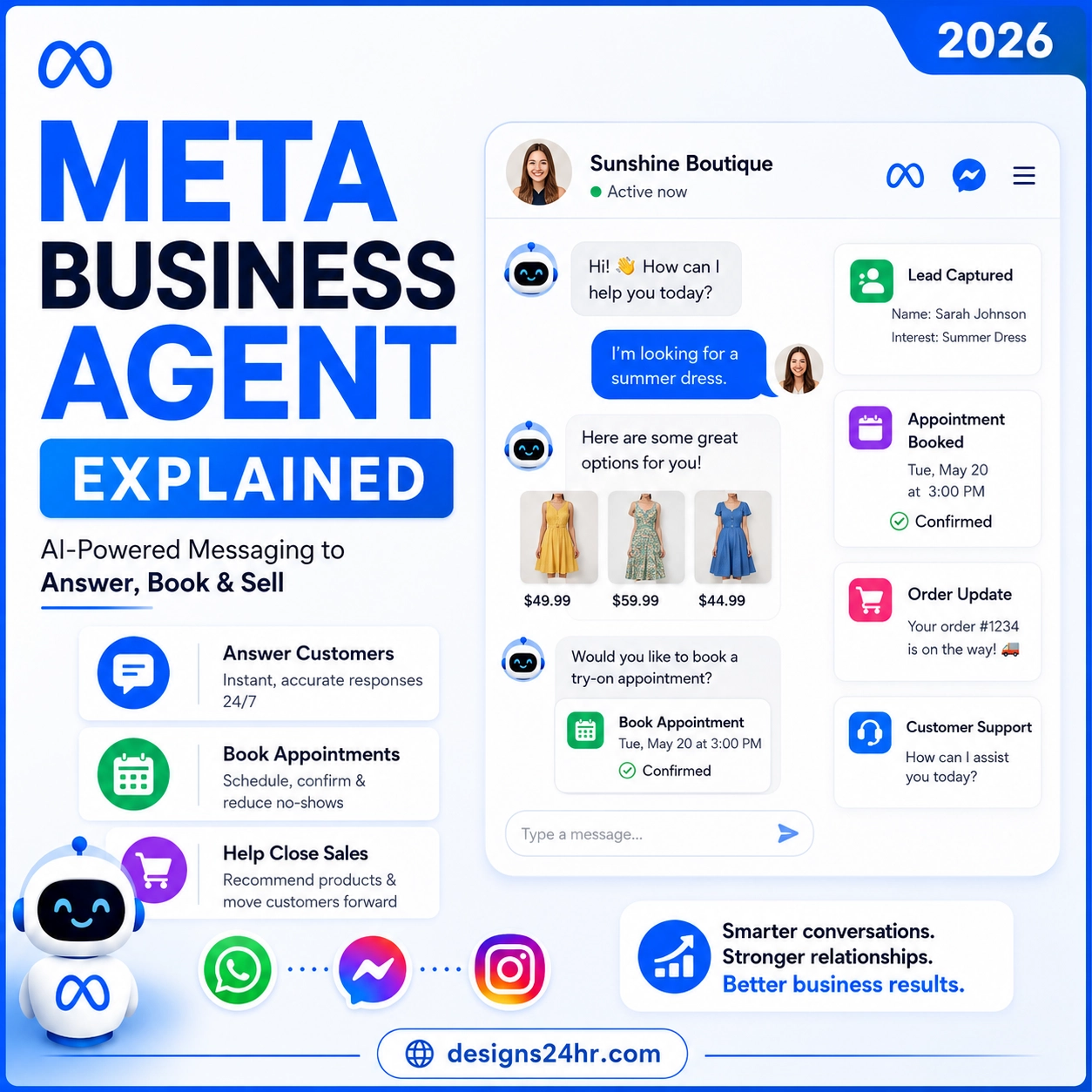
Meta Business Agent for small business could become one of the most practical AI tools for U.S. owners who rely on customer messages to get leads, answer questions, book appointments, recommend products, and close sales across Meta apps.
If your business gets customer messages on Instagram, Facebook, Messenger, or WhatsApp, you already know the problem: people expect fast replies, but small teams cannot always answer every message instantly. A missed chat can turn into a missed booking, a lost sale, or a customer who simply moves to a competitor.
That is why Meta Business Agent for small business matters. Instead of treating AI as a complicated enterprise tool, Meta is positioning Business Agent as an AI customer chat assistant that can help businesses show up for more customers, even when the owner or team is busy.
This guide explains what Meta Business Agent is, why U.S. small business owners should pay attention, where AI customer chats can help, and what to watch before relying on automation for real customer conversations.
What Is Meta Business Agent for Small Business?
Meta Business Agent for small business is Meta’s AI agent for business messaging. According to Meta’s official announcement, Meta Business Agent is designed to let businesses show up for every customer as if they had a larger team behind them. Meta says it can be set up quickly or connected to existing business systems for larger organizations.
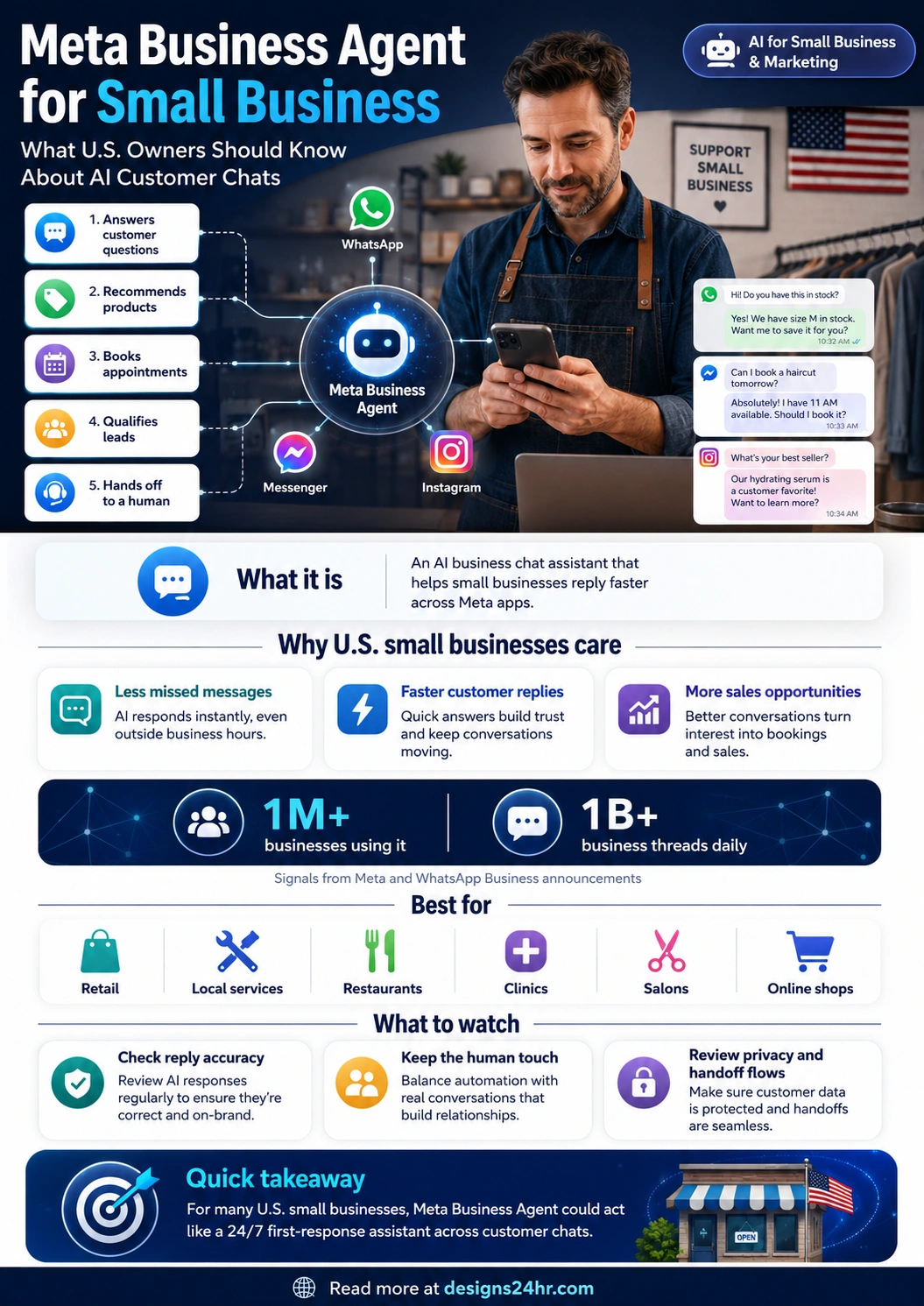
For everyday U.S. owners, the simple version is this: Meta Business Agent can act like a first-response AI assistant inside customer chats. It can help answer common questions, guide people toward products or services, qualify potential customers, and keep conversations moving until a human needs to step in.
The strongest use case is not replacing the owner. It is reducing the number of customers who wait too long for a reply.
Why U.S. Small Business Owners Should Care
Small businesses are a major part of the U.S. economy, but most owners do not have a full-time customer support team. A local salon, repair business, boutique, restaurant, clinic, fitness studio, Etsy seller, or home service company may have one person trying to answer messages, manage orders, post content, schedule appointments, run ads, and serve customers at the same time.
That is where AI customer chats can create real value. A fast first response can keep a customer interested. A clear answer can reduce back-and-forth. A product recommendation can move a shopper closer to checkout. A booking prompt can turn a casual message into a real appointment.
Fewer Missed Messages
AI can help reply when the owner is busy, after hours, or away from the phone, reducing the chance that a customer disappears before getting an answer.
Faster Customer Replies
Customers often want quick answers about pricing, availability, hours, services, product details, appointments, shipping, or location.
Better Lead Capture
AI can ask basic qualifying questions, collect useful details, and help the business understand whether a customer is ready to buy or book.
More Sales Opportunities
Helpful chat replies can recommend products, explain services, suggest next steps, and move interested customers closer to action.
How AI Customer Chats Can Help Small Businesses
The best way to understand Meta Business Agent for small business is to look at normal customer conversations. Most business messages are not complicated at first. Customers ask simple but important questions: “Do you have this in stock?” “How much does it cost?” “Are you open today?” “Can I book for tomorrow?” “Where are you located?” “Can you ship this?” “What service do you recommend?”
These questions are exactly where an AI business agent can help. It can respond quickly, keep the conversation alive, and give the owner more time to focus on high-value work.
| Customer Chat Need | How Meta Business Agent Can Help | Why It Matters for U.S. Owners |
|---|---|---|
| Common questions | Answer questions about hours, services, availability, pricing, location, and policies. | Reduces repetitive replies and helps customers get quick information. |
| Product recommendations | Suggest items or services based on what the customer asks for. | Can turn browsing into a more guided shopping experience. |
| Appointment booking | Help move customers toward booking a service, consultation, visit, or follow-up. | Useful for salons, clinics, repair services, fitness studios, and local service businesses. |
| Lead qualification | Ask basic questions to understand budget, timing, location, needs, and intent. | Helps owners spend more time with the most serious potential customers. |
| Human handoff | Pass complex, sensitive, or high-value conversations to a real person. | Keeps automation helpful without losing trust or personal service. |
Best Businesses for Meta Business Agent
Meta Business Agent for small business is most useful for businesses that already receive customer questions through social media or messaging apps. If customers regularly DM your business before buying, booking, visiting, or asking for details, AI chat support may help.
- Retail shops: Answer stock, size, color, price, pickup, and return questions.
- Restaurants and cafes: Reply about hours, reservations, menu items, specials, and catering.
- Salons and beauty businesses: Help customers ask about services, availability, pricing, and appointments.
- Local service providers: Qualify leads for repairs, cleaning, installation, landscaping, tutoring, or consultations.
- Clinics and wellness businesses: Answer general scheduling and service questions while keeping sensitive issues for staff.
- Online stores: Support product discovery, FAQs, shipping questions, and purchase decisions.
- Creators and digital sellers: Answer questions about downloads, products, bundles, usage rights, and support.
What U.S. Owners Should Watch Before Using AI Chats
AI customer chats are useful, but they are not magic. A small business should not turn on automation and ignore it. Customers still expect accurate, respectful, and brand-safe communication. If the AI gives wrong information, promises something unavailable, mishandles a sensitive issue, or sounds too robotic, it can damage trust.
Check Reply Accuracy
Review AI responses regularly to make sure pricing, availability, policies, hours, and recommendations are correct.
Protect Customer Data
Be careful with sensitive information. Avoid asking customers to share unnecessary private details inside automated chats.
Keep the Human Touch
Small businesses win because customers feel seen. Use AI for speed, but keep real human support for trust-building moments.
Set Handoff Rules
Make sure the AI knows when to stop and send the customer to a real person, especially for complaints, refunds, custom quotes, or urgent issues.
How to Prepare Your Business Before Turning on AI Chats
Before using Meta Business Agent for small business, owners should organize the information customers ask about most. AI works best when the business has clear answers, updated details, and simple rules.
- List your top customer questions. Write down the questions you answer every week about products, services, hours, price, availability, shipping, bookings, and policies.
- Create clear approved answers. Keep responses short, accurate, friendly, and on-brand so the AI has better guidance.
- Update your business details. Make sure hours, location, service areas, prices, product availability, and contact details are current.
- Decide what AI should not answer. Mark sensitive topics, complaints, refunds, custom quotes, legal issues, medical questions, or high-value deals for human review.
- Test before relying on it. Send sample messages and check whether the AI replies the way you would want a real customer to see.
Meta Business Agent vs. Regular Auto-Replies
Many business owners already use simple auto-replies like “Thanks for your message. We will respond soon.” That can be helpful, but it does not actually answer the customer’s question. The difference with AI customer chats is that the agent can respond more specifically based on what the customer asks.
A regular auto-reply is static. It sends the same message to almost everyone. An AI business agent is more dynamic. It can understand the customer’s request, provide a relevant answer, ask a follow-up question, recommend a product, or move the conversation closer to a booking or sale.
| Feature | Basic Auto-Reply | AI Customer Chat Agent |
|---|---|---|
| Message style | Same response for most customers. | Responds based on the customer’s question. |
| Customer help | Confirms the message was received. | Can answer, recommend, qualify, or guide next steps. |
| Sales support | Limited ability to move the customer forward. | Can help turn interest into bookings, leads, or purchases. |
| Owner workload | Still requires manual follow-up for most questions. | Can reduce repetitive replies and prioritize human attention. |
Will AI Chats Replace Human Customer Service?
For most U.S. small businesses, AI chats should not fully replace human customer service. A local business often wins because it feels personal, helpful, and trustworthy. AI can speed up first replies, handle common questions, and keep customers engaged, but humans still matter for judgment, empathy, negotiation, custom requests, complaints, and relationship-building.
The best use of Meta Business Agent for small business is not “set it and forget it.” The best use is “reply faster, qualify better, and hand off smarter.”
Practical Examples for U.S. Small Businesses
Here is how AI customer chats could work in real small business situations:
- Salon: A customer asks if a haircut appointment is available tomorrow. The AI can suggest available times and guide the customer toward booking.
- Boutique: A shopper asks if a dress is available in a certain size. The AI can confirm availability or suggest similar options.
- Restaurant: A customer asks about gluten-free options. The AI can share general menu information and suggest calling staff for allergy-sensitive questions.
- Home service business: A customer asks for a quote. The AI can collect location, service type, timing, and contact details before handing off to the owner.
- Online shop: A buyer asks about shipping time. The AI can answer based on store policy and direct the customer to order support if needed.
How This Fits Into Small Business Marketing
Social media marketing does not end when someone sees a post or ad. For many U.S. businesses, the most important moment happens after the click, when the customer sends a message. If that message is ignored or answered too late, the ad spend can be wasted.
That is why AI customer chats can become part of a stronger marketing funnel. A customer sees a Reel, taps the business profile, sends a DM, asks a question, and gets a fast reply. Instead of losing momentum, the business keeps the conversation going.
For owners running ads, posting content, or trying to grow on Instagram and Facebook, Meta Business Agent for small business could help connect attention to action.
Useful AI Tools for Business Owners
AI chat is only one part of a stronger small business workflow. Owners can also use AI to write better replies, plan content, improve product descriptions, organize tasks, and create clearer marketing messages.
On Designs24hr, you can pair this strategy with tools like the AI Email Reply Generator for faster customer responses, What To Say? for clearer communication, the AI Prompt Generator for better instructions, and the Daily Task Planner to manage follow-ups.
Final Takeaway
Meta Business Agent for small business is important because it points to where customer service and marketing are going. U.S. small business owners are not just competing on price or product anymore. They are also competing on response time, convenience, helpfulness, and trust.
AI customer chats can help owners reply faster, reduce missed leads, answer common questions, recommend products, and move customers toward bookings or sales. But the businesses that use it best will still keep the human touch.
The winning strategy is simple: let AI handle repetitive first responses, let humans handle trust, judgment, and relationship-building, and make sure every customer conversation moves closer to a helpful next step.
Want More Simple AI Guides for Business Growth?
Explore more beginner-friendly guides on The AI Edge and use free Designs24hr tools to write better messages, plan faster, and build smarter customer workflows.
FAQs About Meta Business Agent for Small Business
What is Meta Business Agent for small business?
Meta Business Agent for small business is an AI customer chat assistant designed to help businesses answer questions, qualify leads, recommend products, support bookings, and hand conversations to a human when needed across Meta messaging channels.
How can U.S. small business owners use Meta Business Agent?
U.S. small business owners can use it to reply faster to customer messages, answer common questions, capture leads, recommend products, book appointments, and support sales conversations on platforms like WhatsApp, Messenger, and Instagram.
Can Meta Business Agent help with lead capture?
Yes. AI customer chats can help ask basic qualifying questions, collect customer details, understand customer needs, and guide serious leads toward a booking, purchase, or human follow-up.
Should small businesses fully automate customer chats?
No. Small businesses should use AI to support customer conversations, not ignore them. Owners should review accuracy, protect customer information, keep responses on-brand, and use human handoff for complex, sensitive, or high-value conversations.
Which businesses can benefit most from AI customer chats?
Retail shops, salons, restaurants, clinics, local service providers, online stores, creators, and small businesses that receive frequent customer messages can benefit from faster replies and better conversation follow-up.
Sources and Further Reading
- Meta Newsroom: Be There for Every Customer With Meta Business Agent
- WhatsApp Business: Meta Business Agent AI for Every Business
- Meta for Business: Conversations 2026 Introducing Meta Business Agent
- WhatsApp Help Center: How to Set Up Meta Business Agent
- U.S. Chamber of Commerce: Small Business Data Center
- Reuters: Meta Launches Enterprise-Focused AI Business Agent