AI Job Offer Text Scam: How U.S. Job Seekers Can Spot Fake Recruiters Before Sharing Money or Personal Info
A random recruiter text can feel exciting, especially when it promises remote work, flexible hours, and fast pay. But in 2026, fake job offers are also becoming more polished because scammers can use AI to write messages that sound professional, urgent, and believable.
This guide shows the warning signs, recruiter verification steps, and safe actions U.S. job seekers can take before sending money, Social Security details, banking information, or ID photos.
Quick answer: An AI job offer text scam is a fake recruiting message that uses polished language, urgent promises, or remote-work bait to push you into sending money or personal information. Treat any unexpected job offer by text as suspicious until you verify the recruiter through the company’s official website, official phone number, and real business email domain.
What is an AI job offer text scam?
An AI job offer text scam is a fake job or recruiting message sent by SMS, messaging apps, or email-to-text. The scammer may claim to represent a real company, use a convincing job title, mention remote work, and offer unusually attractive pay. The message may look professional because AI tools can help scammers write cleaner sentences, create fake onboarding language, and imitate normal recruiter communication.
The goal is usually simple: get you to send money, reveal sensitive identity details, click a risky link, or move the conversation to a private messaging app where the scammer can pressure you faster.
Common fake recruiter opening message
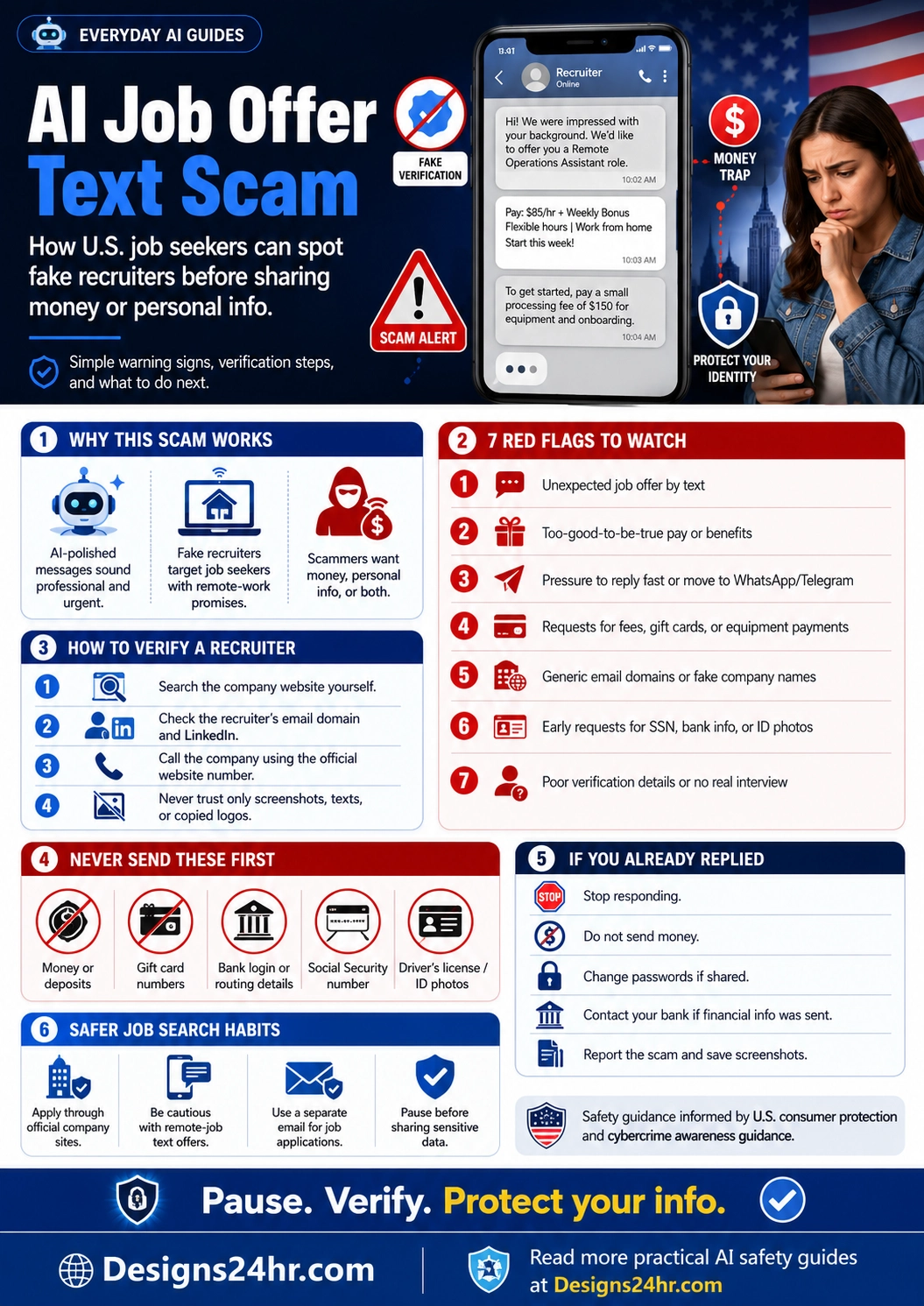
“Hi, we reviewed your profile and would like to offer you a remote assistant position. Pay is $85 per hour plus weekly bonuses. Training starts today. Please reply YES to begin onboarding.”
This type of message creates excitement first, then moves quickly toward a fee, fake equipment payment, fake check, or personal information request.
Why fake recruiter text message scams work
Fake recruiter texts work because they target people at a vulnerable moment: when they are actively looking for income, remote work, a side job, or a better opportunity. AI can make these messages look less sloppy than old scam messages, which means job seekers need to judge the process, not just the grammar.
The Federal Trade Commission has warned consumers about fake recruiter job texts, and FBI cybercrime reporting continues to show how social engineering and AI-assisted fraud can create real financial losses for Americans.
7 red flags of an AI job offer text scam
One warning sign does not always prove a scam, but several together should make you stop before replying. Use this checklist before you click a link, share information, or agree to any “onboarding” step.
Watch for these fake job offer signals
- Unexpected job offer by text: You did not apply, interview, or speak to the company before receiving the offer.
- Too-good-to-be-true pay or benefits: The pay is unusually high for simple tasks, entry-level work, or flexible part-time hours.
- Pressure to reply fast: The recruiter says the position will close today, training starts immediately, or you must respond quickly.
- Move to WhatsApp, Telegram, or private chat: Legitimate recruiters may communicate in different ways, but pushing you away from official company channels is a major warning sign.
- Requests for fees or equipment payments: Be suspicious if you are asked to pay for onboarding, training, background checks, software, equipment, shipping, or a “refundable” deposit.
- Generic email domains or fake company names: A recruiter using a free email address, misspelled domain, or lookalike company name needs extra verification.
- Early requests for sensitive information: SSN, bank login, routing details, driver’s license photos, and ID selfies should never be requested casually through text.
Real recruiter vs. fake recruiter: quick comparison
A real hiring process can still move quickly, but legitimate companies usually have consistent details, official channels, and a real interview process. Fake recruiters often skip normal steps and focus on speed, money, or private information.
| Check | Legitimate recruiter | Possible scam recruiter |
|---|---|---|
| First contact | References a real application, role, company, or hiring platform. | Sends an unexpected job offer by text without a clear application history. |
| Email domain | Uses an official company domain that matches the company website. | Uses free email, misspelled domains, or lookalike addresses. |
| Interview process | Includes a real interview, clear job description, and normal hiring steps. | Offers the job quickly with no real interview or only chat-based questions. |
| Money request | Does not ask you to pay to get hired. | Asks for fees, gift cards, crypto, equipment deposits, or check processing. |
| Personal information | Requests sensitive data only through secure, official HR systems after proper hiring steps. | Requests SSN, bank details, ID photos, or account access through text or messaging apps. |
How to verify a recruiter before you reply
The safest move is not to click the link in the text. Instead, verify the opportunity from outside the message. Scammers want you to stay inside their version of the story, so your job is to step outside it and check the facts independently.
4-step recruiter verification checklist
- Search the company website yourself. Type the company name into your browser or search engine instead of tapping the text link.
- Find the official careers page. Look for the same job title on the company’s real website. If it is not listed, that does not automatically prove a scam, but it is a reason to slow down.
- Check the recruiter’s email domain and profile. A real recruiter should have a company email address or a clear professional presence that matches the employer.
- Call the company using the official website number. Do not call a number provided only by the text message. Ask whether the recruiter and job opening are real.
Simple verification script:
“Hi, I received a text from someone claiming to recruit for your company for a remote position. Before I respond, can you confirm whether this recruiter and job opening are legitimate?”
You can also use Designs24hr’s free AI tools and Everyday AI Guides hub to support smarter everyday decisions, but never paste sensitive personal information, banking details, private IDs, or full scam conversations into any tool unless you fully understand how that information will be handled.
Never send these first in a recruiter text conversation
A real employer should not require you to pay money to receive a job offer. Sensitive personal details should also be handled through secure, official HR systems only after you have verified the employer and completed a real hiring process.
Do not send these through text or private chat
- Money, deposits, “refundable” fees, training fees, or equipment payments
- Gift card numbers, crypto payments, wire transfers, or payment app transfers
- Bank login, bank routing details, payroll login, or direct-deposit details before verification
- Social Security number, full date of birth, or full identity profile
- Driver’s license photos, passport photos, ID selfies, or photos of official documents
- One-time passcodes, verification codes, password reset links, or account recovery details
Common AI job offer text scam examples
Scammers change wording often, but the structure is usually similar: unexpected contact, exciting offer, quick approval, and a request that benefits the scammer.
What to do if you already replied to a fake job text
If you replied, do not panic. The next steps depend on what you shared. The most important thing is to stop the conversation, protect your accounts, and save evidence.
Take these steps now
- Stop responding. Do not argue, explain, or try to catch the scammer. More conversation gives them more chances to pressure you.
- Do not send money. Do not pay fees, send gift cards, deposit suspicious checks, or transfer funds to a “vendor.”
- Save screenshots. Keep the phone number, message thread, links, payment requests, names, and any fake documents.
- Change passwords if you shared login details. Turn on multi-factor authentication where possible.
- Contact your bank if financial information was shared. Ask about account protection, transaction monitoring, card replacement, or fraud alerts.
- Report the scam. Use official reporting options from the FTC, FBI IC3, your state attorney general, and the platform where the scam occurred.
How to report a fake recruiter text in the U.S.
Reporting helps agencies track patterns and warn other job seekers. It may not always recover money, but it can create a record and support broader enforcement efforts.
Useful reporting options
- Report job scams to the FTC through ReportFraud.ftc.gov.
- Report cyber-enabled fraud to the FBI Internet Crime Complaint Center at IC3.gov.
- Forward suspicious texts to 7726, which spells SPAM, if your mobile carrier supports it.
- Report the fake profile or message inside the job platform, social network, or messaging app.
- If your identity details were exposed, visit IdentityTheft.gov for a recovery plan.
Safer job search habits for 2026
You do not need to avoid online job hunting. You just need a safer routine. Build a habit of slowing down before you trust a recruiter text, especially if the message promises fast money or asks for personal details early.
Simple rule: If a recruiter text asks for money, banking details, SSN, ID photos, gift cards, crypto, or urgent action before a real interview, treat it as unsafe until independently verified.
FAQs about AI job offer text scams
How do I know if a job offer text is fake?
A job offer text may be fake if it arrives unexpectedly, promises unusually high pay, skips a real interview, pressures you to act fast, moves you to a private messaging app, uses a suspicious email domain, or asks for money or sensitive personal information.
Do real recruiters text job candidates?
Some real recruiters may text candidates, especially after an application or previous contact. The risk is an unexpected text that claims you are hired or almost hired without a normal process. Verify the recruiter through the company’s official website before continuing.
Can AI make job scams harder to detect?
Yes. AI can help scammers write cleaner messages, create more believable job descriptions, and imitate professional communication. That means spelling and grammar are no longer enough to judge whether a job message is safe.
Should I pay for equipment before starting a remote job?
Be extremely cautious. A job that requires you to pay upfront for equipment, training, shipping, software, or onboarding may be a scam. Verify the company independently and never send money because a text message tells you to.
What should I do if I sent my Social Security number to a fake recruiter?
Stop communicating with the sender, save screenshots, report the scam, and visit IdentityTheft.gov for recovery steps. You may also want to place a fraud alert or credit freeze with the major credit bureaus.
What should I do if I deposited a check from a fake employer?
Contact your bank immediately. Tell them you may have deposited a fake check connected to a job scam. Do not send any money to a vendor, recruiter, or third party, even if the check appears to clear at first.
Helpful official sources
These sources are useful for checking current U.S. consumer protection and cybercrime guidance related to fake recruiter texts, job scams, and AI-assisted fraud.
Pause. Verify. Protect your info.
An exciting job offer should never force you to rush, pay first, or send sensitive personal details through text. Before you reply, verify the recruiter through official company channels and trust the process, not the promise.
For more simple, practical AI safety explainers, visit Designs24hr.com.