AI Referral Traffic Explained: How U.S. Small Businesses Can Get Found in AI Search
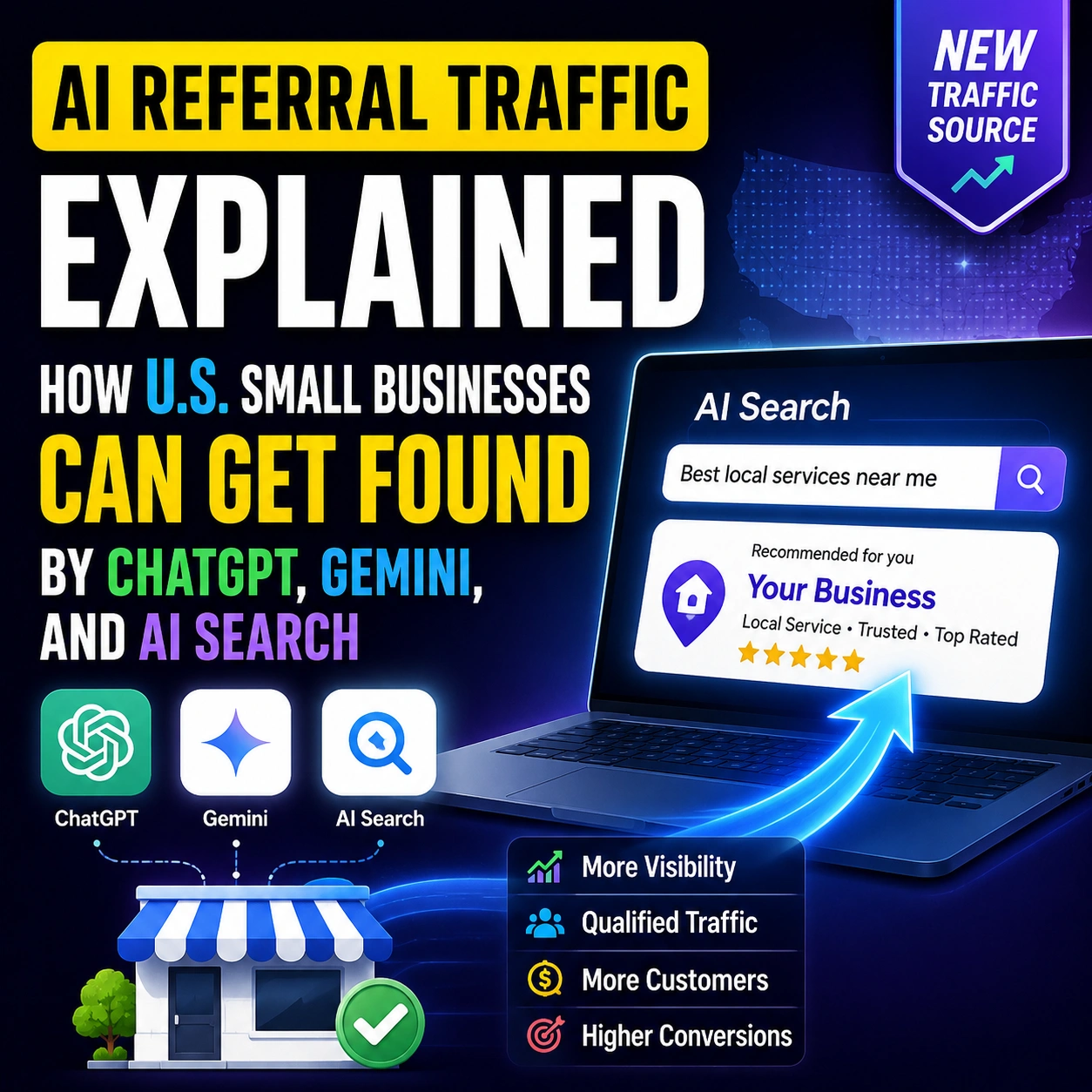
AI referral traffic is becoming a new way for people to discover businesses online. Instead of only searching Google, customers may ask ChatGPT, Gemini, Perplexity, or another AI tool for recommendations, comparisons, local services, product ideas, or trusted websites. If your business pages are clear, helpful, and easy to understand, you have a better chance of being discovered when AI tools help users decide what to click next.
Reuters reported that May 2026 Adobe Analytics data found U.S. shoppers referred from large language models generated 53% more revenue per visit than shoppers from non-AI sources.
For small businesses, this does not mean traditional SEO is dead. It means website content now needs to work for both real people and AI-powered discovery. Search engines, AI answer tools, shopping assistants, and recommendation systems all depend on clear information. If your page is vague, outdated, thin, or hard to scan, it becomes harder for anyone to understand why your business should be trusted.
The good news is that improving AI referral traffic does not require complicated tricks. Most small businesses can start with simple fixes: clearer page titles, better service descriptions, direct answers, trustworthy details, useful FAQs, clean URLs, and content that solves real customer questions.
What Is AI Referral Traffic?
AI referral traffic is website traffic that comes from AI tools, AI-powered search experiences, chatbots, assistants, or recommendation engines. A visitor may ask an AI tool for the best accounting software, a local plumber, a boutique gift shop, a meal planning app, a marketing guide, or a product comparison. If the AI response includes or leads to your website, that visit may show up as referral traffic from an AI source.
In simple terms, AI referral traffic means someone used an AI tool during their search journey before reaching your website.
Why AI Referral Traffic Matters for Small Businesses
AI tools are becoming part of how people research, compare, and decide. A customer might ask ChatGPT to explain which service they need. A shopper might ask Gemini to compare products. A founder might ask Perplexity to find useful tools. A homeowner might ask an AI assistant for nearby service options. These searches are often more specific than traditional keywords because the user is describing a real problem in natural language.
That matters because specific questions often show stronger intent. Someone searching “marketing” may only be browsing. Someone asking “how can my small business get found by ChatGPT and AI search” is closer to taking action.
AI users ask detailed questions
They often explain the problem, budget, location, need, or goal, which can reveal stronger buying or decision intent.
AI tools summarize options
Instead of showing only a list of links, AI tools may explain which businesses, products, or resources seem relevant.
Clear pages can win trust faster
Helpful pages with direct answers, proof, and simple structure are easier for both humans and AI systems to interpret.
The Trend Is Already Showing Up in Data
In June 2026, Reuters reported that U.S. shoppers referred from large language models such as ChatGPT and Gemini generated more revenue per visit than non-AI traffic, based on Adobe Analytics data. Adobe’s 2026 Q2 AI Traffic Report also says AI referrals continue to rise and outperform traditional traffic on engagement, conversion, and revenue per visit.
That does not mean every small business will instantly get traffic from AI tools. It means the discovery journey is changing. Businesses that make their websites clearer now may be better prepared as AI-powered search grows.
How AI Tools Understand a Small Business Website
AI systems look for patterns, context, and signals. They need to understand what your page is about, who it helps, what problem it solves, and why the information is trustworthy. A page with a vague headline like “Welcome to Our Services” is less useful than a page titled “Residential Plumbing Repair in Austin, TX: Emergency Leaks, Drain Cleaning, and Water Heater Help.”
The same idea applies to online stores, blogs, agencies, freelancers, coaches, local service companies, and creators. The clearer your content is, the easier it becomes to connect your page with the right search intent.
| Website Element | Why It Helps AI Search | Small Business Example |
|---|---|---|
| Clear page title | Explains the main topic quickly | “Custom Wedding Cake Bakery in Phoenix” instead of “Home” |
| Helpful intro | Shows who the page is for and what problem it solves | “We help busy families plan affordable weekly meals with simple recipes.” |
| FAQ section | Answers real questions in direct language | Pricing, delivery, service area, turnaround time, guarantees, and support |
| Structured headings | Makes the page easier to scan and understand | Services, pricing, process, locations, reviews, and contact details |
| Trust signals | Helps support credibility | Experience, reviews, policies, licenses, examples, and transparent limitations |
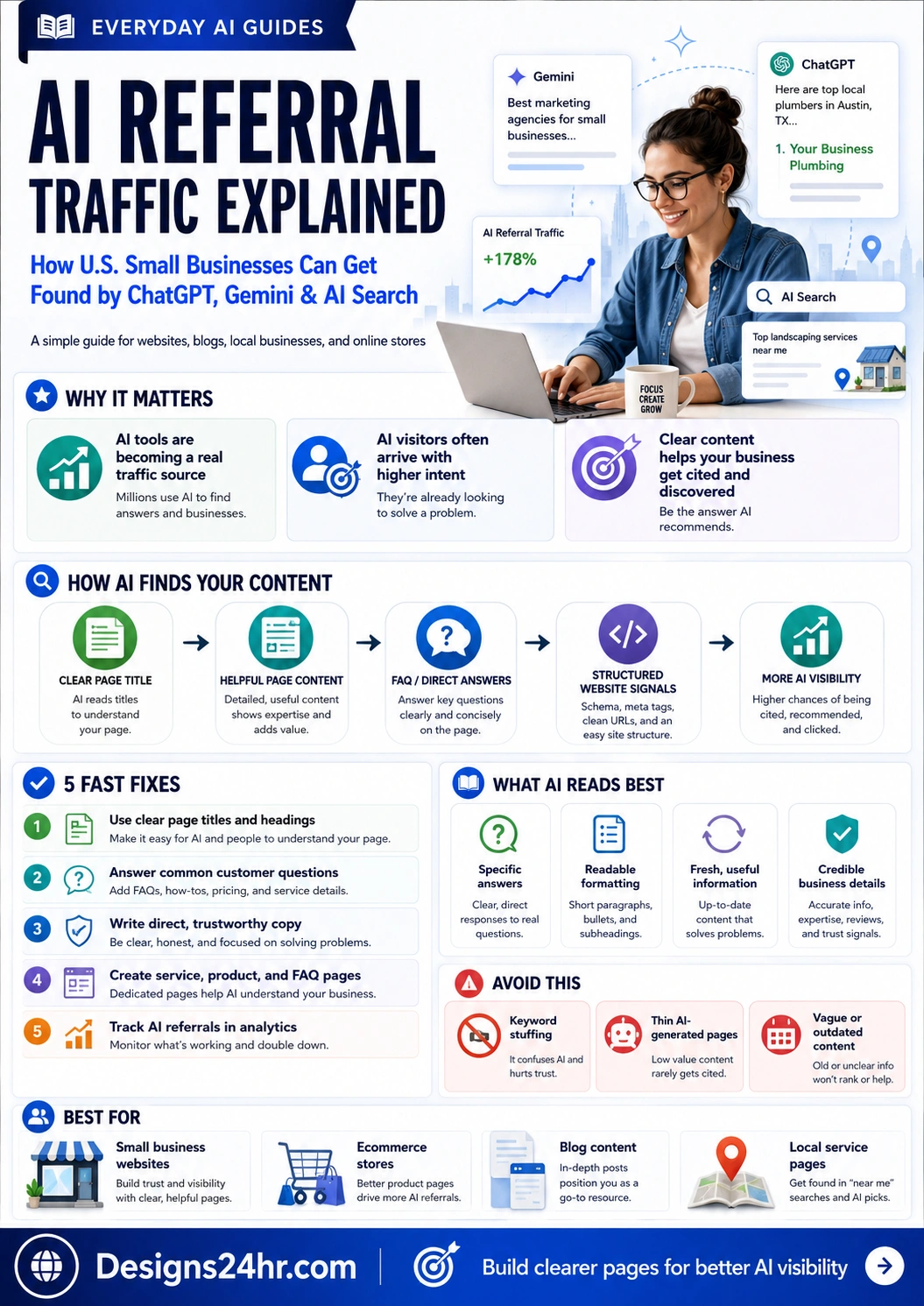
5 Fast Fixes to Improve AI Referral Traffic Potential
You cannot force an AI tool to mention your business, and you should avoid anyone who promises guaranteed AI citations. But you can make your website much easier to understand. Start with these practical fixes.
- Rewrite vague page titles into clear, specific titles. A strong title should explain the topic, audience, and purpose. Instead of “Our Services,” use “Bookkeeping Services for Small Businesses in Dallas.” Instead of “Products,” use “Printable Wall Art for Modern Farmhouse Living Rooms.”
- Add direct answers near the top of important pages. Many business pages take too long to explain what they do. Use the first few sentences to answer: What is this? Who is it for? What problem does it solve? Why should someone trust it?
- Create useful FAQ sections based on real customer questions. AI tools and search users both benefit from direct answers. Include questions about pricing, process, delivery, service area, timing, materials, support, refunds, booking, or product use.
- Use clean URLs and descriptive headings. A clean URL like “/ai-referral-traffic-small-business/” is easier to understand than a messy URL with random numbers. Descriptive H2 and H3 headings also make the page easier to scan.
- Track AI sources in your analytics. Look for referral traffic from AI tools and AI-powered browsers. Watch pages visited, time on page, conversions, contact form submissions, sales, and which content attracts the best visitors.
What Small Businesses Should Avoid
AI search optimization should not turn into keyword stuffing or fake authority. If a page repeats “AI referral traffic” unnaturally, copies generic AI text, or claims expertise it does not have, it can hurt trust. Helpful content still needs to sound human, specific, and honest.
- Avoid thin AI-generated pages that say a lot without helping the reader.
- Avoid fake reviews, fake credentials, or exaggerated claims.
- Avoid hiding important details such as pricing, location, service limits, or refund policies.
- Avoid using the same generic FAQ answers on every page.
- Avoid focusing only on AI tools while ignoring real customer needs.
How to Make a Page More AI-Readable
AI-readable content is not robotic content. It is clear content. It uses plain language, direct answers, organized sections, relevant details, and trustworthy information. A good page should make sense to a first-time visitor in less than one minute.
Use a simple page structure
For an important business page, use a structure like this:
- Clear title that includes the main service, product, or guide topic.
- Short intro that explains who the page helps.
- Benefit-focused section that explains why the topic matters.
- Detailed section that answers how it works.
- FAQ section based on real questions.
- Trust section with examples, experience, policies, or proof.
- Clear call to action that tells the reader what to do next.
Write answers like a helpful expert
Do not write only for search engines. Write like a helpful person who knows the topic. Use examples. Explain tradeoffs. Mention limits. If something depends on the customer’s location, budget, product, or business type, say that clearly.
Make every important page stand on its own
If someone lands on one page from an AI referral, they should not feel lost. Your page should include enough context to understand the offer, the next step, and why your business is credible.
How to Track AI Referral Traffic
Tracking AI referral traffic is still developing, and different analytics tools may label sources in different ways. Start by checking your referral traffic reports for sources that look like AI tools, chat assistants, answer engines, or AI browsers. Then compare behavior against your regular traffic.
Useful signals include:
- Sessions or visits from AI-related referral sources.
- Landing pages that receive AI-referred visits.
- Time on page and pages per session.
- Contact form submissions, purchases, bookings, or email signups.
- Queries or topics that may have led users to your page.
Simple Example: Local Service Business
Imagine a small roofing company in Ohio. Its old homepage says, “Quality roofing solutions for your home.” That sounds nice, but it does not give much detail. A stronger AI-readable page might say: “Roof Repair in Columbus, Ohio for Leaks, Storm Damage, Shingle Replacement, and Emergency Inspections.”
Then the page could answer common questions: Do you offer emergency service? Which areas do you serve? How long does an inspection take? What signs mean a roof needs repair? Do you help with storm damage documentation? These details help customers and AI tools understand when the business is relevant.
AI Search Optimization vs. Traditional SEO
AI search optimization and traditional SEO overlap, but they are not exactly the same. Traditional SEO often focuses on ranking pages in search results. AI search optimization focuses on making your information clear enough to be understood, summarized, recommended, or used as part of an answer.
The best strategy is not to choose one over the other. A small business should build pages that are useful for Google, useful for AI tools, and useful for real people. Clear titles, original explanations, internal links, trustworthy sources, and strong page structure help across all three.
| Traditional SEO | AI Search Optimization | Best Small Business Move |
|---|---|---|
| Targets search rankings and clicks | Targets understanding, answers, and recommendations | Create pages that answer real questions clearly |
| Uses keywords, metadata, links, and technical SEO | Uses clarity, context, structure, authority, and direct answers | Use both keyword research and plain-language explanations |
| Often starts with search volume | Often starts with customer questions and problem-solving | Write for actual buyer intent, not just broad traffic |
Publishing Checklist for Better AI Visibility
Before publishing a new page, product description, service page, or blog post, run through this checklist:
- The page title clearly explains the topic.
- The first paragraph answers who the page is for and why it matters.
- The main keyword appears naturally in the title, intro, one heading, and conclusion.
- Secondary keywords are used naturally without stuffing.
- The page includes useful examples or real-world context.
- The FAQ section answers specific customer questions.
- The URL slug is short, readable, and keyword-focused.
- Internal links help readers find related tools or guides.
- External sources are credible and directly relevant.
- The call to action tells the reader exactly what to do next.
Use Free Designs24hr Tools Before You Publish
Small improvements can make a page easier to understand. Before publishing your next business page or guide, use free Designs24hr tools to improve the title, slug, prompts, and keyword balance.
Where AI Referral Traffic Fits in Your Marketing Plan
AI referral traffic should be treated as one part of a broader small-business marketing strategy. You still need helpful website pages, good customer service, clear offers, strong local signals, honest reviews, useful content, and consistent branding. AI discovery can support those efforts, but it cannot replace them.
The businesses most likely to benefit are the ones that make their expertise easy to understand. A clear service page, a helpful guide, a well-written product page, and a useful FAQ can all help customers make better decisions. That is exactly the type of content AI tools are designed to interpret and summarize.
Final Takeaway
AI referral traffic is not just a future idea. It is already becoming part of how people research products, services, and trusted resources online. For U.S. small businesses, the opportunity is simple: create clearer, more helpful, more trustworthy pages before the competition catches up.
Start with one important page. Rewrite the title. Improve the intro. Add real FAQs. Use a clean slug. Link to helpful related resources. Track what happens. The goal is not to chase every AI trend. The goal is to make your business easier to understand wherever customers search next.
For more beginner-friendly AI explainers, visit Everyday AI Guides or explore more posts in AI for Small Business & Marketing.
Frequently Asked Questions About AI Referral Traffic
What is AI referral traffic?
AI referral traffic is website traffic that comes from AI tools, chatbots, answer engines, AI-powered search experiences, or recommendation systems. A user may ask an AI tool a question, receive a recommendation, and then click through to a website.
Can ChatGPT send traffic to small business websites?
Yes, AI tools can influence discovery when users ask for recommendations, comparisons, or resources. The amount of traffic can vary, and businesses should not expect guaranteed mentions. Clear, helpful, trustworthy content gives your website a better foundation for AI-powered discovery.
How do I make my website easier for AI tools to understand?
Use clear titles, direct answers, descriptive headings, helpful FAQs, clean URLs, specific service details, credible information, and natural internal links. A page that is easy for humans to understand is usually easier for AI systems to interpret too.
Is AI search optimization the same as SEO?
No. They overlap, but they are not exactly the same. SEO helps pages appear in search engines, while AI search optimization focuses on making content clear enough to be understood, summarized, and recommended by AI-powered tools.
How can I track AI referral traffic?
Check your analytics referral reports for visits from AI tools, chat assistants, answer engines, or AI browsers. Then compare landing pages, time on page, conversions, form submissions, purchases, and engagement against your other traffic sources.
What should small businesses avoid when optimizing for AI search?
Avoid keyword stuffing, fake authority, copied AI-generated content, vague pages, outdated information, and generic FAQs. Focus on specific, useful, honest content that answers real customer questions.