Everyday AI Guides
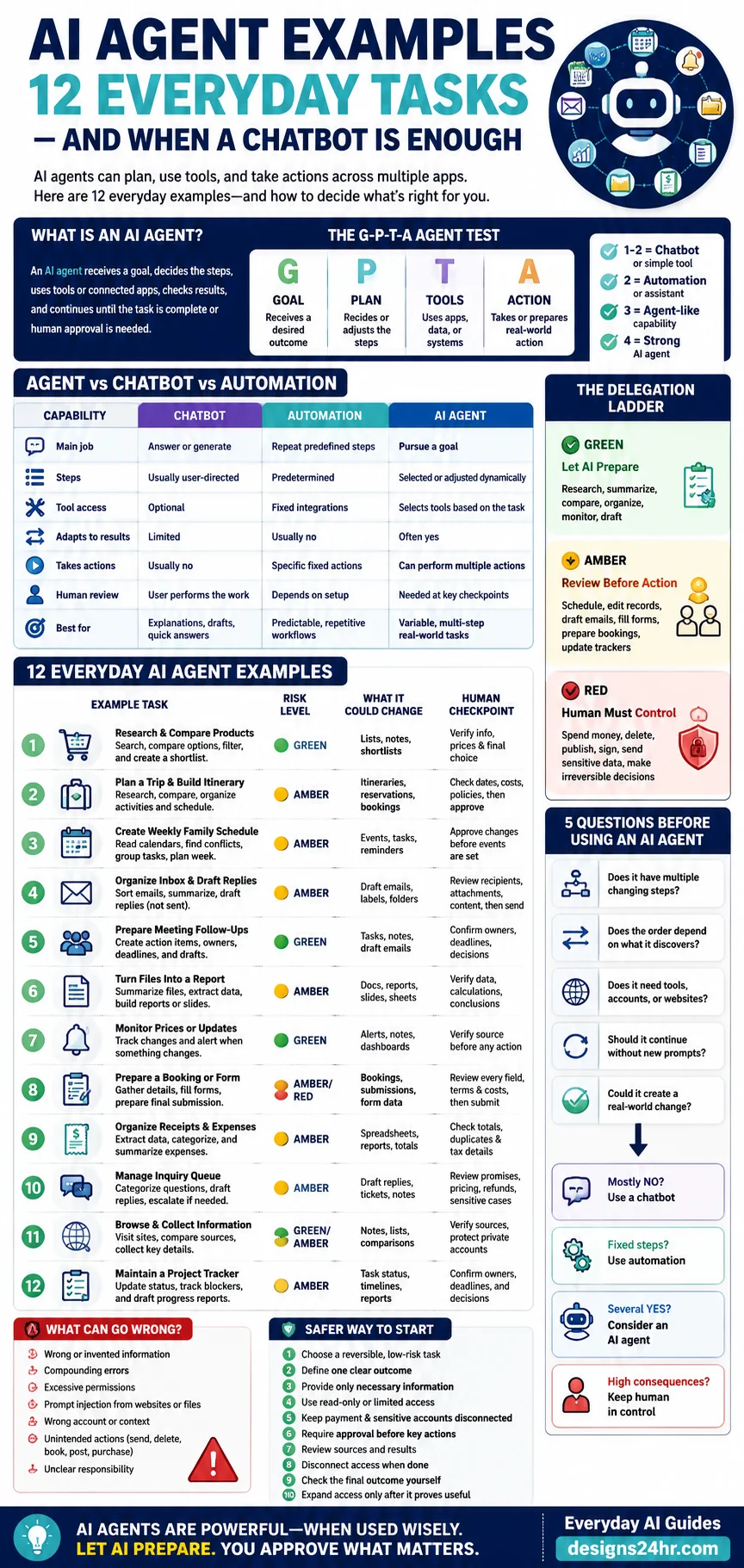
AI agent examples are easiest to understand by looking at what the system can actually do. A normal chatbot usually answers a question and waits for another prompt. An AI agent may receive a goal, decide on several steps, use connected tools, check what happened, and continue working until the task is complete or your approval is required.
This beginner-friendly guide explains 12 realistic everyday tasks, what access an agent may need, what it could change, where a human checkpoint belongs, and when a chatbot or fixed automation is the simpler choice.
Multi-step work where the next step may change based on new information.
Explanations, drafts, summaries, ideas, and one-time answers with no external action.
Let AI prepare the work. You review and approve anything that creates a consequence.
What Is an AI Agent?
An AI agent is a system designed to pursue an outcome rather than only produce one response. Depending on the product and the permissions you allow, it may research information, read files, use websites, compare options, organize records, draft messages, update a system, monitor a condition, or prepare an external action.
An AI agent receives a goal, determines or adjusts the steps, uses approved tools, observes the results, and continues until the task is complete, a stopping condition is reached, or human approval is needed.
The term is not used identically by every company. Some products call any AI-powered workflow an agent. Others reserve the term for systems that choose tools and direct their own process. The practical question is not what the marketing page calls it. The practical question is what the system can actually access, decide, and change.
Official explanations from Google Cloud emphasize goal pursuit, reasoning, planning, and task completion. OpenAI describes agents as systems that combine a model, tools, and instructions to complete workflows with a degree of independence. Anthropic distinguishes dynamically directed agents from workflows that follow predefined paths.
Important: Capabilities vary by product, plan, mode, connected app, permission, country, and account type. Never assume that every tool called an “assistant,” “copilot,” or “agent” can perform the same actions.
The G-P-T-A Agent Test
Use this original four-part test to decide whether a tool genuinely behaves like an AI agent or is mainly a chatbot with extra features.
Goal
Does the user provide an outcome instead of one isolated instruction?
Plan
Can the system decide, sequence, or adjust the steps required?
Tools
Can it retrieve information or use files, apps, websites, or systems?
Action
Can it create, change, send, monitor, submit, or prepare a real-world action?
Usually not an agent
- Answers one question
- Rewrites one paragraph
- Summarizes text you pasted
- Creates a list of ideas
- Waits for a new prompt after every step
More agent-like
- Receives a broader goal
- Chooses among several tools
- Changes its plan after new findings
- Continues across multiple steps
- Creates or prepares an external result
A tool with only one or two G-P-T-A elements is usually a chatbot, assistant, or conventional workflow. Three elements suggest agent-like capability. All four indicate stronger agent behavior—but greater capability also means greater responsibility.
AI Agent vs. Chatbot vs. Automation
These categories can overlap. A modern chat interface may include agent features, and an agent may still ask questions through a chatbot-style window. This comparison focuses on how the work is controlled rather than how the interface looks.
| Capability | Chatbot | Fixed Automation | AI Agent |
|---|---|---|---|
| Main job | Answer, explain, or generate | Repeat predefined steps | Pursue a goal through multiple steps |
| Who controls the steps? | The user usually directs each step | The setup or rule controls the steps | The system may select or adjust steps |
| Tool access | Optional or limited | Fixed integrations | May choose tools based on the task |
| Adapts to results | Limited unless prompted again | Usually follows fixed conditions | May revise the next step dynamically |
| Takes actions | Usually creates text or advice | Performs specific programmed actions | May perform several related actions |
| Best for | Explanations, drafts, summaries, ideas | Predictable and repetitive workflows | Variable, multi-step tasks using tools |
| Main concern | Incorrect or misleading answers | Bad rules or incorrect setup | Permissions, compounding errors, and unintended actions |
Simpler is often better. Anthropic recommends using the simplest workable approach and adding agentic complexity only when the task genuinely needs flexibility, model-directed decisions, or changing steps.
How Do AI Agents Work?
The exact engineering differs, but an everyday agent workflow commonly follows this pattern:
- Receive the goal. The user describes the desired outcome, limits, and important conditions.
- Gather approved context. The system reads the information, files, pages, or app data it is permitted to use.
- Create or adjust a plan. It determines which steps and tools may be needed.
- Use a tool. It searches, reads, compares, drafts, calculates, organizes, or interacts with a system.
- Observe the result. It checks whether the step worked and whether new information changes the plan.
- Continue or revise. It performs another step, corrects the approach, or asks the user a question.
- Request approval. It pauses before sending, submitting, publishing, deleting, buying, booking, or changing something important.
- Stop safely. It finishes when the goal is reached, a limit is hit, or human judgment is required.
OpenAI describes the model, tools, and instructions as foundational agent components. Tools may retrieve data or take actions, while instructions establish boundaries and expected behavior. Guardrails and human intervention remain important because an agent can still misunderstand the task, use incorrect information, or choose a poor step.
12 AI Agent Examples for Everyday Tasks
The following examples are not promises that every AI product can perform each task. They show what an agent-style workflow could look like, the access involved, the possible consequence, and when a simpler tool is enough.
Research and Compare Products
An agent could search several sources, compare specifications, remove unsuitable options, organize findings, and maintain a shortlist.
Web access, product requirements, budget, preferred sellers, and comparison criteria.
Research notes, comparison tables, shortlists, saved items, or a shopping cart.
Green for research
Verify the exact model, seller, total cost, warranty, return policy, and final choice.
Use a chatbot when you already have the product information and only need help comparing it.
Plan a Trip and Build an Itinerary
An agent could research destinations, compare routes, group activities by location, check schedules, and assemble a day-by-day plan.
Travel dates, destination, preferences, mobility needs, budget, and current web information.
Itineraries, calendar drafts, reservation forms, saved options, or booking details.
Amber before booking
Confirm names, dates, time zones, cancellation rules, added fees, accessibility, and every payment.
Use a chatbot when you only need destination ideas or a draft itinerary.
Create a Weekly Family Schedule
An agent could read approved calendars, identify conflicts, group errands, suggest travel time, and prepare a shared weekly plan.
Calendar access, household commitments, school activities, appointments, and family rules.
Events, reminders, shared schedules, locations, invitees, or recurring routines.
Amber
Approve every created, moved, shared, or cancelled event and check who can see private details.
Use a chatbot when you can manually provide the events and only need help arranging them.
Organize an Inbox and Draft Replies
An agent could identify messages that need attention, group them by urgency, summarize long threads, and prepare unsent replies.
Email access, folders or labels, approved response rules, contacts, and account context.
Drafts, labels, folders, flags, archive status, calendar events, or outgoing messages.
Amber
Review recipients, copied recipients, attachments, claims, tone, dates, promises, and confidential details.
Use a chatbot when you are working with one copied email and need one reply drafted.
Prepare Meeting Follow-Ups
An agent could combine notes, identify commitments, suggest owners, create action items, and draft follow-up messages.
Meeting notes or transcript, calendar details, attendee names, project context, and task system access.
Action lists, project records, draft emails, deadlines, meeting notes, and reminders.
Green for drafts
Confirm what was actually agreed, who owns each task, and whether deadlines are realistic.
Use a chatbot when you only need the notes summarized or reformatted.
Turn Several Files Into a Report
An agent could inspect approved files, extract findings, identify missing evidence, organize data, and build a report, spreadsheet, or presentation.
Selected files, output requirements, trusted reference material, and document-creation tools.
Documents, tables, charts, slides, summaries, citations, and project folders.
Depends on file sensitivity
Verify calculations, quotations, evidence, confidential material, conclusions, and missing context.
Use a chatbot when the task involves one short document and one simple output.
Monitor Prices, Availability, or Updates
An agent could revisit an approved source, compare the latest result with a previous result, and alert you when a meaningful change occurs.
A specific source, item, condition, threshold, checking schedule, and notification method.
Alerts, notes, dashboards, watchlists, reminders, or saved comparison data.
Green if alert-only
Open the original source and verify the current result before buying or changing plans.
Use a chatbot when you only need one current lookup rather than repeated monitoring.
Prepare a Booking or Form Submission
An agent could gather approved details, identify missing information, fill routine fields, and prepare the final page for your review.
The form, approved personal details, dates, account access, requirements, and supporting files.
Form fields, reservations, uploaded files, applications, consent choices, and account records.
Red before submission
Review every field, statement, price, date, recipient, checkbox, commitment, and uploaded file.
Use a chatbot when you only need confusing instructions or questions explained.
Organize Receipts and Expenses
An agent could extract dates, vendors, categories, totals, and payment methods from approved receipts and create an expense summary.
Receipt images or files, category rules, spreadsheet access, and approved reporting periods.
Spreadsheets, categories, totals, reimbursement records, reports, and accounting drafts.
Amber
Check duplicates, totals, dates, personal information, tax treatment, and reimbursable items.
Use a chatbot when you only need a few manually entered expenses categorized.
Manage a Small-Business Inquiry Queue
An agent could categorize customer questions, retrieve approved business information, prepare replies, and escalate unusual or sensitive cases.
Inbox or help desk access, approved policies, product information, order context, and escalation rules.
Draft replies, ticket categories, notes, priority levels, customer records, or outgoing messages.
Amber
Review refunds, pricing, promises, complaints, legal language, and sensitive customer situations.
Use a chatbot when one customer inquiry only needs a carefully written response.
Browse Websites and Collect Information
An agent could open several pages, locate relevant details, compare sources, and organize its findings into notes or a decision table.
Browser access, research criteria, approved websites, source requirements, and output format.
Notes, lists, comparison tables, bookmarks, downloads, forms, carts, or logged-in sessions.
Amber when logged in
Verify original sources and keep banking, health, identity, admin, and payment accounts outside the session.
Use a chatbot when you can provide the source text directly.
Maintain a Project Tracker
An agent could read project notes, update task status, identify blockers, organize next steps, and draft a progress report.
Project system access, notes, task rules, owner information, milestones, and reporting format.
Task status, assignments, deadlines, notes, reports, reminders, and shared records.
Amber
Confirm owners, deadlines, dependencies, completion claims, blockers, and decisions.
Use a chatbot when you only need a progress update drafted from information you provide.
Before Connecting an Agent to Your Apps
Review what the tool can read, edit, send, delete, purchase, publish, or share. Give it the smallest permission needed and keep consequential actions under your control.
Review the AI Agent Safety ChecklistWhen Is a Chatbot Enough?
A chatbot is usually the better choice when the task needs a useful answer but does not require continued execution, connected accounts, or real-world actions.
Use a chatbot for:
- Answering one question
- Explaining a concept
- Rewriting a message
- Brainstorming ideas
- Summarizing text you provide
- Creating a first draft
- Building a checklist or template
- Comparing information already supplied
A chatbot is enough when:
- One response can complete the task
- You will take every external action yourself
- No account or app connection is required
- No ongoing monitoring is needed
- The steps are simple and visible
- A wrong result can be checked easily
- More autonomy would add unnecessary risk
More autonomy does not automatically make a tool better. Agent systems may introduce more cost, delay, unpredictability, permission exposure, and opportunities for an early mistake to affect later steps. Use the least complex tool that can complete the job well.
When Is Traditional Automation Better?
Use a fixed rule, scheduled reminder, template, or conventional automation when the steps are predictable and do not require interpretation.
Automation is usually better when:
- The same steps repeat every time
- The inputs are structured
- The conditions are clearly defined
- The desired output is predictable
- Reliability matters more than flexibility
- No creative judgment is required
Simple examples
- Sending the same reminder every Monday
- Moving form entries into a spreadsheet
- Renaming files with a fixed pattern
- Sending a receipt after a payment
- Backing up a folder on a schedule
- Applying a label when a known condition is met
An agent is more appropriate when the system must interpret messy information, choose between possible actions, or revise its approach after discovering something new.
The Three-Level AI Delegation Ladder
The type of action matters more than how impressive the tool appears. Use these three levels to decide where human approval belongs.
Let AI Prepare
Suitable for research, summaries, comparisons, organization, drafts, brainstorming, non-sensitive monitoring, and reversible private work.
Review Before Action
Use human review before scheduling, updating shared records, drafting outgoing messages, filling forms, preparing bookings, or changing project systems.
Human Must Control
Keep direct human control over spending, signing, publishing, deleting, cancelling, sharing sensitive data, and irreversible or high-impact decisions.
Do not delegate professional judgment. AI should not independently make legal, medical, financial, insurance, employment, immigration, safety, or other high-consequence decisions. Use qualified human professionals where appropriate.
What Can Go Wrong With AI Agents?
Agents can be useful, but their ability to use outside information and take actions introduces risks that are less serious in an ordinary question-and-answer chat.
Wrong or Invented Information
An agent may misunderstand a source, combine incompatible information, omit a condition, or confidently produce an incorrect conclusion.
Compounding Errors
One incorrect assumption near the beginning can affect comparisons, drafts, recommendations, calculations, and later actions.
Excessive Permissions
A tool may receive access to an entire inbox, drive, browser profile, or workspace when one message, file, page, or temporary folder would have been sufficient.
Prompt Injection
A webpage, email, document, or other outside content may contain instructions intended to manipulate the agent into doing something the user did not request.
Wrong Account or Context
The agent may use the wrong browser profile, calendar, email account, workspace, customer record, file version, location, or time zone.
Unintended Actions
Sending, deleting, booking, cancelling, publishing, purchasing, sharing, or submitting can create real consequences that are difficult to reverse.
NIST describes AI agent systems as capable of planning and taking autonomous actions that can affect real systems. NIST has also highlighted risks involving adversarial data, insecure tools, and harmful actions. OpenAI explains that prompt injection occurs when third-party content attempts to mislead an AI into doing something the user did not request.
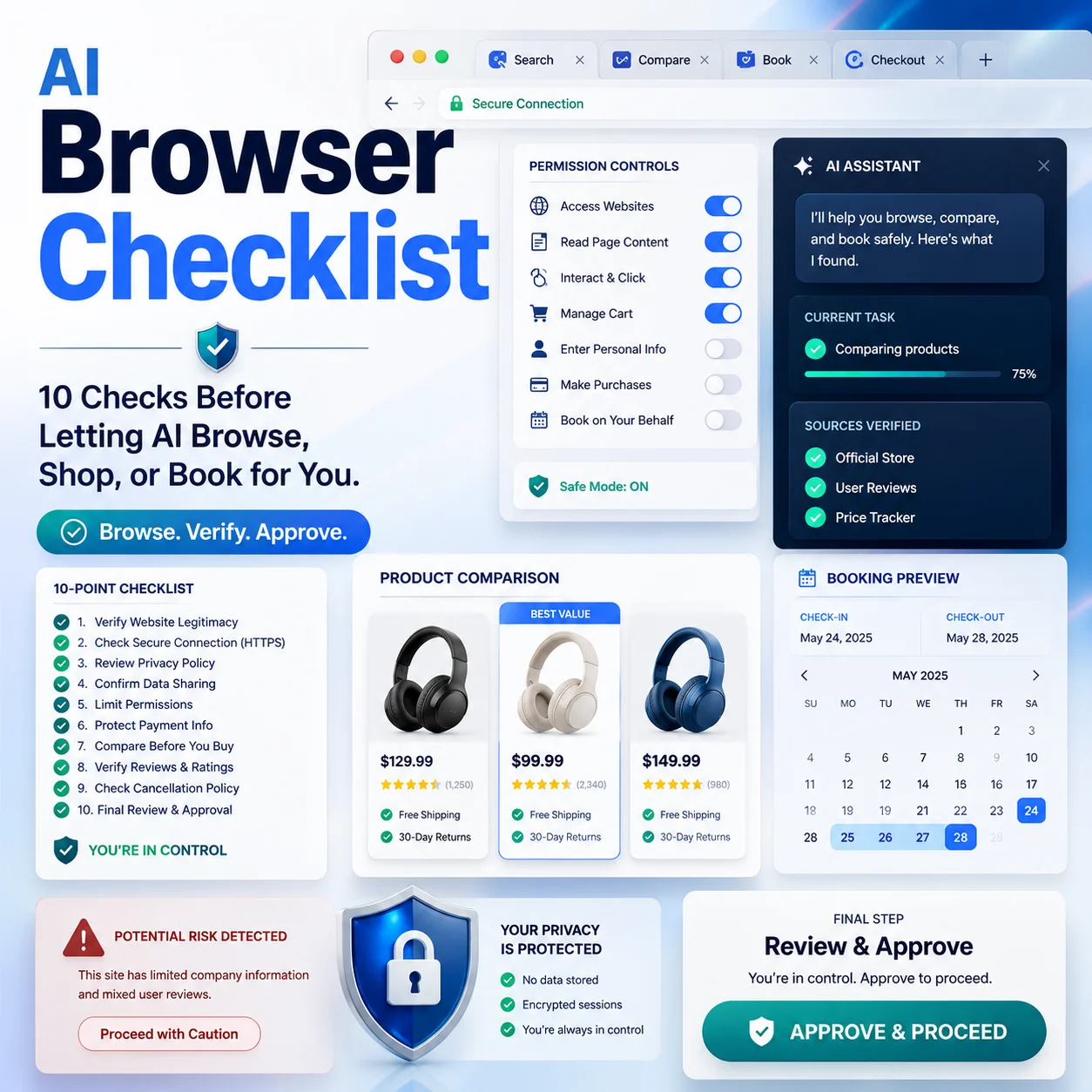
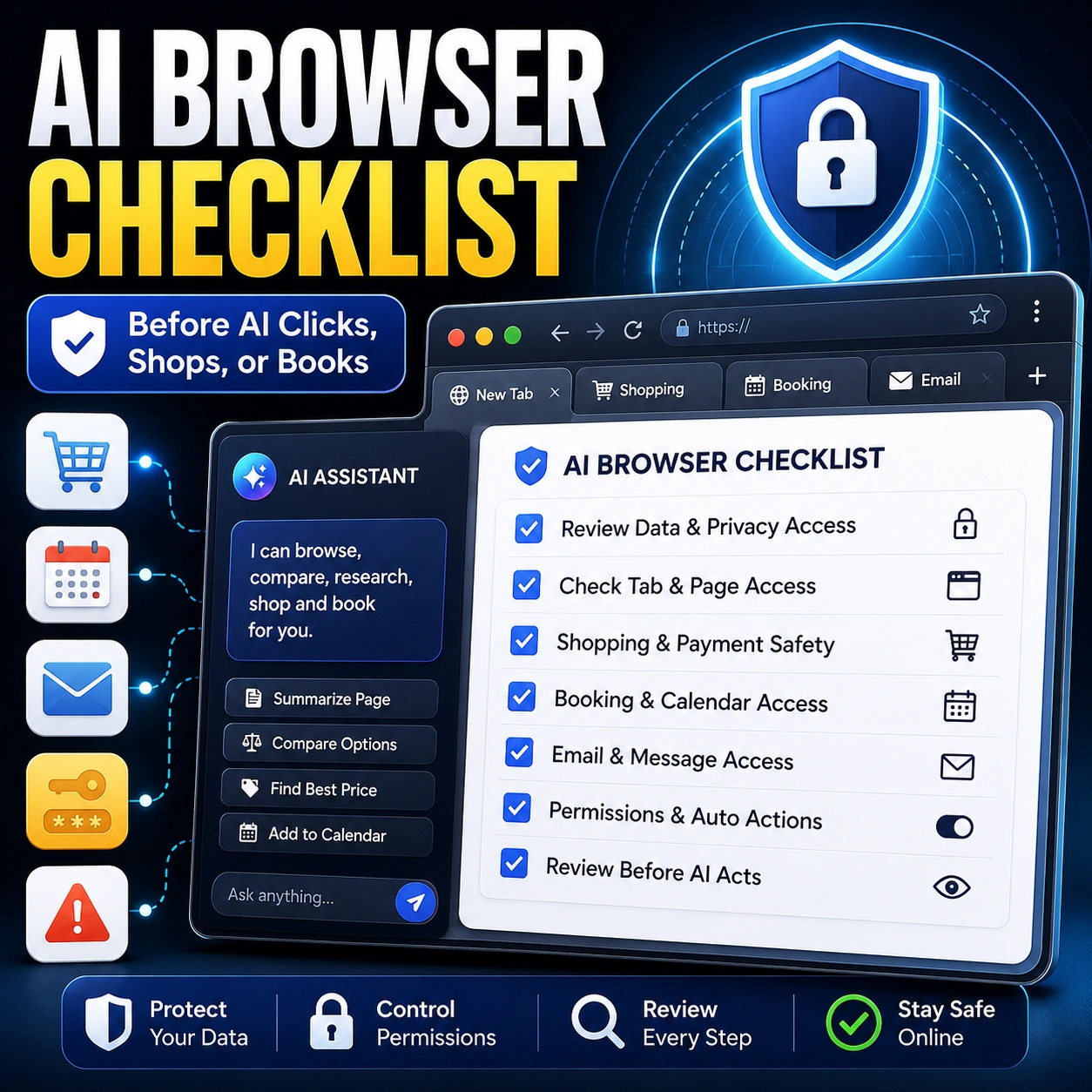
For agents that browse websites, compare products, fill forms, download files, shop, or prepare bookings, use the AI Browser Checklist before granting access.
A Safer Way to Try Your First AI Agent
Begin with a small, reversible workflow. Do not start by connecting your most sensitive accounts or allowing the system to make independent commitments.
- Choose a reversible task. Start with research, organization, comparison, or an unsent draft.
- Define one clear outcome. State exactly what the agent should produce and what it must not do.
- Provide only necessary information. Avoid unrelated files, accounts, messages, and personal records.
- Use limited access. Prefer one file, one folder, one page, read-only access, a temporary account, or logged-out browsing.
- Keep sensitive accounts disconnected. Exclude banking, passwords, health portals, identity services, and confidential admin systems.
- Require approval before action. The agent should pause before sending, submitting, deleting, booking, buying, publishing, or sharing.
- Verify sources and outputs. Check original pages, numbers, names, dates, recipients, attachments, and conclusions.
- Know how to stop it. Confirm how to pause the task, disconnect the app, remove the extension, and revoke access.
- Review the final outcome yourself. Do not assume that a completed-looking result is accurate or appropriate.
- Expand access slowly. Add permissions only after the limited workflow proves genuinely useful.
Broad instructions create unnecessary uncertainty. Instead of asking an agent to “review everything and take whatever action is needed,” describe the exact source, task, limit, output, and approval point.
Too broad
“Review all my emails and handle anything important.”
Clearer and safer
“Review unread messages from the last two days. Identify messages that require my reply and prepare unsent drafts. Do not send, archive, delete, forward, open attachments, or contact anyone.”
Use the free Designs24hr AI Prompt Generator to define a clearer goal, context, constraints, output, and approval boundary.
Quick Agent-or-Chatbot Checklist
Ask these questions before choosing a more autonomous tool.
Consider an AI agent when:
- The task contains several meaningful steps.
- The next step depends on what the system discovers.
- The AI must choose among tools or sources.
- The work should continue without a new prompt after every step.
- The goal, limits, and stopping conditions can be defined clearly.
- Human approval can occur before consequential actions.
Use a chatbot or simpler tool when:
- One response is sufficient.
- You will perform all outside actions yourself.
- No connected account is necessary.
- The task mainly involves explaining, drafting, or summarizing.
- The steps are predictable enough for fixed automation.
- Agent access would create more risk than benefit.
Final rule: Use an agent only when changing, multi-step work genuinely benefits from tool use and continued execution. Let AI prepare whenever possible—and personally approve anything that affects money, privacy, communication, commitments, public content, or important records.
Final Takeaway
The best AI agent examples are not the ones with the most autonomy. They are tasks where several changing steps genuinely save time, access can be limited, the result can be reviewed, and a person still controls every meaningful consequence.
Use a chatbot for explanations, drafts, summaries, and one-time answers. Use fixed automation for predictable repetition. Consider an AI agent when the task requires flexible planning, tool use, and continued work—but keep sensitive data, payments, public communication, deletion, commitments, and high-stakes decisions under direct human control.
When a product description is too technical, use the free How It Works Explainer to turn it into a clear, step-by-step explanation before deciding whether to connect it.
Keep Learning Without the Technical Jargon
Explore clear, practical explanations of new AI capabilities, risks, and everyday uses in the Designs24hr AI Trends Made Simple collection.
Explore AI Trends Made SimpleFrequently Asked Questions
What are some examples of AI agents?
AI agent examples include researching and comparing products, creating a trip itinerary, organizing an inbox, preparing meeting follow-ups, building reports from several files, monitoring availability, preparing forms, categorizing receipts, browsing websites, and maintaining a project tracker. The agent-like element is that the system works through multiple steps and tools toward an outcome.
What is an AI agent in simple terms?
An AI agent is a system that can work toward a goal, decide what step should happen next, use approved tools, check the result, and take or prepare actions instead of only producing a conversational answer.
What is the difference between an AI agent and a chatbot?
A chatbot primarily responds to prompts. An AI agent can continue through several steps, use connected tools, react to what it finds, and work toward completing an outcome. Some modern products combine both behaviors in one interface.
Is ChatGPT an AI agent?
ChatGPT can function as a conversational chatbot or use more agent-like capabilities depending on the selected feature, available tools, connected apps, permissions, and requested task. Product capabilities can change, so evaluate the specific mode rather than applying one permanent label.
Are virtual assistants AI agents?
Some virtual assistants mainly answer questions or follow predefined commands. Others can plan, use tools, access systems, and perform multi-step work. Apply the G-P-T-A test—Goal, Plan, Tools, and Action—to the actual capability.
When should I use an AI agent?
Consider an AI agent when a task has multiple changing steps, requires outside tools or sources, and benefits from continued execution. A chatbot or fixed automation is usually better when the work is simple, predictable, or completed by one response.
Are AI agents safe?
Safety depends on the task, permissions, connected systems, information involved, product safeguards, and level of human oversight. Limit access, use reversible tasks, verify sources, and require approval before consequential actions.
Can AI agents make purchases or bookings?
Some products may prepare or complete parts of purchasing and booking workflows, depending on their capabilities and permissions. Personally verify every product, date, fee, policy, traveler detail, payment method, and final commitment before approval.
Can an AI agent replace a human assistant?
An agent may handle portions of research, organization, drafting, monitoring, and routine workflow preparation. It does not possess human responsibility, accountability, judgment, or full real-world context. Important decisions should remain with a person.
Do I need an AI agent for simple tasks?
Usually not. A chatbot, template, checklist, reminder, or fixed automation is often easier to configure, easier to verify, and less risky for a simple task.
Helpful Primary Sources
- OpenAI: A Practical Guide to Building Agents
- Anthropic: Building Effective Agents
- Google Cloud: What Are AI Agents?
- NIST: AI Agent Standards Initiative
- OpenAI: Understanding Prompt Injections
Editorial note: This guide provides general educational information. AI product capabilities, permissions, safeguards, availability, and interfaces can change. Confirm current details on the official product website before connecting accounts, sharing sensitive information, or approving important actions.