AI Content Trust Checklist: How U.S. Small Businesses Can Use AI Without Sounding Fake
AI can help small businesses write faster, plan smarter, and publish more often. But if the final content sounds robotic, makes weak claims, hides sources, or feels disconnected from real customers, it can hurt trust instead of building it. Use this checklist before publishing AI-assisted blogs, emails, product pages, ads, captions, and website copy.
Quick answer: how can small businesses use AI without sounding fake?
Use AI as an assistant, not as the final voice of your business. Let AI help you brainstorm, outline, organize, rewrite, summarize, and speed up drafts. Then add your real experience, customer questions, product details, local context, proof, sources, examples, and final human judgment before publishing.
The safest rule is simple: AI can help you create faster, but your business should still sound like a real person solving a real problem for real customers.
Why AI content trust matters right now
Small businesses are using AI for blogs, emails, landing pages, social media captions, product descriptions, customer replies, ads, FAQs, and SEO planning. That can save time, especially for owners who are already handling sales, service, shipping, design, content, and customer support.
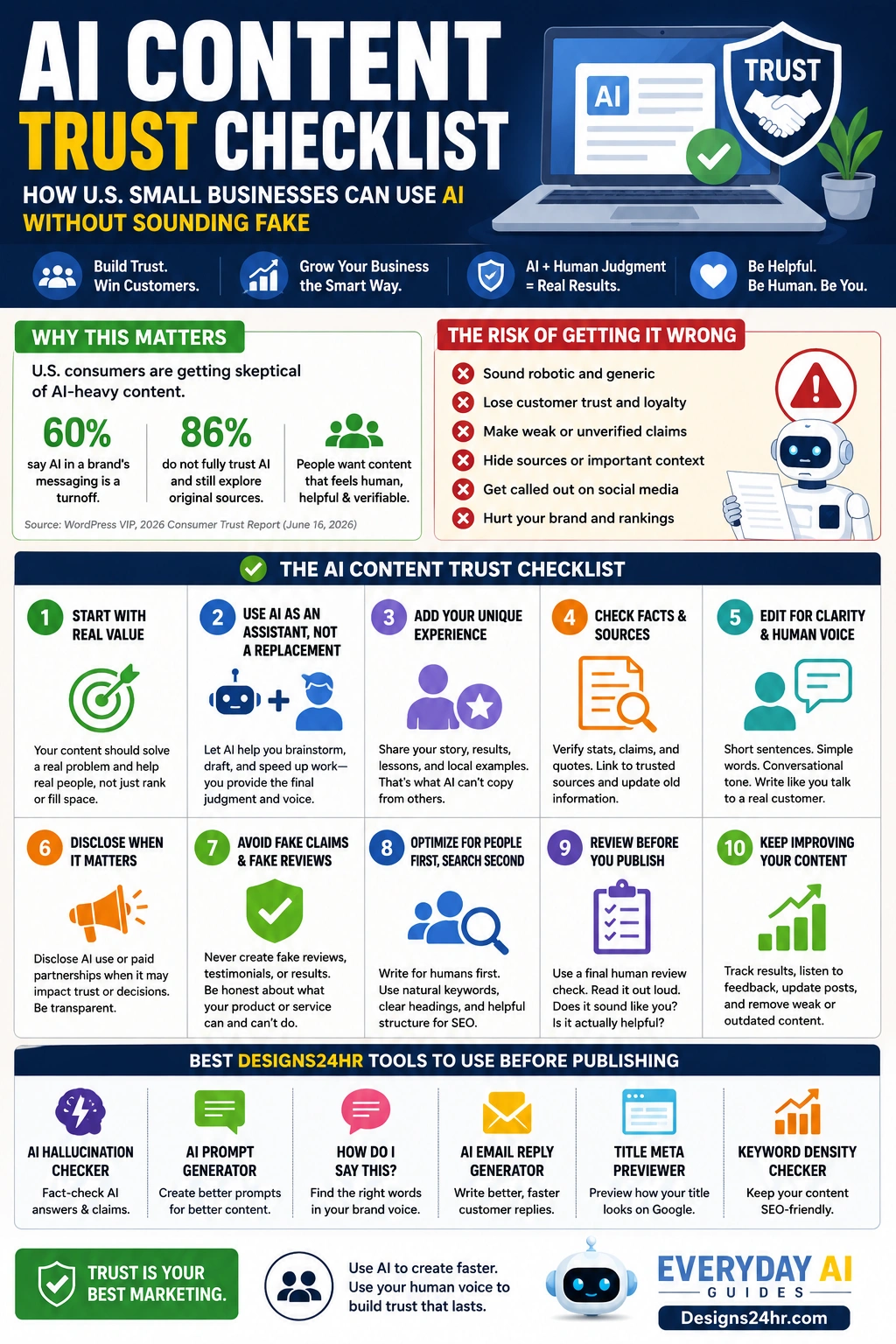
But customers are also becoming more skeptical. WordPress VIP research published through PR Newswire in June 2026 reported that 60% of consumers said AI in a brand’s messaging is a turnoff, while 86% said they always or sometimes explore the original source after receiving an AI summary. The same release points to source visibility as an important trust signal. You can review the report summary here: Brands Race to Be Seen by AI; Consumers Race to Verify the Source.
The lesson is not “never use AI.” The lesson is that businesses need to use AI carefully. Helpful content, honest claims, visible sources, and human voice matter more as AI-generated content becomes easier to publish.
said AI in a brand’s messaging is a turnoff, according to WordPress VIP research shared in June 2026.
said they always or sometimes explore the original source after receiving an AI summary.
AI should support your brand voice, not replace your honesty, judgment, or real customer experience.
What customers are really reacting to
Most customers are not angry that a small business used a tool. They are reacting to content that feels fake, vague, over-polished, repetitive, or disconnected from reality.
Statements like “best quality,” “industry-leading,” “guaranteed results,” or “revolutionary solution” mean very little without proof.
Repeated phrases, generic intros, and overly formal wording can make a real business sound like a template.
If your content uses statistics, laws, safety claims, prices, product comparisons, or health-related information, link to reliable sources.
Customers trust details only your business can provide: what you saw, what worked, what failed, what customers ask, and what you recommend from experience.
The AI content trust checklist
Use this checklist before publishing anything AI-assisted on your website, blog, email list, product page, ad, social media profile, or customer support workflow.
Start with a real customer problem
Before asking AI to write, define the customer problem clearly. Are people confused about pricing? Choosing between products? Comparing services? Looking for safety tips? Trying to understand a process? Your content should solve a real problem, not just fill space.
A strong prompt starts with the customer, the situation, the objection, the buying stage, and the outcome you want to help them reach.
Use AI as an assistant, not the final author
AI can help you brainstorm headlines, create outlines, simplify explanations, organize ideas, improve structure, and rewrite rough drafts. But the final content should still be reviewed by a person who understands the business, product, customer, offer, and brand.
If you copy and paste AI content without review, you risk publishing generic claims, wrong facts, awkward tone, and content that sounds like every other business in your niche.
Add your real experience
This is where small businesses can beat generic AI content. Add details from your own work: common customer questions, mistakes you see, local examples, product details, service steps, before-and-after lessons, support issues, or honest recommendations.
AI can imitate a confident voice, but it cannot truly replace your real experience with customers.
Check every fact, number, date, and claim
Do not trust AI-generated facts automatically. Review statistics, dates, product names, prices, legal statements, health claims, platform rules, shipping details, and competitor comparisons before publishing.
If the information affects money, safety, law, health, customer expectations, or a buying decision, verify it with a reliable source. For a simple review habit, use AI Hallucination Checker.
Remove generic AI phrases
Watch for filler phrases like “in today’s fast-paced digital world,” “unlock the power of,” “game-changing,” “seamless experience,” “elevate your brand,” or “revolutionize your workflow.” These can make a small business sound less human.
Replace broad phrases with specific wording your customers actually use. If a real customer would not say it, consider rewriting it.
Write like a real person from the business
Your content does not need to sound perfect. It needs to sound clear, helpful, honest, and human. Use shorter sentences, natural transitions, specific examples, and plain language.
If you need help finding the right tone for a customer message, try How Do I Say This? before publishing or replying.
Avoid fake reviews, fake testimonials, and fake results
Never use AI to create fake customer reviews, fake testimonials, fake before-and-after stories, fake case studies, fake screenshots, fake star ratings, or fake endorsements. These can damage trust and create legal risk.
The FTC announced a final rule banning fake reviews and testimonials in 2024 and said the rule allows civil penalties against knowing violators. Read the FTC announcement here: Federal Trade Commission Announces Final Rule Banning Fake Reviews and Testimonials.
Disclose AI, sponsorships, or synthetic media when it matters
Not every AI-assisted draft needs a huge disclaimer. But disclosure becomes more important when AI involvement could affect trust, buying decisions, sponsored content, testimonials, influencer-style posts, AI avatars, synthetic images, or product demonstrations.
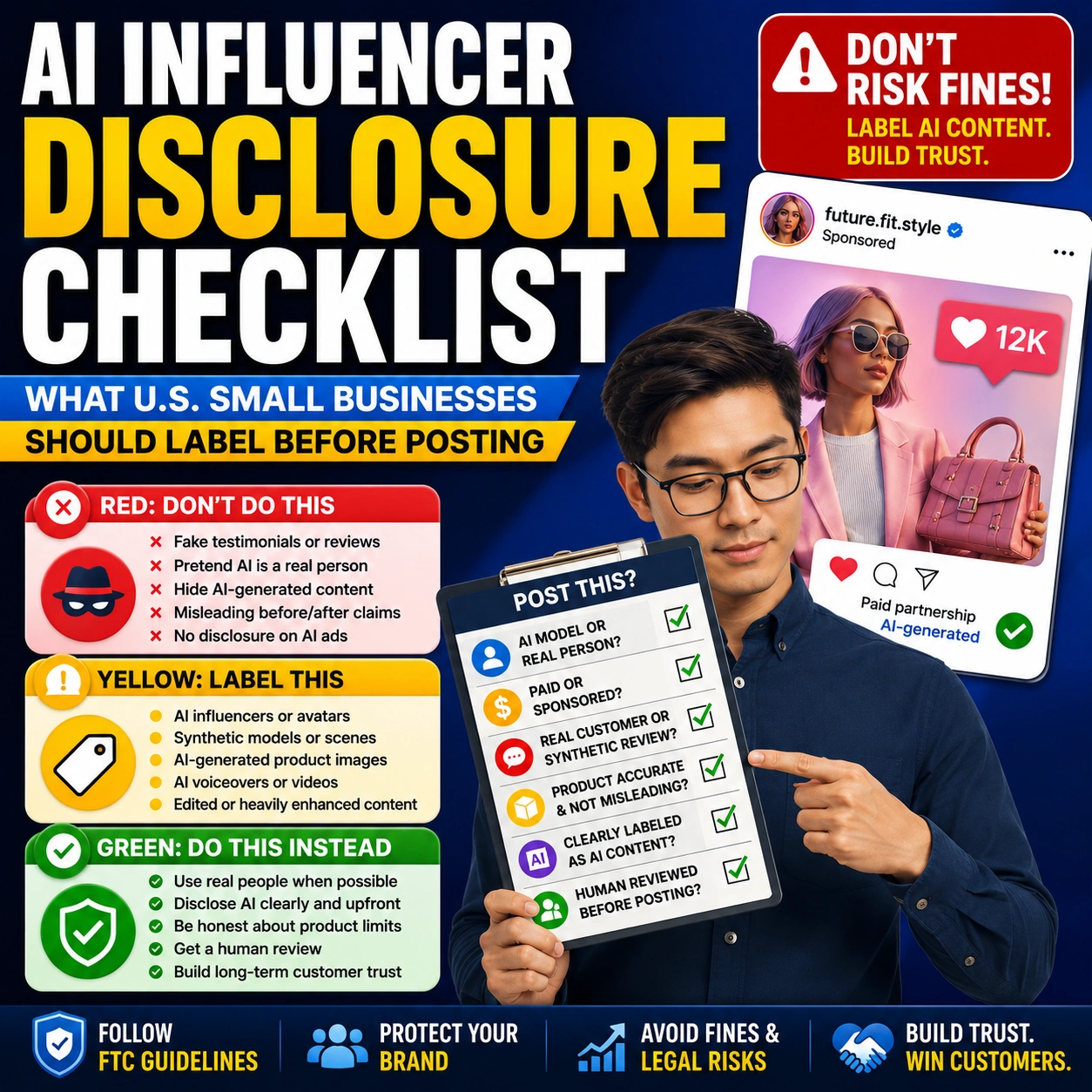
For related guidance, read AI Influencer Disclosure Checklist and the FTC’s business guidance on endorsements, influencers, and reviews.
Optimize for people first, search second
SEO matters, but content that only targets keywords can feel thin. Start with the reader’s question, answer it clearly, organize the page well, and include helpful headings, examples, links, and next steps.
After the content is useful, then check your title, meta description, keyword balance, and search preview with tools like Title Meta Previewer and Keyword Density Checker.
Run a final human review before publishing
Read the content out loud. Ask: Does this sound like us? Is it useful? Is anything exaggerated? Are the facts correct? Are sources linked? Is the offer clear? Would a real customer trust this?
If the answer is no, revise before publishing. AI can speed up the first draft, but human review protects the brand.
AI content mistakes that can hurt customer trust
- Publishing AI-written content without reading it carefully.
- Using statistics without linking to the original source.
- Making product claims your business cannot prove.
- Letting every page sound like a generic marketing template.
- Using fake urgency, fake scarcity, or fake customer stories.
- Creating AI-generated testimonials from imaginary customers.
- Posting AI images that make a product, result, or service look misleading.
- Ignoring customer comments that point out errors or unclear claims.
What to check before publishing AI-written content
| Content type | Trust risk | Human review step |
|---|---|---|
| Blog post | Wrong facts, thin advice, repeated structure, missing sources. | Check sources, add experience, improve examples, and make the article more useful than a basic AI answer. |
| Email campaign | Overpromising, sounding too salesy, unclear offer, fake urgency. | Read it like a customer. Make the offer clear, honest, specific, and easy to understand. |
| Product description | Incorrect features, exaggerated benefits, unclear materials, misleading use cases. | Compare the copy against the real product, photos, file formats, measurements, and customer expectations. |
| Landing page | Big claims without proof, weak differentiation, too much generic wording. | Add proof points, FAQs, who it is for, who it is not for, and clear next steps. |
| Social media post | Clickbait, unclear disclosure, fake-sounding captions, unsupported claims. | Make the post simple, useful, accurate, and written in your real brand voice. |
| Customer reply | Cold tone, wrong policy, missed context, incorrect promises. | Check the customer’s actual issue, your real policy, and the tone before sending. |
| Ad copy | Misleading results, unsupported comparisons, compliance problems. | Verify claims, avoid fake urgency, and make sure the promise matches the product or service. |
| FAQ section | Answers that sound helpful but are too vague or inaccurate. | Use real customer questions, direct answers, and accurate policy or product details. |
How to make AI content sound more human
Human-sounding content does not mean casual, messy, or unprofessional. It means the content feels like it came from a real business with real experience and real customers.
Add details AI cannot know by itself
- What customers ask before buying.
- What mistakes you see often.
- What you recommend based on experience.
- What makes your product, service, location, or process different.
- What limitations or tradeoffs customers should know.
Use simpler wording
- Replace big claims with clear benefits.
- Use short sentences where possible.
- Remove repeated phrases.
- Use customer language instead of corporate language.
- Write like you are helping one person make a better decision.
What small businesses should never fake with AI
AI can help with planning, drafting, editing, summarizing, and organizing. It should not be used to create fake proof. Trust is hard to earn and easy to lose.
Fake reviews
Do not create reviews from imaginary customers. Reviews should reflect real customer experiences.
Fake testimonials
Do not write testimonials for people who never gave them. Do not edit real testimonials in a misleading way.
Fake results
Do not claim guaranteed results, income, rankings, savings, health outcomes, or business growth you cannot prove.
Fake screenshots
Do not create artificial dashboards, messages, ratings, or payment screenshots that make results look real.
Fake expertise
Do not let AI make your business sound qualified in areas where you are not qualified.
Fake scarcity
Do not use AI to create false urgency, fake countdowns, or misleading “almost sold out” claims.
How AI content can still help your business
Used carefully, AI can be a strong support tool for small businesses. The U.S. Chamber’s CO— article on AI-powered growth engines says AI is becoming a strategic asset for small businesses, supporting areas like content creation, customer service, hiring, and decision-making while still emphasizing the value of authentic human perspective. You can read it here: AI-Powered Growth Engines: How Small Businesses Are Scaling Smarter in 2026.
The best approach is not to avoid AI completely. It is to build a smarter workflow where AI helps with speed and structure while people protect accuracy, trust, judgment, and brand voice.
Ask for topic angles, outlines, FAQs, titles, customer objections, and content structure.
Ask it to simplify rough wording, organize messy notes, or turn bullet points into a cleaner draft.
Review claims, add examples, check sources, and make sure the final content sounds like your business.
A simple AI content workflow for small businesses
- Choose the customer problem. Start with a question your audience already has.
- Create a strong prompt. Include audience, goal, tone, product details, offer, and constraints.
- Generate an outline first. Review the structure before writing the full draft.
- Add your real details. Include examples, customer questions, process notes, product details, and experience.
- Fact-check everything important. Verify dates, stats, policies, claims, prices, and sources.
- Edit for brand voice. Remove generic AI wording and rewrite it like your business would actually say it.
- Check the SEO basics. Review the title, meta description, headings, keyword use, and internal links.
- Run a final trust review. Ask whether the content is useful, honest, accurate, clear, and customer-friendly.
- Publish and improve. Track results, read comments, answer questions, and update outdated content.
Best Designs24hr tools to use before publishing
These tools can help you create better AI-assisted content while keeping the final output clearer, more useful, and more search-friendly.
- AI Prompt Generator — create better prompts before asking AI to draft content.
- How Do I Say This? — rewrite difficult messages in a clearer, more human tone.
- AI Email Reply Generator — draft customer replies faster while keeping the final review human.
- AI Hallucination Checker — review AI answers and claims before trusting them.
- Title Meta Previewer — preview how your SEO title and meta description may look before publishing.
- Keyword Density Checker — check whether your article uses keywords naturally without stuffing.
People-first SEO still matters
AI content is not automatically bad for SEO. The bigger issue is whether the content is useful, original, accurate, and written for real readers. If a page is thin, copied, generic, repetitive, misleading, or created only to target keywords, it is unlikely to build long-term trust.
For small businesses, the strongest content usually answers real customer questions better than competitors do. That means clear explanations, practical examples, honest limitations, helpful visuals, internal links, credible external sources, and a final human review.
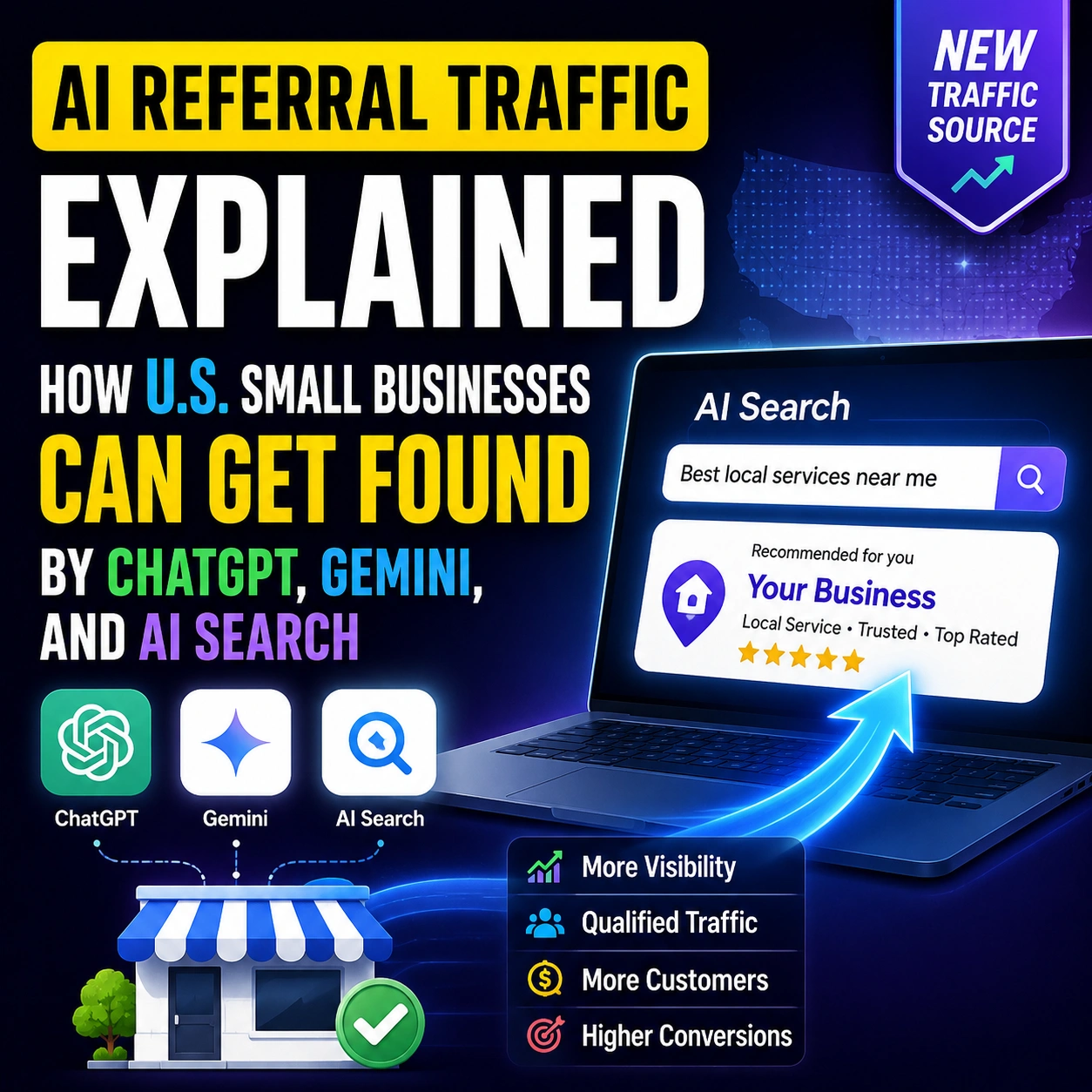
If your business wants to understand AI visibility beyond traditional search, read AI Referral Traffic Explained: What Small Businesses Should Know About ChatGPT, Perplexity, and Gemini Visitors.
Related Designs24hr guides
- Everyday AI Guides for simple AI explainers across work, school, family, safety, creativity, smart living, and small business.
- AI for Small Business & Marketing for AI tools, branding, content, customer communication, and growth ideas.
- AI Safety, Privacy & Trust for safer AI habits, scams, fake media, privacy, passwords, and trust-focused AI guides.
- AI Influencer Disclosure Checklist for sponsored posts, synthetic media, endorsements, and clearer labeling.
- AI Referral Traffic Explained for small businesses tracking visitors from AI search and answer engines.
Helpful sources
- PR Newswire / WordPress VIP: Brands Race to Be Seen by AI; Consumers Race to Verify the Source
- U.S. Chamber CO—: AI-Powered Growth Engines: How Small Businesses Are Scaling Smarter in 2026
- FTC: Federal Trade Commission Announces Final Rule Banning Fake Reviews and Testimonials
- FTC Business Guidance: Endorsements, Influencers, and Reviews
Frequently asked questions
What is an AI content trust checklist?
An AI content trust checklist is a review process small businesses can use before publishing AI-assisted content. It helps check whether the content is accurate, helpful, human-sounding, source-supported, and not misleading.
Can small businesses use AI to write website content?
Yes. Small businesses can use AI for drafts, outlines, ideas, emails, product descriptions, social posts, and blog planning. The safest approach is to review, edit, fact-check, and add real business experience before publishing.
Why does AI content sometimes sound fake?
AI content can sound fake when it uses generic phrases, vague promises, repeated structures, unsupported claims, and no real examples. Adding brand voice, customer language, specific details, and human review makes it stronger.
Should I disclose that AI helped create my content?
It depends on the content and context. If AI involvement could affect customer trust, advertising clarity, testimonials, influencer-style content, synthetic images, or sponsored posts, clear labeling is safer.
Can AI write customer reviews or testimonials?
No. Small businesses should not use AI to create fake reviews, fake testimonials, fake customer stories, or fake endorsements. Reviews and testimonials should come from real customer experiences.
How do I make AI marketing content more trustworthy?
Start with a real customer problem, verify every claim, cite trusted sources when needed, add your own examples, remove robotic wording, avoid exaggeration, and run a final human review before publishing.
Is AI content bad for SEO?
Not automatically. AI-assisted content can work when it is useful, original, accurate, well-structured, and edited for real readers. Thin, generic, repeated, or misleading AI content is the bigger risk.
What should I check before posting AI-written social media content?
Check the claim, tone, source, offer, disclosure, audience fit, image accuracy, and whether the post could mislead customers. Also confirm the post sounds like your brand, not a generic AI template.
Can AI help with customer emails?
Yes, AI can help draft customer replies faster, but a human should review the tone, policy, promise, and details before sending. Never let AI promise refunds, delivery dates, results, or exceptions that your business cannot honor.
What is the best way to review AI content before publishing?
Read the content out loud, verify facts, check links, remove generic wording, add real examples, confirm the offer, review the SEO title and meta description, and ask whether a real customer would find the page helpful and trustworthy.
Use AI to create faster, but keep trust human
Explore more simple AI guides and free tools for small business content, customer communication, SEO, privacy, and safer everyday AI use.
Explore Everyday AI Guides