AI Influencer Disclosure Checklist: What U.S. Small Businesses Should Label Before Using AI Models, Avatars, or Synthetic Ads
AI influencer disclosure is becoming more important as small businesses use AI-generated influencers, synthetic models, AI avatars, edited product photos, and virtual ad scenes. This checklist helps U.S. small businesses label AI marketing clearly, avoid fake customer experiences, and protect customer trust before posting.
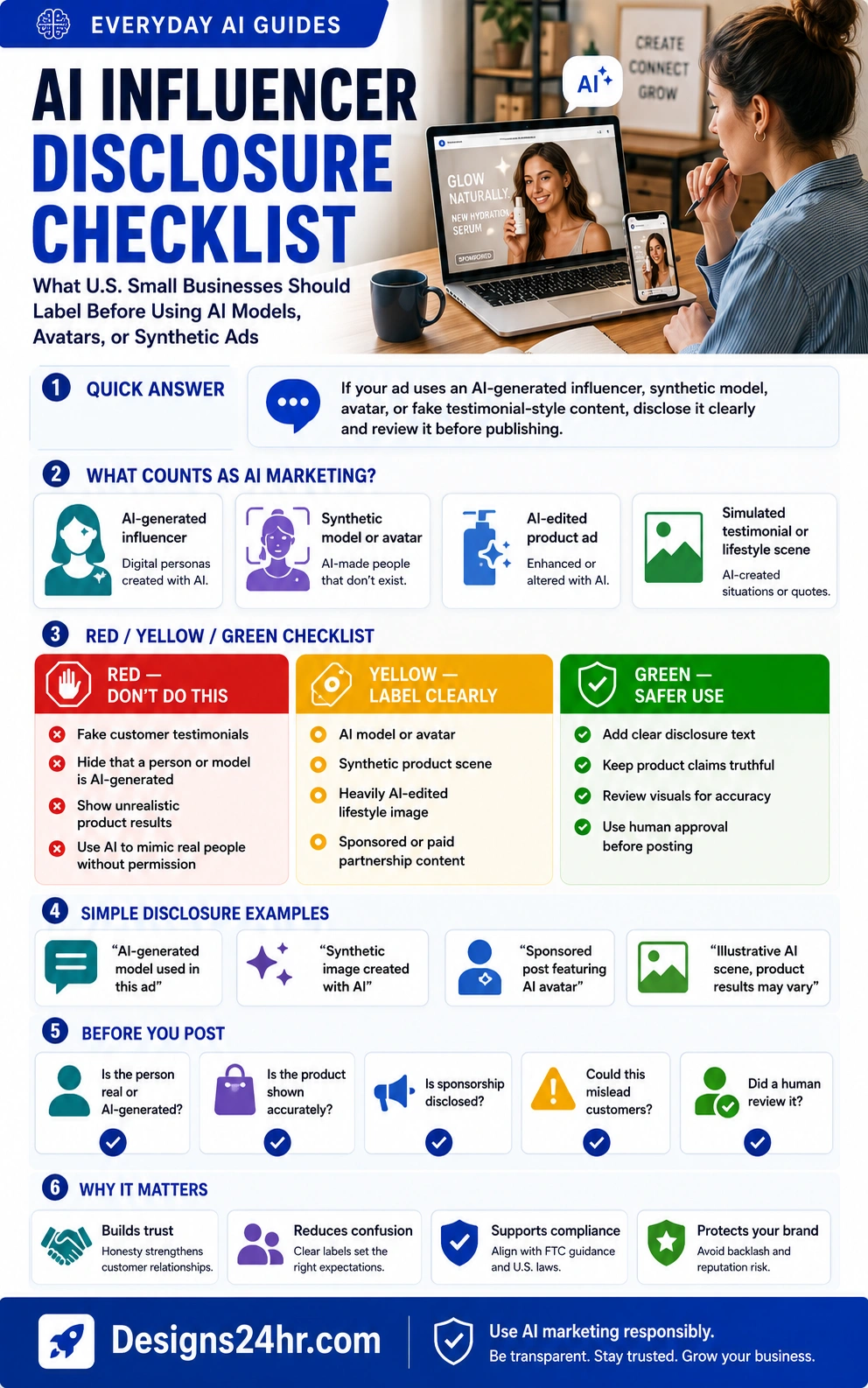
Quick answer: If your ad uses an AI-generated influencer, synthetic model, AI avatar, fake lifestyle scene, AI-edited product result, or testimonial-style content that could make customers think a real person used or endorsed your product, label it clearly and review it before publishing.
Do You Need to Disclose AI Influencers?
Small businesses should treat AI influencer disclosure as a trust and advertising-safety issue. Even when there is not one single AI-labeling rule for every platform and situation, U.S. businesses still need to avoid misleading customers, fake testimonials, hidden sponsorships, exaggerated results, and unclear endorsements.
The safest approach is simple: if AI makes a person, review, lifestyle scene, product result, endorsement, or sponsored post look more real than it is, add a clear label. A short disclosure can prevent confusion and help customers understand what they are seeing.
Label synthetic people
If a model, influencer, customer, spokesperson, or avatar is AI-generated, label it when the content could be mistaken for a real person.
Do not fake experience
Do not create fake customer reviews, fake testimonials, fake before-and-after claims, or pretend a synthetic person actually used your product.
Be clear upfront
Use simple labels such as “AI-generated model,” “Synthetic image,” “AI avatar,” or “Illustrative AI scene” near the content.
What Counts as an AI Influencer or Synthetic Ad?
An AI influencer is a digital character or synthetic person created with AI and used in promotional content. A synthetic ad may include AI-generated models, AI avatars, fake lifestyle scenes, AI-edited product photos, AI voiceovers, or AI-created testimonial-style posts.
AI-generated influencer
A digital persona that looks like a real creator, model, reviewer, customer, or spokesperson but was created with AI.
Synthetic product ad
A product shown in an AI-generated room, lifestyle setting, outdoor scene, office, beauty setup, or customer-style moment.
Heavily edited visual
A real product photo that has been changed with AI in a way that could affect size, color, texture, fit, results, or expectations.
Fake testimonial
A made-up quote, review, customer story, or endorsement that makes it look like a real person used and loved the product.
AI avatar or voiceover
A talking-head video, synthetic voice, AI presenter, or virtual spokesperson used to explain or promote a product.
Clearly labeled creative
AI visuals used for creative illustration, mood, examples, or inspiration when the product and claims are still accurate.
Why AI Influencer Disclosure Matters for Small Businesses
Small businesses use AI because it can make marketing faster, cheaper, and more polished. It can help create product images, social posts, ad concepts, avatars, videos, and campaign ideas without hiring a full production team.
But customer trust is fragile. If shoppers later realize a “customer,” “reviewer,” “model,” or “real-life scene” was artificial and unlabeled, they may feel misled. That can hurt conversions, reviews, brand reputation, and long-term loyalty.
What customers expect
- Truthful product claims
- Clear sponsorship labels
- No fake customer reviews
- No misleading before-and-after results
- Honest visuals that match the real product
What businesses should protect
- Customer trust
- Brand reputation
- Platform account safety
- Ad approval quality
- Compliance with advertising expectations
The Red-Yellow-Green AI Marketing Checklist
Use this checklist before posting AI influencers, synthetic models, AI avatars, AI product ads, AI lifestyle images, or promotional content created with generative AI.
Don’t Do This
- Do not create fake customer testimonials or reviews.
- Do not pretend an AI-generated person is a real customer.
- Do not hide that a model, avatar, or influencer is AI-generated when it could mislead customers.
- Do not show unrealistic product results, fake before-and-after outcomes, or exaggerated use cases.
- Do not use AI to copy a real person’s face, voice, or style without permission.
- Do not post sponsored or paid content without a clear sponsorship disclosure.
Label Clearly
- Label AI-generated influencers, models, avatars, or spokespeople.
- Label synthetic lifestyle scenes that look like real customer experiences.
- Label heavily AI-edited product photos if the edits affect customer expectations.
- Label AI voiceovers or talking avatars when they appear to be real endorsers.
- Label sponsored AI content when a brand relationship, payment, gift, or affiliate link exists.
- Label illustrative AI scenes when the product setting is not real.
Safer Use
- Use AI for clearly labeled creative concepts, not fake experiences.
- Keep product claims accurate, specific, and provable.
- Use real product photos when product details matter.
- Place disclosures where customers can easily see them.
- Review every AI-generated visual before posting.
- Use human approval before publishing ads, emails, product pages, or influencer-style posts.
FTC Disclosure Basics for Influencers and Brands
The FTC’s influencer guidance focuses on clear disclosure when there is a material connection between a brand and the person promoting a product. A material connection can include payment, free products, gifts, discounts, affiliate commissions, employment, or another relationship that could affect how customers view the endorsement.
For AI influencer disclosure, the practical small-business takeaway is this: do not make an ad look like a real independent customer endorsement if it is actually synthetic, paid, scripted, AI-generated, or controlled by the brand.
Simple rule for U.S. small businesses
If a customer would care that the person, review, image, scene, or endorsement is AI-generated, paid, sponsored, edited, or controlled by your business, make that information easy to see before they rely on the content.
Important note
This guide is general educational information for small businesses and creators. It is not legal advice. For regulated products, high-risk claims, health/beauty results, financial offers, children’s products, or complex campaigns, consider professional legal or compliance review.
Simple AI Disclosure Examples
Good disclosures should be clear, easy to notice, and close to the content. Avoid hiding them in a long caption, tiny text, or a separate page that most customers will not read.
“AI-generated model used in this ad.”
Use this when the person shown is not a real model, customer, creator, or spokesperson.
“Synthetic image created with AI.”
Use this when the background, room, lifestyle setup, or product scene was generated with AI.
“AI avatar used for illustration.”
Use this when a virtual presenter or digital character explains or promotes a product.
“Illustrative AI scene. Product results may vary.”
Use this when AI helps create a lifestyle scene that should not be read as a guaranteed product result.
“Sponsored post featuring an AI-generated avatar.”
Use this when the content is both sponsored and uses a synthetic person or AI presenter.
“Real customer review” when it is not real
Do not describe synthetic endorsements as real reviews, real customers, or real product experiences.
What to Label on Instagram, TikTok, Etsy, Ads, and Websites
Different platforms may have different tools and policies, but the same trust rule applies everywhere: customers should not have to guess whether a person, testimonial, lifestyle image, or product result is real or synthetic.
| Platform or Placement | What to Watch | Safer Label Example |
|---|---|---|
| Instagram post or Reel | AI influencer, sponsored content, beauty results, product demonstration, or fake customer-style scene. | “AI-generated model used. Sponsored post.” |
| TikTok or short-form video | AI avatar, synthetic voice, scripted endorsement, or fake testimonial-style content. | “AI avatar used for this product explanation.” |
| Etsy listing images | AI lifestyle mockups, unrealistic product size, false material appearance, or synthetic model wearing a product. | “AI lifestyle mockup. Actual product files shown in preview.” |
| Facebook or Google ad | Synthetic people, edited product results, sponsored claims, or visually enhanced before-and-after examples. | “AI-generated visual. Product results may vary.” |
| Website hero image | AI-generated team members, fake customers, imaginary storefronts, or synthetic product use scenes. | “Illustrative AI-generated image.” |
| Email marketing | AI testimonials, AI product visuals, sponsored offers, or performance claims. | “AI-generated illustration used for visual example.” |
AI Product Photos vs. Misleading Product Results
AI product visuals can be helpful for brainstorming, mockups, seasonal campaigns, and polished social graphics. But small businesses should be careful when AI changes what customers believe they will receive.
Usually safer
- AI background behind an accurately shown product
- Clearly labeled lifestyle mockup
- Concept art for a future idea
- Ad creative that does not change product details
- General illustration for a blog, guide, or educational post
Higher risk
- AI makes the product look larger, higher quality, or more premium than it is
- AI changes color, texture, material, fit, or packaging
- AI shows a result the product cannot realistically deliver
- AI creates fake customer photos or reviews
- AI hides defects, limitations, scale, or important usage details
Before You Post: Small Business Review Checklist
Use this quick review before posting AI influencer marketing, AI product ads, synthetic lifestyle visuals, or AI avatar videos.
Real or AI?
Could customers think the person, model, influencer, or reviewer is real?
Paid or sponsored?
Is there payment, a free product, affiliate commission, partnership, or brand relationship?
Real customer?
Does the post imply a real customer used, reviewed, or recommended the product?
Product accurate?
Does the visual accurately show size, color, material, quality, fit, packaging, and realistic results?
Clearly labeled?
Is the disclosure easy to see, simple to understand, and close to the AI-generated or sponsored content?
Best publishing habit
Before posting, ask: “Would a normal customer understand what is real, what is AI-generated, what is sponsored, and what product result they can realistically expect?” If the answer is unclear, revise the post or add a clearer disclosure.
Helpful Designs24hr Guides and Tools
For more practical AI marketing and safety guides, explore Everyday AI Guides, especially AI for Small Business & Marketing, AI Safety, Privacy & Trust, and AI for Design & Creativity.
For better prompts
Use the AI Prompt Generator to create clearer AI marketing prompts while avoiding fake claims or misleading testimonial wording.
For SEO previews
Use the Title/Meta Previewer before publishing product pages, ads, or blog posts.
For design consistency
Use the Color Palette Generator to keep AI-created ads on-brand and visually consistent.
For image prep
Use the Image Resizer to prepare social thumbnails, product previews, and campaign graphics.
For creative workflow
Read Adobe Creative Agent Explained for a simple guide to AI-assisted creative tools.
For workplace safety
Read Shadow AI at Work Checklist before using AI tools with business data, client files, or internal content.
Official and Reference Sources
Advertising rules, platform policies, and AI labeling expectations can change. Always check the latest platform rules and official guidance before running important campaigns.
FAQ About AI Influencer Disclosure
What is AI influencer disclosure?
AI influencer disclosure means clearly labeling when a promotional post uses an AI-generated influencer, synthetic model, AI avatar, or AI-created testimonial-style content so customers are not misled.
Do small businesses need to disclose AI-generated influencers?
Small businesses should disclose AI-generated influencers when the content could make customers believe a real person, customer, model, or reviewer is endorsing a product. The safest approach is to label synthetic or AI-generated promotional content clearly.
Does the FTC require influencer disclosures?
The FTC says influencers and brands should clearly disclose material relationships, such as paid partnerships, free products, sponsorships, affiliate links, or other connections that could affect how people view an endorsement.
What AI marketing content should be labeled?
Label AI-generated influencers, synthetic models, AI avatars, fake lifestyle scenes, heavily AI-edited product visuals, AI voiceovers, AI-generated testimonials, and any paid or sponsored AI-created content.
Can I use an AI model to promote my product?
Yes, but the product must be shown truthfully, the AI model should not pretend to be a real customer, and the AI-generated or synthetic nature should be clear when it could affect customer understanding.
Are fake AI testimonials risky?
Yes. Fake AI testimonials are risky because they can make customers believe a real person used, experienced, or recommended a product when that did not happen.
What is a simple AI disclosure example?
Simple examples include “AI-generated model used in this ad,” “Synthetic image created with AI,” “AI avatar used for illustration,” or “Illustrative AI scene. Product results may vary.”
Can AI product photos be misleading?
Yes. AI product photos can be misleading if they exaggerate size, quality, color, texture, fit, results, packaging, or real-life use. Businesses should review AI visuals carefully before posting.