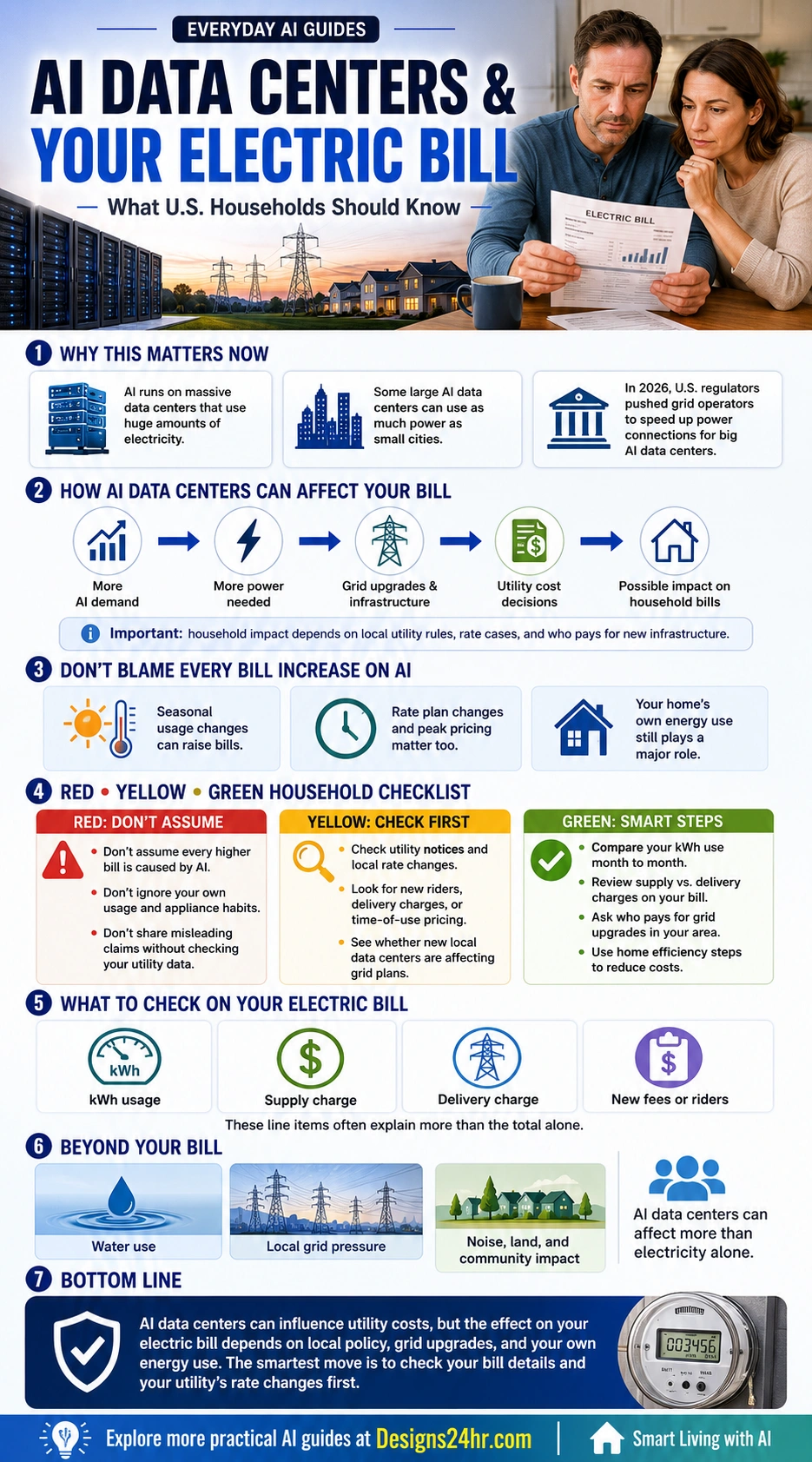
AI Data Centers and Your Electric Bill Explained: What U.S. Households Should Know
AI data centers electric bill questions are becoming more common as AI tools grow and large data centers connect to the power grid. This guide explains how AI data centers may affect electricity demand, local utility costs, household bills, water use, and what families should check before blaming AI for every higher bill.
Quick answer: AI data centers can increase local electricity demand and may influence grid upgrade costs, utility planning, and future rate decisions. But your electric bill also depends on your own kWh usage, weather, rate plan, supply charges, delivery charges, local utility rules, and who pays for new infrastructure.
Are AI Data Centers Raising Electric Bills?
AI data centers can contribute to higher electricity demand, especially in areas where many large facilities connect to the same regional grid. However, a household’s electric bill is not controlled by AI data centers alone. Bills usually reflect a mix of personal energy use, seasonal heating or cooling, utility supply costs, delivery charges, grid upgrades, rate plans, state regulation, and local infrastructure decisions.
The best way to understand the issue is to separate two questions. First, are data centers increasing electricity demand? In many regions, yes. Second, does that automatically mean your specific bill increase is caused by AI? Not always. You need to check your bill details and local utility notices first.
What Are AI Data Centers?
AI data centers are large facilities filled with servers, specialized chips, storage systems, networking equipment, cooling systems, backup power, and security infrastructure. They support AI services such as chatbots, image generators, search assistants, coding tools, video tools, business AI systems, and cloud computing platforms.
For everyday users, the AI tool may look like a simple app or website. But behind that app is physical infrastructure that needs electricity and sometimes water for cooling. That is why data centers are now part of the national conversation about power grids, utility bills, local permits, and community impact.
Why AI Needs So Much Electricity
AI data centers use electricity for more than answering a prompt. They power servers, GPUs or accelerators, cooling equipment, networking systems, storage, building operations, and backup systems. The more people and companies use AI, the more demand there can be for compute capacity.
More AI use
Consumers and businesses use more AI tools for work, search, writing, images, code, and video.
More compute
More servers and AI chips are needed to process prompts, train systems, and run AI services.
More cooling
High-powered equipment creates heat, so cooling systems also require energy and, in some cases, water.
Grid upgrades
Utilities may need new lines, substations, generation, storage, or transmission upgrades.
Rate questions
Regulators, utilities, data centers, and customers may debate who should pay for new infrastructure.
What FERC’s 2026 Grid Order Means
In June 2026, the Federal Energy Regulatory Commission directed major grid operators to move faster on rules for connecting large electricity users such as AI data centers. The goal is to help the grid handle rising demand while keeping reliability and customer costs in view.
For households, this does not mean a data center will instantly raise every electric bill. It means regulators are paying attention to a major question: how should the power system connect large AI-related loads quickly without shifting unfair costs onto regular customers?
Why this matters for families
If new power lines, substations, generation, or grid upgrades are needed, someone has to pay. Depending on local rules, those costs may be paid by the data center, the utility, a group of customers, or through a rate structure approved by regulators. That cost-allocation question is the part households should watch.
How AI Data Centers Can Affect Local Electric Bills
Data centers may affect bills indirectly when they increase local demand, require new infrastructure, change utility planning, or influence wholesale power costs. But the impact depends heavily on location. A region with many new data center projects may feel different pressure than a region with fewer large-load requests.
| Possible Factor | How It Can Affect Bills | What Households Should Check |
|---|---|---|
| Higher local demand | More electricity demand can require more generation, transmission, or grid capacity. | Look for local news about large-load projects, utility planning, and regional grid studies. |
| Grid upgrades | New substations, lines, transformers, or infrastructure may create cost-allocation debates. | Check whether regulators require data centers to pay their own upgrade costs. |
| Supply costs | Wholesale power costs can influence the supply portion of some bills. | Review the supply or generation line item, especially if your utility or supplier changes rates. |
| Delivery charges | Infrastructure and grid maintenance often show up in delivery, distribution, or transmission charges. | Compare delivery charges month over month and read utility notices about rate changes. |
| New riders or fees | Some utilities add riders, surcharges, or adjustment fees for specific costs. | Look for new bill line items, riders, infrastructure fees, or cost recovery charges. |
| Your own usage | Weather, HVAC use, appliances, insulation, and habits can raise kWh usage. | Compare your kWh usage to the same month last year before blaming AI or data centers. |
Red-Yellow-Green Household Checklist
Use this checklist before assuming an AI data center caused a higher electric bill. It helps you avoid false assumptions while still paying attention to real grid and utility changes.
Don’t Assume
- Do not blame every bill increase on AI without checking your usage.
- Do not ignore seasonal heating, cooling, or appliance changes.
- Do not rely only on social media claims about data centers.
- Do not overlook new rate plans, delivery charges, or utility riders.
- Do not assume using ChatGPT on your phone is the main reason your home bill went up.
Check First
- Check utility notices, rate-case updates, and local regulator decisions.
- Look for new riders, delivery charges, adjustment fees, or peak pricing.
- Check whether local data center projects are being approved nearby.
- Ask who pays for grid upgrades tied to large new power users.
- Compare your current bill to the same month last year.
Smart Steps
- Track your monthly kWh usage, not just the total dollar amount.
- Review supply, delivery, taxes, fees, and rider line items separately.
- Use your utility’s online bill comparison tools when available.
- Ask your utility what caused recent rate changes.
- Use efficiency steps to reduce controllable home energy costs.
What to Check on Your Electric Bill
If your bill went up, start with the line items. The total amount is important, but the details explain more. A higher bill could come from higher usage, higher rates, new fees, seasonal demand, delivery costs, or changes in supply pricing.
kWh used
Compare your kilowatt-hour usage to the previous month and the same month last year.
Price per kWh
Check whether your energy rate changed. A higher price per kWh can raise the bill even if your usage is similar.
Grid charges
Delivery, distribution, and transmission charges may reflect grid costs, maintenance, and infrastructure investment.
New riders or surcharges
Look for new adjustment charges, riders, infrastructure fees, or cost recovery items.
Peak pricing
If you have time-of-use rates, peak-hour usage can make bills higher even when total kWh usage looks reasonable.
Heating and cooling
Air conditioning, electric heat, space heaters, dehumidifiers, and heat pumps can shift bills quickly during extreme weather.
Does Using ChatGPT at Home Directly Raise Your Electric Bill?
Using ChatGPT, Gemini, Claude, Copilot, or another AI tool on your phone or laptop usually does not add much to your home electricity usage by itself. Your device still uses some electricity, but the larger energy issue is the data center infrastructure behind AI services.
In other words, your personal AI app use is not the same as running a data center in your house. The bigger question is whether growing data center demand changes local utility planning, grid infrastructure costs, or future rates in your region.
Who Should Pay for Grid Upgrades?
This is one of the biggest policy questions behind AI data centers and electric bills. If a large data center needs new lines, substations, or grid upgrades, should the data center pay the full cost, or should some costs be spread across all customers?
If data centers pay directly
- Households may be more protected from project-specific upgrade costs.
- Large customers have stronger incentives to plan efficiently.
- Utilities may still need broader planning for reliability and future demand.
If costs are spread widely
- Residential customers may help pay for infrastructure used by large power users.
- Rate cases and riders become more important to watch.
- Consumer advocates may push for stronger cost protections.
Beyond Your Bill: Water, Noise, Land, and Community Impact
Electric bills are only one part of the data center conversation. Communities may also ask about water use, cooling methods, noise, backup power, land use, construction traffic, tax incentives, jobs, and whether local infrastructure can handle rapid growth.
Cooling can matter
Some data centers use water for cooling, while others use different methods. Local water stress can make this a major community issue.
Reliability questions
Large new loads can raise questions about grid reliability, peak demand, transmission planning, and backup power.
Local tradeoffs
Communities may weigh jobs, tax revenue, land use, noise, energy demand, water demand, and long-term infrastructure costs.
Questions to Ask Your Utility or Local Officials
Useful questions for households
- Are any new data centers or large-load customers connecting to our local grid?
- What new infrastructure is required, and who will pay for it?
- Will residential customers pay any portion through rates, riders, or fees?
- Has the utility filed a rate case or request for cost recovery?
- Are there protections to prevent household customers from subsidizing large users?
- Will the project affect local water use, noise, backup generation, or land use?
How Households Can Manage Their Own Electricity Costs
| Household Step | Why It Helps | What to Do |
|---|---|---|
| Compare kWh usage | Usage tells you whether the home consumed more energy, separate from rate changes. | Compare current month, last month, and same month last year. |
| Check HVAC settings | Heating and cooling are often major bill drivers. | Use efficient thermostat settings, replace filters, and seal obvious drafts. |
| Shift peak usage | Time-of-use plans can charge more during peak hours. | Run laundry, dishwashers, or EV charging during lower-cost hours if your plan rewards it. |
| Review old appliances | Inefficient appliances can increase usage quietly. | Check refrigerators, freezers, water heaters, space heaters, and older HVAC systems. |
| Read utility notices | Utilities often explain rate increases, riders, or new charges in bill inserts or online notices. | Search your utility website for rate case, tariff, rider, supply charge, or delivery charge updates. |
Helpful Designs24hr Guides and Tools
For more simple AI and smart-living guides, explore Everyday AI Guides, especially Smart Living with AI, AI News & Breakthroughs, and AI Tools & Beginner Guides.
Official and Reference Sources
- AP News: Federal regulators order grid operators to speed power to energy-hungry AI data centers
- Reuters: Top U.S. energy regulator pushes grids to overhaul data center power rules
- Penn State: What AI data centers could mean for your electric bill
- Consumer Reports: AI data centers’ impact on electric bills, water, and more
- U.S. Energy Information Administration: Data center electricity demand outlook
FAQ About AI Data Centers and Electric Bills
Are AI data centers raising electric bills?
AI data centers can add pressure to local electricity demand, but the effect on a household bill depends on local utility rules, grid upgrade costs, rate cases, household usage, and who pays for new infrastructure.
Why do AI data centers use so much electricity?
AI data centers use electricity to power servers, AI chips, cooling systems, networking equipment, storage, backup systems, and other infrastructure needed to train and run AI tools.
Can one AI data center use as much power as a small city?
Some large data centers can use extremely high amounts of electricity, and AP reported that some can consume more electricity than small cities.
What should I check on my electric bill first?
Check your kWh usage, supply charge, delivery charge, peak pricing, new fees, riders, seasonal changes, and whether your utility has announced rate increases or infrastructure cost recovery.
Does using ChatGPT at home directly raise my personal electric bill?
Using ChatGPT on your phone or laptop usually does not add much to your home electricity use. The bigger energy issue is the data center infrastructure behind AI services.
Can AI data centers affect water and local communities too?
Yes. Depending on where data centers are built and how they are cooled and powered, they can affect water use, local land use, noise, construction, grid planning, and community infrastructure.
Who pays for grid upgrades caused by new data centers?
That depends on utility rules, state regulators, rate structures, grid operators, and specific connection agreements. In many areas, regulators are debating how to make sure large power users pay fairly for infrastructure they require.