AI Hurricane Prep Checklist: 7 Ways U.S. Families Can Use AI Before Severe Weather Hits
Hurricanes and severe weather can move fast, but your family plan should not be rushed. This AI hurricane prep checklist shows U.S. families how to use AI to organize supplies, prepare for outages, protect pets and medications, and create a simple plan before the weather turns serious.
Last reviewed: June 18, 2026
An AI hurricane prep checklist can help you think through details you might forget when a storm is approaching. It can turn your household needs into a clear task list, help you organize an emergency kit, draft family check-in messages, and create reminders for power outages, pets, seniors, medications, and important documents.
But AI has a clear safety limit: it should help you prepare early, not make emergency decisions during the storm. For real-time warnings, evacuation orders, storm updates, and life-safety instructions, rely on official U.S. sources such as NOAA, the National Weather Service, Ready.gov, Wireless Emergency Alerts, and your local emergency officials.
What Is an AI Hurricane Prep Checklist?
An AI hurricane prep checklist is a simple planning method that uses AI to turn your family’s situation into practical preparation steps. Instead of staring at a long emergency list and wondering where to start, you can ask AI to organize your household needs into a clear plan.
For example, a family with two kids, a dog, prescription medications, a freezer full of food, and one car may need a different plan than a single renter in an apartment. AI can help personalize the checklist, but the safety instructions should always come from official emergency sources.
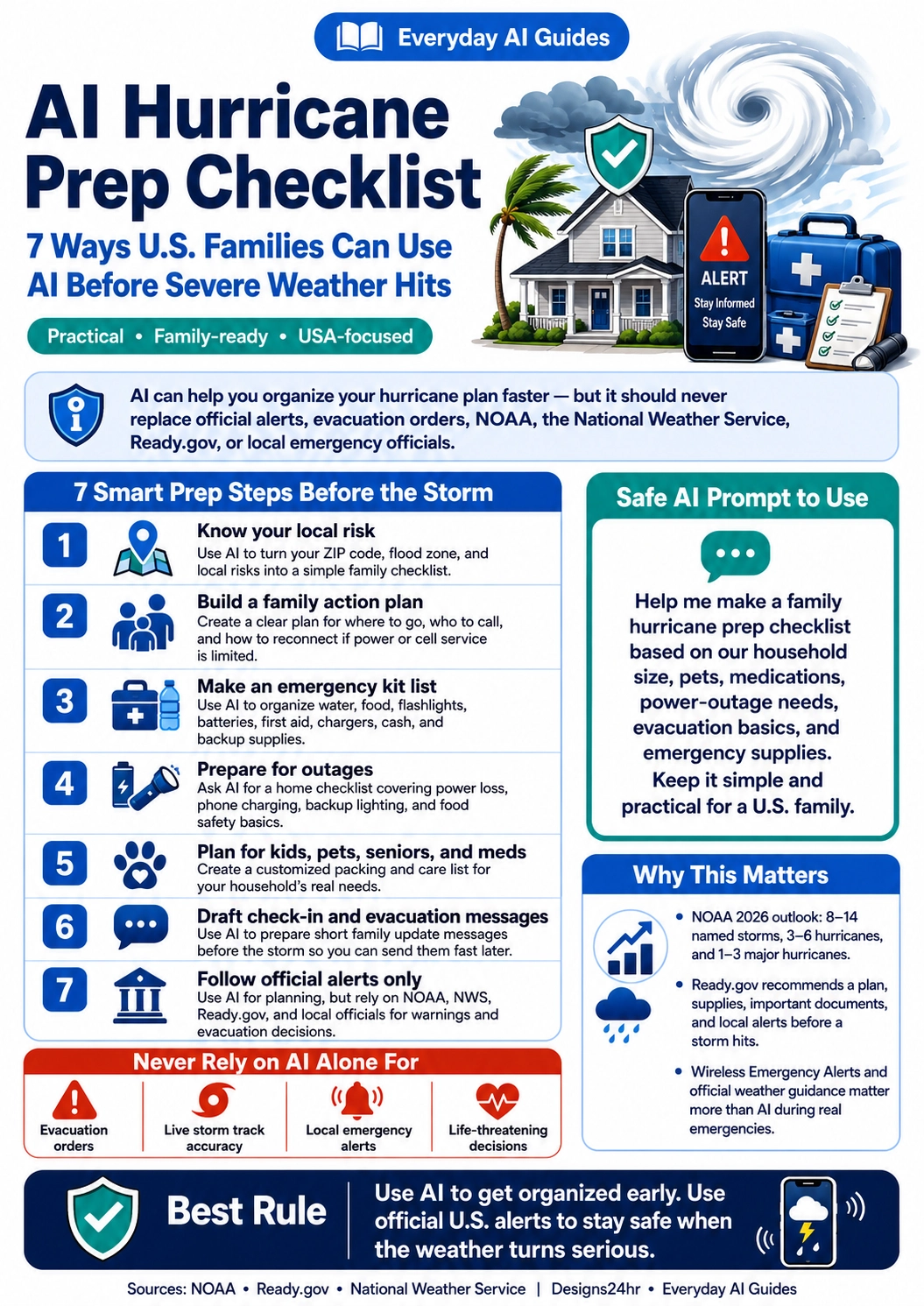
7 Smart Prep Steps Before the Storm
Use this hurricane prep checklist for families before a storm is close enough to create panic. The earlier you organize, the easier it is to make calm decisions.
- Know your local risk. Ask AI to help you turn your county, city, evacuation zone, flood risk, power-outage risk, and household needs into a simple planning checklist. For privacy, avoid pasting your exact home address into AI. Use general location details such as city, county, or region when possible.
- Build a family action plan. Create a clear plan for where your family will go, who will call whom, where you will meet if separated, and how you will reconnect if power or cell service becomes limited. Your plan should include local emergency contacts, an out-of-area contact, and a backup communication method.
- Make an emergency kit list. Use AI to organize supplies such as water, food, flashlights, batteries, first aid items, a battery-powered or hand-crank radio, chargers, cash, hygiene items, important documents, and backup supplies for kids, pets, or older adults.
- Prepare for outages. Ask AI for a home checklist covering phone charging, backup lighting, battery banks, refrigerator and freezer safety, medical devices, internet loss, and ways to keep essential information available offline.
- Plan for kids, pets, seniors, and medications. A strong family hurricane plan with AI should include real household details: baby supplies, pet food, carriers, leashes, prescriptions, mobility needs, glasses, hearing aids, medical equipment, and comfort items for children.
- Draft check-in and evacuation messages. Use AI to prepare short family update messages before the storm. That way, you can quickly send “we are safe,” “we are leaving,” “we are sheltering,” or “we lost power” messages if service becomes limited.
- Follow official alerts only. Use AI for planning and organization, but rely on NOAA, the National Weather Service, Ready.gov, Wireless Emergency Alerts, local officials, and emergency management offices for warnings, evacuation orders, shelter instructions, and life-safety decisions.
Safe AI Prompt to Use for Hurricane Prep
Copy this prompt into your AI tool and customize it with general household details. Do not include private documents, exact addresses, medical record numbers, account numbers, or sensitive identity information.
Never Rely on AI Alone For These Decisions
AI can be useful before the storm, but it is not the right source for live emergency judgment. Do not use AI as your authority for:
- Evacuation orders
- Live storm track accuracy
- Local emergency alerts
- Road closure decisions
- Floodwater safety
- Rescue decisions
- Medical emergencies
- Whether it is safe to return home
- Life-threatening choices during active severe weather
Why This Matters for the 2026 Hurricane Season
NOAA’s 2026 Atlantic hurricane outlook forecasts 8–14 named storms, 3–6 hurricanes, and 1–3 major hurricanes. Even if a season is forecast to be quieter than average, one storm can still create major disruptions for a family that is not prepared.
Ready.gov recommends that households know their risks, make a plan, gather supplies, get local alerts, and prepare before a hurricane strikes. This is exactly where AI can help: not by predicting the storm, but by helping your family turn official guidance into a simple, personalized action plan.
AI Severe Weather Checklist for U.S. Families
Use this table to turn broad hurricane advice into practical household actions.
| Prep Area | How AI Can Help | Official-Alert Boundary |
|---|---|---|
| Family plan | Create a checklist for contacts, meeting places, shelter options, transportation, and backup communication. | Follow local emergency officials for evacuation routes, shelters, and timing. |
| Emergency kit | Build a supply list for water, food, batteries, flashlight, radio, chargers, first aid, hygiene, and cash. | Use Ready.gov and local guidance for official supply recommendations. |
| Power outage prep | Make a phone-charging plan, food-safety checklist, flashlight checklist, and backup-device reminder list. | Follow utility company and local emergency updates for outage and restoration information. |
| Pets and medications | Create a packing list for prescriptions, pet food, carriers, leashes, medical devices, and comfort items. | Check official shelter rules because not every shelter accepts pets or specific medical needs. |
| Evacuation messages | Draft short texts for family updates, neighbor check-ins, and out-of-area contacts. | Evacuate only based on official instructions, local orders, and emergency guidance. |
What to Include in a Hurricane Emergency Kit
Your kit should match your household, but a practical hurricane emergency kit checklist USA usually starts with the basics:
AI can help you customize this list, but your final kit should follow official emergency supply guidance and your household’s real needs.
How to Use AI Without Sharing Too Much Personal Information
Emergency planning can involve sensitive details, so use AI carefully. You can describe general needs without sharing private information.
- Use “two adults and two children” instead of full names.
- Use “one senior with daily medication” instead of medical record details.
- Use “Gulf Coast county” or “coastal Florida city” instead of your exact street address.
- Use “one dog and one cat” instead of license or microchip numbers.
- Do not upload IDs, insurance documents, prescriptions, tax documents, or private files into AI.
Use AI to Make a Simple Family Communication Plan
When a storm is approaching, communication can become stressful. Ask AI to help you draft short messages before conditions get worse.
Helpful Designs24hr Tools for Storm Planning
These free Designs24hr tools can help you turn hurricane preparation into a clearer, calmer plan.
- Use the AI Daily Task Planner to turn your hurricane prep list into a simple day-by-day plan.
- Use What To Do Next? if you feel overwhelmed and need the next safe preparation step.
- Use Decision Helper to compare preparation options, but never use it to override evacuation orders or official emergency guidance.
- Use Explain This For Me to simplify a non-private excerpt from official emergency guidance.
- Use the AI Prompt Generator to create a cleaner, safer hurricane prep prompt for your household.
Best Rule: Plan With AI, Act on Official Alerts
Use AI to get organized early. Let it help you make lists, draft messages, prepare supplies, and remember household needs. But when the weather turns serious, follow official U.S. alerts, local emergency instructions, evacuation orders, and National Weather Service guidance.
Frequently Asked Questions
What is an AI hurricane prep checklist?
An AI hurricane prep checklist is a planning guide that uses AI to organize storm preparation tasks, emergency supplies, outage plans, evacuation messages, pet needs, medication needs, and household responsibilities before severe weather arrives.
Can AI predict a hurricane or tell me whether to evacuate?
No. AI should not be used for live storm tracking, evacuation decisions, or life-threatening emergency choices. Use AI to get organized early, but rely on NOAA, the National Weather Service, Ready.gov, Wireless Emergency Alerts, and local officials for real-time safety decisions.
How can AI help my family prepare for a hurricane?
AI can help turn household details into a checklist, organize supplies, draft family check-in messages, create a pet or medication packing list, plan for power outages, and break preparation into manageable steps.
What should be in a hurricane emergency kit?
A basic hurricane kit should include water, non-perishable food, a flashlight, batteries, first aid supplies, a battery-powered or hand-crank radio, medications, chargers, cash, important documents, hygiene items, and pet or baby supplies if needed.
Is this guide only for coastal families?
No. Hurricanes can also affect inland areas through flooding, power outages, tornadoes, transportation disruptions, and supply delays. Families away from the coast can still use this checklist to prepare for severe weather.
What should I not use AI for during a hurricane?
Do not use AI for evacuation orders, live storm track accuracy, local emergency alerts, road safety, flood decisions, rescue decisions, medical emergencies, or whether it is safe to return home. Use official U.S. alerts and local emergency guidance.
What is the safest AI prompt for hurricane prep?
Use: “Help me make a family hurricane prep checklist based on our household size, pets, medications, power-outage needs, evacuation basics, and emergency supplies. Keep it simple and practical for a U.S. family. Do not replace official alerts or evacuation guidance.”
Sources and Further Reading
NOAA: 2026 Atlantic Hurricane Season Outlook
Ready.gov: Hurricanes
Ready.gov: Build a Kit
Ready.gov: Make a Plan
National Weather Service: Wireless Emergency Alerts