ChatGPT Shopping With Visa: How AI Agents May Start Buying Things for You
ChatGPT shopping with Visa could become one of the clearest signs that AI assistants are moving from answering questions to helping people complete everyday tasks, including product research, comparison, checkout, and payment approval.
For most people, ChatGPT has been a place to ask questions, write faster, plan better, summarize information, and compare options. But the next stage of AI may feel more practical: you ask an AI assistant what to buy, it compares choices, checks your preferences, and helps complete the purchase after you approve it.
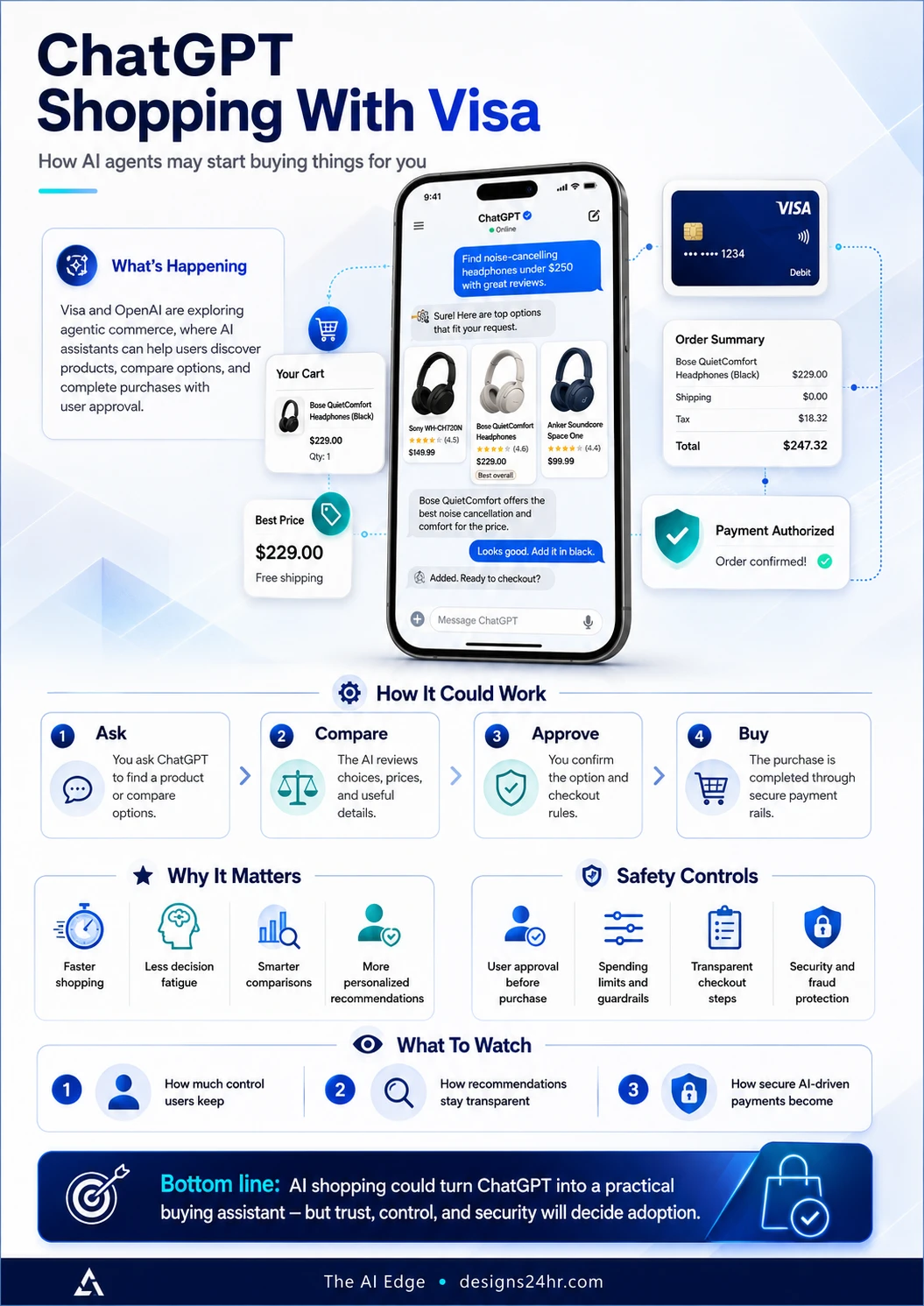
That is why the new ChatGPT shopping with Visa conversation matters. Visa and OpenAI are working on infrastructure for agentic commerce, which is a future where AI agents can help people shop, compare, and buy through more secure payment systems. OpenAI has also been building toward this direction with Instant Checkout and the Agentic Commerce Protocol, showing that AI-powered shopping is becoming a serious part of the online shopping experience.
Simple explanation: AI shopping does not just mean asking ChatGPT for product ideas. It means an AI assistant may help move the buyer from “what should I buy?” to “compare these options,” then to “approve this purchase,” and eventually to checkout.
What Is ChatGPT Shopping With Visa?
ChatGPT shopping with Visa refers to the idea of using ChatGPT as an AI shopping assistant while Visa provides secure payment infrastructure behind the scenes. In practical terms, a user could ask ChatGPT to find a product, compare price and quality, narrow the choices, and help complete a purchase using approved payment rules.
This is part of a larger shift called agentic commerce. Instead of only showing search results, an AI agent can take steps toward completing a task. In shopping, that task may include understanding your request, comparing merchants, checking product details, applying your preferences, and preparing a purchase for approval.
The important part is approval. AI shopping only becomes useful if users feel in control. People will want clear checkout steps, spending limits, merchant transparency, payment protection, and the ability to say yes or no before money is spent.
How AI Shopping Could Work
The future version of an AI shopping assistant may work like a guided buying flow instead of a normal search page. You explain what you need, the AI compares choices, and the payment step happens only after your permission.
You tell ChatGPT what you need, such as a product, budget, size, use case, or preferred brand.
The AI reviews available options, useful details, prices, ratings, and possible trade-offs.
You confirm the choice, spending rules, merchant, delivery details, and payment approval.
The purchase is completed through secure payment rails with confirmation and protection steps.
Why This Matters for Everyday Shoppers
Online shopping has become crowded. People compare dozens of listings, check reviews, open tabs, look for shipping details, and still wonder if they made the right choice. AI shopping could reduce that friction by acting like a personal research assistant that understands the buyer’s goal.
For example, instead of searching “best noise cancelling headphones under $250” and opening ten pages, a shopper could ask ChatGPT to compare the best options based on comfort, battery life, reviews, price, return policy, and shipping speed. The AI could then explain the top choice in plain language.
What AI shopping could improve
- Faster decisions: AI can narrow down choices without forcing users to sort through endless product pages.
- Better comparisons: ChatGPT can summarize differences between products in a more readable way.
- More personal results: An AI assistant can remember preferences like budget, size, use case, and style.
- Less checkout friction: Payment infrastructure from companies like Visa could make approval and payment smoother.
- More guided buying: Instead of browsing randomly, shoppers can move through a clear ask, compare, approve, and buy flow.
Why Visa’s Role Is Important
AI agents can recommend products, but payments require trust. That is where Visa’s role becomes important. Payments are not just about moving money. They involve identity, merchant rules, fraud protection, spending limits, card authorization, refunds, and user confidence.
If AI assistants are going to help people buy things, users need to know who is charging them, how much they are spending, when the purchase happens, and whether they can stop or review the transaction before it is completed. This is why Visa AI payments could become a key part of making agentic commerce feel safer for mainstream shoppers.
| Shopping Step | What ChatGPT Could Do | Why Visa Matters |
|---|---|---|
| Product discovery | Find products based on budget, needs, and preferences. | Not directly payment-related, but it starts the buying journey. |
| Comparison | Summarize differences between options and recommend a best fit. | Can help connect the chosen option to a secure checkout path. |
| Approval | Ask the user to confirm product, merchant, amount, and rules. | Can support spending controls, permissions, and payment authorization. |
| Payment | Help complete the purchase after the user approves. | Provides payment rails, fraud protection, and transaction security. |
The Biggest Benefit: Less Decision Fatigue
One of the strongest reasons people may use ChatGPT buying things workflows is not because they want AI to spend money automatically. It is because they want help making better choices faster.
Shopping often feels simple until the buyer has to compare specs, reviews, shipping dates, return policies, hidden fees, and brand claims. A good AI shopping assistant could turn that chaos into a short explanation: “Here are the best three options, here is why one fits your request best, and here is what you should check before buying.”
The Biggest Risk: Trust
AI shopping will only work if people trust the process. If users feel that recommendations are biased, unclear, sponsored without disclosure, or too aggressive, they may avoid letting an AI assistant handle shopping decisions.
The most important question is not whether AI can find products. It is whether the AI explains why a product is recommended, whether the user understands the checkout step, and whether the payment system prevents unwanted or mistaken purchases.
Safety controls shoppers should expect
- User approval before purchase: The AI should not complete purchases without clear permission.
- Spending limits: Users should be able to set maximum purchase amounts.
- Merchant controls: Users should know which seller they are buying from.
- Transparent checkout: The AI should show price, taxes, shipping, and return details before payment.
- Fraud protection: Payment networks should help detect suspicious activity.
- Easy cancellation or review: Users should be able to stop or review a purchase before it is finalized.
Will ChatGPT Actually Buy Things for You?
The short answer is: it depends on the product, merchant, payment setup, user permissions, and rollout. OpenAI has already introduced shopping-related checkout features, and Visa is building payment infrastructure for AI commerce. But that does not mean every ChatGPT user will instantly have a fully autonomous shopping agent for every store.
A more realistic near-term version is assisted checkout. ChatGPT may help you compare and select products, then ask you to approve the final purchase details. Over time, the experience could become more automated, especially for repeat purchases, subscriptions, groceries, travel, and simple household items.
What This Means for Small Businesses
AI shopping is not only important for consumers. It could also change how small businesses think about online visibility. If shoppers start asking AI agents what to buy, businesses will need product pages that are clear, structured, trustworthy, and easy for AI systems to understand.
This means small businesses should focus on accurate product titles, helpful descriptions, transparent pricing, strong FAQs, clear shipping details, return policies, authentic reviews, and consistent brand information. AI search and AI shopping will likely reward pages that answer buyer questions clearly.
Small business takeaway: The future of shopping may not only be about ranking on Google. It may also be about being understandable and trustworthy enough for AI assistants to recommend your product.
How Consumers Can Use AI Shopping Safely
Even if AI shopping becomes easier, users should still slow down before checkout. AI can help compare options, but it can also miss details, misunderstand preferences, or recommend something that looks good but is not the best fit.
Before using any AI assistant to help with online buying, shoppers should verify the seller, review the final price, check return policies, avoid suspicious discounts, and never approve a purchase unless the checkout details are clear.
Smart checklist before approving an AI-assisted purchase
- Confirm the merchant name and website.
- Check the total cost, including shipping and tax.
- Review the product model, size, color, and quantity.
- Look for return policy and warranty details.
- Be careful with unusually large discounts or unknown sellers.
- Use spending limits when available.
- Do not let AI complete purchases without your approval.
What To Watch Next
The biggest developments to watch will be rollout speed, user controls, merchant adoption, and how clearly AI assistants separate organic recommendations from paid or sponsored options.
If ChatGPT shopping with Visa becomes widely available, it could change how people search for products. Instead of typing keywords into a search engine, users may ask an AI assistant to complete a full shopping task from research to checkout.
| What To Watch | Why It Matters |
|---|---|
| User control | People need clear approval steps before AI-assisted purchases become mainstream. |
| Recommendation transparency | Users should know why a product is recommended and whether any placement is sponsored. |
| Merchant adoption | AI shopping only becomes useful if enough stores and payment systems support it. |
| Fraud protection | AI-driven checkout must protect users from scams, fake stores, and unauthorized purchases. |
Bottom Line
ChatGPT shopping with Visa could turn AI from a recommendation tool into a practical buying assistant. The opportunity is clear: faster product research, smarter comparisons, easier checkout, and more personalized shopping.
But the future of AI shopping will depend on trust. People need approval controls, spending limits, transparent recommendations, and secure payment systems before they let AI agents handle purchases. If those safeguards work, agentic commerce could become one of the most practical everyday uses of AI.
Try smarter decision-making before you buy
Before using AI to shop, compare your options clearly. You can use Designs24hr tools like Is This Worth It? and Decision Helper to think through purchases, compare choices, and avoid rushed buying decisions.
For more beginner-friendly AI updates, visit The AI Edge.
FAQ: ChatGPT Shopping With Visa
What is ChatGPT shopping with Visa?
ChatGPT shopping with Visa refers to AI-assisted shopping where ChatGPT may help users find, compare, and prepare purchases while Visa supports secure payment infrastructure and approval-based checkout.
Can ChatGPT buy things for me?
ChatGPT may be able to help with buying workflows where supported, but purchases should require user approval, clear checkout details, and secure payment authorization before completion.
What is agentic commerce?
Agentic commerce is a shopping model where AI agents help complete parts of the buying journey, such as product discovery, comparison, checkout preparation, and payment approval.
Is AI shopping safe?
AI shopping can be useful, but safety depends on user approval, spending limits, transparent recommendations, fraud protection, and clear merchant information. Users should always review purchase details before approving payment.
Why is Visa involved in AI shopping?
Visa’s role is important because payments require secure infrastructure, authorization, fraud protection, and user trust. AI agents can recommend products, but payment systems must make the transaction safe and controlled.