AI majors explained simply: AI degrees are growing fast, but the smartest path depends on your goals. AI majors, AI minors, certificates, and computer science degrees can all lead to valuable skills. The real question is not only “Should I study AI?” It is “Which path gives me the strongest mix of AI depth, career flexibility, projects, internships, and long-term options?”
AI Majors Explained: Quick Answer for 2026 Students
AI majors explained in one sentence: an AI major can be worth it in 2026 if you want deep training in machine learning, programming, data, math, responsible AI, and applied AI systems.
It can be especially useful if you already enjoy coding, problem-solving, statistics, automation, robotics, data science, or building technical projects. But an AI major is not automatically better than computer science. For many U.S. students, a traditional computer science degree with AI electives, an AI minor, or a focused certificate may offer more flexibility while still building strong AI skills.
AI Majors Explained by the 2026 Research
AI is no longer just a niche topic inside computer science. More colleges are creating dedicated AI programs because students, parents, employers, and universities all see artificial intelligence becoming part of future work.
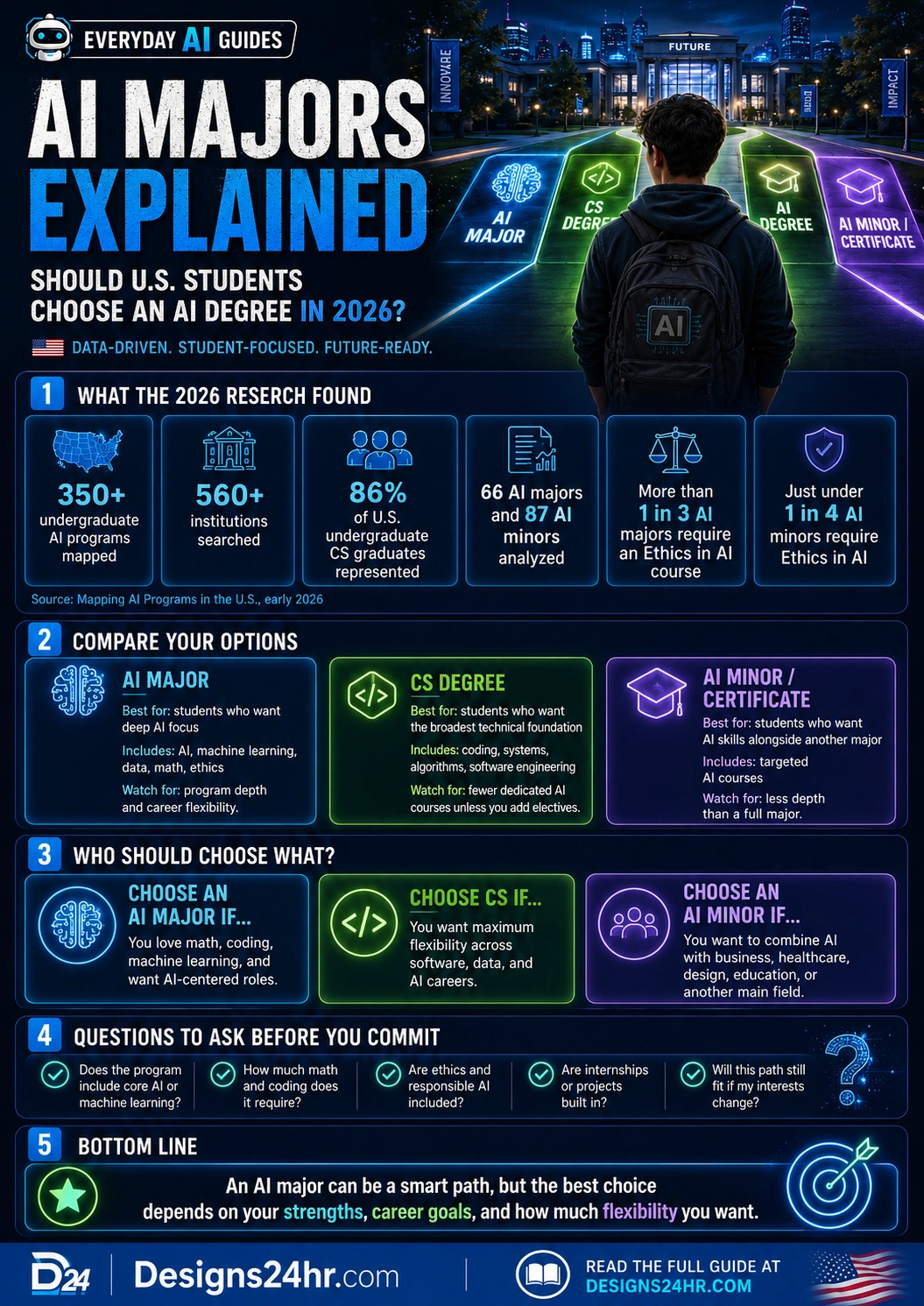
A 2026 research report on U.S. undergraduate AI programs found that researchers mapped more than 350 undergraduate AI programs across four-year universities. The report says the tool searched more than 560 institutions, representing 86% of U.S. undergraduate computer science graduates. It also analyzed 66 AI majors and 87 AI minors, showing that program requirements vary widely.
Source: “Mapping AI Programs in the U.S: A Status Report from Early 2026 and an Analysis of AI Majors and Minors”, submitted to arXiv in May 2026.
AI Majors Explained: What Students Actually Study
Every college is different, but many AI degree programs include a mix of computer science, math, statistics, machine learning, data, ethics, and applied projects. Some programs are very technical. Others combine AI with human-centered design, business, robotics, cybersecurity, or data analytics.
Technical foundation
- Programming
- Data structures
- Algorithms
- Software development
- Systems or databases
AI and data skills
- Machine learning
- Data science
- Statistics
- Model evaluation
- AI applications
Responsible AI
- AI ethics
- Bias and fairness
- Privacy
- Human impact
- AI policy basics
AI Majors Explained vs Computer Science Degrees
For many students, this is the biggest decision. An AI major sounds future-ready, but computer science has a long track record and can keep more doors open. The better choice depends on how focused you want to be.
| Path | Best for | Strength | Watch out for |
|---|---|---|---|
| AI Major | Students who want AI, machine learning, robotics, data, or intelligent systems as the main focus. | Deeper AI-specific training and clearer alignment with AI-focused projects. | Some programs may be too narrow if they do not include strong coding, math, systems, and project work. |
| Computer Science | Students who want maximum flexibility across software engineering, data, cybersecurity, AI, product, and tech roles. | Broad technical foundation that can adapt as the job market changes. | You may need to add AI electives, projects, research, or a minor to show AI depth. |
| AI Minor or Certificate | Students who want AI skills without making AI the entire degree. | Great add-on for business, healthcare, design, education, engineering, marketing, data, or CS students. | May not be deep enough for highly technical AI engineering or machine learning research roles by itself. |
If you are unsure, computer science plus AI electives can be a strong default. If you are already confident that AI systems, machine learning, and data-driven work are your long-term direction, then a strong AI major may make sense.
AI Majors Explained: When This Path Makes Sense
An AI major is a strong fit when you are not just casually interested in AI, but genuinely interested in the technical and practical work behind it.
Choose an AI major if you can say yes to most of these:
- You enjoy coding or are willing to get good at it.
- You are comfortable building math, statistics, and data skills.
- You want to understand how AI systems work, not only how to use AI tools.
- You want AI-related internships, research, projects, or startup experience.
- You are interested in machine learning, robotics, automation, data science, AI safety, or intelligent software.
- You are willing to keep learning because AI tools, models, and job roles will keep changing.
An AI major is not just about using ChatGPT or prompting tools. It should help you understand the systems, data, limitations, and responsibilities behind AI.
Why Computer Science May Still Be the Better Choice
Computer science may be better if you want a broader foundation and do not want your degree to feel too narrow. It can prepare you for software engineering, cloud systems, cybersecurity, product engineering, data work, AI engineering, and many other technical paths.
Computer science can also be safer if your college’s AI major is new, small, or unclear about core requirements. A new program is not automatically bad, but you should inspect it carefully before committing.
AI Majors Explained for Minors and Certificates
An AI minor or certificate can be a strong choice if you want AI skills connected to another field. This may be especially useful because many future AI jobs will not be purely technical. They may combine AI with healthcare, education, law, finance, marketing, design, operations, cybersecurity, or small business workflows.
Good fit for an AI minor
- Business students who want AI analytics skills
- Healthcare students interested in medical AI tools
- Design students exploring AI creativity and UX
- Education students preparing for AI-assisted learning
- Cybersecurity students studying AI-driven threats and defenses
- Computer science students who want a formal AI focus
Possible limitation
- Less depth than a full AI major
- May not include enough machine learning or math
- May not be enough for research-heavy AI roles
- Quality depends heavily on course selection
- May require extra projects to prove real ability
AI Majors Explained for Career Paths
An AI degree can support several career paths, but your exact options will depend on your skills, projects, internships, school reputation, portfolio, and how much software or data experience you build.
| Career direction | Skills to build | How students can prepare |
|---|---|---|
| Machine learning or AI engineering | Programming, machine learning, model evaluation, data pipelines, math, deployment basics. | Build projects, contribute to code, complete internships, and document results clearly. |
| Data science or analytics | Statistics, Python or SQL, visualization, data cleaning, experimentation, business communication. | Create portfolio projects using real-world datasets and explain your insights simply. |
| Software engineering with AI | Algorithms, systems, APIs, databases, testing, cloud basics, AI tool integration. | Keep your coding foundation strong and avoid becoming only tool-dependent. |
| AI product or operations | Product thinking, workflow design, user research, automation, responsible AI, business process analysis. | Combine AI knowledge with communication, documentation, and practical workflow projects. |
| AI in another field | Domain knowledge plus applied AI literacy, privacy awareness, and responsible use. | Pair AI courses with a strong major in healthcare, education, business, design, law, or engineering. |
Students should also prepare early for resumes, portfolios, internships, and interviews. Your degree title matters, but proof of skill matters too.
Questions to Ask Before Choosing an AI Program
Before you commit to an AI major, minor, or certificate, compare the actual curriculum. Do not rely only on the program name or marketing page.
- Does the program require core AI or machine learning? A strong AI program should include real AI foundations, not only general technology courses.
- How much coding is included? AI careers usually require practical programming ability, especially for technical roles.
- How much math and statistics are required? Machine learning, data science, and model evaluation depend on quantitative thinking.
- Are ethics and responsible AI included? Students should learn about bias, fairness, privacy, safety, and the real-world impact of AI systems.
- Are projects built into the degree? Employers care about what you can build, explain, test, and improve.
- Are internships, research, or industry connections available? A strong program should help you turn coursework into experience.
- Will this path still fit if your interests change? The best degree gives you room to pivot as technology and job markets evolve.
Parent and Student Decision Checklist
Use this checklist before choosing between an AI major, computer science degree, AI minor, or certificate.
Choose an AI major if…
- You want AI to be the main focus.
- The program includes coding, machine learning, math, data, ethics, and projects.
- You can see clear internship or research opportunities.
- You want AI-centered roles after graduation.
- You are ready for continuous learning.
Choose computer science if…
- You want maximum career flexibility.
- You want a proven technical foundation.
- You may want software, AI, data, cybersecurity, or product roles.
- You can add AI electives, projects, or a minor.
- You are not fully sure AI should be your entire degree.
Choose an AI minor if…
- You want AI skills with another main field.
- You are interested in applied AI, not necessarily deep AI engineering.
- You want a more flexible college plan.
- You are pairing AI with business, healthcare, design, education, or engineering.
Be cautious if…
- The program has very few AI-specific courses.
- There is little coding or math depth.
- There are no real projects or internships.
- The degree sounds trendy but lacks clear career preparation.
- The program does not explain ethics, safety, or responsible AI.
How to Make Any AI Path Stronger
Whether you choose an AI major, computer science degree, AI minor, or certificate, your results will depend on what you build outside the classroom too.
Build proof of skill while you study
- Create a portfolio with AI, data, or automation projects.
- Explain your projects in plain English, not only technical language.
- Practice responsible AI by documenting limitations, privacy risks, and bias concerns.
- Use internships, campus research, hackathons, and capstone projects to gain experience.
- Keep learning tools such as AI agents, reasoning models, automation platforms, and data workflows.
- Improve your resume and interview skills before internship season starts.
AI careers reward students who can combine technical ability with judgment, communication, and real-world problem solving.
AI Majors Explained: Bottom Line for 2026
AI majors are becoming more common, and that growth is worth paying attention to. But the best choice is not the trendiest title. The best choice is the path that matches your strengths, your career goals, and the quality of the program available to you.
If you want deep AI focus and the program has strong technical depth, an AI major may be a smart move. If you want broader flexibility, computer science with AI electives may be safer. If you want AI skills added to another career path, an AI minor or certificate may be the better fit.
In 2026, the strongest students will not simply say they studied AI. They will be able to show what they built, explain how it works, understand its risks, and use it responsibly.
AI Majors Explained: FAQs About AI Degrees
Is an AI major worth it in 2026?
An AI major can be worth it if the program includes strong coding, machine learning, math, data, ethics, projects, and career support. It is best for students who want AI to be their main focus.
Is an AI major better than computer science?
Not always. Computer science may offer broader flexibility, while an AI major may offer deeper AI-specific training. Many students may benefit from computer science plus AI electives, an AI minor, or an AI certificate.
What do students study in an AI major?
AI majors often include programming, algorithms, machine learning, data science, math, statistics, AI ethics, and applied AI projects. Requirements vary a lot between colleges.
Should I choose an AI minor instead of an AI major?
An AI minor can be a smart option if you want AI skills while keeping another main field, such as business, healthcare, design, education, engineering, computer science, or cybersecurity.
What careers can an AI degree lead to?
Possible paths include machine learning, data science, software engineering, AI product work, robotics, cybersecurity, healthcare AI, business analytics, AI operations, and applied AI roles in many industries.
What should parents and students check before choosing an AI program?
Check whether the program includes core AI or machine learning courses, enough coding and math, ethics or responsible AI, real projects, internships, faculty expertise, and career support.
Can I work in AI without an AI degree?
Yes. Many people can build AI-related careers through computer science, data science, engineering, math, business, design, healthcare, or another major combined with AI projects, internships, certificates, and practical skills.
Keep Learning AI the Simple Way
Want more student-friendly AI guides? Explore Everyday AI Guides on Designs24hr for simple explanations, career-focused AI learning, practical tools, and beginner-friendly breakdowns of how AI is changing school, work, and future jobs.