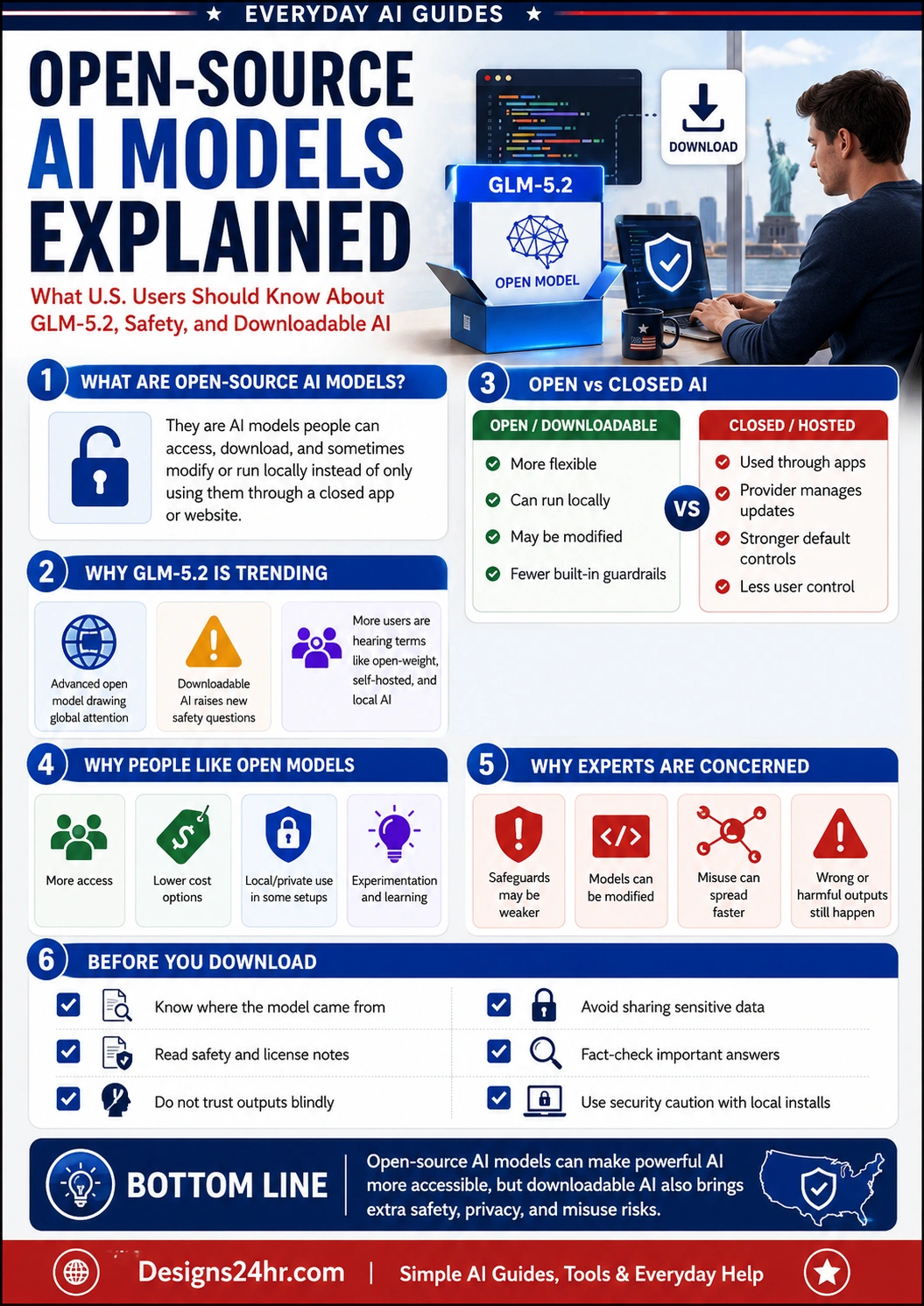
Open-Source AI Models Explained for U.S. Users
Open-Source AI Models are AI systems that people can often access, download, study, modify, or run outside a closed app like ChatGPT, Gemini, or Claude. The topic is getting more attention because models like GLM-5.2 show how powerful downloadable AI can become, while also raising new safety, privacy, and misuse questions for everyday U.S. users.
Quick Answer: What Are Open-Source AI Models?
Open-Source AI Models are AI models released in a way that gives users more access than a normal closed AI app. Depending on the release, users may be able to view model files, download model weights, run the model locally, study how it works, or modify it for a specific use.
The simple idea is this: closed AI tools usually run on a company’s servers, while open or open-weight models can sometimes be downloaded and used outside the original provider’s app. That can make AI more flexible and affordable, but it can also reduce the built-in safety controls that commercial platforms normally manage.
In This Guide
- Why open-source AI models are trending now
- Why GLM-5.2 is getting attention
- Open-source vs open-weight vs closed AI
- Why downloadable AI models can be powerful
- Why security experts are concerned
- What everyday U.S. users should not do
- When open-source AI models can be useful
- Safety checklist before using downloadable AI
- Helpful Designs24hr tools to use next
- FAQs about open-source AI models
Why Open-Source AI Models Are Trending Now
Open-Source AI Models are trending because powerful AI is no longer only available through big hosted apps. More labs are releasing models that developers, companies, researchers, students, and advanced users can run through APIs, cloud platforms, or local setups.
For everyday users, this trend can feel confusing. You may hear phrases like open-source AI, open-weight model, local AI, downloadable AI, self-hosted AI, or model weights. These terms sound technical, but the main question is practical: who controls the model, where does it run, and what safety protections are in place?
This matters in the United States because AI models are now connected to work, school, coding, business automation, cybersecurity, privacy, and even national competitiveness. A model that is cheaper, downloadable, and powerful can help builders move faster, but it can also make unsafe use easier if people remove guardrails or run it without oversight.
What Beginners Should Know First
Why GLM-5.2 Is Getting Attention
GLM-5.2 is a recent model from Z.ai that is getting attention because it is designed for long-horizon tasks, coding, and agent-style work. Z.ai describes GLM-5.2 as having a 1M-token context window, which means it is built to handle very long inputs compared with many older AI tools.
Reuters reported that GLM-5.2 is closely rivaling top closed-source models in coding and agent tasks. Axios also reported that security researchers are watching the model closely because advanced open or open-weight models can be downloaded, modified, and potentially used without the same oversight found in closed commercial platforms.
For beginners, the most important point is not whether GLM-5.2 is “better” than every other model. The important point is that powerful AI is becoming easier to access outside traditional closed apps. That changes the safety conversation.
Open-Source vs Open-Weight vs Closed AI
The term open-source AI is often used loosely. Not every model called “open-source” gives users the same level of access. Some are truly open in a deeper sense, while others mainly release model weights so people can run or fine-tune the model.
Open or Open-Weight AI
- May allow model downloads
- May run locally or on private servers
- May be modified or fine-tuned
- Can offer more control and flexibility
- May have fewer built-in safety checks after modification
Closed or Hosted AI
- Runs through an app, website, or API
- Provider manages most updates
- Provider controls access and usage rules
- Often includes stronger default monitoring and guardrails
- Gives users less control over the model itself
The Open Source Initiative says open-source AI should include the information and code needed to understand and modify the system, not just a marketing label. That is why careful wording matters. In this guide, “open-source AI models” is used in the common search sense, while also explaining that many popular releases are more accurately described as open-weight or downloadable models.
Why Downloadable AI Models Can Be Powerful
Downloadable AI models can be powerful because they give users and organizations more control. Instead of relying only on a hosted chatbot, a company or developer may run a model in a more customized environment.
That can create real benefits:
- Lower cost: Some open models may be cheaper to run at scale than closed model APIs.
- Customization: Developers can adapt models for specific workflows, products, or internal tools.
- Local use: Some models can run on personal devices, private servers, or controlled cloud systems.
- Research and learning: Open releases help researchers study how models behave and improve them.
- More competition: Open releases can pressure closed AI companies to improve pricing, performance, and transparency.
This is why open AI is not automatically bad. In many cases, it can support education, innovation, accessibility, privacy-focused workflows, and smaller teams that cannot afford expensive closed systems.
Why Security Experts Are Concerned
The same openness that makes a model useful can also make it harder to control. If an advanced model can be downloaded and modified, users may be able to remove safeguards, run it privately, or adapt it for unsafe tasks.
That is why cybersecurity experts are paying attention to GLM-5.2 and similar models. Their concern is not only that AI can write code. The concern is that advanced models may lower the barrier for people trying to automate scams, personalize phishing, test malicious ideas, or create harmful content outside a provider’s normal monitoring system.
This guide will not provide instructions for misuse. The safe takeaway for everyday users is simple: treat powerful downloadable AI like any other advanced technology. Check the source, understand the license, avoid sensitive data, use trusted platforms, and do not assume the model is safe just because it is popular.
What Everyday U.S. Users Should Not Do
Most beginners do not need to download a frontier AI model to get value from AI. If you are not technical, the safer path is usually to use trusted, well-known tools while learning the basic terms first.
Before experimenting with Open-Source AI Models, avoid these mistakes:
- Do not download random model files from unknown websites, social posts, or private links.
- Do not paste private data into unfamiliar AI tools, local apps, or unverified interfaces.
- Do not run unknown scripts just because a tutorial says they install an AI model.
- Do not ignore license rules if you plan to use a model for school, business, content, or client work.
- Do not trust outputs blindly just because the model has a large context window or strong benchmarks.
- Do not use AI for cyber, fraud, impersonation, or harmful automation.
When Open-Source AI Models Can Be Useful
Open models can be useful when they are used responsibly and in the right setting. For some people, the benefit is learning. For others, it is privacy, customization, lower cost, or control.
Students and learners
Students studying AI can learn how models are built, evaluated, and deployed. This can help them understand the difference between using a chatbot and understanding AI systems.
Developers and builders
Developers can test models for coding, documentation, internal tools, research, or app prototypes. Advanced users may compare open models with closed AI tools to decide what fits their project.
Small businesses
Some small businesses may eventually use open models for internal search, document workflows, customer support drafts, or private productivity systems. But this should be done with security, privacy, and legal review.
Privacy-focused workflows
Local or self-hosted AI can sometimes reduce data-sharing risks if configured correctly. But “local” does not automatically mean safe. Poor setup, untrusted files, or insecure plugins can still create problems.
Safety Checklist Before Using Downloadable AI
If you are thinking about using downloadable AI, use this checklist before trusting it. This is especially important for beginners, students, creators, and small businesses.
Check the source
Use official model pages, trusted repositories, or well-known platforms. Avoid random downloads from forums, private messages, or suspicious “free model” websites.
Read the license
Some models allow commercial use. Others have restrictions. Before using a model for business, content, clients, or products, check what the license actually permits.
Protect private data
Do not upload passwords, financial records, private customer information, health details, confidential work documents, private school records, or personal identity documents.
Fact-check important outputs
Open models can still hallucinate. Check important answers with official sources, trusted documentation, expert review, or your own judgment before acting.
Use security caution
Running a local model may involve software packages, command-line tools, plugins, or scripts. If you do not understand what something does, do not run it on your main computer.
Helpful Designs24hr Tools to Use Next
If this topic feels technical, start by simplifying the terms and learning how advanced AI tools work before downloading anything.
Read AI Reasoning Model Explained to understand how advanced reasoning models work and why they matter for coding, planning, and problem-solving.
Use Explain This For Me to simplify confusing AI terms, model announcements, technical updates, or safety notes.
Use How It Works? to understand how a new AI tool, feature, product, or technology works in plain language.
You can also use the AI Prompt Generator to create safer prompts for AI tools, or explore AI Tools & Beginner Guides for more simple AI explanations.
Bottom Line
Open-Source AI Models can make powerful AI more accessible, flexible, and affordable. They can help developers, researchers, students, and businesses build faster and learn more deeply.
But downloadable AI also changes the safety equation. When models can be copied, modified, and run outside a provider’s normal guardrails, users need stronger judgment. The question is not only “Can I use this model?” The better question is “Do I understand where it came from, what it can do, what data I am sharing, and what risks I am accepting?”
For most beginners, the smartest path is to learn the basics first, use trusted tools, avoid random downloads, protect private data, and fact-check anything important before acting on AI output.
Sources and Further Reading
This guide is based on official model information, current AI reporting, and open-source AI definition guidance available at the time of publication.
FAQs About Open-Source AI Models
What are Open-Source AI Models?
Open-Source AI Models are AI models released with more public access than closed AI systems. Depending on the model, users may be able to download weights, study model files, run the model locally, modify it, or build tools around it.
Are Open-Source AI Models the same as ChatGPT?
No. ChatGPT is a hosted AI product that runs through OpenAI’s platform. Open or open-weight AI models may be downloadable or usable through other platforms, giving users more control but often requiring more technical and safety awareness.
What is GLM-5.2?
GLM-5.2 is a model from Z.ai that is getting attention for long-context, coding, and agent-style tasks. It is part of the broader trend of powerful open or open-weight models becoming more accessible outside closed AI apps.
What does open-weight AI mean?
Open-weight AI usually means the model weights are available for users to download or use. It does not always mean the full training data, training code, and complete development process are fully open.
Can I download an AI model to my computer?
Some AI models can be downloaded and run locally, but beginners should be careful. Local AI may require strong hardware, technical setup, trusted files, security caution, and a clear understanding of what data is being processed.
Are Open-Source AI Models safe?
They can be safe when used responsibly, but they are not automatically safe. Users should check the source, license, setup instructions, privacy risks, and output quality before trusting a downloadable model.
Why are security experts worried about downloadable AI?
Security experts worry that advanced downloadable models can be modified, run privately, or used without the same monitoring found in closed commercial platforms. This could make unsafe automation, scams, or cyber misuse easier for bad actors.
What is the difference between open-source and closed-source AI?
Open-source or open-weight AI gives users more access to model files or weights. Closed-source AI usually runs through a provider’s app or API, where the company controls access, updates, safeguards, and usage policies.
Should beginners use local AI models?
Most beginners should learn the basics first before downloading local AI models. Hosted tools are usually easier and safer for everyday tasks. Local AI is better for users who understand installation, privacy, security, and model limitations.
What should U.S. users check before downloading an AI model?
U.S. users should check the official source, model license, privacy risks, hardware requirements, safety notes, update history, and whether the model is appropriate for their intended use. They should also avoid sharing sensitive data and fact-check important answers.
Powerful AI Is Becoming Easier to Download
Open models can help more people learn, build, and experiment with AI. But beginners should move carefully: check the source, protect private data, understand the license, and never treat AI output as automatically correct.
Explore more simple AI guides and free tools at Designs24hr.com.