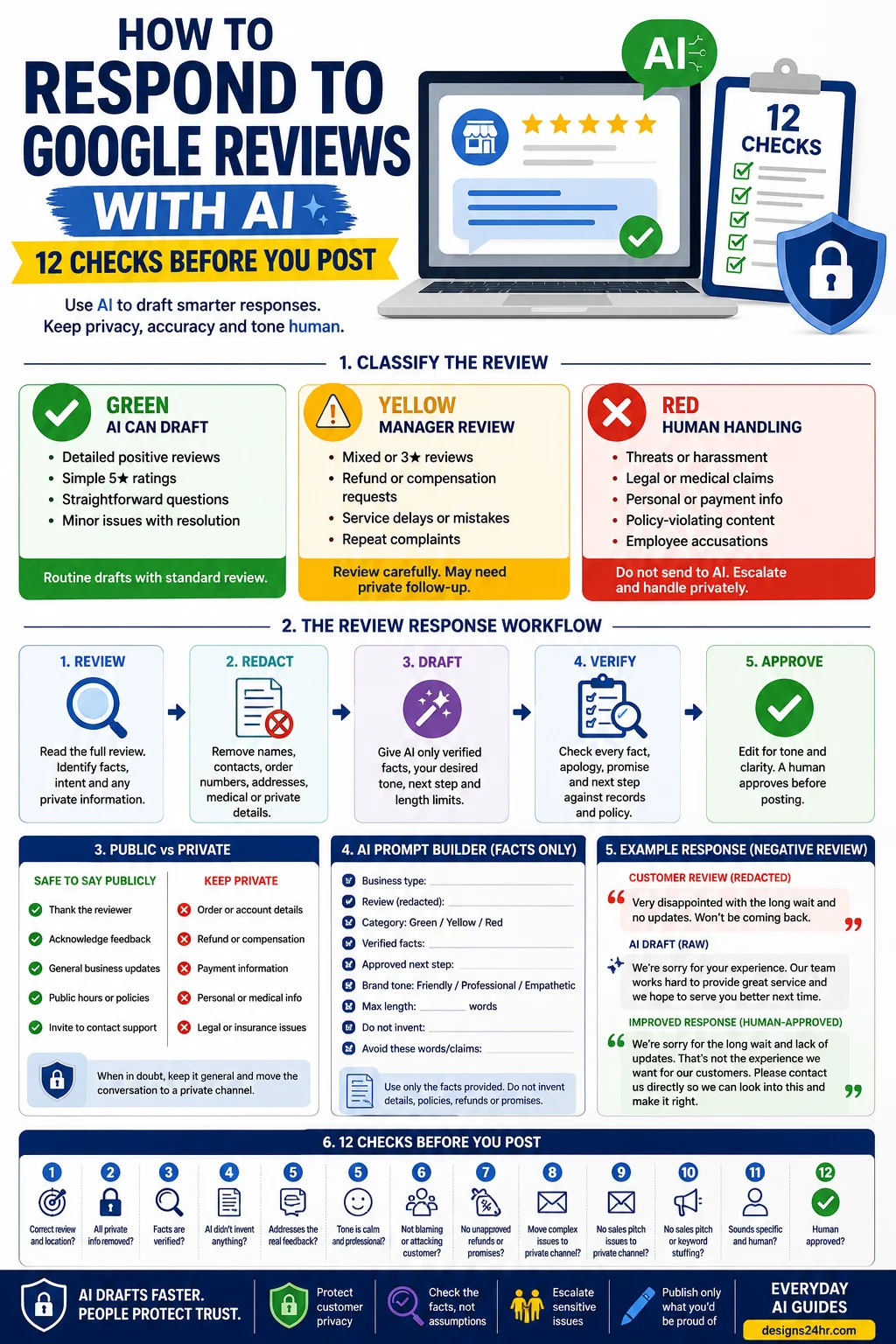
Small businesses can respond to Google reviews with AI to create faster first drafts, improve clarity, and maintain a more consistent response process. However, AI does not know which customer claims are accurate, what happened during a transaction, which promises are authorized, or whether a complaint creates a privacy, safety, legal, or reputational risk.
The safest approach is to let AI assist with routine drafting while keeping customer privacy, disputed facts, escalation decisions, and final approval under human control. An inaccurate or defensive response can damage trust because an approved Google review reply is displayed publicly beneath the customer’s review.
This guide provides a green–yellow–red review-triage system, a five-step drafting workflow, a facts-only AI prompt, response examples, and 12 checks to complete before anything is posted publicly.
Can You Use AI to Respond to Google Reviews?
AI can help draft concise Google review replies when the business supplies verified facts, removes private information, and reviews the finished response before posting. Do not allow AI to invent transaction details, refunds, policies, explanations, or promises. Sensitive complaints and disputed facts require direct human handling.
What AI Should—and Should Not—Do
An AI review response works best as an editable first draft. It can organize a response, reduce unnecessary wording, suggest a calmer tone, and help a busy business avoid staring at a blank reply box.
AI can help with:
- Drafting a starting response to routine feedback.
- Shortening an overly long reply.
- Making language clearer and more conversational.
- Creating several versions for a manager to compare.
- Turning verified notes into a structured response.
- Checking whether a reply sounds defensive or promotional.
- Creating a consistent response format for a small team.
AI should not decide:
- Whether the reviewer is telling the truth.
- Whether the business was at fault.
- Whether a refund or discount should be offered.
- Whether private transaction details may be disclosed.
- Whether a legal, medical, safety, or discrimination claim is valid.
- Whether a review violates Google’s policies.
- Whether a sensitive response is safe to publish.
Important distinction
Using AI to draft a business reply to a genuine customer review is different from using AI to create a fake customer review or testimonial. Businesses should never generate, purchase, publish, or encourage false reviews that pretend to describe a real customer experience.
Why Every AI Review Response Needs Human Review
AI can produce fluent language without knowing what actually happened. Unless the business provides accurate records, the tool may fill gaps with plausible-sounding assumptions. Those assumptions can become public claims when a draft is copied directly into a Business Profile.
Human review is necessary because an AI-generated response may:
- Misunderstand the customer’s main complaint.
- Claim that the business investigated when it did not.
- Promise a refund, replacement, discount, or follow-up that has not been authorized.
- Apologize for a specific event that remains disputed.
- Repeat private information contained in the review or prompt.
- Sound generic, promotional, defensive, or insincere.
- Use wording that creates unnecessary legal or reputational risk.
- Send a customer to the wrong location, phone number, or support channel.
Google advises businesses to keep replies professional, polite, relevant, direct, and reasonably short. For complex negative reviews, Google recommends protecting privacy and asking the reviewer to continue the discussion by phone or email rather than arguing publicly.
Public replies are not private customer-service messages
Write for two audiences: the reviewer and every potential customer who may read the exchange later. A calm, factual reply can demonstrate professionalism even when the business and reviewer disagree.
Use the Green, Yellow and Red Review Triage System
Classify the review before creating an AI draft. The star rating alone is not enough. A five-star review can contain private information, while a one-star review may be straightforward and easy to resolve.
Green: AI May Draft
Routine reviews that normally need standard human checking:
- Detailed positive feedback.
- A simple five-star rating.
- Praise for a verified product or service.
- A straightforward public question.
- A general suggestion.
- A minor complaint with a verified resolution.
Action: Draft with AI, personalize, verify, and approve manually.
Yellow: Manager Review
Reviews requiring closer investigation or private follow-up:
- Mixed or three-star feedback.
- Refund or compensation requests.
- Incorrect-order claims.
- Service delays or missed appointments.
- Repeat complaints.
- Conflicting accounts of what happened.
- Employee-specific criticism.
Action: Verify records, redact details, and require manager approval.
Red: Human Handling Only
Sensitive matters that should not be routinely sent to an AI tool:
- Threats or safety incidents.
- Discrimination allegations.
- Medical information.
- Legal or insurance disputes.
- Payment or account information.
- Employee-misconduct allegations.
- Potential fraud or extortion.
Action: Preserve evidence and escalate to the appropriate decision-maker.
Regulated businesses need stricter controls
Healthcare, legal, financial, insurance, education, and other regulated businesses should follow their established privacy, recordkeeping, professional, and compliance procedures. A general-purpose AI workflow is not a substitute for those requirements.
The Review–Redact–Draft–Verify–Approve Workflow
This five-step workflow prevents a convenient AI draft from becoming an inaccurate or unsafe public statement.
Review
Read the complete review. Identify the customer’s main concern, the facts that can be checked, disputed points, private information, and any escalation risk.
Redact
Remove names where unnecessary, contact details, order numbers, payment data, addresses, medical information, internal notes, and private employee details.
Draft
Provide only verified facts, the approved next step, the intended tone, and clear instructions not to invent details, promises, policies, or explanations.
Verify
Check every fact, apology, promise, contact method, and next step against real records and approved business policies.
Approve
Edit the reply for specificity, privacy, clarity, and tone. A responsible team member manually approves the final response before posting.
A useful reply structure
- Acknowledge the specific feedback.
- Respond with an appropriate verified statement.
- Provide a realistic next step.
- Move account-specific discussion to a private channel.
12 Checks Before Posting an AI Review Response
Complete all 12 checks before publishing an AI-assisted Google review reply.
-
Confirm the review and location
Make sure the response belongs to the correct reviewer, business, branch, and situation.
-
Remove private information
Delete unnecessary names, contact details, order numbers, addresses, payment data, and personal records.
-
Verify every factual statement
Compare the response with real records, staff notes, public policies, and the actual service history.
-
Find anything AI invented
Remove unsupported explanations, events, apologies, policies, investigations, or outcomes.
-
Address the actual feedback
Mention a genuine point from the review instead of posting a vague response that could fit anyone.
-
Check the tone
Keep the reply calm, professional, conversational, and free from sarcasm or hostility.
-
Avoid attacking the reviewer
Do not accuse, insult, threaten, embarrass, or publish private evidence to win a public argument.
-
Remove unauthorized promises
Do not promise refunds, discounts, replacements, guarantees, investigations, or deadlines without approval.
-
Move sensitive details privately
Use an approved phone number, email address, or support process for account-specific discussion.
-
Remove sales language
A review reply is not an advertisement. Avoid promotions, offers, slogans, and local-keyword stuffing.
-
Make the response specific
Replace generic phrases with brief, truthful wording related to the reviewer’s actual feedback.
-
Require human approval
A person with the appropriate authority should approve the exact final version before it becomes public.
What Can Be Said Publicly—and What Should Stay Private?
A public response should acknowledge the feedback without revealing the customer’s private history. Even when a reviewer has shared personal details publicly, the business should not repeat or expand them unnecessarily.
| Usually Safe Publicly | Move to a Private Channel | Never Publish in the Reply |
|---|---|---|
| Thanking the reviewer | Order or appointment investigation | Payment-card or banking information |
| Acknowledging the feedback | Refund or compensation discussion | Passwords, login details, or security codes |
| A verified general update | Account-specific information | Medical or health information |
| Public business hours | Employee investigation | Home addresses or private phone numbers |
| A public policy already on the website | Disputed transaction details | Another customer’s information |
| An invitation to contact support | Legal or insurance discussions | Private messages or internal notes |
Public response example
“We’re sorry to hear about the delay. We would like to review what happened, but we cannot discuss order details publicly. Please contact our support team at the official number on our website so a manager can investigate.”
Copyable Facts-Only AI Review Response Prompt
A good AI review reply prompt controls the information the tool receives and clearly states what it must not invent.
Information to prepare
Copyable prompt
Draft a short public response to the redacted customer review below.

BUSINESS TYPE:
[Insert business type]

REDACTED REVIEW:
[Insert the review after removing private information]

CLASSIFICATION:
[Green / Yellow / Red]

VERIFIED FACTS:
[Insert only facts confirmed by records or approved public information]

APPROVED NEXT STEP:
[Insert the exact public next step or private contact channel]

TONE:
[Professional / friendly / calm / empathetic]

MAXIMUM LENGTH:
[Insert word limit]

REQUIREMENTS:
- Acknowledge the reviewer’s specific feedback.
- Use only the verified facts provided.
- Do not invent transaction details, policies, explanations, refunds, promises, investigations, or outcomes.
- Do not blame or attack the reviewer.
- Do not repeat private information.
- Move account-specific discussion to the approved private channel.
- Keep the response conversational and non-promotional.
- Produce a draft for human review, not an automatically publishable response.
After generating the draft, run it through the 12 checks instead of copying it directly into the reply field.
Google Review Response Examples: Weak AI Drafts vs Better Replies
These examples demonstrate the editing decisions a person should make after receiving an AI-generated draft. They are templates for structure, not claims that should be copied without checking the facts.
“Thank you for your amazing review! We always provide the best service and are the number-one company in the area.”
“Thank you for mentioning the clear explanations and timely installation. We’re glad the process went smoothly and appreciate you taking the time to share your experience.”
“We’re thrilled that you loved your recent purchase and our friendly delivery team.”
“Thank you for the five-star rating. We appreciate your support and hope to serve you again.”
“We’re sorry for any inconvenience. Customer satisfaction is our top priority, and we value your feedback.”
“Thank you for sharing both parts of your experience. We’re glad you were pleased with the final result, and we understand that slower communication was frustrating. We’re reviewing how updates are provided during service.”
“We were extremely busy, and delays sometimes happen. Our staff did the best they could.”
“We’re sorry you experienced a long wait without an update. That is not the communication experience we want to provide. Please contact our manager through the official number on our website so we can review the visit privately.”
“This review is completely false. You are leaving out important facts, and we have proof.”
“We’re sorry to hear about your concern. We have not been able to confirm the details from the information available publicly. Please contact our manager directly so we can identify the relevant visit and review the matter privately.”
“This is a fake review from someone trying to damage our business. We have reported you.”
“We take customer feedback seriously, but we have not been able to identify this experience from the information provided. Please contact us directly with the relevant details so we can investigate.”
Mistakes That Make AI Review Replies Sound Fake
AI-generated replies often fail because they sound polished but interchangeable. Potential customers notice when every reviewer receives the same empty phrases.
Generic language to reduce
- “Customer satisfaction is our top priority.”
- “We value your valuable feedback.”
- “We strive to provide exceptional service.”
- “We are thrilled beyond words.”
- “Your feedback helps us improve every day.”
Better editing decisions
- Mention one truthful detail from the review.
- Use plain language rather than slogans.
- Keep routine replies short.
- Do not repeat the customer’s entire message.
- Provide a specific, authorized next step when needed.
Other warning signs include repeating the business name unnaturally, inserting location keywords, excessive exclamation marks, making unsupported claims, using identical replies, and turning every response into a promotion.
Should You Automate Google Review Responses?
A small business can automate parts of the workflow without automating the final judgment. The safest automation prepares and routes work rather than publishing unsupervised replies.
Reasonable tasks to automate
- New-review alerts.
- Suggested green, yellow, or red classification.
- Assignment to the appropriate staff member.
- First-draft generation for routine reviews.
- Reminders for unanswered reviews.
- Monthly analysis of repeated feedback themes.
Decisions to keep human
- Whether the business was responsible.
- Whether compensation should be offered.
- Whether private details may be discussed.
- Whether a review creates legal or safety risk.
- Whether the response accurately reflects records.
- Whether the exact final reply should be published.
What to Do With Fake, Abusive, or Policy-Violating Reviews
Reporting a review and replying to it are separate decisions. A business should not report a review merely because it is negative or because the owner disagrees with the customer’s account. Google states that reviews should be reported when they violate its content policies.
- Save relevant records. Preserve screenshots, transaction records, correspondence, and other lawful evidence needed for an internal review.
- Check the actual policy. Compare the content with Google’s prohibited and restricted content rules.
- Avoid a public argument. Do not threaten the reviewer, publish private evidence, or accuse someone of criminal behavior without appropriate grounds.
- Report for a genuine policy reason. Use Google’s review-reporting process when the content appears to violate a published policy.
- Keep any public response brief. State that the business cannot identify the matter and invite direct contact when that is truthful and appropriate.
- Escalate serious conduct. Threats, extortion, fraud, impersonation, discrimination claims, or safety incidents may require management or professional assistance.
Never trade a benefit for positive sentiment
Do not offer a discount, refund, gift, or other incentive on the condition that a customer posts a positive review, changes a negative review, or removes criticism. Review requests and customer resolutions should not manipulate the sentiment of the review.
A Simple AI Review Response Policy for Small Teams
A written policy reduces inconsistent decisions and helps employees understand what may be entered into an AI tool.
Small-Team Review Response Policy
Only business-approved AI and review-management tools may be used.
Redacted review text, verified public facts, approved policies, and authorized contact details.
Payment data, passwords, medical information, private addresses, account details, and confidential records.
May be drafted by approved staff and published after standard human review.
Require record verification and manager approval before publication.
Must be escalated and should not be routinely processed through a general AI tool.
Employees may not offer compensation, guarantees, or outcomes outside approved authority.
Use one approved phone number, email address, or support page for sensitive follow-up.
Check response patterns monthly for repetition, unresolved complaints, privacy risks, and tone problems.
The person approving the response remains responsible for the published wording.
Final Google Review Response Checklist
Before posting, confirm that the final response passes every relevant check:
- The correct review, business, and location are selected.
- Private and confidential details have been removed.
- Every factual statement has been verified.
- No detail, explanation, or action was invented by AI.
- The response addresses the reviewer’s actual feedback.
- The tone is calm, polite, and professional.
- The response does not blame, insult, or threaten the reviewer.
- No unauthorized refund, discount, guarantee, or deadline is promised.
- Sensitive discussion is moved to an approved private channel.
- The response contains no promotion or keyword stuffing.
- The wording sounds specific rather than copied.
- An authorized person approved the exact final response.
Do not post when a check fails
Pause the response, correct the problem, or escalate it. Replying quickly is less important than publishing something accurate, private, and professionally responsible.
Frequently Asked Questions
Can I use AI to respond to Google reviews?
AI can be used to create a first draft when private information is removed and the business supplies verified facts. A person should check the response for accuracy, tone, promises, privacy, and escalation risk before posting it publicly.
Does Google allow AI-generated review replies?
Google’s published review-reply guidance focuses on whether the response follows its content policies and is professional, relevant, honest, concise, and privacy-conscious. Businesses should not describe that guidance as a specific endorsement of AI-generated replies.
Should every Google review receive a response?
A response can be useful when it acknowledges meaningful feedback, answers a question, provides an update, or demonstrates that the business is listening. Google advises businesses not to send the same generic thank-you message to everyone merely for the sake of replying.
How should a business reply to a negative Google review?
Acknowledge the concern, remain calm, avoid publishing private information, correct only what can be stated safely and accurately, and invite the reviewer to continue complex or account-specific discussion through an approved private channel.
Can I ask a customer to remove a negative review?
A business may resolve the underlying issue and let the customer decide whether to update their review. Do not pressure, threaten, or offer an incentive conditioned on changing or removing a negative review.
What information should never appear in a public review response?
Do not publish payment information, account credentials, medical information, private addresses, confidential messages, another customer’s details, private employee records, or unnecessary transaction information.
How do I make AI review responses sound human?
Mention one truthful detail from the review, use plain language, remove clichés, keep the response concise, avoid exaggerated praise, and provide a specific next step only when one is genuinely needed and authorized.
Should Google review replies be fully automated?
Automatic alerts, classification suggestions, routing, and routine drafts can save time. Final publication should remain controlled because each response may involve different facts, privacy concerns, customer expectations, and escalation risks.
Can I report a review because its claims are incorrect?
Disagreeing with a review does not automatically make it eligible for removal. Report it when there is a genuine reason to believe it violates Google’s published content policies, and preserve relevant evidence for the reporting process.
How long should a Google review response be?
There is no single required word count. Routine replies are usually more effective when they are brief and direct. Use enough wording to acknowledge the feedback and provide an appropriate next step without turning the response into a long public argument.