Pew Research 2026
Americans and AI 2026 Explained
Artificial intelligence is no longer just a future idea. A new Pew Research Center report shows that many Americans are already using AI through chatbots, AI search summaries, smart speakers, smart doorbells, robot vacuums, and other connected devices.
But the same report also shows a major trust gap. AI use is growing, yet many U.S. adults still worry about privacy, personal information, and how quickly the technology is changing.
Quick Answer: What Does the Americans and AI 2026 Report Show?
The Americans and AI 2026 report shows a clear pattern: AI is becoming more common in everyday American life, but trust is not keeping up with adoption. More people are using AI chatbots than in 2024, many are reading AI search summaries, and smart devices are bringing AI into the home.
At the same time, many Americans are skeptical. Pew found that majorities think AI is advancing too quickly and that increased AI use will make personal information less secure.
Simple takeaway: Americans are using AI more often, especially for search, work, and daily tasks, but many still want better privacy, clearer limits, and stronger trust before relying on it fully.
Why This Report Matters for Everyday U.S. Users
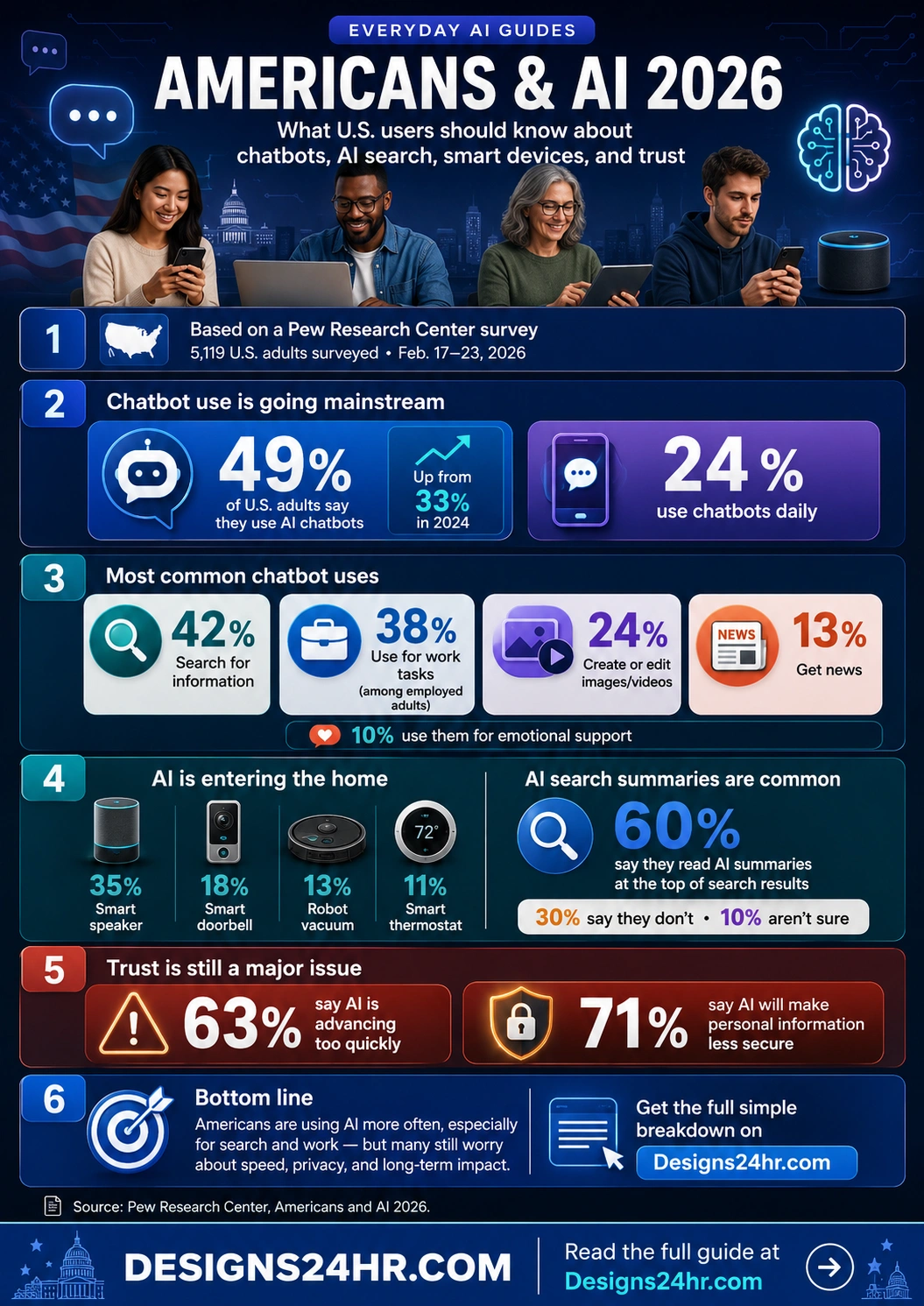
Pew Research Center surveyed 5,119 U.S. adults from February 17 to February 23, 2026. That makes the report useful because it is not just about what tech companies are launching. It shows how real people in the United States say they are using and thinking about AI.
For everyday users, the report matters because AI now appears in places many people already use: search engines, phones, laptops, smart speakers, home devices, work tools, image tools, and chatbot apps.
- 1 AI is becoming normal: Chatbots and AI search summaries are now part of everyday digital behavior for many users.
- 2 AI is entering the home: Smart speakers, doorbells, robot vacuums, and thermostats are making AI feel less like software and more like a household feature.
- 3 Trust is still unresolved: More usage does not mean people feel completely safe, informed, or confident about AI.
AI Chatbot Use Is Going Mainstream
One of the biggest findings is that about half of U.S. adults now say they use AI chatbots. In 2024, Pew reported that 33% of U.S. adults used chatbots. In 2026, that number rose to 49%.
This is important because chatbots are no longer only for early adopters. Many people now use tools like ChatGPT, Gemini, Copilot, or similar AI assistants to ask questions, summarize information, brainstorm ideas, write messages, and get help with everyday tasks.
What this means
AI adoption is growing quickly, but it is not universal. That matters for workplaces, schools, businesses, creators, and families. Some people are already comfortable using AI every day, while others may still be unsure what AI does, whether it is accurate, or whether it is safe to use.
What Americans Use AI Chatbots For
The most common chatbot uses are practical. Many Americans use chatbots to search for information, help with work tasks, create or edit media, get news, or ask for personal support.
| Chatbot Use | Reported Share | What It Means for Everyday Users |
|---|---|---|
| Search for information | 42% | AI is becoming a search helper, but important answers should still be checked against reliable sources. |
| Work tasks among employed adults | 38% | AI is becoming part of productivity, writing, research, summaries, and workplace support. |
| Create or edit images or videos | 24% | AI is helping more creators, students, marketers, and small businesses make visual content. |
| Get news | 13% | News-related AI use needs extra caution because summaries can miss context or make mistakes. |
| Emotional support or advice | 10% | Some users are turning to chatbots for personal guidance, but AI should not replace trusted people or professional help. |
Best habit: Use chatbots for a fast starting point, not the final word. For medical, legal, financial, safety, school, or news-related questions, verify important details before acting.
AI Search Summaries Are Now Common
AI is also changing how people use search engines. Pew found that 60% of U.S. adults say they read AI summaries at the top of search results. Another 30% say they do not, and 10% are not sure.
This matters because many people may now get a quick answer before clicking a website. That can be convenient, but it also creates a new trust question: did the AI summary understand the topic correctly, and did it use reliable sources?
- ✓ Use AI summaries for orientation: They can help you understand a topic quickly.
- ✓ Click through for details: For important topics, read the original source instead of relying only on the summary.
- ✓ Compare sources: If the answer affects money, health, safety, work, or school, check more than one reliable source.
For a related beginner-friendly breakdown, read Google AI Mode Explained: How AI Search Agents Are Changing Google Search.
AI Is Entering the Home Through Smart Devices
AI is not only showing up in apps and search results. It is also entering homes through smart speakers, smart doorbells, robot vacuums, and smart thermostats.
Pew found that 35% of U.S. adults say they have a smart speaker that uses AI. Smaller shares say they have AI-powered smart doorbells, robot vacuums, or smart thermostats.
What this means for privacy
Smart devices can be useful, but they may also involve microphones, cameras, location patterns, home routines, cloud accounts, voice history, and app permissions. That does not mean people should avoid every device. It means users should review settings before treating smart devices as normal household objects.
For a deeper smart-home guide, read Gemini for Home Explained. For wearable privacy, read AI Smart Glasses Privacy Checklist.
Why Trust Is Still a Major Issue
The strongest theme in the report is not just adoption. It is the gap between AI use and AI trust. Pew found that 63% of U.S. adults think AI is advancing too quickly. It also found that 71% think increased AI use will make their personal information less secure.
This shows that many Americans are not simply excited or simply afraid. They are using AI in practical ways while still worrying about the long-term impact, privacy, and control.
- ! Speed concern: When AI tools change quickly, users may not understand what data is being used, stored, or shared.
- ! Privacy concern: Chatbots, search tools, apps, and smart devices may collect prompts, account data, device data, or usage history depending on settings.
- ! Accuracy concern: AI can sound confident even when it is wrong, incomplete, outdated, or missing context.
- ! Human impact concern: People may worry about jobs, school rules, online scams, personal relationships, and whether AI will make decisions less transparent.
What This Means for Everyday U.S. Users
The Americans and AI 2026 data does not mean every person should use AI constantly. It also does not mean people should avoid AI completely. The practical middle ground is to use AI carefully, understand its limits, and protect personal information.
| Situation | Good AI Use | Risky AI Use |
|---|---|---|
| Search and research | Use AI to get a quick overview, then check original sources. | Believing a summary without checking where it came from. |
| Work tasks | Use AI for drafts, summaries, brainstorming, and organization. | Pasting confidential client, customer, employee, or company data into tools without permission. |
| Smart devices | Review voice, camera, cloud, and app settings before daily use. | Leaving every permission on without understanding what is stored. |
| News and public issues | Use AI for background, then read reliable reporting and official sources. | Sharing AI-generated claims before confirming them. |
| Personal advice | Use AI to organize thoughts or prepare questions. | Replacing trusted people, professionals, or emergency support with a chatbot. |
Simple Safety Checklist Before Relying on AI
Before relying on any chatbot, AI search summary, smart speaker, AI-powered app, or connected device, use this simple checklist.
- 1 Check the source: Does the AI answer show where the information came from?
- 2 Check the date: Is the information recent enough for the topic?
- 3 Check the risk level: Is this about health, money, safety, law, school, work, or personal data?
- 4 Check your privacy: Are you sharing names, addresses, passwords, account details, private documents, or sensitive images?
- 5 Check device settings: For smart devices, review microphone, camera, cloud storage, voice history, and connected app permissions.
- 6 Check before sharing: Do not repost AI claims, images, or summaries until you know they are accurate and fair.
For a step-by-step verification guide, read AI Hallucination Checker: 7 Ways to Fact-Check AI Answers Before You Trust Them.
Helpful Designs24hr Tools for AI Users
After reading AI advice, users often need a simple way to turn the idea into action. These free Designs24hr tools can help with writing, checking, simplifying, deciding, and publishing.
Plain Language Translator
Simplify confusing AI explanations, policy wording, emails, or technical text before making a decision.
Decision Helper
Turn an overwhelming AI tool choice, device purchase, or privacy tradeoff into clearer next steps.
Is This Worth It?
Compare usefulness, cost, risk, and effort before buying a smart device or paying for an AI tool.
AI Prompt Generator
Create clearer prompts for ChatGPT, Gemini, Copilot, and other AI tools.
Title/Meta Previewer
Preview SEO titles and meta descriptions before publishing blog posts or tool pages.
Keyword Density Checker
Check whether your content uses target keywords naturally before publishing.
Related Everyday AI Guides
This report connects to many everyday AI topics, including AI search, smart-home tools, privacy settings, memory controls, data centers, and AI agents.
Google AI Mode Explained
Learn how AI search agents may change the way people search, compare, and act on information.
AI Agents Explained
Understand how AI agents differ from simple chatbots and why they matter for everyday tasks.
Gemini for Home Explained
See what AI smart speakers may mean for everyday home routines and voice-controlled devices.
AI Smart Glasses Privacy Checklist
Review camera, microphone, cloud, and bystander privacy concerns before wearing AI glasses.
AI Data Centers and Electric Bills
Learn how AI infrastructure connects to energy demand and household cost concerns.
ChatGPT Memory Summary Explained
Review how memory settings can affect what AI tools remember and how to control them.
Final Takeaway
The Americans and AI 2026 report shows that AI is becoming part of everyday life in the United States. Many people now use chatbots, read AI search summaries, and live with smart devices that include AI features.
But increased use does not automatically mean full trust. Many Americans still worry that AI is moving too fast and that personal information may become less secure. The smartest path is to use AI with curiosity and caution: check important answers, limit sensitive data, review privacy settings, and keep human judgment in the loop.
Bottom line: Use AI, but do not hand it your trust automatically.
AI can save time, organize information, and make everyday tasks easier. For important decisions, privacy-sensitive details, or high-stakes questions, verify before you rely.
Frequently Asked Questions
What is the Americans and AI 2026 report?
It is a Pew Research Center report about how U.S. adults use and view artificial intelligence in 2026. It covers chatbot use, smart devices, AI search summaries, privacy concerns, and views on AI’s impact.
How many Americans use AI chatbots in 2026?
Pew found that 49% of U.S. adults say they use AI chatbots like ChatGPT, Gemini, or Copilot. That is up from 33% in 2024.
What do Americans use AI chatbots for?
Common uses include searching for information, work tasks, creating or editing images and videos, getting news, and asking for emotional support or advice.
Are AI search summaries common now?
Yes. Pew found that 60% of U.S. adults say they read AI summaries at the top of search results. Users should still click through to reliable sources for important topics.
Do Americans trust AI?
Trust is mixed. Many people are using AI, but Pew found that majorities think AI is advancing too quickly and that increased AI use will make personal information less secure.
Why are Americans worried about AI privacy?
AI tools can involve prompts, account data, device data, search behavior, voice history, images, or cloud storage. Users may not always know what is saved, shared, or used to improve systems.
What should everyday users check before trusting AI answers?
Users should check the source, date, risk level, and whether the answer affects health, money, safety, law, work, school, or personal data. For important topics, compare AI answers with reliable sources.
Are smart devices part of everyday AI use?
Yes. Smart speakers, smart doorbells, robot vacuums, smart thermostats, and wearable AI devices can all bring AI into daily life. Users should review microphone, camera, cloud, and app settings.
Sources and Further Reading
This article summarizes Pew Research Center’s 2026 findings in plain language for everyday U.S. readers. For the full report and methodology, read the original source directly.