A ChatGPT parent teacher conference workflow can help you turn scattered concerns into a short, useful meeting plan. Instead of asking AI to guess what is happening at school, use it to organize what you already know, improve your questions, prioritize what matters, and prepare for the conversation.
The goal is not to walk into the conference with 30 generic questions. It is to arrive with a few important observations, three strong questions, and a clear idea of what you want to understand before the meeting ends.
What ChatGPT Can Help You Do Before a Parent Teacher Conference
ChatGPT is most useful here as an organizer and conversation-preparation tool. It cannot know what is happening in your child’s classroom unless a real person provides that information.
Turn a messy list of concerns into a few clear discussion topics.
Change vague questions into requests for examples, patterns, actions, and follow-up.
Choose which questions matter most if meeting time is limited.
Rehearse calm ways to bring up a concern without predicting what the teacher will say.
This preparation-first approach also matches established parent-teacher conference guidance. New York City Public Schools recommends talking with your child and preparing a short list of questions or concerns before the conference. Understood similarly recommends prioritizing questions so the most important topics are covered first.
Before You Start: Write Down What You Actually Know
The quality of your ChatGPT parent teacher conference preparation depends heavily on what you give the tool. Start with observations rather than conclusions.
A helpful way to do this is to create three short lists:
Specific things you have personally seen or heard.
Questions or concerns that you cannot verify from home.
Information the teacher may be able to clarify with classroom examples.
Strengths, improvements, interests, or routines that may also be worth discussing.
Facts are more useful than assumptions
This distinction matters because ChatGPT can make a polished assumption sound convincing. Keeping observations separate from conclusions makes it easier to ask the teacher for evidence instead of asking AI to fill in missing facts.
Step 1: Ask ChatGPT to Organize Your Concerns
Turn a messy note into discussion topics
Give ChatGPT only the minimum context it needs. You do not need to provide your child’s full name, school name, teacher name, student ID, or other unnecessary identifying details.
Review the result yourself. Remove anything that does not accurately reflect what you meant. AI output is preparation material, not a record of what happened.
Step 2: Turn Concerns Into Better Parent Teacher Conference Questions
A useful conference question should help you learn something specific. Generic questions can still start a conversation, but questions that ask for examples, patterns, actions, or follow-up are usually more actionable.
Before adding a question to your meeting plan, see whether it can help you uncover one of these four things:
Example
Can you show or describe an example of what you are noticing?
Pattern
Is this happening occasionally, or have you noticed it consistently?
Action
What is one practical step we can try at school or at home?
Follow-up
When should we check again, and what improvement would we hope to see?
Step 3: Build Your 3-2-1 Conference Plan
You may have more questions than the conference can comfortably cover. Instead of treating every concern as equally urgent, reduce your preparation to a simple 3-2-1 Conference Plan.
The questions you most want answered before the meeting ends.
Specific things from home that may help the teacher understand your concern.
What should happen after the conversation, and when should you revisit it?
This does not mean every conference must fit perfectly into three questions. The framework is simply a way to protect the most important part of the conversation from getting lost in a long list.
Step 4: Practice the Conversation With ChatGPT
Role-play can be useful when you know what you want to discuss but are unsure how to say it. The goal is not to predict the teacher’s response. It is to practice expressing your own concern clearly and respectfully.
A useful way to soften an assumption
The second version gives the teacher something concrete to respond to while still communicating the parent’s experience.
Step 5: Create a One-Page Parent Teacher Conference Meeting Card
Once your questions are ready, stop generating more ideas. Condense the useful output into one page you can quickly review before or during the meeting.
My Parent Teacher Conference Card
What I most want to understand Two observations I may share My three priority questions Examples or information the teacher shares What we agreed to try next When we will revisit itUseful ChatGPT Prompts for Parent Teacher Conferences
You do not need dozens of prompts. These cover the main jobs where AI can add practical value.
1. Separate facts from assumptions
2. Improve one vague question
3. Shorten a long list
4. Prepare a calm opening
5. Organize your own notes afterward
Questions ChatGPT Should Not Answer for You
Some questions need evidence from the teacher, school, or a qualified professional rather than a prediction from AI.
- your child has ADHD, a learning disability, or another medical or psychological condition;
- the teacher is intentionally treating your child unfairly;
- another child is responsible for a problem;
- a school has violated a law or legal obligation;
- a particular medical treatment is appropriate;
- your child qualifies for a specific school service or accommodation; or
- the teacher “really thinks” something that has not been said.
AI can help you formulate questions about these topics, but the answers may require the teacher, appropriate school staff, official school procedures, or a qualified medical, psychological, educational, or legal professional.
Protect Your Child’s Privacy When Using ChatGPT
A conference-preparation prompt usually does not need your child’s full identity. Share the minimum information required to get useful organizational help.
Use placeholders when possible
| Instead of sharing | Try |
|---|---|
| Your child’s full name | “my child” |
| The teacher’s name | “the teacher” |
| The school’s full name | “the school” |
| Another student’s name | Omit it unless absolutely necessary |
Avoid pasting unnecessary sensitive information
- Student identification numbers
- Passwords or school account credentials
- Private information about other children
- Full medical records
- Detailed disciplinary records when they are not needed for the task
- An entire report card when a small sanitized excerpt would be enough
- Documents containing addresses, phone numbers, signatures, or account details
OpenAI currently provides account-level Data Controls that let signed-in users turn off “Improve the model for everyone.” OpenAI says conversations can remain in chat history when that setting is off, but new conversations are not used to improve its models.
OpenAI also offers Temporary Chat. Its current documentation says unsaved Temporary Chats do not appear in ordinary chat history, do not create new memories, and are not used to improve its models. OpenAI also says a copy may still be retained for safety purposes for up to 30 days. Because product settings can change, check the current official documentation rather than treating any mode as a guarantee that sensitive information is risk-free.
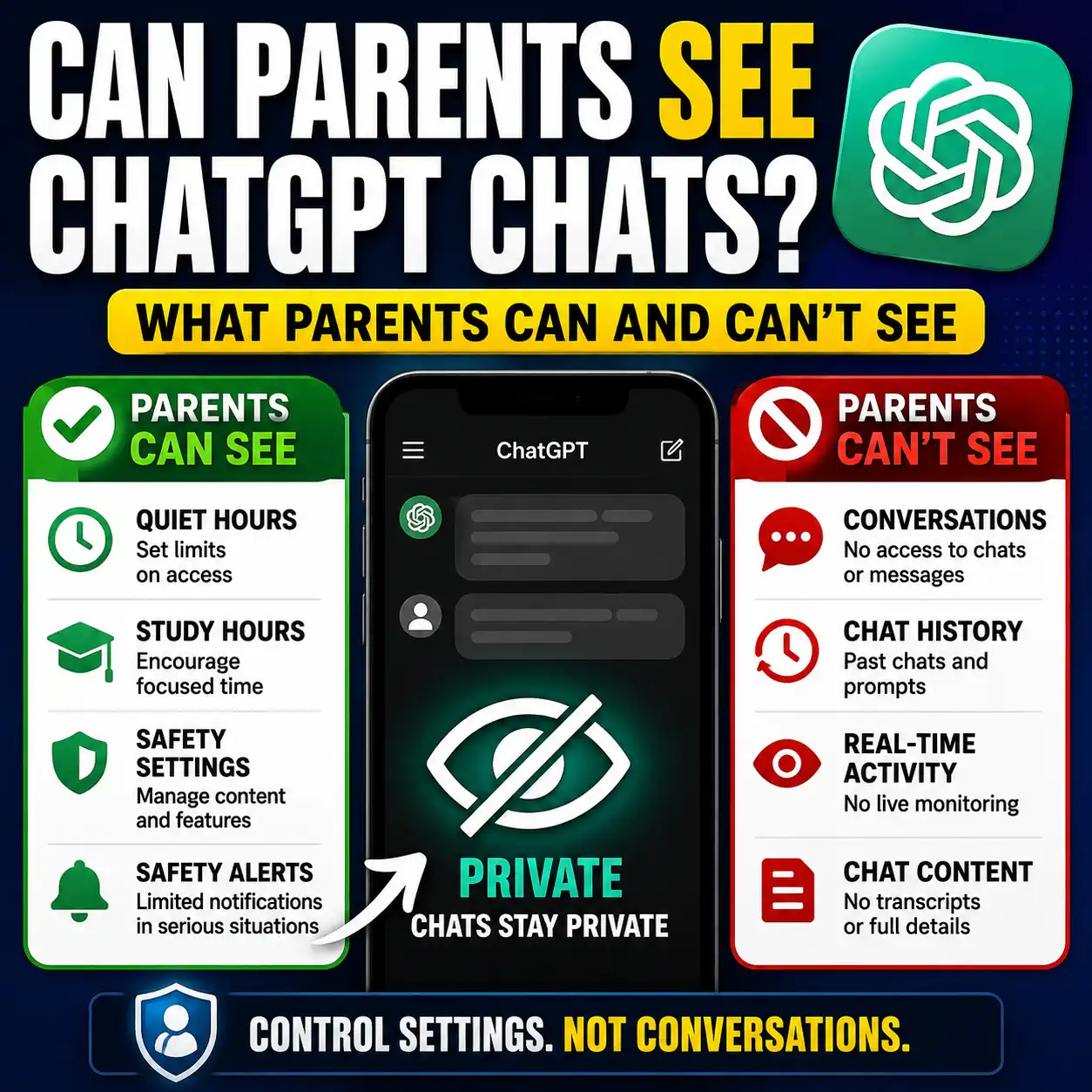
For more context about family privacy and account controls, read what parents can and cannot see in ChatGPT chats.
What to Do During the Actual Parent Teacher Conference
Once the meeting starts, the teacher’s real observations matter more than the AI-generated preparation.
- Start with your highest-priority question instead of trying to follow a script perfectly.
- Listen for new information that may make your prepared questions less important.
- Ask for an example when a statement feels too broad.
- Ask what the teacher has noticed over time rather than relying on one isolated event.
- Clarify unfamiliar school or educational terms.
- Write down actions that the parent, teacher, or school agrees to take.
- Ask when it would make sense to check progress again.
New York City Public Schools similarly encourages parents to ask about observations, strengths, struggles, progress, and what families can do to support learning at home.
After the Conference: Turn Your Notes Into Clear Next Steps
After the meeting, your own notes can be more valuable than another round of generic AI advice. Use ChatGPT only to organize what was actually discussed.
| What we learned | Who will act | Next action | When to revisit |
|---|---|---|---|
| Example or observation from the meeting | Parent, teacher, student, or school | Specific agreed action | Date or approximate timing |
| Question that remains unanswered | Relevant person | What needs clarification | Follow-up timing |
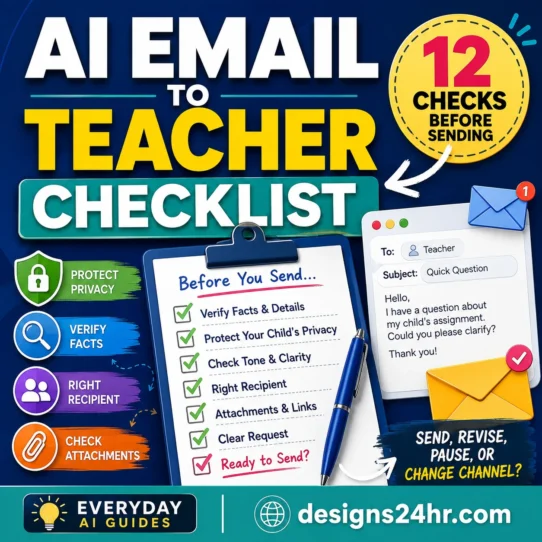
If a follow-up email is appropriate, do not make this article do the same job as another guide. Use the dedicated AI parent-teacher email checklist to check facts, tone, privacy, recipient, attachments, and the requested action before sending.
Keep AI in the Right Role
ChatGPT can be useful before a parent-teacher conference because it is good at reorganizing text, proposing alternative wording, and helping you practice a conversation. Those strengths do not make it an authority on your child.
The most reliable workflow is:
- You supply the observations.
- ChatGPT helps organize them.
- The teacher supplies classroom evidence and context.
- You decide what action makes sense based on real information.
The same principle applies when children use AI for schoolwork. If AI is also part of your family’s homework routine, the AI homework rules for kids and parents provide a practical framework for keeping the child’s own thinking at the center.
Frequently Asked Questions
Can ChatGPT help me prepare for a parent teacher conference?
Yes. ChatGPT can help organize your observations, turn concerns into clearer questions, prioritize discussion topics, and practice the conversation. It cannot independently know what is happening in your child’s classroom, so important facts should come from the teacher, school, your child, or other appropriate sources.
What should I tell ChatGPT before a parent teacher conference?
Give it only the context needed for the task, such as observations you have personally made and the topics you want to understand. Avoid unnecessary names, student IDs, account information, private information about other children, or sensitive records.
Can ChatGPT create questions to ask my child’s teacher?
Yes, but the most useful questions are based on your actual observations. Ask ChatGPT to create questions that request examples, patterns, possible actions, or follow-up rather than generating a long generic list.
What are the most important questions to ask at a parent teacher conference?
Prioritize questions that help you understand what the teacher is observing, concrete examples of strengths or difficulties, whether there is a consistent pattern, what can be done next, and when progress should be reviewed again.
Should I paste my child’s report card into ChatGPT?
Usually you do not need to paste an entire report card just to prepare questions. Share the minimum information necessary for the task, remove unnecessary identifying details, and review the current privacy and data-control settings of any AI service before providing personal information.
Can ChatGPT tell me whether my child has a learning disability?
Do not use ChatGPT to diagnose a child. If you have concerns about learning, development, behavior, health, or school support, use the conference to ask for specific observations and appropriate next steps, and involve qualified professionals or school staff when needed.
How many questions should I prepare for the conference?
There is no universal number, but prioritizing a small number of important questions can make the meeting easier to manage. The Designs24hr 3-2-1 Conference Plan starts with three key questions, two useful observations, and one next step to clarify.
Take Five Minutes Before Your Conference
Write down one thing that seems to be going well, one concern, and one specific example you have noticed. Then use the prompts above to turn those notes into your 3-2-1 Conference Plan.
You do not need the perfect script. You need a few useful questions and enough room to listen to the answers.
Sources and Further Reading
This guide is for general educational information and AI-use planning. It is not medical, psychological, educational-placement, or legal advice. School procedures and available services vary, so verify important questions with the appropriate school or qualified professional.
Get new AI guides every week
Short, practical how-tos and free tools from Designs24hr. No spam, unsubscribe anytime.