AI Voice Translator Explained: How Real-Time AI Translation Works in 2026
An AI voice translator is no longer just a travel app that repeats a phrase after a delay. In 2026, real-time AI voice translation is moving closer to live conversation. It can listen to speech, understand what is being said, translate the meaning, and return translated audio or captions while people are still talking.
That shift matters because language friction affects everyday situations: customer support calls, business meetings, online classes, travel, live events, sales conversations, and global content. When a live AI translator works well, two people can speak naturally in different languages without stopping every few seconds to type, copy, paste, or manually translate.
Quick answer: An AI voice translator uses speech recognition, language understanding, machine translation, and voice generation to convert spoken language into another language in near real time. The best use cases today include meetings, captions, travel conversations, customer support, education, and multilingual video content.
What Is an AI Voice Translator?
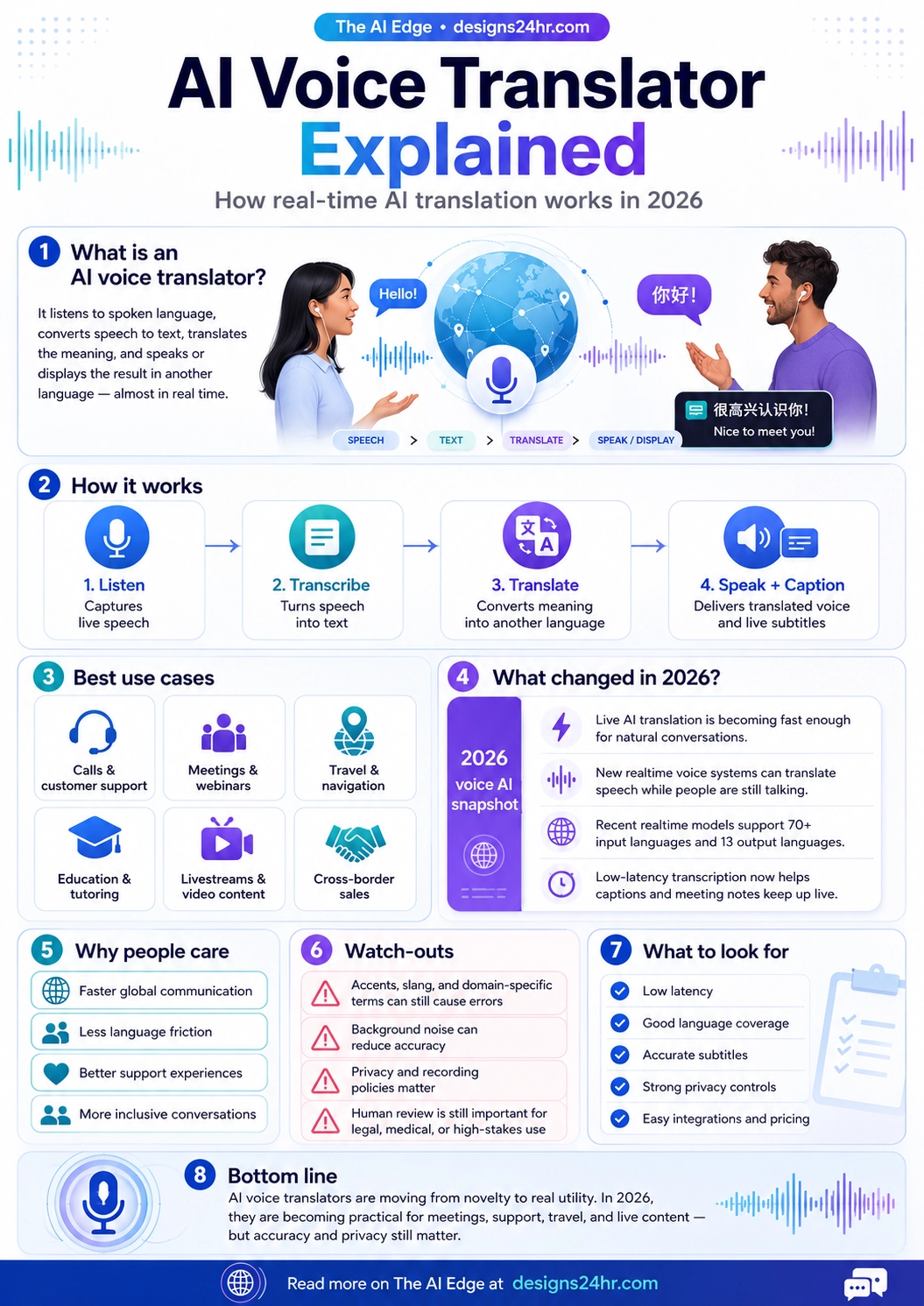
An AI voice translator is a tool that takes spoken words in one language and turns them into another language as either translated text, live subtitles, or spoken audio. Instead of translating one word at a time, modern systems try to understand the meaning of the full sentence, the context, the speaker’s intent, and the best natural phrasing in the target language.
The biggest improvement in 2026 is speed. Older translation tools were useful, but they often felt slow or awkward in real conversations. Newer realtime voice systems are designed to keep pace with natural speech, which makes them more practical for live calls, support conversations, webinars, classrooms, and travel situations.
OpenAI’s 2026 realtime voice model release is one example of this direction. OpenAI announced GPT-Realtime-Translate, a live translation model designed to translate speech from more than 70 input languages into 13 output languages while keeping pace with the speaker. OpenAI also introduced GPT-Realtime-Whisper for streaming speech-to-text, which helps live captions and meeting notes appear as people speak. You can read OpenAI’s official announcement here: OpenAI realtime voice models.
How Real-Time AI Voice Translation Works
A live AI translator may feel simple from the outside, but several AI steps are happening behind the scenes. The goal is to turn a spoken sentence into a useful translated response as quickly and naturally as possible.
- Listen: The system captures live speech from a microphone, phone call, video meeting, or app.
- Transcribe: Speech recognition turns the audio into text. This step must handle accents, pauses, background noise, and natural speaking patterns.
- Understand: The AI looks at context, intent, tone, and meaning instead of translating every word literally.
- Translate: The system converts the message into the target language in a way that sounds natural.
- Speak or caption: The output appears as translated audio, live subtitles, or both.
The best real-time AI voice translation tools are not just fast. They also need to be accurate enough for the situation. A casual travel conversation can tolerate small imperfections, but a medical appointment, legal discussion, financial conversation, or customer contract needs far more caution.
Why AI Voice Translators Are Getting Attention in 2026
AI voice translation is becoming more important because work, shopping, education, and customer support are increasingly global. A small business may receive messages from international buyers. A creator may have viewers across countries. A support team may need to help customers who speak different languages. A student may join an online class with multilingual participants.
This is where a live AI translator becomes more than a convenience. It can reduce language barriers, make information easier to access, and help people participate in conversations they might otherwise avoid.
The key phrase is real-time AI voice translation. A translator that responds after long pauses may still be useful for basic phrases, but it does not feel natural during a meeting or customer call. Real-time translation aims to keep the flow of conversation alive.
Best Use Cases for an AI Voice Translator
Calls and customer support AI translation can help support teams communicate with customers who prefer a different language, especially for basic questions, account help, order updates, and appointment scheduling.
Meetings and webinars An AI translator for meetings can provide live captions, translated summaries, and easier participation for multilingual teams.
Travel and navigation AI voice translation for travel can help with directions, transportation, hotel check-ins, restaurant questions, and quick everyday conversations.
Education and tutoring Teachers, tutors, and students can use live speech translation AI to make lessons easier to follow across language barriers.
Livestreams and video content Creators can use AI transcription and translation tools to make videos, live events, and product demos more accessible to international audiences.
Cross-border sales Sales teams can explain products, answer questions, and support buyers in more languages without needing a separate human interpreter for every first conversation.
AI Voice Translator vs Traditional Translation Apps
Traditional translation apps are still useful, especially for text translation, quick phrases, menus, signs, and travel basics. But real-time AI voice translation is built for a different experience: live conversation.
| Feature | Traditional Translation App | Modern AI Voice Translator |
|---|---|---|
| Main input | Typed text or short speech clips | Live speech, calls, meetings, or conversations |
| Speed | Often requires pauses between phrases | Designed for near real-time conversation flow |
| Output | Text, phrase playback, or copied translation | Translated voice, live captions, transcripts, and summaries |
| Best for | Menus, signs, simple phrases, quick lookups | Meetings, support calls, travel conversations, webinars, and live content |
What to Look for Before Choosing an AI Voice Translator
Not every live AI translator is equal. Some tools are better for travel. Some are better for meetings. Some are designed for developers building voice apps. Some focus on captions, while others focus on spoken audio.
- Low latency: The translation should happen quickly enough that the conversation does not feel broken.
- Strong language coverage: Check both input languages and output languages. A tool may understand many languages but only speak back in a smaller set.
- Accurate subtitles: Live captions are useful for meetings, accessibility, noisy environments, and reviewing what was said.
- Privacy controls: Look for clear recording, storage, consent, and data handling policies.
- Conversation mode: A good AI translation for phone calls or meetings should support natural turn-taking, interruptions, and context.
- Integrations: Businesses should check whether the tool connects with meeting platforms, call systems, customer support software, or workflow tools.
- Pricing: Some real-time translation tools may charge by minute, by user, by meeting, or by API usage.
Where AI Voice Translation Can Save Time
The most practical value of an AI voice translator is not just “cool technology.” It is time saved during real conversations. A customer support team can reduce back-and-forth messages. A traveler can ask for help without opening five different apps. A remote team can keep meetings moving. A creator can reach more viewers without manually creating every translated version from scratch.
For everyday users, the biggest benefit is confidence. People are more likely to ask questions, join calls, travel, learn, and buy when language feels less intimidating.
For businesses, the biggest benefit is reach. Real-time language translation apps can help companies serve more customers, explain products more clearly, and reduce missed opportunities caused by language friction.
Important Limits and Risks
AI voice translation is improving quickly, but it is not perfect. The biggest mistake is assuming every translated sentence is automatically safe to trust.
Accents, slang, fast speech, overlapping voices, poor microphones, background noise, and industry-specific terms can still create errors. Names, addresses, numbers, legal terms, medical terms, and financial details need extra care.
Privacy also matters. A live AI translator may process voice, transcripts, captions, or call content. Before using one for business or sensitive conversations, check whether conversations are recorded, how long data is stored, who can access transcripts, and whether users need to give consent.
Practical rule: Use AI voice translation to make everyday communication easier, but do not rely on it alone for high-stakes legal, medical, safety, immigration, financial, or contractual decisions. Human review is still important when accuracy truly matters.
AI Voice Translation for Meetings
Meetings are one of the strongest use cases for an AI voice translator because the workflow is clear. People speak, the AI creates live captions, translates what is being said, and can often help generate notes or summaries afterward.
This is helpful for remote teams, international clients, online events, training sessions, and webinars. An AI translator for meetings can make a call easier to follow for people who are not fully comfortable in the meeting’s main language.
The best meeting-focused tools should support clear speaker labels, accurate captions, exportable transcripts, and strong privacy settings. For businesses, those details are just as important as translation quality.
AI Voice Translation for Travel
AI voice translation for travel is one of the easiest ways for regular people to understand the value of this technology. Travelers can use a live AI translator to ask for directions, understand transportation options, check into hotels, order food, explain allergies, or ask simple local questions.
In travel situations, speed and simplicity matter more than advanced integrations. A good travel translator should be easy to open, quick to switch languages, and reliable in noisy real-world environments.
Still, travelers should be careful with critical information. For emergencies, medical needs, legal questions, or official documents, translation mistakes can have serious consequences.
AI Voice Translation for Customer Support
Customer support is another major area where real-time AI voice translation can create value. A company may not have a human agent available for every language, especially outside normal business hours. AI translation can help bridge that gap for basic questions and first-level support.
The strongest business use cases include appointment reminders, order status, billing questions, product setup help, troubleshooting steps, and routing customers to the right department.
However, businesses should not hide the use of AI when customers need to know. They should also create escalation paths so a human can step in when the conversation becomes sensitive, complex, or high-value.
Will AI Voice Translators Replace Human Interpreters?
AI voice translators will likely reduce friction in many everyday conversations, but they are not a full replacement for trained human interpreters in every situation.
Human interpreters understand culture, emotion, context, sensitive topics, legal nuance, medical risk, and interpersonal meaning in ways that automated systems can still miss. AI can be extremely useful for speed and access, but human expertise remains important where precision and responsibility matter.
The better way to think about it is this: an AI voice translator can handle many simple, repetitive, and low-risk conversations. Human interpreters should still be involved when the cost of being wrong is high.
Simple Buyer Guide: Which Type of AI Voice Translator Do You Need?
| Your need | Best tool type | What to prioritize |
|---|---|---|
| Travel conversations | Mobile live translator app | Fast language switching, offline options, clear audio, simple interface |
| Business meetings | Meeting translator with captions | Speaker labels, live subtitles, summaries, privacy controls |
| Customer support | Voice AI or call-center translation tool | Low latency, escalation to humans, CRM or support integrations |
| Video content | Caption and dubbing workflow | Subtitle accuracy, export formats, voice quality, editing controls |
| Building an app | Realtime voice translation API | Supported languages, pricing per minute, latency, documentation, safety controls |
FAQs About AI Voice Translators
What is the best AI voice translator?
The best AI voice translator depends on your use case. Travelers need a simple mobile app. Teams need meeting captions and summaries. Businesses may need a realtime voice translation API or customer support integration.
Can AI translate phone calls in real time?
Real-time AI translation for phone calls is becoming more practical, but availability depends on the app, device, carrier, and supported languages. Always test the tool before relying on it for important calls.
Is real-time AI voice translation accurate?
It can be very useful for everyday conversations, but accuracy can drop with background noise, accents, slang, overlapping speakers, or specialized terms. Human review is still recommended for high-stakes situations.
Can an AI translator help in meetings?
Yes. An AI translator for meetings can provide live subtitles, translated captions, transcripts, and summaries, making calls easier for multilingual teams and international participants.
Does AI voice translation protect privacy?
Privacy depends on the provider. Before using any AI transcription and translation tools for sensitive conversations, check the tool’s recording, consent, storage, and data usage policies.
Bottom Line
An AI voice translator is becoming one of the most practical AI tools for everyday communication. In 2026, real-time AI voice translation is improving fast enough to support meetings, travel, customer support, education, live captions, and global content.
The opportunity is clear: faster communication, fewer language barriers, better customer experiences, and more inclusive conversations. But the caution is just as clear: accuracy, privacy, consent, and human review still matter.
The smartest approach is to use AI voice translation where it adds speed and access, then keep human judgment involved when the conversation becomes sensitive, complex, or high-stakes.
Sources and Further Reading
- OpenAI: Advancing voice intelligence with new realtime voice models
- OpenAI Developers: Build live translation apps with GPT-Realtime-Translate
- Reuters: OpenAI unveils realtime audio models for voice tasks
Explore More Practical AI Guides
Designs24hr creates simple, useful, and visually clear AI explainers for people who want to understand how new technology fits into everyday life, work, creativity, and smarter digital habits.
For more beginner-friendly AI guides, visit The AI Edge on Designs24hr. You can also return to Designs24hr whenever you want to learn something new about AI, design, smart tools, and practical digital ideas.
If this guide helped you understand AI voice translators, share your thoughts, questions, or real-world use cases in the comments so other readers can learn from your experience too.